Google Ads for Home Service Companies: Stop Funding Google’s Growth and Start Funding Yours
Why are you paying Google a “success tax” for leads that never pick up the phone? Most contractors feel like their marketing budget is a black hole where money goes in and telemarketers come out. You’ve likely seen your Cost Per Lead (CPL) climb as high as $250 for a single HVAC call in the Phoenix market while your competitors snatch up every high-value job before your team even sees the notification. It’s a broken system that rewards Google’s bottom line, not yours.
Effective Google Ads for home service companies shouldn’t be a gamble. We agree that vanity metrics like clicks and impressions are worthless if they don’t result in a technician at a customer’s door. This article will teach you how to eliminate ad waste and transform high-intent search traffic into booked jobs through a systematic, results-only approach. You’ll learn how to leverage the Magnitude Lead Hub to automate follow-ups, gain full transparency on your ROI, and finally scale your revenue with predictability.
Key Takeaways
- Stop measuring success by impressions and start evaluating your marketing spend based on the number of technicians dispatched to qualified jobs.
- Learn how to escape the “Broad Match Trap” by focusing your budget on high-intent emergency keywords like “AC repair Phoenix” or “burst pipe repair Tucson.”
- Discover the 2026 strategy for balancing Local Services Ads and traditional Google Ads for home service companies to ensure you only pay for valid leads that fit your service area.
- Use the Magnitude Lead Hub to eliminate lead waste by integrating your ad spend directly with a transparent sales pipeline and automated follow-ups.
- Apply hyper-local GEO-targeting and conversion-focused landing pages to stop funding Google’s growth and start capturing higher average job values in your specific trade.
Why Contractor Google Ads Are Cash Black Holes
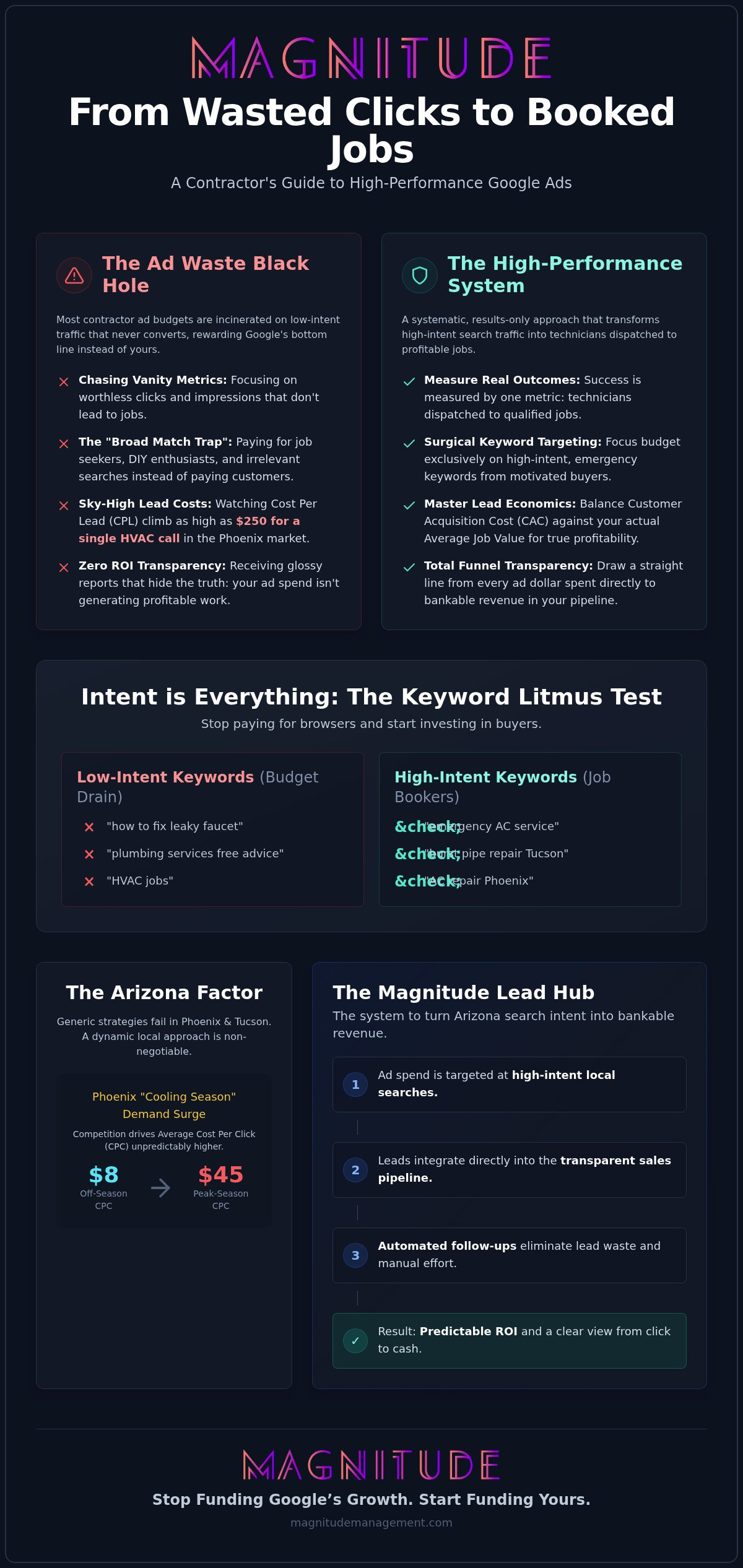
Most marketing agencies are experts at “Industry Theater.” They present glossy reports filled with impressions, reach, and click-through rates to justify their monthly fees. These metrics are vanity. They hide the uncomfortable truth that your budget is being incinerated on low-intent traffic that never converts. If your agency can’t draw a straight line from a click to a technician in a truck, they’re just managing a black hole. With the 12% increase in average CPC seen across the board in 2026, every wasted click is more painful than ever for your bottom line.
The “Broad Match Trap” is the primary engine of this waste. Google’s default settings encourage you to bid on broad terms like “HVAC jobs” or “plumbing services.” To a computer, these seem relevant. To a business owner in Arizona, they’re a disaster. You end up paying for job seekers, DIY enthusiasts, and people looking for “free” advice instead of homeowners in Tucson needing an immediate AC replacement. Without a rigorous, trade-specific negative keyword list, you’re essentially donating your profit to Google’s shareholders. Successful Google Ads for home service companies require surgical precision, not broad-brush spending.
Ad Waste is the delta between clicks paid for and qualified leads captured. It is the silent killer of local contractors.
The Hidden Cost of “Click-Only” Marketing
Cheap clicks are often the most expensive ones you’ll ever buy. A low Cost Per Click (CPC) looks great on a spreadsheet, but it frequently leads to a high Cost Per Job. If you’re paying $2 for a click from someone looking for “how to fix a leaky faucet” instead of $40 for “emergency plumber Phoenix,” you’re losing money. The latter has intent; the former is just browsing.
Agencies that don’t understand the specific economics of digital advertising for trades often optimize for the wrong goals. You don’t need 100 telemarketers calling your office. You need 10 homeowners with a high average job value ready to book. When your agency focuses on click volume rather than lead quality, they’re prioritizing their reporting over your revenue.
The Arizona Factor: Seasonality and Competition
Arizona presents unique challenges that national agencies ignore. The Phoenix “Cooling Season” creates a massive surge in demand and bidding competition. During these peaks, the average CPC in Arizona can swing from $8 to $45 depending on the trade. If your bidding strategy doesn’t shift dynamically with the thermometer, you’ll either overpay for leads or disappear from the search results entirely.
Generic strategies fail in local Tucson and Mesa markets because they don’t account for local service areas or specific neighborhood demographics. You need a system that understands when to push and when to pull back based on real-world capacity and local demand. Run an Ad Waste Audit to see where your budget is leaking before the next seasonal shift drains your accounts.
The Difference Between “Clicks” and “Trucks on the Road”
Stop obsessing over clicks. A click is a cost. A truck on the road is revenue. Most agencies fail to distinguish between informational searches and high-intent searches. When a homeowner in Phoenix searches for “how to patch a roof,” they’re looking for a DIY solution. If you pay for that click, you’re subsidizing their Saturday project. High-intent search terms like “burst pipe repair Phoenix” or “emergency AC service” signal a crisis. These users don’t want to read a blog post. They want a technician at their door now. Targeting these emergency keywords ensures your budget goes toward immediate ROI rather than educational outreach.
Your Customer Acquisition Cost (CAC) must be viewed through the lens of your Average Job Value. If you’re a roofer paying $200 per lead but your average contract is $18,000, that’s a sustainable system. If you’re a plumber paying that same $200 for a $350 drain cleaning, you’re going out of business. Success in Google Ads for home service companies requires a deep understanding of these lead economics. You must also adhere to the rules and guidelines that protect consumers to ensure your messaging remains transparent and compliant. Following these standards builds the trust necessary to convert a stranger into a lifelong customer.
Ad copy is the bait, but your landing page is the hook. You can have the most persuasive ad in the world, but if your landing page is cluttered or slow, the lead will bounce to a competitor. A high-converting page should prioritize a “Click-to-Call” button and a simple lead form. For Arizona contractors, this is where the battle is won or lost. If your site doesn’t load instantly on a mobile device in Scottsdale, you’ve already lost the job. Google Ads for home service companies only work if the destination is as sharp as the targeting.
Targeting High-Value Trades: HVAC, Plumbing, and Roofing
Bidding strategies must reflect the job value. For roofing companies, separate your campaigns into “full replacements” and “minor repairs.” You can afford to bid aggressively on replacement keywords because the margin supports a higher CAC. In Scottsdale and Peoria, plumbing companies should dominate “near me” searches by using hyper-local ad extensions. Seasonality dictates your maximum bid. When the Phoenix temperature hits triple digits, your HVAC bids must increase to stay at the top of the page. This is the only way to capture the surge in emergency cooling calls when demand is at its peak.
Measuring What Matters: Revenue, Not Reach
Call tracking is non-negotiable. If you aren’t recording and tagging calls, you’re guessing. Closed-loop reporting allows you to see which specific keywords resulted in a signed contract. This transparency is the difference between an “expense” and an “investment.” For a deeper dive into these strategies, see our Paid Ads for Local Services: 2026 Contractor’s Guide. If you want to see how your current spend stacks up against these benchmarks, you can request a professional account review to identify hidden waste in your current funnel.
Local Services Ads (LSAs) vs. Traditional Search: Which Wins in 2026?
Choosing between Local Services Ads and traditional Search Ads isn’t a matter of preference. It’s a matter of math. In 2026, the landscape has shifted. The old green “Google Guaranteed” badge has been retired in favor of a unified “Google Verified” blue checkmark. For a homeowner in Tucson, that blue checkmark is a signal of legitimacy that bypasses the skepticism often aimed at traditional advertisements. LSAs operate on a pay-per-lead model. You only pay when a customer calls you and the conversation lasts longer than 30 seconds. This creates a low-risk entry point for contractors who are tired of paying for clicks that don’t convert.
However, LSAs are not a “set it and forget it” solution. Google’s ranking algorithm for these ads is ruthless. It prioritizes three things: your proximity to the searcher, your average star rating from your Google Business Profile, and your response time. If you let calls go to voicemail, Google will demote your profile faster than a summer monsoon hits the Valley. Digital ads help them compete by giving smaller outfits a chance to stand at the top of the page, but only if they have the operational discipline to answer the phone. Relying solely on LSAs is a mistake because they lack the volume needed for aggressive scaling. A hybrid strategy is the only way to dominate the first page of Google.
Winning the Google Verified Badge in Arizona
To secure that blue checkmark, Phoenix contractors must pass rigorous background checks and provide proof of general liability insurance. It’s a hurdle that keeps fly-by-night operations out of the market. In 2026, the LSA market is saturated. Standing out requires more than just being verified. You need a constant stream of fresh reviews because Google no longer uses LSA-specific review links. Since July 2025, everything pulls from your Google Business Profile. If you receive a “junk” lead, don’t look for a dispute button. Google removed it. You must now mark the lead as “Dissatisfied” to trigger the AI-driven credit evaluation system. This is the only way to recover costs from robocalls or out-of-area inquiries.
When to Use Traditional Search Ads
Traditional Search Ads are your precision tools. While LSAs are great for general “plumber” searches, Search Ads allow you to target specific zip codes in Oro Valley or high-value neighborhoods where the average home age suggests an upcoming roof replacement. They are also superior for promoting specific seasonal maintenance offers, like a $79 HVAC tune-up, which LSAs cannot effectively highlight. When you run both, you take up more “real estate” on the search results page. This dual presence increases your authority and ensures that whether a customer wants to call immediately or browse your specific offers, you are the only logical choice. To see where your current visibility stands, you should run a local search visibility audit to identify gaps in your hybrid strategy.
The Magnitude Framework: 4 Pillars of a High-Performance Ad Account
Most agencies set up a campaign and walk away. That is not management; it’s neglect. Our framework for Google Ads for home service companies focuses on four non-negotiable pillars that turn search intent into booked revenue. We start with Hyper-Local GEO-Targeting. If you’re an HVAC contractor in Phoenix, you don’t just want “Phoenix” traffic. You want the specific zip codes in Gilbert or Chandler where the homes are 15 years old and the units are reaching their end-of-life. We refine your reach to ensure you aren’t paying for clicks in areas your trucks don’t service or in neighborhoods where the job value doesn’t support your margins.
Lead Hub: The Infrastructure of Conversion
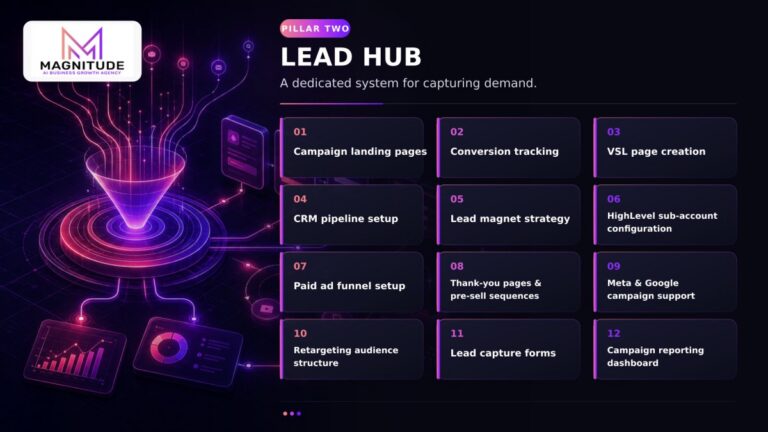
Sending expensive ad traffic to your homepage is a recipe for failure. Your homepage is a brochure; a landing page is a sales tool. The Magnitude Lead Hub approach replaces generic pages with high-performance environments designed for one thing: getting the user to call or fill out a form. A landing page that converts at 20% or higher requires a clear value proposition, social proof, and zero distractions. If your current site is leaking leads, you should Get a Local Search Visibility Audit for your Arizona service area to see where you’re losing money.
Advanced Lead Capture & Call Tracking is our third pillar. We don’t just track that a call happened. We track which keyword triggered it and whether it resulted in a qualified lead. This visibility allows us to double down on what works and kill what doesn’t. Without this data, you’re flying blind in the most competitive search market in the country. We use this intelligence to shift budget toward high-margin services like full roof replacements or complete repiping jobs.
Lead Guard: Why Response Time is Your Most Critical Metric
The final pillar is Speed to Lead Automation. In the home services industry, the “5-Minute Rule” is law. If you don’t respond to a lead within five minutes, your odds of qualifying them drop by 80%. Homeowners in Tucson don’t wait. They call the next person on the list. Magnitude uses Lead Guard systems to ensure no lead goes cold. This infrastructure turns Google Ads for home service companies from a cost center into a predictable growth engine. Learn more about how we build this in our guide to Lead Response Automation for Service Businesses.
If you’re ready to stop the bleeding and start scaling your Arizona service business with a proven system, schedule a framework deep-dive with our team today.
Magnitude Lead Hub: Turning Arizona Search Intent into Bankable Revenue
The Magnitude Lead Hub isn’t just another dashboard. It’s the connective tissue between your ad spend and your bank account. Most agencies consider their job done once the phone rings. We don’t. Our system integrates Google Ads for home service companies directly into your sales pipeline. This means we see which specific ad campaign resulted in a high-value roofing contract versus a minor repair. By using AI-powered tracking, similar to the methodology used at futureshiftmarketing.com, we identify the high-intent triggers that lead to your most profitable jobs. We then redirect your budget toward those winners, starving the low-value clicks of resources. This is how you stop guessing and start scaling.
We also implement Database Reactivation to squeeze every drop of value from your marketing. This process mines your existing lead list for missed opportunities. If a lead didn’t book six months ago, our automation re-engages them without costing you a single extra cent in new ad spend. This maximizes the lifetime value of every dollar you’ve already invested. We aren’t a vendor you hire to “do ads.” We are a strategic partner focused on your operational efficiency and the recovery of lost revenue. We value logic over creative vanity, and our systems reflect that discipline.
Scaling in competitive markets like Phoenix and Scottsdale requires more than just a bigger budget. It requires a fractional CMO approach. We align your Google Ads for home service companies with your actual crew capacity. There is no point in generating 50 plumbing leads on a Tuesday if your trucks are already booked through Friday. We shift your strategy from “Survival Bidding”—where you take whatever Google gives you—to “Market Dominance.” This transition is built on radical accountability. Our reporting doesn’t hide behind jargon. We show you exactly how much revenue was generated from every dollar spent.
Next Steps: From Ad Waste to Revenue Recovery
The path to recovery starts with honesty. Most Arizona contractors are shocked to find that a significant portion of their current budget is spent on “junk” traffic. Our transition process begins with a comprehensive Ad Waste Audit. We identify the leaks, plug them, and then migrate your account into the managed Magnitude Lead Hub system. This isn’t a slow, theoretical transition. We move with the urgent pragmatism your business deserves. Stop letting your competitors win the best jobs in the Valley. You have the choice to keep funding Google’s growth or to start funding yours. Stop wasting budget and start booking jobs with Magnitude.
Take Control of Your Arizona Service Growth
You can’t build a dominant service business on impressions alone. You need trucks on the road and money in the bank. We’ve established that successful Google Ads for home service companies require more than just a high budget. They require a disciplined system that combines hyper-local targeting with the Magnitude Lead Hub for full pipeline visibility. By shifting to a hybrid strategy and prioritizing speed-to-lead automation, you stop the hemorrhage of ad waste that kills your margins.
Our specialized Arizona market expertise ensures your campaigns are optimized for the unique seasonal demands of Phoenix and Tucson. You deserve a partner who values radical accountability over industry theater. Advanced call tracking and CRM integration mean you’ll finally see which keywords are actually driving revenue. Don’t let another high-value job go to a competitor because of a slow response or unoptimized bidding. It’s time to take control of your lead flow and your future.
Eliminate ad waste and start booking more jobs with Magnitude today.
Frequently Asked Questions
How much should a home service company spend on Google Ads in 2026?
A home service company should plan to spend between $1,500 and $4,000 per month on Google Ads for home service companies to provide the algorithm with enough data to optimize. This range ensures your business remains visible in competitive Arizona markets like Phoenix and Mesa. Spending less often results in starving the algorithm, which leads to higher costs and fewer booked jobs over the long term. High-growth companies often reinvest a percentage of revenue to scale further.
What is the average cost per lead for HVAC and plumbing in Phoenix?
The average cost per lead for HVAC and plumbing in the Phoenix market typically ranges from $60 to $250. These figures fluctuate based on the specific trade and the urgency of the service. For example, a routine tune-up lead costs less than an emergency burst pipe call. In high-demand zones like Scottsdale, competition drives these costs toward the higher end. Monitoring your lead-to-job close rate is essential to ensure these costs align with your average job value.
How long does it take to see results from a new Google Ads campaign?
You should see phone calls and form submissions within the first 48 hours of a campaign launch. However, true optimization takes 30 to 90 days as the system gathers enough data to refine bidding. During this initial phase, we analyze call recordings and lead quality to adjust negative keyword lists. This methodical approach ensures your budget is eventually focused only on the highest-converting neighborhoods and search terms in Oro Valley and Tucson.
Is Google Verified (LSA) better than traditional Google Ads?
Neither is objectively better because they serve different roles in a dominant search strategy. Local Services Ads provide the “Google Verified” blue checkmark and a pay-per-lead model, which is excellent for building trust. Traditional Search Ads offer more control over specific offers and geographic targeting in cities like Glendale and Peoria. A hybrid approach is the only way to capture the maximum volume of high-intent search traffic available in your service area.
Why am I getting so many spam calls from my Google Ads?
Spam calls usually stem from the “Broad Match Trap” or unoptimized keyword settings that attract telemarketers and job seekers. If your ads appear for searches like “HVAC equipment sales” instead of “AC repair,” you’ll get junk calls. Magnitude uses trade-specific negative keyword lists and the Lead Hub to filter out these distractions. We also leverage Google’s AI-driven credit system to flag invalid leads and recover costs from robocalls or spam inquiries automatically.
Can I run Google Ads myself, or do I need an agency?
You can run ads yourself, but it’s often a recipe for massive ad waste. Google’s default settings are designed to maximize their revenue, not yours. Managing Google Ads for home service companies requires constant monitoring of search terms, bid adjustments, and landing page optimization. Most contractors find that the time spent managing campaigns is better used in the field, especially when a specialized agency can lower the cost per booked job significantly through expertise. If you are looking for a dedicated partner to handle these complexities, you can discover Cloud Tech Digital and their specialized lead generation services for tradies.
A high-performing contractor landing page should convert at 20% or higher. Most generic homepages convert at less than 5%, which effectively quadruples your cost per lead. To hit the 20% mark, your page must be mobile-optimized, load instantly, and feature a clear click-to-call button. In competitive markets like Scottsdale, a slow or cluttered page is the fastest way to lose a lead to a faster competitor who makes it easier for the customer to book.
How does Magnitude track which ads lead to actual booked revenue?
Magnitude uses the Lead Hub to integrate your Google Ads directly with your CRM and sales pipeline. We track every call and form submission back to the specific keyword that triggered it. Once your team marks a job as closed in the CRM, our system attributes that revenue to the correct ad. This closed-loop reporting provides full transparency on your actual ROI, allowing us to scale the most profitable campaigns and eliminate those that don’t produce revenue.