Why Your Competitors Outrank You on Google – SEO Survival Guide
What is Local SEO Visibility in the Age of AI Search?
You’re a contractor in Tucson or Phoenix. You do great work, your trucks are wrapped, and your team is the best in the business. But online, you’re invisible. Your competitors are snagging the top spots in the Google Map Pack, and you’re left wondering why your phone isn’t ringing. The problem isn’t your service; it’s your visibility. This guide explains why you’re being outranked and provides a no-nonsense blueprint to dominate the local search landscape.
Local SEO visibility is no longer about a static #1 ranking. It’s the measure of how consistently your business appears across all the places a customer looks for you—the Local 3-Pack, Google Maps, and now, in AI-generated answers. It is the digital proof that you are the dominant, trusted authority in your service area. For an HVAC company in Oro Valley, true visibility means your name is the one an AI assistant like Google’s Gemini recommends when a homeowner asks, “Who is the best AC repair near me?” It’s about owning the “share of voice” across every digital surface where a customer can find you. In short, Local Visibility is the digital footprint that triggers immediate consumer trust.
The Shift from Rankings to GEO (Generative Engine Optimization)
The game has changed. Traditional keywords, while still relevant, are losing ground to the conversational, intent-driven questions people ask their phones and smart speakers. The era of Generative Engine Optimization (GEO) is here. This is the science of making your business the definitive, citable answer for AI search engines.
In 2026 and beyond, AI models like Google Gemini and Perplexity don’t just “crawl” your website; they synthesize information about your business from all over the web—your reviews, your Google Business Profile, local directories, and articles about you. To win, your business information must be structured in a way that AI can read, understand, and trust. This is where structured data (or schema markup) becomes critical. It translates your website’s content into a language AI understands, making it easy for them to cite your plumbing company as the go-to expert for slab leaks in Phoenix.
Why Visibility is the Only Metric That Impacts Revenue
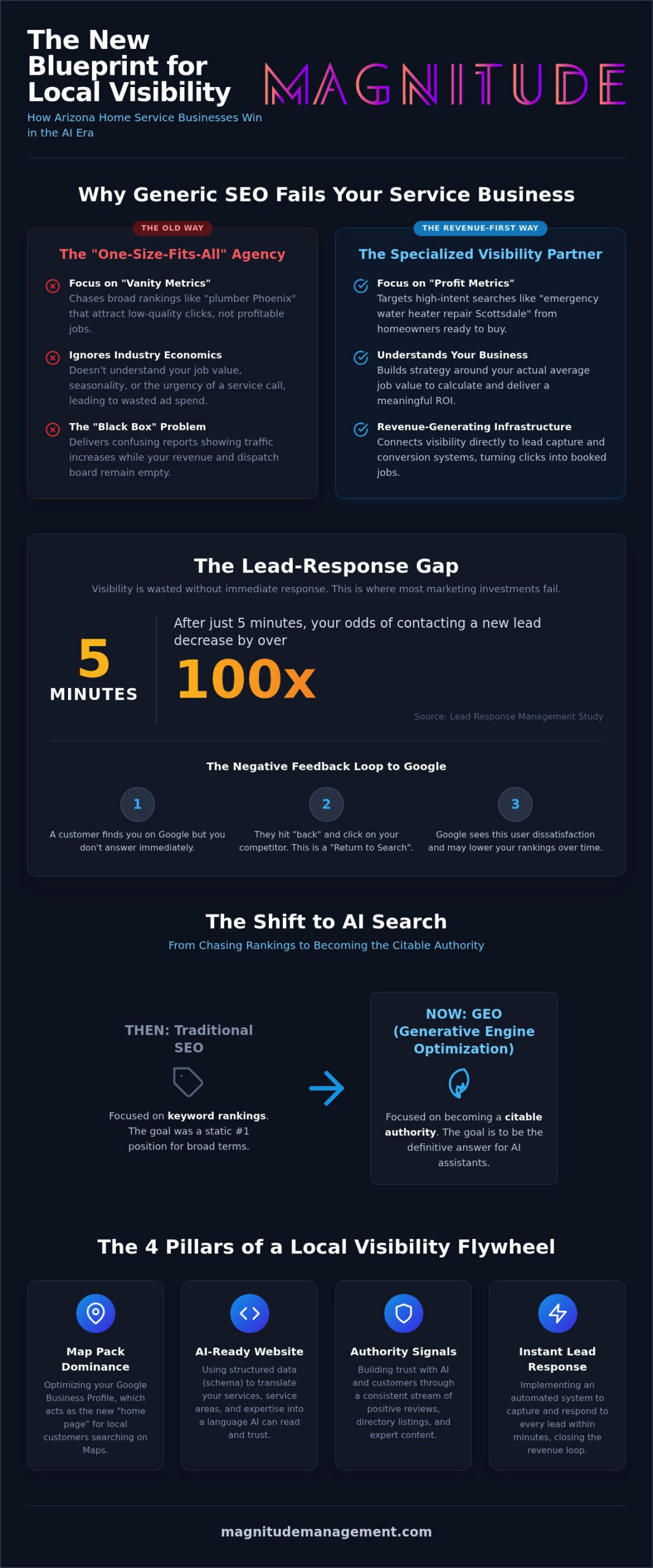
Most SEO agencies sell you a fantasy. They celebrate when you rank #1 for a broad term like “plumber Phoenix.” This is a vanity metric. It feels good, but it doesn’t necessarily lead to profitable jobs. True profit comes from visibility for high-intent searches like “emergency water heater repair Scottsdale.” That’s not just a search; it’s a desperate homeowner with a credit card in hand.
This is the core failure of what we call “Industry Theater”—agencies that deliver beautiful reports filled with traffic graphs that trend up and to the right, yet your revenue stays flat. They focus on clicks, not customers. High visibility for the *right* searches directly reduces your customer acquisition cost (CAC) because you’re capturing demand at the exact moment of need. While other agencies are busy performing for you, Magnitude focuses on building the revenue-generating infrastructure that makes your business the obvious choice.
Why Generic Phoenix SEO Agencies Fail Home Service Businesses
Hiring a generic SEO agency in Phoenix or Tucson to grow your home service business is like hiring a roofer to fix your plumbing. They might understand the basic tools, but they have no grasp of the system they’re working on. These “one-size-fits-all” firms don’t understand the brutal seasonality of Arizona HVAC, the high-ticket urgency of a roof leak during monsoon season, or the specific economics of a plumbing truck roll.
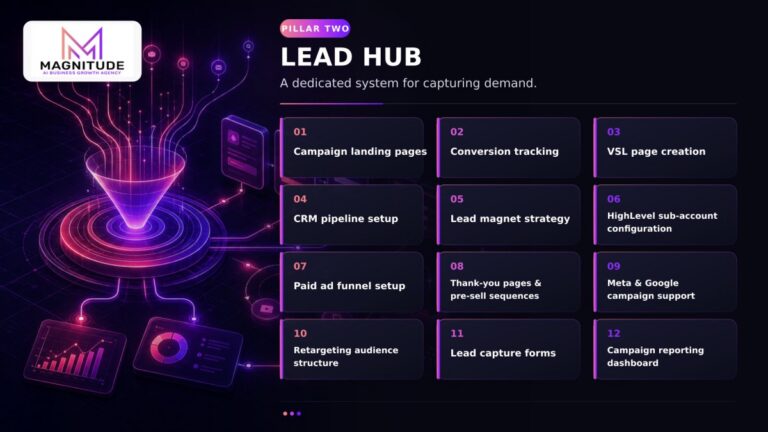
This leads to the “black box” problem. You pay a hefty monthly retainer for vague promises and receive reports that show “progress” but no new jobs booked. They celebrate keyword rankings while you stare at an empty dispatch board. Home service marketing isn’t just about being found; it’s about converting that discovery into a scheduled appointment, fast. Generic SEO completely ignores the operational reality of lead-response speed. Our approach is different. We build systems that link your hard-won visibility directly to the Magnitude Lead Hub, ensuring every opportunity is captured and converted immediately.
The Problem with “One-Size-Fits-All” Marketing
A marketing strategy designed for a personal injury lawyer in Scottsdale is fundamentally useless for an electrician in the same city. The lawyer chases one massive case; the electrician needs a consistent flow of profitable service calls. Generic agencies don’t get this. They don’t know your average job value, so they can’t possibly calculate a meaningful return on investment (ROI) for your SEO spend.
They waste your budget chasing broad, top-of-funnel terms that attract DIYers and tire-kickers. They don’t understand that for you, a “lead” isn’t a form fill—it’s a qualified homeowner in your service area with a problem that you can solve today. Without this deep industry knowledge, their efforts are just expensive noise that never translates into a truck roll.
The Lead-Response Gap: Why SEO Isn’t Enough
Let’s say a generic agency actually succeeds. Your visibility is high, and a lead comes in for an emergency AC repair in Mesa. But your team is on other jobs, and the call goes to voicemail. That lead is gone. According to studies by Lead Response Management, your odds of contacting a lead decrease by over 100 times if you wait more than 5 minutes. We call this the “5-Minute Rule,” and it’s a business killer.
Google tracks this. When a user clicks on your business in the search results but then immediately returns to Google to click on a competitor, it sends a powerful negative signal. Google interprets this “Return to Search” behavior as user dissatisfaction. If it happens enough, your rankings will drop, no matter how “optimized” your website is. Visibility without a system for immediate response is wasted visibility. Magnitude solves this with CRM automation and the Lead Hub, ensuring no lead is ever left behind and your marketing investment is never wasted.
Dominating the “Map Pack” in Tucson and Phoenix: A 2026 Blueprint
For home service contractors in Arizona, Google Maps isn’t just a feature; it’s the primary battleground for new customers. The “Map Pack,” that box of three local businesses at the top of the search results, is the most valuable digital real estate you can own. Getting there and staying there depends on mastering the three core pillars of Google’s local algorithm: proximity, relevance, and prominence.
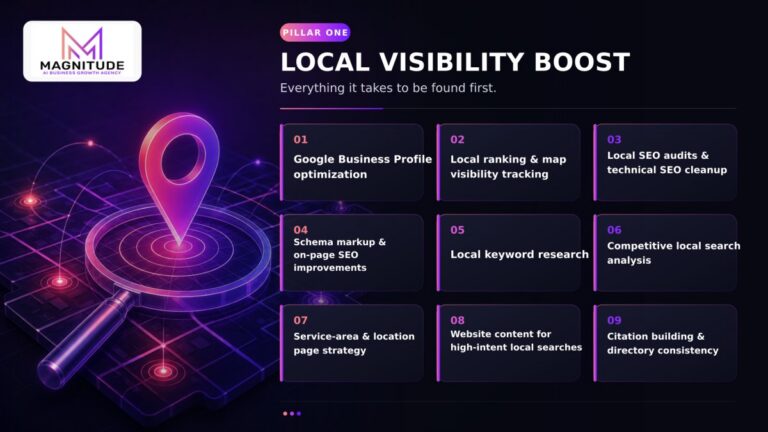
Simply having an office in Phoenix isn’t enough. You need to prove your relevance across the entire metro area. This means building out dedicated, content-rich location pages for the neighborhoods and suburbs you serve, from Mesa and Glendale to Peoria and Chandler. These pages signal to Google that you are the authority not just in a single city, but in the specific communities where your customers live. Here is the step-by-step blueprint for optimizing your Google Business Profile (GBP) for maximum local reach.
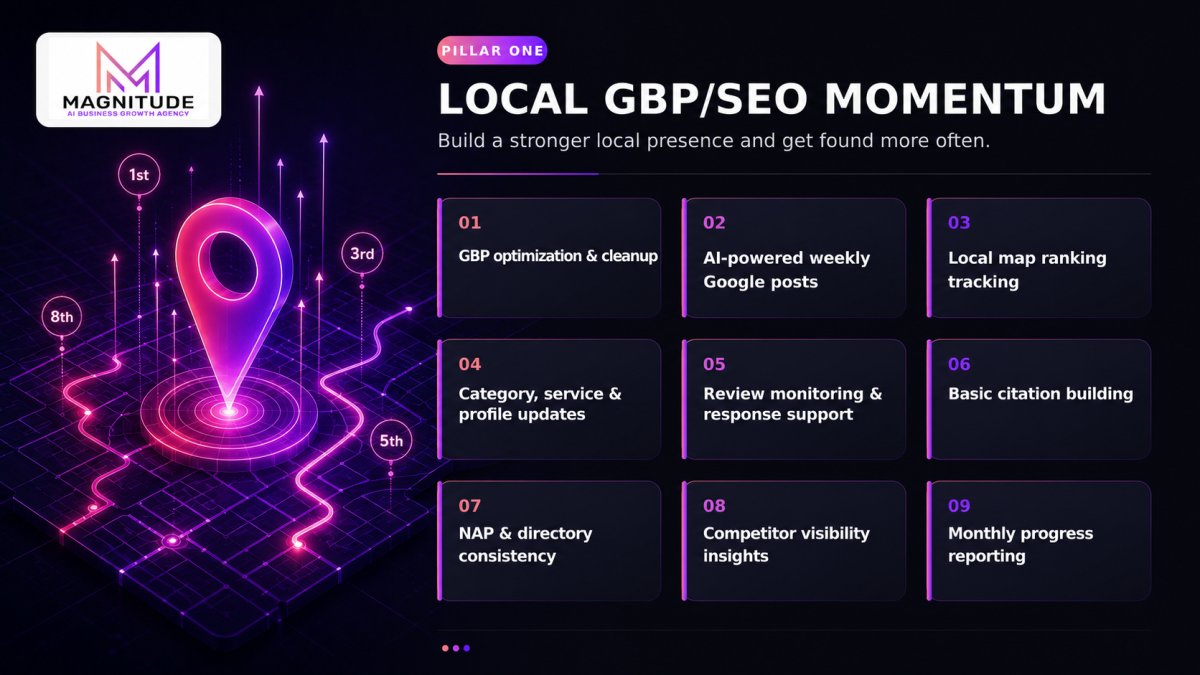
Step 1: Advanced Google Business Profile Optimization
Most of your competitors have claimed their GBP, added their hours, and stopped there. This is your opportunity. Advanced optimization goes far beyond the basics. It means using every single feature Google gives you to signal your relevance.
- Secondary Categories: Don’t just list “Plumber.” Add secondary categories like “Water Heater Installation,” “Drain Cleaning Service,” and “Sewer Contractor” to capture more specific searches.
- Geo-tagged Photos: Upload high-quality photos from every job site. Before you upload, ensure the photos have GPS data embedded. This provides Google with undeniable proof of your service area footprint. Consistency is key; a high frequency of new, geo-tagged photos is a powerful ranking signal.
- Service Menus & Attributes: Detail every single service you offer in your GBP services menu. Use attributes to match specific search filters, such as checking “24-hour service” or “Emergency Services” if you offer them. This helps you appear when users apply these filters. For more on this, check out our complete Google Business Profile Optimization checklist.
Step 2: The Reputation Flywheel and Review Automation
Your online reputation is a direct ranking factor. However, many contractors mistakenly believe that having the most reviews is the goal. It’s not just about volume; it’s about velocity, recency, and the content within the reviews. Google wants to see a steady, consistent stream of new, positive reviews. A sudden burst of 50 reviews followed by six months of silence is less effective than getting two new reviews every week.
This is where automation creates a “Reputation Flywheel.” By integrating with your job management software, you can automatically send a review request via text or email the moment a job is marked complete in Tucson. This captures the customer’s satisfaction at its peak. Furthermore, the keywords customers use in their reviews (e.g., “fixed our leaky faucet in Oro Valley”) become powerful relevance signals. Responding to every review—the good and the bad—is also critical. The “Magnitude” way is to respond thoughtfully, mention the service and location, and demonstrate that you are an engaged, customer-focused business.
Step 3: Hyper-Local Citation Building
A citation is any online mention of your business’s Name, Address, and Phone number (NAP). While national directories like Yelp are important, hyper-local Arizona directories, trade association websites, and community portals often carry more weight for local rankings. Google uses these sources to verify that your business is a legitimate, established part of the local community.
The absolute most critical element of citation building is NAP consistency. Any variation in your business name, address, or phone number across the web can confuse Google and hurt your rankings. You must ensure your information is 100% identical across the “Big Four” data aggregators (Data Axle, Foursquare, Neustar Localeze) that feed hundreds of other online directories. Unsure where you stand? Run a comprehensive analysis with our Local Search Visibility Audit to identify and fix inconsistencies that are holding you back.
AI Search and GEO: The New Frontier for Arizona Contractors
The rise of AI search is the single biggest shift in local marketing since the invention of the smartphone. AI engines like Google’s AI Overviews are becoming the new gatekeepers, summarizing search results and providing direct recommendations to users. If you’re not prepared for this shift, you will be left behind. Generative Engine Optimization (GEO) is the discipline of structuring your digital presence to directly influence these AI-driven recommendations.
It’s about making your business the most logical, authoritative, and trustworthy answer to a homeowner’s problem. When someone in Phoenix asks their phone, “Which plumber can fix a running toilet?”, you don’t just want to be on a list of results—you want the AI to confidently state your company’s name. Magnitude uses AI-powered strategies and a deep understanding of entity-based SEO to build your brand’s authority, ensuring you become the “recommended” choice for your trade.
Winning the “AI Recommendation” for Home Services
How do you become the AI’s favorite? You have to feed it the right information. AI models build a comprehensive understanding of your business by synthesizing data from countless sources. They read your Google reviews, your website content, mentions in local blogs, and your standing on third-party sites like the Better Business Bureau. Your reputation is no longer just for humans; it’s a critical data source for machines.
To win the AI recommendation, you must shift your content strategy. Stop writing generic blog posts about “5 plumbing tips.” Instead, create a deep “Knowledge Hub” on your website that answers the specific “Why” and “How” questions your customers ask. A detailed article explaining *why* a water heater is making a popping noise and *how* to diagnose it in an Arizona home provides immense value to both a human reader and an AI model looking for expert content to cite.
GEO Strategies for Multi-City Dominance
For contractors serving the sprawling Phoenix metro, achieving visibility in one suburb is not enough. The key to multi-city dominance is scaling your authority without losing local relevance. GEO strategies allow you to do this effectively. This involves creating highly specific content and data points for each service area, from Peoria to Scottsdale.
We use AI tools to perform sophisticated content gap analyses, identifying the questions customers are asking in specific neighborhoods that your competitors aren’t answering. By creating the best answer for “best landscapers for xeriscaping in Glendale,” you build topical authority that AI engines recognize. This granular approach ensures you’re not just a “Phoenix contractor,” but the go-to expert in every community you serve. If you’re spending money on ads but not seeing results, it’s a sign your visibility is broken. Find out where the money is going with an Ad Waste Audit and stop the bleed.
Scaling Your Revenue with a Local Visibility Flywheel
Achieving top-tier local visibility is just the first step. If you can’t convert that attention into paying jobs, it’s all for nothing. This is where a systematic approach transforms your marketing from an expense into a revenue-generating machine. Think of it as a flywheel: powerful local visibility gets the wheel spinning, but the Magnitude Lead Hub is the engine that accelerates it, turning clicks into a predictable sales pipeline.
This is the transition from “getting clicks” to “owning the market” in Phoenix. It requires a strategy that integrates every part of your customer acquisition process. As your visibility and lead flow grow, a Fractional CMO can provide the high-level strategic guidance needed to manage your growth, optimize your marketing spend, and ensure your entire system is firing on all cylinders. In 2026, the only way to judge an SEO agency in Tucson or Phoenix is by two metrics: radical transparency and measurable ROI.
From Lead Capture to Sales Pipeline
A lead that isn’t handled instantly is a lead you paid to give to your competitor. Integrating your local visibility with CRM automation ensures 24/7 lead handling, so you never miss an opportunity, even if it comes in at 2 a.m. By using advanced call tracking, we can pinpoint exactly which local keywords and search phrases are driving your most valuable, high-ticket jobs.
This data is gold. It allows you to double down on what’s working and eliminate wasted ad spend. The Magnitude Lead Hub is the central nervous system for this entire process. It’s where searchers who find you on Google Maps are instantly routed, nurtured, and converted into lifelong customers, creating a seamless and profitable journey from first click to final invoice.
Building Long-Term Authority in the Arizona Market
Once you’ve achieved market-leading visibility, the final step is to build a defensive “moat” around your position. This is the role of strategic content marketing. By consistently publishing expert-level content that addresses the specific needs of Arizona homeowners, you solidify your status as the undisputed category leader in Tucson or Phoenix.
This long-term authority makes your rankings more resilient to algorithm updates and harder for competitors to challenge. You’re no longer just a service provider; you’re the trusted resource the entire market turns to. This is the end-game of a well-executed strategy for local SEO for home service businesses. It’s not about a short-term trick; it’s about building a valuable, defensible asset for your company.
Ready to stop chasing vanity metrics and start building a system for total market domination? Schedule your Magnitude Visibility Audit today.
Frequently Asked Questions About Local SEO
Here are direct answers to the most common questions we hear from contractors in Arizona.
What is the difference between Local SEO and regular SEO?
Regular SEO focuses on ranking for broad topics on a national or global scale (e.g., “how to fix a faucet”). Local SEO is geographically constrained and focuses on ranking for service-based queries within a specific area (e.g., “plumber near me” or “AC repair Tucson”). It heavily involves optimizing for Google Maps and the Local Pack, leveraging signals like your physical address, local reviews, and local citations.
How long does it take to see results from a Local SEO agency in Phoenix?
While some quick wins can be seen in 30-60 days from technical fixes to a Google Business Profile, significant and sustainable results typically take 4-6 months. Building true local authority, earning high-quality reviews, and creating a strong citation profile is a gradual process. Agencies promising #1 rankings in 30 days are selling a fantasy; real results require a systematic, long-term strategy.
Why is my business not showing up on Google Maps in Tucson?
There are several common reasons: an unoptimized or incomplete Google Business Profile, inconsistent NAP (Name, Address, Phone) information across online directories, a lack of local reviews, or your physical location being too far from the searcher’s location. It could also be that your competitors simply have a stronger, more authoritative local profile built over time.
How much do local SEO services typically cost for contractors?
Costs vary widely, but for a comprehensive local SEO strategy from a specialized agency, contractors can expect to invest anywhere from $2,000 to $7,500+ per month. The price depends on the competitiveness of your market (Phoenix is more competitive than a smaller town), the number of locations you have, and the scope of services included (e.g., content creation, link building, reputation management).
Does my business need a physical office in every city I want to rank in?
No, but it helps. Google’s local algorithm is heavily weighted by proximity. While you can rank in surrounding cities without a physical office by using service area business settings and building location-specific pages on your website, it is much harder to compete in the Map Pack against a business that has a verified physical address in that city.
What is GEO and why should an HVAC company care about it?
GEO stands for Generative Engine Optimization. It’s the practice of optimizing your online presence to be the preferred source for AI search engines like Google’s AI Overviews. An HVAC company should care because when a homeowner asks their phone, “Who should I call for an AC tune-up in Scottsdale?”, you want the AI to recommend your business by name. GEO ensures your expertise, reputation, and services are clearly understood and cited by these new AI gatekeepers.
How do online reviews impact my local search visibility?
Reviews are a massive ranking factor. Google uses the quantity, quality (star rating), velocity (how frequently you get them), and content of your reviews to judge your business’s prominence and trustworthiness. Reviews containing keywords and location names (e.g., “great job on our roof repair in Oro Valley“) provide powerful signals that directly boost your visibility for those terms in that area.