Local SEO Guide 2026: Dominating Tucson & Phoenix
The Hard Truth About Local Search: Why Rankings Alone Won’t Save Your Business
Most agencies sell you a lie. They tell you that ranking #1 on Google is the finish line. It’s not. For home service businesses in hyper-competitive markets like Tucson and Phoenix, that’s barely the start. In 2026, local SEO is not a keyword game; it’s a trust filter. It’s the complex system Google uses to decide which plumber, HVAC tech, or roofer it can confidently recommend to a homeowner in distress.
Chasing page-one rankings is a vanity metric trap. It feels good to see your name at the top, but it means nothing if the phone doesn’t ring. Visibility without conversion is just noise. This is the core of the Magnitude philosophy: we eliminate “marketing theater”—the fluff, the confusing reports, the focus on metrics that don’t translate to booked jobs. We build revenue systems, not just rankings.
Contractors in Arizona face a unique challenge: competitive density. The sheer number of qualified service providers in Phoenix and Tucson means you aren’t just fighting to be seen; you’re fighting to be chosen. This guide cuts through the noise and gives you the 2026 playbook for a local SEO strategy that produces measurable ROI.
The Difference Between Visibility and Revenue
It’s entirely possible to rank for a high-volume keyword like “plumber Phoenix” and still fail to book a single job from that click. Why? Because the click is only the first step. If your website is slow, your reviews are mediocre, your phone number is hard to find, or your lead response time is measured in hours instead of seconds, that visibility is worthless. The prospect simply clicks back and calls your competitor.
The home service industry operates on intent. When a homeowner’s AC dies in the middle of a Tucson summer, they aren’t browsing—they are buying. They search with urgent, intent-based queries like “emergency AC repair near me” or “leaking pipe fix Oro Valley.” Your entire online presence, from your Google Business Profile to your website, must be optimized to capture and convert this high-stakes intent instantly. Forget abstract definitions. For a contractor, Local SEO ROI is the direct ratio of search visibility to profitable, booked jobs.
Why Traditional SEO is Dying for Contractors
The old SEO playbook is obsolete. The days of stuffing your website with long-tail keywords are over. Today, homeowners use natural language. They ask their phones, “Who is the best roofer in Scottsdale?” or tell their smart speaker, “Find an electrician who can come today.” This shift to “near me” and AI-driven queries demands a new approach.
Think of your website as Google’s lie detector. Your Google Business Profile might claim you offer “24/7 emergency plumbing,” but if your website doesn’t have a dedicated page with case studies, testimonials, and clear contact information for emergency services, Google sees a mismatch. It loses trust. In 2026, Google doesn’t just rank websites; it validates service claims. A true local growth strategy must encompass every touchpoint—your site, your reviews, your response time, your local citations—to build an undeniable case that you are the authoritative choice in your service area.
Dominating the 2026 Map Pack: Signals That Actually Move the Needle
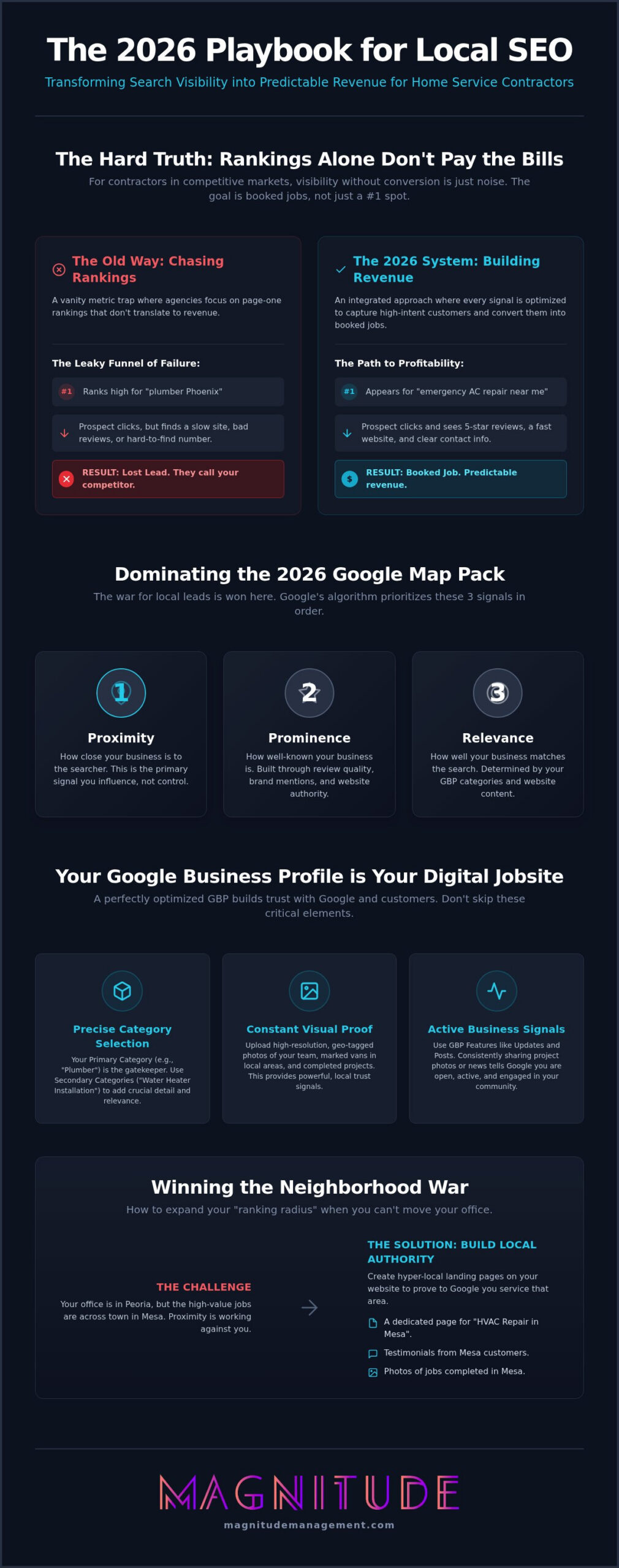
The Google Map Pack is where the war for local leads is won or lost. It’s the three listings that appear below the map in a local search, and it generates the majority of high-intent calls. To dominate it, you must understand the hierarchy of signals Google uses to rank businesses: Proximity, Prominence, and Relevance. In that order.
- Proximity: How close is your business to the searcher? This is the one factor you can’t directly control, but you can influence it.
- Prominence: How well-known is your business? This is determined by factors like your review count and quality, brand mentions across the web, and the authority of your website.
- Relevance: How well does your business match the searcher’s query? This comes down to your Google Business Profile (GBP) categories and the content on your website.
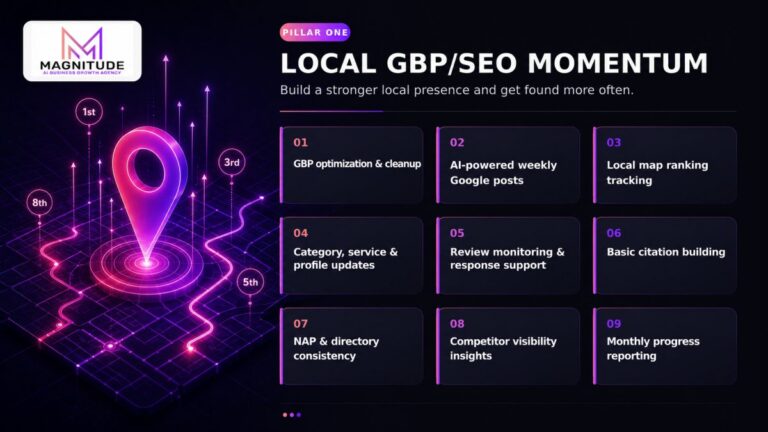
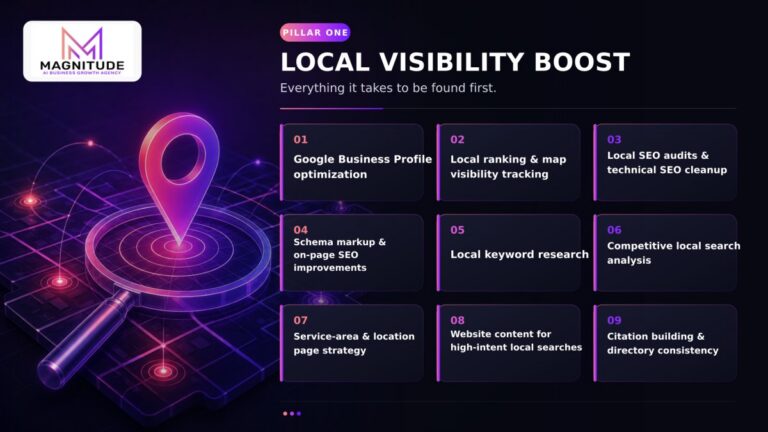
Your GBP profile is the first jobsite Google inspects. It must be perfectly optimized. At Magnitude, we use a proprietary system called the ‘Local Visibility Boost’ to build an impenetrable fortress of trust signals around your business, anchoring you in specific Tucson and Phoenix neighborhoods. For service area businesses like roofers and HVAC pros, the 2026 shift is critical: your ‘Service Area’ settings in GBP are no longer a suggestion; they are a primary signal used to define your ranking radius.
Optimizing Your Google Business Profile for 2026
A poorly optimized GBP is like showing up to a bid with the wrong paperwork. You’re immediately disqualified. The most critical element is your category selection. Your primary category is the gatekeeper; it tells Google what you do at the most fundamental level. Choosing “Plumber” instead of “Plumbing Contractor” can make a significant difference. Secondary categories allow you to add nuance, like “Water Heater Installation” or “Drain Cleaning Service.”
Next, focus on visual proof. High-resolution, geo-tagged photos of your team on the job, your marked vans in local neighborhoods, and completed projects provide powerful local trust signals. Finally, use GBP’s features like Updates and Posts. These act as a signal of active business health. Consistently posting project photos, special offers, or company news tells Google you are open, active, and engaged in your community. For a complete breakdown, use our 2026 Contractor’s Checklist for GBP Optimization.
Proximity vs. Authority: Winning the Neighborhood War
How do you win jobs in Mesa when your office is in Peoria? You can’t change your physical address, but you can expand your “ranking radius” by building local authority. This is done by creating hyper-local landing pages on your website. A generic “Services” page isn’t enough. You need a dedicated page for “HVAC Repair in Scottsdale” that features testimonials from Scottsdale customers, photos of jobs completed in that area, and content that addresses specific local concerns (like hard water issues or monsoon season prep).
This strategy directly supports your Map Pack visibility. Google uses your website content to verify the claims you make in your Google Business Profile. When you select “Roofing Contractor” as your GBP category, Google’s crawlers scan your website looking for content about roofing services, materials, and local projects to confirm that you are, in fact, an authoritative roofer. Without these supporting pages, your Map Pack authority is severely weakened.
Beyond the Map: Optimizing for AI Search and GEO Visibility
The next frontier is already here. AI search engines like Perplexity and Google’s AI Overviews are changing how customers find local services. Instead of just showing a list of links, these tools summarize the best options and present a direct answer. Your goal is to be the business that AI engines trust and cite as the definitive choice for your trade in your city.
This is the core of Generative Engine Optimization (GEO). For an Arizona plumber, it means your online presence must be structured so that when someone asks an AI, “Who is the most reliable plumber in Tucson for a tankless water heater installation?” the answer is you. This requires building what we call the ‘Magnitude Authority Engine’—a complete ecosystem of content, data, and social proof that makes your business the undeniable consensus choice.
As zero-click searches increase, where users get their answer without ever visiting a website, winning these AI-powered summaries is no longer optional. It’s essential for survival. Learn more about how to prepare for this shift in our guide to AI Search Visibility for contractors.
Structuring Data for AI Search Engines
AI engines don’t “read” your website like a human; they extract structured data. The most powerful tool for this is Schema markup, a type of code you add to your website to explicitly define your business information. Using Schema for LocalBusiness, Review, and FAQ tells AI engines exactly what you do, where you do it, your average rating, and the common questions you answer.
Your content must also be structured to answer the natural language questions homeowners ask. Instead of just a page titled “Our Services,” create content that directly answers questions like, “How much does it cost to replace an AC unit in Phoenix?” or “What are the signs of a slab leak?” By providing clear, expert answers, you position your business as a helpful authority, making it more likely that AI will use your information to formulate its recommendations.
GEO Strategies for Home Service Contractors
To become the consensus choice, you need to prove your expertise on a hyper-local level. Generic blog posts won’t cut it. Create detailed, hyper-local case studies: “Monsoon Roof Damage Repair in Oro Valley” or “Hard Water Filtration System Install in a Glendale Home.” These serve as powerful reference points that AI can cite.
Beyond your own website, focus on “unlinked mentions” and brand citations. When a local news site, a community blog, or a neighborhood Facebook group mentions your company name (even without a link), it contributes to your prominence. This digital word-of-mouth is a key signal of real-world authority. The goal is to position your business not just as a service provider, but as the undisputed category leader for your trade in Tucson or Phoenix.
Building a Local Authority Engine: Reviews, Citations, and Proximity
Trust is the currency of local search. You build it through a consistent, deliberate process of collecting reviews and ensuring your business information is accurate everywhere online. We call this the ‘Reputation Flywheel.’ It’s a system where every completed job becomes a ranking signal.
Many contractors obsess over their star rating. While important, what matters more to Google in 2026 is review velocity—the consistent flow of new, positive reviews. A business with 100 reviews and 4.9 stars that gets a new review every few days is seen as more relevant and active than a business with 150 reviews and a 5-star rating that hasn’t received a new one in six months.
The foundation of this trust is citation building: ensuring your Name, Address, and Phone number (NAP) are 100% consistent across the web. This consistency is the bedrock of local trust. In the eyes of a search engine, any variation creates doubt. These signals of social proof in the Local Pack work together to reduce homeowner anxiety and make your business the obvious, low-risk choice.
Automating the Review Generation Process
You cannot leave reviews to chance. Hoping satisfied customers will remember to leave a review is a recipe for a weak reputation. You need a systematic, automated ‘Flywheel’ that makes it effortless. This typically involves sending a text or email link to the customer shortly after the job is completed, guiding them directly to your review platform of choice.
Equally important is responding to every review, both good and bad. This is a public signal of active business management and customer care. When responding, you can naturally incorporate keywords related to the service and location. For example: “Thank you for trusting us with your AC installation in Tucson! We’re glad our team could get your new unit running smoothly.” This reinforces your local relevance with every response.
Citations and Local Directory Management
While hundreds of online directories exist, a few are critical. The ‘Big Four’ data aggregators (Data Axle, Foursquare, Neustar/Localeze) feed your business information to hundreds of other sites and apps. Ensuring your NAP is correct with them is step one. For a detailed strategy, read our Arizona contractor’s plan for citation building.
Next, you must clean up ‘zombie’ listings. These are old, incorrect, or duplicate listings from previous addresses or phone numbers that are quietly confusing search engines and killing your Phoenix rankings. Finally, build a presence on niche industry directories that matter for your trade, such as Angi, Houzz, or HomeAdvisor. These platforms are trusted authorities, and a strong profile on them feeds into Google’s overall assessment of your prominence.
The Magnitude System: Transforming Local Visibility into Predictable Revenue
Visibility is only half the battle. The final step is converting that hard-won traffic into profitable jobs. This is where most SEO agencies fail. They drive the clicks, but they don’t provide the infrastructure to capture and convert them. At Magnitude, we bridge that gap.
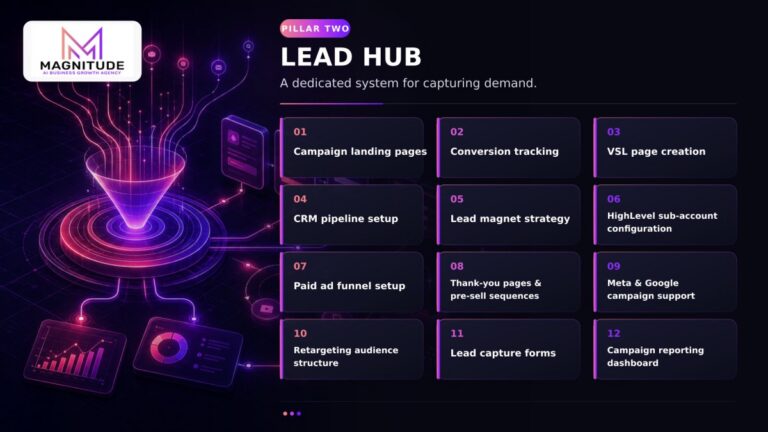
Our system starts with the ‘Lead Hub,’ an all-in-one platform where visibility meets conversion. It’s not just a website; it’s an engine built with high-converting landing pages, CRM automation, and lead management pipelines. It’s paired with our ‘Lead Guard’ advantage, which focuses on speed-to-lead—the single most critical factor in converting an online inquiry into a booked job. We also deploy Revenue Recovery campaigns, mining your old customer database to generate new jobs without spending a dollar more on ads.
Magnitude isn’t just an SEO provider. We are a strategic growth partner for Tucson and Phoenix contractors who are tired of the guesswork and ready to scale with a predictable system.
Conversion-Focused Infrastructure
Your website must be a sales machine, not a digital brochure. Every element, from the button placement to the page load speed, should be engineered to drive one action: a phone call or a form submission. Once a lead comes in from Google Maps or your website, our integrated CRM automation ensures it is never missed. No more leads falling through the cracks or going unanswered for hours.
This commitment to fast follow-up has a direct impact on your local search reputation. Google is beginning to incorporate user interaction signals into its rankings. When a customer calls a business from the Map Pack and no one answers, it’s a negative signal. By ensuring every lead is handled with speed and professionalism, you not only increase your conversion rate but also strengthen your reputation in the eyes of Google and your customers.
Scaling with Magnitude’s Fractional CMO Services
Eventually, you will move beyond tactical SEO. The focus will shift to high-level business development, market expansion, and profitability analysis. Our Fractional CMO services provide that strategic oversight. We use marketing analytics to eliminate guesswork, providing clear data on your cost-per-lead, cost-per-acquisition, and true return on investment in the Arizona market.
Stop paying for “marketing” and start investing in a system that generates predictable revenue. The first step is to see where you stand. Schedule your Local Visibility Audit today. We’ll analyze your current online footprint and provide a no-nonsense action plan to dominate your market.
Frequently Asked Questions About Local SEO
How long does it take to see results from local SEO for my home service business?
While some quick wins like Google Business Profile optimization can show results in as little as 30-60 days, a comprehensive local SEO strategy is a long-term investment. Expect to see meaningful traction in traffic and leads within 3-6 months, with foundational authority and competitive rankings solidifying over 6-12 months. It’s a marathon, not a sprint; consistency is the key to building lasting dominance.
Does my business need a physical office in Tucson or Phoenix to rank in the Map Pack?
No, you do not need a physical, customer-facing office. Home service businesses can register as a “Service Area Business” (SAB) on Google Business Profile. You use a residential address for verification (which is hidden from the public) and then define the specific cities and zip codes you serve. This allows you to rank in the Map Pack for searches in your designated service area, even without a commercial storefront.
Why is my competitor ranking higher than me even though I have more reviews?
While reviews are a major ranking factor (Prominence), they aren’t the only one. Your competitor might be ranking higher due to Proximity (their business is physically closer to the searcher) or Relevance (their website and GBP profile are better optimized for the specific search term). They may also have a stronger backlink profile, more consistent citations, or a faster, more mobile-friendly website.
What is the most important ranking factor for Google Maps in 2026?
Proximity remains the most dominant factor—Google wants to show users the closest, most relevant option. However, since you can’t change your location, the most important controllable factor is the combination of your Google Business Profile optimization and the authority of your website. A perfectly optimized GBP, verified by a website with strong, hyper-local content, is the key to expanding your ranking radius and overcoming the proximity advantage of competitors.
How much should a home service business spend on local SEO services?
This varies widely based on market competitiveness (Phoenix is more expensive than a small town), the current state of your online presence, and your growth goals. A reasonable budget can range from $1,500 to $5,000+ per month. Instead of focusing on cost, focus on ROI. A better question is, “How many new jobs do I need to book to make this investment profitable?” A good SEO partner should be able to help you answer that question.
Can I do local SEO myself, or do I need an agency?
You can absolutely handle the basics yourself, such as claiming and optimizing your Google Business Profile, encouraging reviews, and ensuring your NAP is correct on your website. However, competing at a high level in a dense market like Tucson requires advanced strategies in citation management, technical SEO, content creation, and link building. An agency provides the expertise, tools, and time that most business owners lack.
How does AI search change the way customers find plumbers and HVAC techs?
AI search (like Google’s AI Overviews) provides direct answers and summaries instead of just a list of links. This means customers may get a recommendation for “the best HVAC company for emergency repair in Scottsdale” without ever clicking to a website. To win, your business needs to become the “consensus choice” by having strong reviews, expert content that answers common questions, and structured data (Schema) that makes it easy for AI to understand and trust your information.
What is the ‘Speed to Lead’ rule and why does it matter for SEO?
The ‘Speed to Lead’ principle states that the faster you respond to a new inquiry, the exponentially higher your chance of converting them into a customer. Studies show that responding within the first five minutes can increase conversion rates by over 100%. While not a direct, confirmed Google ranking factor yet, it’s a critical business factor that impacts user experience and online reputation. Positive reviews often mention “quick response time,” which indirectly boosts your SEO through improved prominence and trust signals.