Local SEO Citations for Contractors: The 2026 Visibility Playbook
If you think your top-ranking competitor in Phoenix has a “secret” marketing strategy, you’re wrong. They simply have a more verified digital entity than you do. You’ve likely spent thousands on a website and hundreds of hours chasing reviews, yet you’re still stuck in the “More Places” basement of the Google Map Pack. It’s frustrating to see inconsistent business data and duplicate listings from three addresses ago suppress your rankings while your phone stays silent. These are the common local SEO mistakes contractors make when they treat citations as a one-time chore rather than a structural foundation.
You deserve a system that turns visibility into closed sales. This playbook shows you how to build a bulletproof citation profile that verifies your business entity and dominates the Google Map Pack in competitive Arizona markets like Phoenix and Tucson. We will break down the 2026 verification requirements, the mechanics of AI search trust, and the exact steps to eliminate data waste so your business becomes the undisputed authority in your service area. It’s time to stop guessing and start building a high-performance infrastructure that forces Google to recognize your firm as the legitimate leader in your trade.
Key Takeaways
- Understand how citations provide the structural verification needed to support 32% of your Google Business Profile ranking signals.
- Eliminate common local SEO mistakes contractors make by fixing inconsistent NAP data that confuses Google’s entity logic and triggers penalties.
- Prioritize trade-specific citations on platforms like Houzz and Angi to build industry-specific authority that generic directories cannot match.
- Follow a disciplined audit and suppression process to remove duplicate listings, which is the highest priority for immediate ranking recovery.
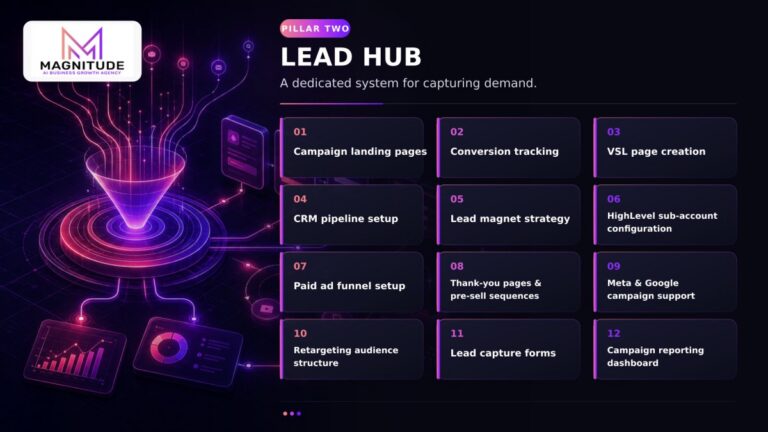
- Connect your map visibility to the Magnitude Lead Hub to ensure top-tier rankings translate into revenue through rapid lead response.
What Are Local SEO Citations & Why They Matter in 2026
A local SEO citation is any online mention of your Name, Address, and Phone number (NAP). Think of it as a digital breadcrumb trail that confirms your business exists. In local search engine optimization, these mentions serve as a distributed ledger of your legitimacy. One of the biggest local SEO mistakes contractors make is assuming these listings are just old-school phone book entries. They aren’t. They are the structural verification Google requires to prove your plumbing shop or roofing crew isn’t a “ghost” business clogging up the results.
Google prioritizes trust above all else. If your business info appears consistently on Yelp, the BBB, and trade-specific sites, Google stops questioning your location. Structured citations live in directories with defined fields. Unstructured citations appear in local news articles, project blogs, or community mentions. Both tell the algorithm that you are a real entity with a physical footprint in Arizona. Without this external proof, your Google Business Profile remains a weak, unverified claim.
The 7% Direct Signal vs. the 32% GBP Trust Multiplier
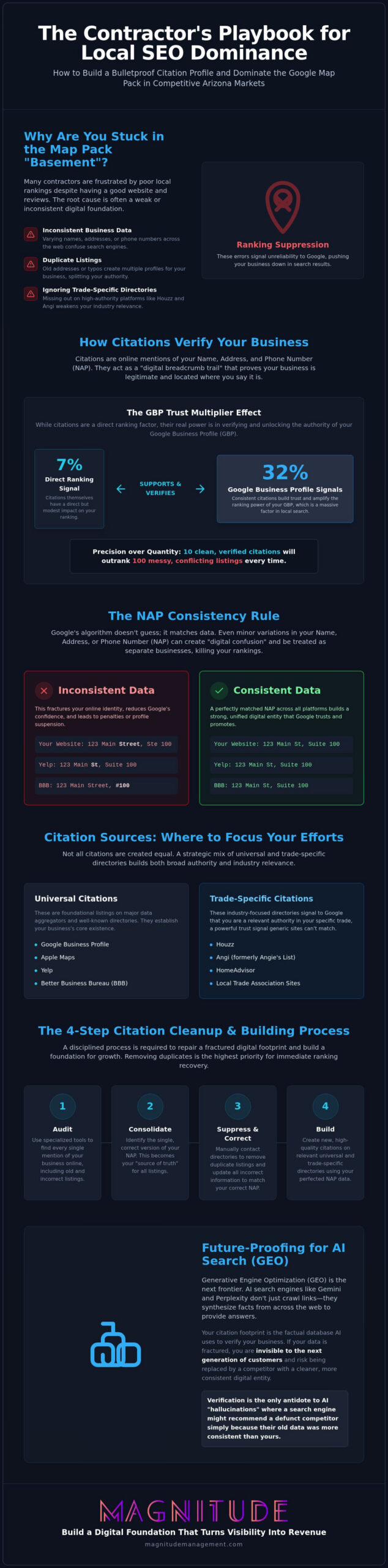
In 2026, citations carry a 7% direct ranking weight. That sounds small until you realize they act as the foundation for the 32% weight assigned to Google Business Profile (GBP) signals. Consistent data across the web “unlocks” your profile’s authority. If your address is “123 Main St” on your website but “123 Main Street” on three other sites, Google’s trust drops because you look like two different entities. A contractor with 10 clean, verified citations will outrank a competitor with 100 messy, conflicting listings every time. This precision is what stops ranking suppression in high-competition markets like Phoenix and Tucson. To further establish your brand’s local authority outside of the digital space, you can explore Signs from Signarama that reinforce your professional reputation.
Why AI Search Engines (GEO) Rely on Your Citation Footprint
The rise of Generative Engine Optimization (GEO) has changed the stakes. AI search engines like Perplexity and Gemini don’t just crawl links; they synthesize facts. They use directory data to verify your business before recommending you to a user. Verification is the only antidote to AI hallucinations where search engines might accidentally suggest a defunct competitor because their data was more “consistent” than yours. GEO search visibility is the measurable ability of your business to be identified and recommended by AI-driven search models based on the accuracy of your verified digital entity. If your footprint is fractured, you’re invisible to the next generation of customers. To see where your data is leaking, start with a Local Search Visibility Audit to identify the waste holding you back.
The NAP Consistency Rule: Why Data Mismatches Kill Contractor Rankings
Google doesn’t guess. It categorizes. When your business is listed as “123 Main St” on Yelp and “123 Main Street” on your website, Google’s entity logic treats these as two separate data points. This creates duplicate business entities in the algorithm’s database. While 73% of consumers report losing trust when they find incorrect business info, Google’s algorithm penalizes you much faster. In 2026, inconsistency is no longer a minor oversight. It is a signal of unreliability that suppresses your visibility in the Map Pack.
One of the most frequent local SEO mistakes contractors make is the improper use of call tracking numbers. If you swap your primary business line for a tracking number on a directory without using dynamic number insertion, you’ve just broken your NAP consistency. Other pitfalls include failing to update old office locations or varying your address between “Suite,” “Unit,” or “#.” Correcting these local SEO mistakes contractors make is essential because mismatches often trigger duplicate Google Business Profile (GBP) listings. This is the primary reason for profile suspension, which can take weeks of revenue-draining downtime to resolve.
The Economics of Inconsistent Data in Arizona Trades
Accuracy is a matter of survival during seasonal demand spikes. Consider a Phoenix HVAC company during a 115-degree July week. If their citation data has a conflicting “Open Now” status or an old phone number, they can easily lose $5,000 in emergency service calls in a single day. Google assigns a Confidence Score to your business data based on how well it matches across the web. To keep this score high, you must treat your data like infrastructure. You can identify these leaks early with an Ad Waste Audit to ensure your budget isn’t being burned by bad data.
Managing Service Area Businesses (SABs) Without a Shop
Plumbers and roofers often operate out of trucks and use their home addresses for registration. Google guidelines for 2026 require SABs to hide their physical address in GBP settings to avoid suspension. However, your hidden address must still match the documentation provided to the Small Business Administration or your local utility bills. Maintaining consistency in Scottsdale and Mesa requires a disciplined approach to phone formatting and service area definitions. If you want to stop the bleed and professionalize your digital footprint, partnering with a results-driven agency is the fastest path to recovery.
Universal vs. Trade-Specific Citations: Which Ones Drive Leads?
Don’t waste your time on the “shotgun approach.” Listing your business on 500 low-quality directories is a waste of resources. Start with the Big 25. These are non-negotiable anchors like Yelp, Bing, Apple Maps, and the Better Business Bureau. They provide the foundational trust Google needs to verify your entity. If you aren’t present on these core platforms, your business lacks the basic digital infrastructure required to compete in the Arizona market.
One of the most frequent local SEO mistakes contractors make is prioritizing quantity over quality. 30 high-authority citations from reputable sources will always beat 300 spammy links from “link farm” directories. Focus on data aggregators like Data Axle and Foursquare. These platforms act as the hidden layer of the local internet; they feed your business information to thousands of smaller apps, car GPS systems, and niche directories. When your data is clean at the aggregator level, it creates a ripple effect of accuracy across the entire web.
For high-ticket trades like home remodeling or roofing, a citation on Houzz or Angi carries significantly more weight than a generic directory. These platforms are where customers go to vet your work quality and project history. If your info is missing or inconsistent here, you aren’t just losing SEO points; you’re losing high-value leads. Google recognizes this user behavior and rewards businesses that maintain active, accurate profiles on these trade-specific powerhouses because they provide contextual proof of your expertise. This is especially true for emergency services like restoration, where dryriteaz.com uses verified profiles to build immediate trust with homeowners facing property damage.
The top directories for your specific trade provide the highest contextual value to search engines. For HVAC pros, a listing with the Air Conditioning Contractors of America (ACCA) is essential. Plumbers should prioritize the Plumbing-Heating-Cooling Contractors Association (PHCC), and roofers need the National Roofing Contractors Association (NRCA). These trade association memberships act as powerful unstructured citations that confirm your professional standing. Magnitude uses a disciplined decision framework to identify exactly which niche sites your competitors are using to outrank you in the Map Pack.
Local Arizona Citations: Dominating Phoenix and Tucson
Dominating Phoenix and Tucson requires more than just national listings. You need hyper-local signals. A link from a Tucson community blog or the Greater Phoenix Chamber of Commerce tells Google you are physically present and active in the valley. These Arizona-specific associations provide the geographic relevance needed to win the Map Pack during peak seasons. Take a Local Search Visibility Audit to see where you stand in AZ and identify which high-value citations you are currently missing to stop common local SEO mistakes contractors make.
The Step-by-Step Citation Cleanup and Building Process
Recovery starts with a spreadsheet, not a software subscription. If you want to fix the local SEO mistakes contractors make, you must first face the reality of your data. The process is methodical. It requires a disciplined audit of every corner of the web where your business info might be hiding. You aren’t just looking for your current address; you’re hunting for every ghost of your business’s past that is currently haunting your rankings.
- Step 1: The NAP Audit. Document every variation of your business name, address, and phone number currently indexed by search engines.
- Step 2: Identifying and Suppressing Duplicates. This is your #1 priority for ranking recovery. Duplicate listings confuse Google’s entity logic and dilute your ranking power.
- Step 3: Claiming the Core Aggregators. Ensure source data is correct at the aggregator level, specifically with Data Axle and Foursquare, which feed thousands of smaller directories.
- Step 4: Manual Submission to Top-Tier Trade Directories. Submit your info to high-authority sites like the BBB or trade-specific associations. Avoid automated junk that creates low-value profiles.
- Step 5: Ongoing Monitoring. Protect your data from “suggested edits” by competitors or bots that can change your business hours or phone number without your consent.
Auditing Your Current Digital Footprint
Hidden listings are often the result of old office locations or previous business names. Use search operators like “site:yourwebsite.com” or search for your primary phone number in quotes to uncover profiles you didn’t even know existed. This methodical approach is the only way to permanently solve the local SEO mistakes contractors make during office moves or rebrands. Poor visibility isn’t just an SEO problem; it’s a financial one. Check for wasted ad spend caused by poor local visibility with our Ad Waste Audit.
Why Manual Cleanup Beats Automated Syncing
Many agencies push “syncing” services that promise instant results. These are a trap. The moment you stop paying their monthly fee, your data often reverts to its messy, original state. This “lock-in” model keeps you dependent on a subscription rather than allowing you to own your digital assets. Magnitude’s approach is different. We perform permanent, manual citation building. Once it’s built, it stays yours forever. This is critical when handling business name changes or office moves in the Valley. You shouldn’t lose years of SEO history just because you moved to a larger shop in Mesa or Tucson. To build a permanent foundation that outlasts any subscription, start your manual citation cleanup with Magnitude today.
Beyond Rankings: Integrating Visibility with the Magnitude Lead Hub
Rankings are an ego metric. Revenue is a performance metric. One of the most common local SEO mistakes contractors make is assuming that a top-3 spot in the Google Map Pack automatically results in a profitable business. It doesn’t. Visibility only provides the opportunity to compete for a lead. If your internal systems are broken, you are simply paying for the privilege of watching potential customers call your competitors.
In 2026, the “Speed to Lead” requirement is non-negotiable. Data from current service-area trends suggests that contractors who respond to a lead within five minutes are significantly more likely to qualify that prospect than those who wait thirty minutes. If you have done the hard work of cleaning up your citations and dominating Phoenix search results, you cannot afford to waste that momentum on a slow office response. High visibility must be backed by high-velocity sales infrastructure.
This creates what we call the Reputation Flywheel. Increased visibility leads to more service calls. More service calls, when handled with operational excellence, lead to more authentic customer reviews. These reviews then feed back into Google’s algorithm, further solidifying your verified entity status and fueling even better rankings. Magnitude acts as your strategic partner in this process, handling the technical theater of SEO so you can focus on the technical execution of your trade.
Turning Map Pack Rankings into Revenue
The Magnitude Lead Hub is designed to ensure that your optimized local profile actually converts traffic into closed jobs. By using the Lead Hub to capture and automate responses, you eliminate the “leaky bucket” problem that plagues most local service companies. Call tracking is an essential component of this system. Without it, you cannot measure the true ROI of your citation building efforts or determine which directories are actually driving high-value emergency calls in Tucson. You can learn more by reading our guide on Lead Response Automation.
The 2026 Contractor Growth Framework
Sustainable growth requires a three-pillar approach: Local SEO, Reputation Management, and Database Reactivation. This framework ensures you aren’t just hunting new leads, but also maximizing the value of your existing customer base. It is a disciplined system that builds long-term equity in your business name. One of the local SEO mistakes contractors make is ignoring the power of their own data. For a deeper look at this approach, explore our strategy for Authority Building for Arizona Trades. It’s time to stop playing the guessing game with your marketing budget. Stop being invisible and start dominating Arizona search today.
Own Your Service Area and Turn Visibility into Revenue
Citations in 2026 are not just digital phone book entries; they are the structural proof that your business is a legitimate authority. We have covered how NAP consistency acts as a trust multiplier for your Google Business Profile and why trade-specific listings on platforms like Houzz or Angi are non-negotiable for high-ticket roofing or plumbing jobs. Ignoring these foundational elements is one of the costliest local SEO mistakes contractors make, especially in high-stakes Arizona markets where competition for the Map Pack is fierce.
Magnitude provides the AI-powered local SEO infrastructure that HVAC, plumbing, and roofing companies in Phoenix and Tucson need to stay dominant. By combining manual citation building with the Magnitude Lead Hub, we ensure your visibility translates into closed sales through rapid lead response. Don’t let inconsistent data or duplicate listings suppress your growth. It is time to professionalize your digital footprint and secure your business entity for the long term. Get Your Free Local Search Visibility Audit and start dominating Arizona search today. Your next big job is waiting for a verified pro to show up.
Frequently Asked Questions
How many local SEO citations does a contractor actually need?
You generally need 30 to 50 high-quality citations to see a measurable impact in competitive Arizona markets. While some agencies push for hundreds of listings, most are low-value spam that Google ignores. Focus on the Big 25 universal directories and 5 to 10 trade-specific associations. This ensures your infrastructure is lean and accurate. Quality beats quantity every time when you are trying to avoid common local SEO mistakes contractors make during their initial setup phase.
What is the most important citation site for a home service business?
Google Business Profile is your primary citation, but the most important external site is often a trade-specific powerhouse like Houzz or Angi. For plumbers and HVAC pros in Phoenix, these platforms act as a secondary verification of your professional expertise. Google looks at these niche sites to confirm you are active in your trade. A complete profile on a vertical directory carries more weight than a dozen mentions on generic business lists that have no industry relevance.
How long does it take for new citations to improve my Google Maps ranking?
Most contractors see ranking movement within four to eight weeks after a cleanup or new building phase. Google’s crawlers must first discover the new data and then update their internal confidence score for your business entity. Speed depends on how frequently these third-party directories are indexed. While you might see some minor fluctuations sooner, the full authority of a clean citation profile takes time to stabilize across the broader digital landscape in Tucson and Scottsdale.
Can I use a P.O. Box for my local SEO citations?
You cannot use a P.O. Box or a virtual office for local SEO citations. Google’s 2026 guidelines are strict about physical presence. Using a P.O. Box is one of the fastest ways to get your Google Business Profile suspended. If you are a service-area business working from home, you must use your residential address for registration but set your profile to “hide address” so it doesn’t appear publicly to customers in Mesa or Peoria.
Do I need to pay for premium listings on sites like Yelp or Angi?
You don’t need to pay for premium ad packages to get the SEO benefits of a citation. The ranking signal comes from the accuracy of your name, address, and phone number, not your monthly ad spend with Yelp or Angi. While paid features might increase your internal lead volume on those specific platforms, they don’t directly boost your Google Map Pack position. Focus on maintaining a free, fully optimized, and consistent profile to secure your entity verification.
How do I find and remove duplicate citation listings for my business?
Finding duplicates requires a methodical search using your business phone number and old addresses in quotation marks. Google search operators like “site:yelp.com [Business Name]” also help uncover hidden listings. Once identified, you must manually request a merge or deletion from each directory. This cleanup is the highest priority for recovery because duplicate data is one of the most frequent local SEO mistakes contractors make, leading to fractured authority and suppressed visibility in Phoenix search results.
Will changing my business phone number hurt my local SEO rankings?
Changing your business phone number will temporarily hurt your rankings if you don’t update every citation simultaneously. A new number creates an immediate NAP mismatch across the web, which lowers Google’s confidence in your data. If a change is necessary, you must execute a full manual update across all aggregators and top-tier directories. This ensures your new number becomes the “one true version” of your contact info for customers in Tucson and surrounding Arizona service areas.
Are citations still a ranking factor in the age of AI search?
Citations remain a critical ranking factor in 2026 because AI and GEO search engines use them for entity verification. Models like Gemini and Perplexity synthesize facts from multiple sources to recommend local pros. If your footprint is inconsistent, these AI systems may “hallucinate” or skip your business entirely in favor of a competitor with a cleaner data trail. Citations provide the structural proof these advanced search models need to trust and recommend your services to local users.