Paid Ads for Local Services: 2026 Contractor’s Guide
Why are you paying $51 for a single HVAC lead just to watch it die in your inbox because your team didn’t call back within four minutes? In 2026, paid advertising for local service businesses has become a high-stakes game where speed and transparency are the only things that matter. You’re likely exhausted from competing against lead aggregators who sell the same “exclusive” lead to five of your competitors simultaneously. It feels like you’re burning cash on a system designed to make everyone rich except the contractor doing the actual work.
You’re right to be skeptical of standard marketing metrics that don’t translate to revenue. This guide will show you how to stop the waste and build a high-conversion lead engine that turns clicks into profitable service contracts. We’ll break down the August 2026 Google Ads migration, the shift toward AI-driven local search, and the exact automation systems you need to handle follow-ups while you’re out in the field. It’s time to move past the industry theater and start tracking every dollar from the initial ad click to the final bank deposit.
Key Takeaways
- Stop wasting money on “set and forget” campaigns and learn why speed-to-lead is the single most important factor in your 2026 sales process.
- Navigate the critical differences between Google LSA and Search Ads to ensure you are targeting high-value installations rather than just low-margin repairs.
- Discover how a structured Lead Hub turns paid advertising for local service businesses into a transparent system that tracks every click to a final bank deposit.
- Master the economics of lead generation by calculating your maximum allowable cost-per-lead to stay profitable through seasonal shifts and competitive spikes.
- Shift your perspective from buying “leads” to building a revenue engine that uses radical accountability to eliminate marketing waste.
Why Paid Advertising for Local Service Businesses Often Fails
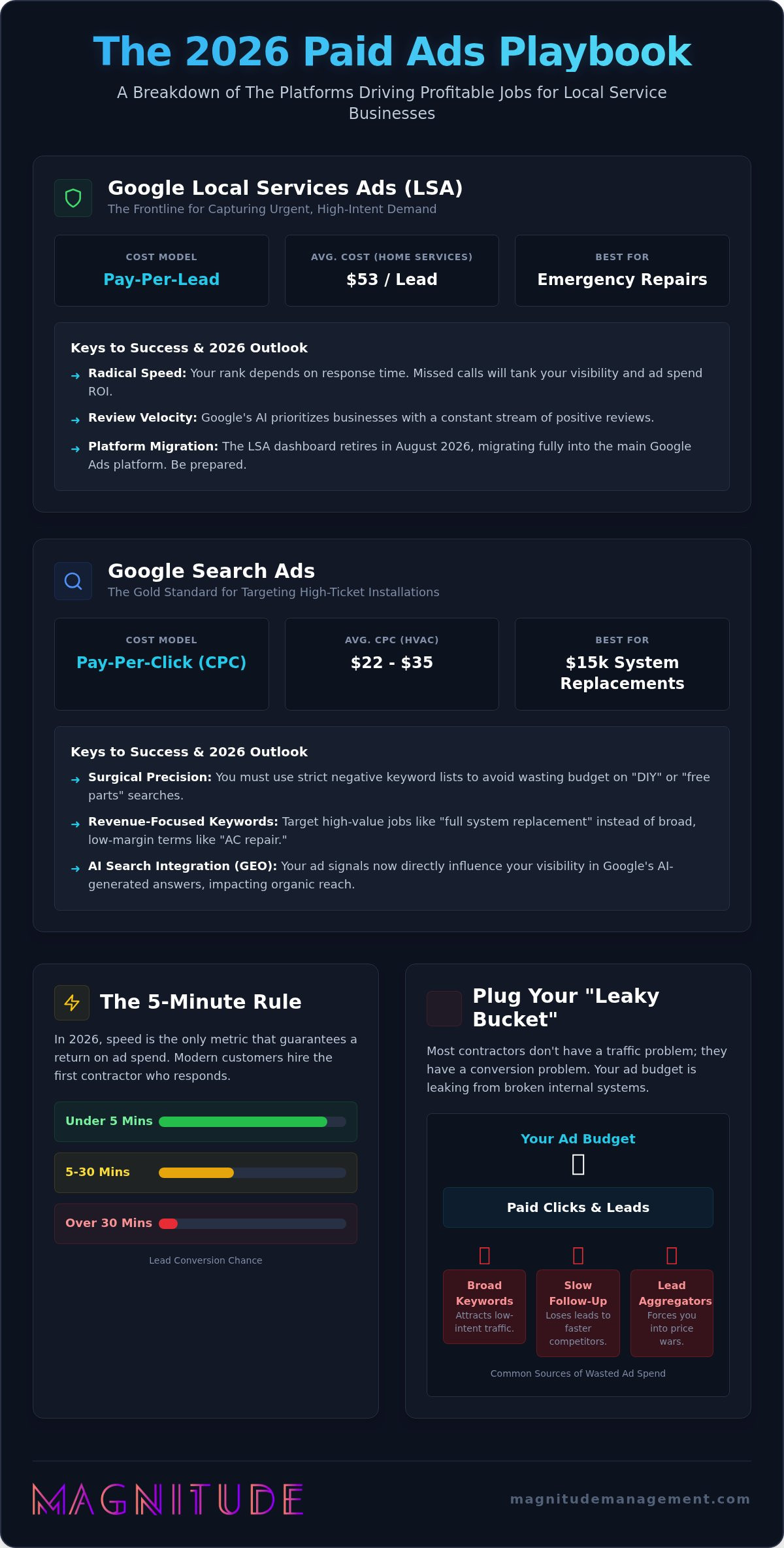
Most contractors think they have a traffic problem. They don’t. They have a conversion problem. They pour thousands of dollars into online advertising only to watch those leads evaporate because their internal systems are broken. This is the Leaky Bucket syndrome. You can’t fix a hole in the bottom of the bucket by turning the faucet up higher. In 2026, simply getting a click is the easy part. The failure happens in the silence that follows.
The market is too crowded for the “set and forget” mentality of the last decade. If you aren’t active, you’re invisible. Many local businesses lose the ROI battle because they rely on lead aggregators. These platforms sell the same lead to five different contractors simultaneously. You aren’t buying a customer; you’re buying a stressful race to the bottom on price. To win, you must stop buying leads and start owning a customer acquisition system that you control.
Effective paid advertising for local service businesses requires radical accountability. It means knowing exactly which keywords drive revenue and which ones just burn your budget. Most agencies hide behind “impressions” because they don’t want to show you how little of that traffic actually turns into a signed contract. You need a system that translates clicks into contracts, not just more noise.
The 5-Minute Rule: Why Speed-to-Lead is the Only Metric That Matters
Data shows a massive drop-off in conversion if you wait more than 300 seconds to respond. Modern homeowners are impatient. They hire the first person who answers the phone or replies to the text. If you’re under a sink or on a roof, you’re losing money. Automated SMS and email sequences are no longer optional; they are the bridge that keeps the lead warm until you can pick up the phone. Speed is the only metric that guarantees a return on your ad spend. Deploying lead response automation for service business ensures every high-intent prospect receives an immediate, personalized reply even when your team is out in the field.
Identifying the “Ad Waste” in Your Current Strategy
Broad keywords are a silent killer. Bidding on “AC repair” when you only want high-value “full system replacements” is a fast way to go broke. Poor negative keyword management in HVAC and plumbing allows your ads to show up for “DIY repair” or “free parts,” wasting your budget on zero-intent searches. You need to be surgical. If you suspect your current campaigns are bleeding cash, use our Ad Waste Audit to find exactly where your paid advertising for local service businesses is failing and identify immediate savings.
Google LSA vs. Google Search Ads vs. Meta: A 2026 Comparison
Choosing the wrong platform is the fastest way to drain your bank account. In 2026, paid advertising for local service businesses is defined by intent. You have high-intent searchers looking for an immediate fix and passive browsers who need to be convinced over time. If you treat every platform the same, you’re subsidizing Google’s profit margins at the expense of your own. Success requires understanding where your specific service fits into the homeowner’s journey.
A new variable has entered the equation: AI search visibility, or Generative Experience Optimization (GEO). Google’s AI now uses your paid ad signals, review velocity, and response times as ranking factors for its AI-generated answers. This means your paid strategy directly impacts your “organic” visibility in AI search results. Integrating these local marketing strategies ensures you aren’t just buying clicks, but training Google’s AI to see you as the dominant local authority.
Google Local Services Ads: The “Google Guaranteed” Advantage
Google Local Services Ads (LSA) are your frontline for emergency work. With an average cost-per-lead of $53 across the home services sector, LSAs operate on a pay-per-lead model. This is ideal for HVAC repair or emergency plumbing where the customer needs a solution now. However, the LSA dashboard is being retired in August 2026 as management migrates into the main Google Ads platform. You must prioritize review velocity and response time; missed calls will tank your rankings. A proactive approach to reputation management for contractors ensures your review volume and response times actively support your LSA rankings rather than undermining them. Standard Search Ads, by contrast, remain the gold standard for high-ticket installations. While LSAs land the $200 repair, Search Ads target the $15,000 replacement. With HVAC CPCs ranging from $22 to $35, precision is mandatory to avoid waste.
Strategic Meta Ads for Home Remodelers and Landscapers
While Google captures demand, Meta Ads create it. This is a different flavor of paid advertising for local service businesses that thrives on visual transformations. Visual trades like roofing and landscaping succeed here because they can showcase the “before and after.” It’s about capturing “latent” demand. A homeowner might not be searching for a new deck today, but a high-quality video testimonial in their feed can trigger the decision. Retargeting is your secret weapon. It keeps you top-of-mind for long-cycle decisions, ensuring that when the homeowner is ready to sign, your brand is the only one they consider. If you want to build a complete demand-generation system on social, our Meta Ads pipeline guide for home service contractors breaks down the exact mechanics of manufacturing jobs through paid social. If you want to see how your current online presence stacks up, consider a local search visibility audit to identify gaps. Building this authority is how you scale your service business beyond simple repair calls.
The Infrastructure of Conversion: Why You Need a Lead Hub
Getting the click is only 20% of the battle. If your ads are working but your phone isn’t ringing with qualified jobs, your infrastructure is the problem. A website is a digital brochure; a Lead Hub is a conversion engine. Paid advertising for local service businesses fails most often at the point of contact. Sending high-intent traffic to a generic homepage is professional suicide. You need a destination designed to do one thing: convert a stranger into a scheduled appointment.
Modern consumers don’t want to search for your contact info. They want an immediate solution to a specific problem. If they clicked an ad for “emergency pipe repair,” they shouldn’t land on a page talking about your company history or your “commitment to excellence.” They need a clear path to booking. Without this dedicated infrastructure, you’re essentially donating your marketing budget to the platforms while your competitors reap the rewards.
The Magnitude Lead Hub: A Proprietary System for Growth
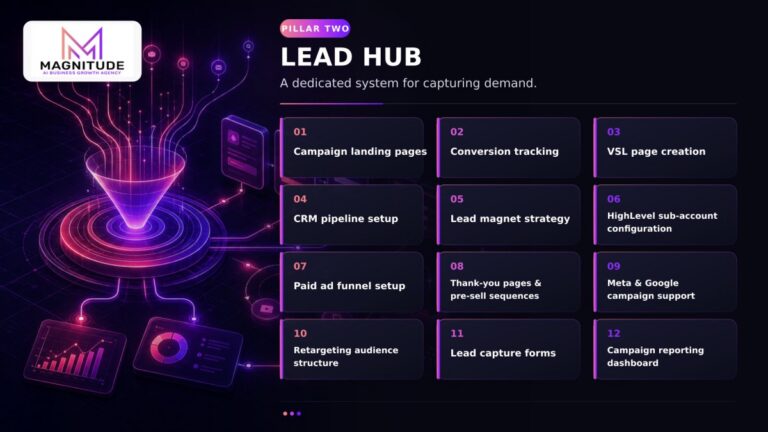
Our AI-powered Lead Hub doesn’t just collect names. It captures, tracks, and nurtures every prospect through a disciplined sales pipeline. It moves homeowners from “interested” to “scheduled” without manual intervention. This visibility allows you to see exactly where a job is stuck. Is it waiting for a quote? Is it waiting for a follow-up? Most contractors ignore the hundreds of leads sitting in their old spreadsheets. We use database reactivation to mine that “hidden gold,” generating new revenue from old data without spending an extra dime on new ads. The foundation of this system is lead response automation for service business, which guarantees that no prospect waits more than five minutes for a reply regardless of how busy your team is on the ground.
Landing Page Essentials for Local Contractors
A high-converting service page requires specific anatomy. You need trust signals, a singular CTA, and flawless mobile optimization. In 2026, “click-to-call” and “instant-book” buttons are non-negotiable. Homeowners want friction-less booking. To dominate specific markets like Phoenix or Tucson, your content must be GEO-specific. This signals relevance to both the user and the search engine. When you align your messaging with the user’s location and intent, your conversion rates will skyrocket. Understanding exactly why your homepage underperforms is critical; learn how conversion landing pages for home services are engineered to turn urgent searches into booked jobs and stop the cash drain from generic destinations.
You must know which ad produced the $15,000 HVAC replacement. Advanced call tracking provides this visibility by assigning unique numbers to different campaigns. It removes the guesswork and allows for radical accountability in your spend. When following the SBA guide to marketing budgets, you’ll see that efficiency is about recovery and the systematic removal of waste. A Lead Hub ensures that every dollar spent on paid advertising for local service businesses is accounted for. It bridges the gap between a click and a bank deposit.
Budgeting for Growth: The Economics of Local Service Leads
Stop treating your marketing budget like a donation to Google. Advertising is fuel for a revenue engine; if you don’t know the yield of every dollar spent, you’re just gambling. When you commit to paid advertising for local service businesses, you aren’t just buying clicks. You’re purchasing a predictable future for your company. To do this effectively, you must calculate your Maximum Allowable Cost Per Lead (CPL) by working backward from your average job profit and close rate. If you don’t know these numbers, you shouldn’t be spending a dime.
The first 90 days of any campaign are an investment in data, not just immediate profit. The algorithm needs time to identify which homeowners in your specific service area actually sign contracts. This is especially critical for HVAC contractors in Arizona. You cannot wait until the Phoenix heat hits 110 degrees to start your ads. You must build your data foundation during the lulls so that your systems are optimized when the emergency calls spike. High lead volume is useless if your team is overwhelmed or the leads are low-quality; 2026 is about surgical precision, not just raw numbers.
The Math of a $1M Service Business
Your advertising budget should be a fixed percentage of your target revenue, typically 8 to 12 percent, adjusted based on your average ticket price and the competitiveness of your local market. A roofer can afford to pay $200 for a lead because a single replacement job carries a high ticket value. A pest control professional cannot sustain that same cost for a recurring service call. You must also account for the compound interest of reputation management. As your review velocity increases, your ad performance improves because trust lowers the barrier to the click. High-performing ads and a strong reputation work together to drive your customer acquisition costs down over time. Building an automated system for reputation management for contractors ensures your review velocity keeps pace with your ad spend, compounding your returns rather than letting them plateau.
Scaling Your Budget: When to Press the Gas
Identifying the “Sweet Spot” is about finding the point where increased spend produces more profit without breaking your operations. Don’t scale your ads if your office staff can’t answer the phone within four minutes. You must hire and train for the volume before you turn up the dial. If you want to find your market ceiling and see where the gaps are in your current approach, use our Local Search Visibility Audit. Successful paid advertising for local service businesses requires a shift from emotional spending to mathematical certainty. Once your infrastructure is stable, you can scale your revenue with Magnitude by feeding the system more fuel.
Choosing the Right Partner: Why Magnitude is the Antidote to Industry Theater
Most marketing agencies are in the business of selling theater. They present you with colorful charts and “vanity metrics” like impressions or clicks while your actual revenue remains stagnant. Magnitude is the antidote. We don’t operate as a simple marketing vendor; we function as your Fractional CMO. This shift in perspective means we’re focused on the mechanics of your success, not just the appearance of activity. If an ad campaign isn’t resulting in signed contracts and bank deposits, it’s a failure. Period.
Specialization is the key to radical accountability. Why would you hire a generic agency that markets for dentists and law firms to handle paid advertising for local service businesses? They don’t understand the seasonality of HVAC, the specific intent behind an emergency plumbing call, or the unique operational needs of a professional firm like Summit Force Security Group. Our systems are built specifically for the high-stakes world of service trades. We understand that your business doesn’t need “more noise.” It needs a repeatable, scalable system for customer acquisition that you can actually trust.
This requirement for specialized knowledge extends beyond marketing; it’s about understanding the core operations of the industry. For instance, to see how a leader in the civil and mining sectors maintains high standards of service delivery, check out McMahons Civil and Contracting PTY LTD.
Beyond Ads: A Holistic Growth Strategy
Growth doesn’t happen in a vacuum. To dominate a competitive market like Arizona, your strategy must be holistic. We integrate SEO, reputation management, and paid advertising for local service businesses into a single, high-performance flywheel. This ensures that every review you earn and every organic ranking you achieve makes your paid ads more effective. Our deep expertise in the Tucson and Phoenix markets provides a tactical advantage; we know which neighborhoods have aging infrastructure and which ones are looking for high-efficiency upgrades. You’ll receive transparent, real-time reporting that eliminates the “black box” of traditional marketing.
Your Next Steps: From Ad Waste to Lead Mastery
The path to scaling beyond $1M in revenue begins with clarity. You must identify exactly where your budget is being mismanaged before you can fix the problem. Use our Ad Waste Audit to get a clear picture of your current digital footprint. Once we’ve identified the leaks, the transition to the Magnitude Lead Hub ensures that no lead ever falls through the cracks again. It’s time to stop gambling with your marketing budget and start building a revenue engine. Ready to dominate your local market? Start your growth journey here.
Stop Donating to Google and Start Owning Your Market
Success in 2026 isn’t about who spends the most; it’s about who wastes the least. You now understand that paid advertising for local service businesses is a mathematical equation where infrastructure determines your profit. If you continue sending high-intent traffic to a generic website without automated follow-up, you’re choosing to lose. You’ve seen how specialized growth strategies for HVAC, plumbing, and roofing contractors turn raw leads into scheduled appointments while your competitors are still checking their voicemails.
It’s time to move past the industry theater of vanity metrics. You need radical accountability and a system that tracks every dollar from the initial click to the signed contract. Our AI-powered Lead Hub is designed to bridge the gap between marketing spend and bank deposits; it ensures your speed-to-lead is unmatched. Eliminate Ad Waste and Scale Your Service Business with Magnitude. You have the tools and the strategy. Now, you just need the engine to drive it home. Your most profitable season starts with a single decision to fix your sales pipeline.
Frequently Asked Questions
Is Google Ads or Meta Ads better for a local plumbing business?
Google Ads is superior for plumbing because it captures high-intent searches when a pipe bursts. Meta Ads are better for maintenance or brand awareness; they won’t help when someone has an active flood. You need to be where the search happens. Focus your budget on Google Search and LSAs to capture the immediate demand that drives high-ticket emergency calls.
How much should a local service business spend on paid advertising?
Most local service businesses spend between $2,000 and $5,000 monthly on Google Ads to see consistent data. The minimum recommended starting point is $1,500 per month. Without this floor, you won’t generate enough traffic for the algorithm to optimize. View your spend as a percentage of target revenue, typically 8 to 12 percent, to ensure your paid advertising for local service businesses remains profitable.
What is a good cost-per-lead for HVAC companies in 2026?
A healthy average cost-per-lead for HVAC in 2026 is approximately $51 for Local Services Ads. Standard Google Search leads often cost more because they target high-value installations rather than simple repairs. Your focus shouldn’t just be on the lowest CPL; you must prioritize lead quality. A $100 lead that converts into a $15,000 system replacement is always better than five “cheap” leads that go nowhere.
Can I run my own Google Ads, or do I need an agency?
You can run your own ads, but you’ll likely waste 30 to 40 percent of your budget on poor keyword management. Google’s default settings are designed to maximize their profit, not yours. Professional management provides radical accountability and advanced tracking that DIY accounts lack. Unless you have 10 hours a week to manage negative keywords and landing page tests, hire a partner who focuses on revenue.
How long does it take to see results from paid advertising?
You will see activity within 48 hours, but true profitability takes 90 days of consistent data. This period allows the algorithm to learn which homeowners actually convert into paying customers. It’s a mistake to kill a campaign after two weeks because you didn’t get a big hit. Treat the first three months as an investment in the systems that will eventually provide a predictable flow of calls.
What is the difference between Google Search Ads and Local Services Ads?
Local Services Ads (LSA) operate on a pay-per-lead model and appear at the very top of search results with a “Google Guaranteed” badge. They are best for emergency repairs. Google Search Ads are pay-per-click and offer precision targeting for high-value jobs like full system replacements. Successful contractors use both to dominate the page and capture different types of customer intent at the same time.
How does speed-to-lead affect my ad profitability?
Speed-to-lead is the single most important factor in your profitability. Conversion rates drop significantly if you wait longer than five minutes to respond. If you’re paying for leads but letting them sit in your inbox, you’re lighting money on fire. Automated SMS and CRM systems are mandatory in 2026 to bridge the gap between a prospect’s inquiry and your first human interaction.
Do I need a new website to start running paid ads successfully?
You don’t need a full website redesign, but you do need conversion-focused landing pages. Sending paid advertising for local service businesses to a generic homepage is a recipe for failure. A dedicated Lead Hub or landing page removes distractions and provides a clear path to booking. It’s better to have one high-performing page than a 20-page website that confuses your prospects and kills your conversion rate. If you want to understand the full cost of this mistake, our guide on conversion landing pages for home services explains exactly why your homepage is killing your ad ROI and how to fix it.