Google Business Profile Optimization: The 2026 Contractor’s Checklist
Why Your Google Business Profile is a Ghost Town (and the Fix)
Your Google Business Profile (GBP) exists. You’ve claimed it, added your phone number, and maybe even uploaded a photo of your truck. So why isn’t the phone ringing? Why are you invisible on Google Maps while your competitors, some with fewer reviews and less experience, own the top three spots? The answer is simple: your profile is a digital business card when it should be a lead-generation machine.
This isn’t about bad luck. It’s about a failure to treat your GBP as a critical piece of operational infrastructure. Most contractors suffer from the “Invisible Contractor” syndrome, where a lack of strategic optimization leaves them buried on page two of the map results. In 2026, Google uses your profile as the ultimate verification of your real-world authority. It’s no longer about stuffing keywords into your business name; it’s about proving your legitimacy, service quality, and local dominance through consistent, verifiable signals.
The Local Pack: Where 70% of Clicks Happen
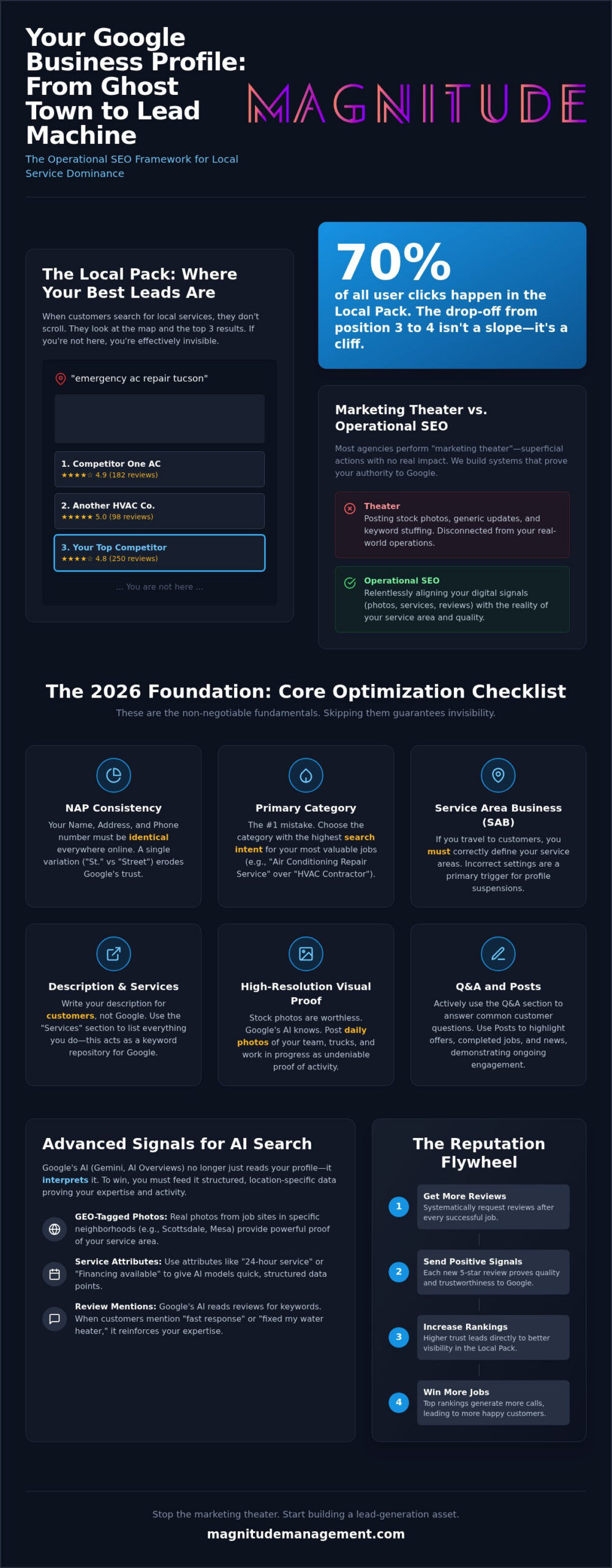
When a homeowner in Tucson searches for “emergency AC repair,” they don’t scroll through pages of blue links. They look at the map and the three businesses listed beneath it—the Local Pack. According to industry studies, this small piece of screen real estate captures up to 70% of all user clicks. Being in the top three means you get the lead. Being number four means you’re practically invisible.
The anatomy of the Local Pack on a mobile device is brutally efficient: name, review score, and a “Call” button. In competitive Arizona markets like Phoenix and Mesa, proximity is no longer the deciding factor. Google’s algorithm now weighs authority, reputation, and relevance more heavily than ever. The drop-off in lead volume from position three to four isn’t a gentle slope; it’s a cliff.
Marketing Theater vs. Operational SEO
Most SEO agencies sell “marketing theater.” They create a few posts, add some stock photos, and tell you they’re “optimizing” your profile. These are superficial updates that do nothing to influence rankings because they lack operational proof. They are disconnected from the reality of your business—the jobs you complete, the areas you serve, and the feedback you earn.
At Magnitude, we reject tricks in favor of systems. We believe in Operational SEO. So, what is Google Business Profile optimization? It is the relentless alignment of your digital signals with the reality of your physical service area and operational quality. It’s not about looking busy; it’s about building a profile so authoritative and trustworthy that Google has no choice but to rank you at the top.
The 2026 Foundation: Core Optimization Checklist
Before you can dominate, you must get the fundamentals right. These core elements are non-negotiable. Skipping them is like building a house on a faulty foundation—it will eventually collapse, likely resulting in a suspended profile and lost revenue.
- NAP Consistency: Your business Name, Address, and Phone number must be identical everywhere online, from your website to local directories. A single variation like “St.” vs. “Street” can erode Google’s trust in your location data.
- Primary Category Selection: This is the #1 mistake HVAC, plumbing, and roofing companies make. Choosing “HVAC Contractor” when “Air Conditioning Repair Service” has higher search intent can kill your visibility for high-value emergency jobs.
- Service Area Business (SAB) Settings: If you’re a contractor who travels to customers, you must correctly define your service areas. Incorrect settings are a primary trigger for profile suspensions.
- The “Business Description” Trap: Stop writing for Google. Your business description is for customers. Use it to state your unique value proposition and what makes you the best choice in your service area. Google reads your services and reviews to understand what you do.
- High-Resolution Visual Proof: Stock photos are worthless. Google’s AI can tell the difference between a stock image and a real photo from a job site in Scottsdale. Post daily photos of your team, your trucks, and your work in progress. This is undeniable proof of your activity.
Mastering Categories and Services
Your primary category is the most critical ranking factor you control directly. You must choose the category that best represents your core, high-intent service. For a plumber, “Plumber” is good, but “Emergency Plumber” might be better if you focus on high-margin, urgent jobs. Research the search volume and choose the category that aligns with the jobs you want most.
Secondary categories allow you to capture niche leads. While your primary category might be “Plumber,” secondary categories like “Water Heater Repair Service,” “Drain Cleaning Service,” and “Tankless Water Heater Installation” tell Google about the full scope of your expertise. Finally, use the “Services” section to build out a comprehensive menu. Each service you add acts as a secondary keyword repository, providing Google with the specific terms needed to match you with qualified customers.
SAB vs. Physical Location Strategy
For contractors without a showroom, you are a Service Area Business (SAB). You must hide your address and define your service areas by zip code or city. When setting your service radius in dense areas like Tucson and Phoenix, be realistic. Claiming you serve the entire state from a single location is a red flag that can lead to suspension. Google’s official guidelines are clear: your service area should reflect where you can realistically and reliably serve customers.
Even if you hide your address, having it verified by Google is crucial. This often requires a physical location (even a registered home office or a co-working space) where you can receive a verification postcard. This proves to Google that you are a legitimate local business. If you genuinely operate out of multiple distinct service areas with separate teams—for example, one in Tucson and one in Phoenix—it may be appropriate to set up a second profile, but this must be done carefully to avoid violating Google’s terms of service.
Advanced GEO Signals and AI Search Visibility
The game is changing. Google’s AI, including Gemini and AI Overviews, no longer just reads your profile—it interprets it. It pulls data from your attributes, reviews, and photos to construct a direct answer for users. To win in 2026, you must optimize for these AI models by feeding them structured, location-specific information.
- GEO-tagging Your Photos: Every photo you upload should be GEO-tagged with the coordinates of the job site. This metadata provides Google with irrefutable proof that you performed work in that specific neighborhood, strengthening your local relevance.
- Building “Local Authority”: Your authority isn’t just built on your profile. It’s reinforced by mentions on other local websites. Getting featured in a local Tucson business directory or a Phoenix community blog sends powerful trust signals back to Google.
- Response Time as a Ranking Signal: How quickly you respond to inquiries from your GBP matters. Google tracks call answer rates and message response times. A faster “Speed to Lead” is a quality signal that can positively influence your Google Maps ranking.
Optimizing for AI Search (GEO Search)
Think of GEO search as the way AI models understand your business’s location, reputation, and service quality in the real world. To optimize for it, you must be explicit. Use the Q&A section on your profile to proactively answer the questions potential customers are asking. By providing the answers yourself, you feed the AI the exact information it wants to show in its generated results. Furthermore, your “Attributes” are critical AI triggers. Selecting attributes like “Emergency Services,” “Veteran-Owned,” or “Provides Free Estimates” allows AI to match you with highly specific user queries, giving you a competitive edge. For a deeper dive, read our guide on achieving AI Search Visibility.
Hyper-Local Citations in Arizona
A citation is any online mention of your business’s Name, Address, and Phone number. Not all citations are created equal. There is a clear hierarchy, starting with high-authority platforms like the Better Business Bureau (BBB) and Yelp, followed by industry-specific directories, and finally, hyper-local Phoenix and Tucson business directories. A mention in the local news or a feature on a community partner’s website acts as high-octane fuel for your profile’s authority. Systematically building these local signals is fundamental to proving you are a pillar of the community you claim to serve. This is a core component of how we build local dominance with citations.
The Reputation Flywheel: Turning Reviews into Rankings
Reviews are the single most important signal of your real-world service quality. But simply getting reviews isn’t enough. You need a system to generate a steady stream of high-quality, recent feedback. This is what we call the Reputation Flywheel—an operational process that turns every completed job into a ranking asset.
- Review Velocity: A sudden burst of 10 reviews in one day looks unnatural and can trigger a filter. It’s far better to get one new review every day. This steady velocity signals ongoing, consistent business activity.
- The “Keyword-Rich Review” Myth: Begging customers to mention “AC repair in Tucson” in their review is a dead end. Instead, train your team to ask questions that naturally prompt customers to describe the work, like, “How is the new air conditioner working for you?” The customer will mention the service organically.
- Responding to Reviews: You must respond to every single review, positive or negative, within 24 hours. This shows Google—and customers—that you are engaged and attentive. Your response is also a chance to reinforce your location and services naturally.
- Automating the Ask: Don’t leave getting a review to chance. Integrate your CRM or dispatch software to automatically send a review request via SMS the moment a job is marked complete.
Review Quality and Recency
A 4.8-star rating with 150 reviews, where the last one was posted yesterday, will outrank a 5.0-star rating with 50 reviews from two years ago. Recency is a powerful indicator of current business health. When you receive a negative review, don’t panic. Address it professionally and publicly within 24 hours, taking the conversation offline to resolve it. A well-handled 1-star review can actually build more trust than a page of generic 5-star ratings. Also, pay attention to reviews from “Google Local Guides,” as their feedback often carries more weight in the algorithm.
Operationalizing the Feedback Loop
The best time to ask for a review is the moment the customer is happiest: right after the job is done. Train your technicians to secure that feedback before they leave the driveway. Equip them with QR codes that link directly to your GBP review form. This simple step reduces friction for the customer, dramatically increasing the completion rate. At Magnitude, our Reputation Flywheel automates this entire process, from the SMS trigger to tracking review sentiment, turning customer feedback into a predictable engine for local search visibility.
Stop the Marketing Theater: Magnitude’s Local Visibility Boost
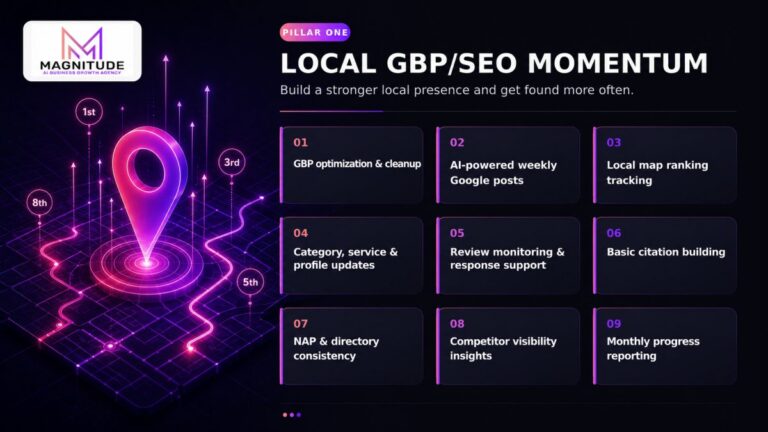
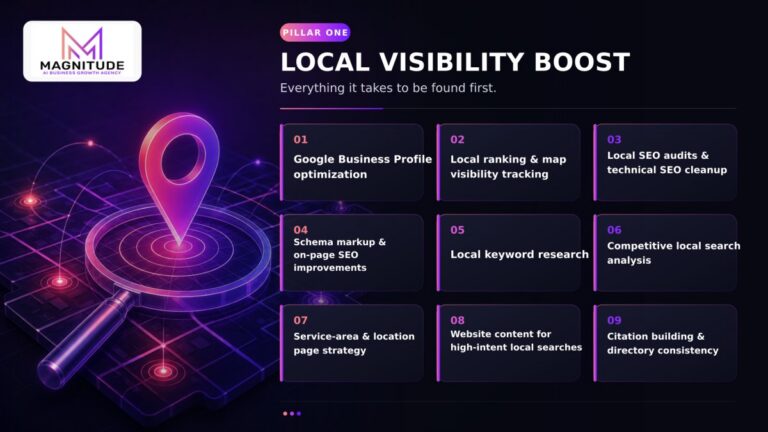
For a scaling contractor, trying to manually manage every photo upload, review response, and Q&A submission is a losing game. You need a system, not another task on your to-do list. This is why we developed the Local Visibility Boost—a comprehensive system designed to dominate competitive Arizona markets by integrating your Google Business Profile directly with your sales operations.
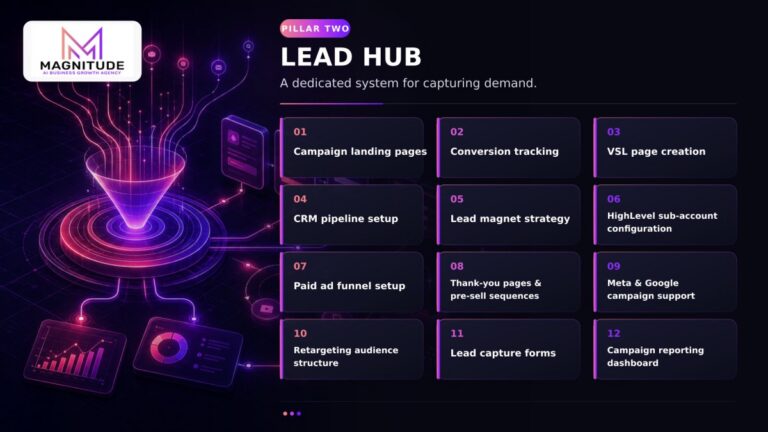
We connect your GBP to the Magnitude Lead Hub, giving you total transparency from the first click to the final sale. We move beyond vanity metrics like “clicks” and focus on what actually grows your business: booked jobs and measurable revenue. Radical accountability is our guiding principle.
The Magnitude Lead Hub Advantage
How do you know if your GBP optimization is actually working? With the Magnitude Lead Hub, we track every phone call, form fill, and web chat that originates from your profile. We close the loop by integrating this data with your sales pipeline, allowing us to see which services and locations are driving the most revenue. This data-driven approach allows us to continually refine your local SEO strategy based on real-world business results. We eliminate the “black box” of traditional marketing; you see exactly what’s working and why.
Your Next Step to Local Dominance
There’s a massive difference between an “SEO guy” who tinkers with your profile and a strategic growth partner who builds systems to drive your business forward. One delivers reports; the other delivers results. If you’re tired of being invisible in Tucson or Phoenix and ready to stop the marketing theater, the next step is to get a clear, data-backed picture of where you stand today.
We offer a comprehensive audit of your current online visibility, identifying the exact gaps that are costing you leads. No fluff, no jargon—just a straightforward action plan. Get your Local Visibility Boost audit today.
Frequently Asked Questions (FAQ)
How long does it take to see results from Google Business Profile optimization?
While some foundational fixes can improve visibility in a matter of weeks, Google Business Profile optimization is an ongoing process, not a one-time task. You can expect to see meaningful, consistent lead flow and ranking improvements within 3 to 6 months of implementing a systematic strategy that includes steady review generation and proof of local activity.
Does my business need a physical office in Tucson to rank there?
Not necessarily. As a Service Area Business (SAB), you can serve Tucson without having a public storefront there. However, you still need a verified address to prove to Google you are a legitimate entity. This can be a registered home office or a non-public industrial space. The key is to be honest about your business model and use SAB settings correctly.
How often should I post updates to my Google Business Profile?
Quality and authenticity matter more than frequency. Posting a real photo from a completed job in Oro Valley once or twice a week is far more valuable than posting a generic stock photo every day. Focus on documenting your real-world work, as this provides Google with the proof of activity it needs to rank you.
Can I hide my address on Google and still rank in the Local Pack?
Yes. This is the standard and correct setup for any contractor who travels to their customers (a Service Area Business). Hiding your address tells Google not to display a map pin or provide directions to your location. This does not negatively impact your ability to rank in the Local Pack for your designated service areas.
Why did my Google Business Profile get suspended, and how do I fix it?
Suspensions are commonly caused by violations of Google’s guidelines, such as keyword stuffing in the business name, setting an unrealistic service area, NAP inconsistencies, or creating multiple profiles for the same business. To fix it, you must first identify and correct the violation, then submit a reinstatement request through your GBP dashboard, providing evidence that you comply with the rules. You can review Google’s official reinstatement policies for detailed steps.
How do I get my customers to leave more reviews on Google?
Systematize the “ask.” Don’t just hope customers will leave a review; make it part of your process. The most effective method is to send an automated SMS with a direct link to your review page the moment a job is completed. Training your technicians to mention it and providing them with a QR code also dramatically reduces friction and increases your review rate.
What is the most important ranking factor for Google Maps in 2026?
There isn’t a single “most important” factor. In 2026, ranking is a result of a holistic evaluation of your real-world authority. This is a combination of factors, including the relevance of your primary category, the velocity and quality of your reviews, the geographic relevance proven by job-site photos, and the authority established by hyper-local citations. Proximity is still a factor, but its weight is diminishing in favor of these stronger trust signals.
Is Google Business Profile optimization different from regular SEO?
Yes. It is a highly specialized subset of Local SEO. While regular SEO focuses broadly on website content, technical performance, and backlinks to rank in traditional search results, GBP optimization is laser-focused on a single platform. It relies more heavily on real-world signals, operational consistency (like review generation and photo uploads), and data accuracy to rank in the Google Maps Local Pack.