Google Maps Ranking for Contractors: Why You’re Invisible in 2026 (and How to Fix It)
The ‘Invisible Contractor’ Syndrome: Why Proximity Isn’t Enough in 2026
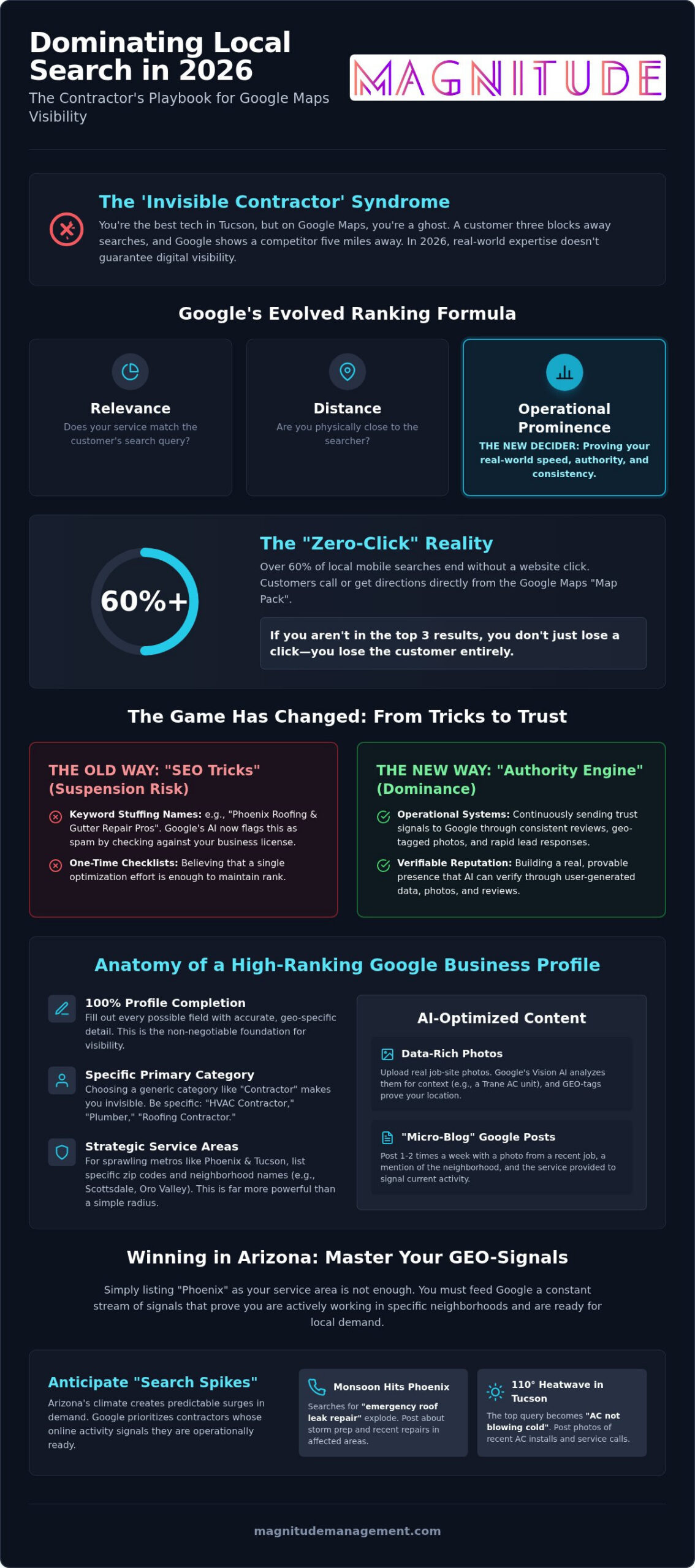
You’re the best HVAC tech in Tucson. Your plumbing work is flawless. But on Google Maps, you’re a ghost. A potential customer three blocks away searches for “AC repair near me,” and Google shows them a competitor located five miles across town. This is the ‘Invisible Contractor’ syndrome: the frustrating reality where your real-world expertise doesn’t translate to digital visibility. Being the best no longer guarantees you’ll be seen by the customers who need you most.
In 2026, Google’s local ranking algorithm has evolved beyond simple geography. It now relies on a sophisticated trio of factors: Relevance (do you match the search?), Distance (are you close?), and a critical new element, Operational Prominence. This isn’t just about being well-known; it’s a direct measure of your digital footprint and, more importantly, your real-world responsiveness. Google now ranks businesses that prove they operate with speed, authority, and consistency.
This matters more than ever in the “zero-click” economy. Research consistently shows that a majority of local searches on mobile devices end without a click to a website. Why? Because over 60% of these high-intent searches result in a direct phone call or driving directions from the Google Maps “Map Pack.” If you aren’t in those top three results, you don’t just lose a click—you lose the customer entirely.
The Death of the ‘SEO Trick’ and the Rise of the Authority Engine
For years, contractors were told to play games with Google. The most common “trick” was keyword stuffing a business name—think “Phoenix Roofing & Gutter Repair Pros.” In 2026, this is a guaranteed path to a Google Business Profile (GBP) suspension. Google’s AI is no longer just reading text; it’s cross-referencing your name with your state business license, insurance documents, and other official records. A mismatch is a red flag that signals spam, not authority.
The game has shifted from “doing SEO” to building an “Authority Engine.” This isn’t a one-time checklist of optimizations; it’s an operational system that continuously sends trust signals to Google. It’s about proving you are a legitimate, active, and responsive business in your service area. This engine is fueled by consistent reviews, geo-tagged photos of real work, and rapid lead response times—all things a fly-by-night operation can’t fake.
Google’s AI now actively verifies your business’s physical presence and service quality through user-generated data. It analyzes the photos customers upload, the language they use in reviews, and even call data from your profile to confirm you do what you say you do, where you say you do it. Trying to cheat this system is no longer a viable strategy; building a real, verifiable reputation is the only way to win.
Geography vs. GEO-Signals: Dominating Tucson and Phoenix
Ranking as a Service Area Business (SAB) in sprawling Arizona cities like Tucson and Phoenix presents a unique challenge. Without a physical storefront for customers to visit, you must prove your relevance across dozens of zip codes and neighborhoods. Simply listing “Phoenix” as your service area is not enough. You have to feed Google a constant stream of GEO-signals that prove you are actively working in specific areas like Scottsdale, Mesa, or Oro Valley.
Arizona’s climate creates predictable “Search Spikes” that Google’s algorithm expects you to be prepared for. When a monsoon hits Phoenix, searches for “emergency roof leak repair” explode. When the first 110-degree heatwave hits Tucson, “AC not blowing cold” becomes the top query. Google prioritizes contractors whose online activity—like recent reviews, Google Posts about storm prep, or photos of recent jobs in affected neighborhoods—signals they are operationally ready to handle this surge in demand.
This means a Tucson plumber battling hard water issues needs to send different GEO-signals than a Phoenix roofer dealing with sun-baked shingles. Your content, reviews, and photos must reflect the specific problems you solve in the specific locations you serve. Generic content gets generic results, leaving you invisible when it matters most.
The Anatomy of a High-Ranking Google Business Profile for Contractors
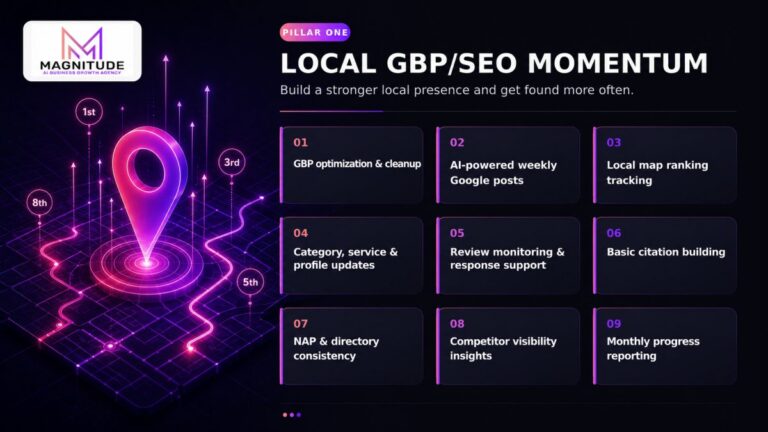
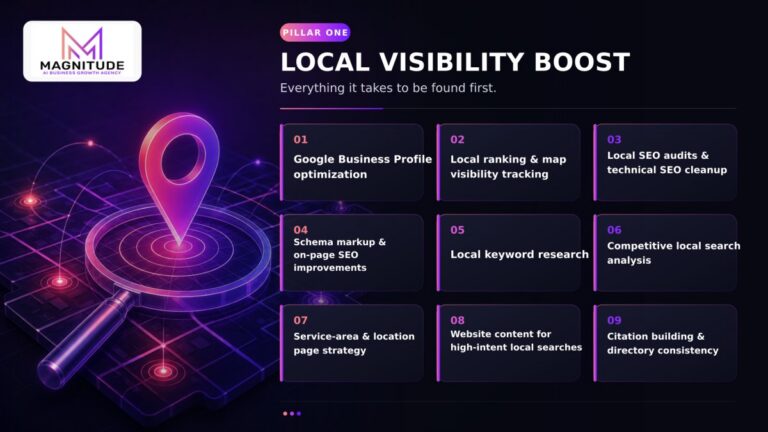
Your Google Business Profile is not a simple online directory listing; it’s the engine of your local visibility. Configuring it correctly is the first step to getting out of the digital graveyard. A “Visibility Boost” configuration means every single section is completed with meticulous, geo-specific detail that aligns with how customers in your service area actually search. For contractors, achieving 100% profile completion means filling out every possible field with accurate, compelling, and location-aware information to maximize the trust signals you send to Google.
A common mistake is the ‘Primary Category’ trap. Choosing a generic category like “Contractor” is a death sentence for your ranking. You are telling Google you do everything, which means you specialize in nothing. You must choose the most specific category possible, such as “HVAC Contractor,” “Plumber,” or “Roofing Contractor.” This single choice dictates which searches your business is relevant for, and getting it wrong makes you invisible to your ideal customers.
When optimizing for “GEO-Search,” you must be strategic. Google allows you to define your service area by a radius or by a list of specific zip codes or cities. For the sprawling Phoenix and Tucson metros, listing specific zip codes and neighborhood names is far more powerful than a simple 30-mile radius. It sends clear signals to Google that you understand the local market and are actively serving distinct communities like Glendale, Peoria, and Scottsdale.
AI-Optimized Content: Feeding Google’s Vision AI
In 2026, the photos you upload to your GBP are being analyzed by Google’s Vision AI. It’s not enough for them to be “clean” photos of your work. They need to be data-rich assets. This means ensuring your photos are GEO-tagged with the coordinates of the job site before you upload them. Furthermore, Google’s AI can identify objects and context within the image. A photo of a newly installed Trane HVAC unit in a home in Oro Valley tells the algorithm infinitely more than a stock photo of a generic air conditioner.
Think of Google Posts as “Micro-Blogs” that signal current activity. Most contractors ignore this feature, which is a massive missed opportunity. Posting once or twice a week with a photo from a recent job, a mention of the neighborhood (e.g., “Just finished an emergency plumbing repair in the Sam Hughes neighborhood!”), and a link to your website sends powerful freshness signals. It proves you are an active, operating business, a key component of Operational Prominence.
Video content is the secret weapon for contractor engagement on Maps. Short, 15-30 second videos of a technician explaining a common issue, a quick walk-through of a finished project, or a time-lapse of a roof installation can dramatically increase user engagement. Google tracks how long users interact with your profile, and video is the most effective way to hold their attention, signaling to the algorithm that your listing is a valuable resource.
The ‘NAP+W’ Framework: Consistency Across the Desert
The old rule of local SEO was NAP consistency: Name, Address, Phone. The 2026 framework is NAP+W, with the “W” for Website being more critical than ever. Google’s crawlers don’t just look at your GBP; they cross-reference it with your website. If your GBP lists “Emergency AC Repair” as a service but that term is nowhere to be found on your site, it creates a credibility gap that hurts your ranking.
You must also clean up your “Digital Pollution.” Many established contractors have a messy online history—old phone numbers, previous office addresses, or slight variations of their business name scattered across directories like Yelp, Angi, and the BBB. An old listing in Scottsdale with the wrong phone number can directly hurt your current Phoenix ranking by confusing Google and diluting your authority. A thorough citation audit and cleanup is not optional.
Building “Citation Authority” is still crucial, but it’s about quality over quantity. Being listed in major local Arizona directories, your local Chamber of Commerce site, and contractor-specific portals like Houzz is essential. These high-authority, relevant citations act as third-party verification of your business information, reinforcing to Google that you are a legitimate and established local operator.
GEO-Signals and AI Search: How Tucson Contractors Stay Ahead
For local contractors, the concept of “GEO-Visibility” is replacing traditional backlinking as the dominant ranking factor. GEO-Visibility is the measure of how strongly your online presence is tied to a specific geographic location. It’s not about getting a link from a random blog; it’s about being mentioned on a local Tucson news site, having geo-tagged project photos from a specific Phoenix subdivision, and creating location-specific content on your website. These signals prove your real-world connection to the community you serve.
Google’s AI, including its advanced conversational models, now “reads” your customer reviews for semantic context. It’s looking beyond the star rating to understand what services you actually provide and where. When multiple reviews mention “fixed my leaky pipe in Marana” or “fast AC replacement in Gilbert,” the AI learns to associate your business with those specific services in those specific areas. This user-generated proof is often more powerful than the services you list yourself.
This is why dedicated Location Pages on your website are non-negotiable. A generic “Services” page is not enough. You need distinct, high-quality landing pages for “HVAC Repair Tucson” and “Air Conditioning Installation Phoenix.” These pages should feature unique content, including testimonials from that area, photos of local jobs, and mentions of local landmarks or neighborhoods. They serve as powerful ranking assets that connect your website authority directly to a geographic area.
This is where Magnitude GEO-Optimization bridges the gap between your website and the Map Pack. By systematically creating and promoting these hyper-local signals across your GBP, website, and local directories, you build a powerful web of geographic relevance that makes it clear to Google you are the dominant player in a specific service area.
Dominating Multiple Service Areas without Multiple Offices
The “Proximity Anchor” strategy is essential for contractors serving a wide area like the Phoenix and Tucson metros without having physical offices in every suburb. This strategy involves creating a dense network of GEO-signals centered around a target neighborhood or zip code. You can anchor your presence by creating a location page on your site, running a Google Post campaign focused on jobs in that area, and actively seeking reviews from customers there.
To signal GEO-relevance, weave local landmarks and neighborhood names into your online content. On your “Scottsdale AC Repair” page, mention working in homes near Old Town Scottsdale or McCormick-Stillman Railroad Park. In a Google Post about a Tucson job, reference the Catalina Foothills. This demonstrates a level of local knowledge that generic, national-level competitors can’t replicate, signaling to both users and Google that you are a true local expert.
A major pitfall to avoid is the “Duplicate Content” penalty. You cannot simply create a dozen location pages and swap out the city name. Each page must offer unique, valuable content. Discuss the specific challenges of that area (e.g., hard water issues in one city, older HVAC systems in a historic neighborhood), include unique customer testimonials, and embed a map of your service area for that specific location.
AI Search Visibility: Preparing for the SGE Era
The rise of AI-powered search, like Google’s Search Generative Experience (SGE), changes how customers find you. Instead of just showing a list of links, SGE will provide a summarized answer to questions like “Who is the most trustworthy roofer in Phoenix for tile roof repair?” This summary is compiled from information across the entire web, including your reviews, website content, and local news mentions.
This makes “Unstructured Citations” incredibly valuable. These are mentions of your business name, address, or phone number in online content that isn’t a formal directory, such as a feature in a local Arizona community blog, a mention on a neighborhood social media group, or a sponsorship shout-out on a local event page. These organic mentions are powerful trust signals for AI search engines.
Your business description on your GBP and other profiles must now be written for both humans and AI crawlers. It needs to be clear, concise, and incorporate key terms about your primary services and locations. Think of it as the source text for your future AI-generated business summary. It must directly answer the questions your potential customers are asking, because that’s exactly what AI search is designed to do. For more on this, see our guide to AI Search Visibility for contractors.
The Reputation Flywheel: Turning Reviews into a Ranking Signal
Here’s a hard truth: that collection of 100 five-star reviews you worked so hard to get in 2024 is now worth less than 10 fresh reviews from last week. Google’s algorithm heavily prioritizes recency and velocity in its evaluation of your reputation. A steady stream of new reviews signals that you are an active, thriving business that consistently delivers quality service right now.
This is the core of the “Reputation Flywheel” concept. Each new positive review doesn’t just add to a static score; it acts as a fresh signal that boosts your “Prominence” score in Google Maps. This temporary boost increases your visibility, which leads to more jobs. More jobs provide more opportunities for reviews, which in turn fuels the flywheel, creating a self-sustaining cycle of visibility and growth.
You can supercharge this effect by encouraging customers to leave keyword-rich reviews. You can’t tell them what to write, but you can frame the request in a way that prompts specifics. Instead of “Leave us a review,” try “We’d love to hear about your experience with our AC repair service in Tucson.” When customers naturally include these valuable keywords, it provides Google with powerful, user-generated proof of your service offerings and location.
Finally, the “Response Rule” is critical. Google actively monitors how quickly and professionally you reply to all reviews, both positive and negative. A prompt, thoughtful response shows Google (and potential customers) that you are engaged, accountable, and customer-focused. Ignoring reviews, especially negative ones, sends a signal of poor operational management, which can suppress your ranking.
Automating the Ask: Systems Over Luck
Leaving review generation to chance is a recipe for failure. The most effective way to fuel your flywheel is to automate the request at the moment of peak customer satisfaction—typically right after the job is completed and the invoice is paid. The Magnitude Reputation Flywheel system automates this process, sending a simple, direct link for the customer to leave a review on the platform that matters most: Google.
By integrating your CRM or scheduling software with your review system, you can eliminate manual follow-ups entirely. The system knows when a job is closed and can trigger the review request automatically. This ensures consistency and dramatically increases the percentage of customers who follow through, creating the steady velocity Google wants to see.
When you inevitably receive a negative 1-star review, a strategic response plan is your best defense. The key is to respond quickly, professionally, and publicly. Acknowledge the customer’s frustration, take the conversation offline to resolve the issue, and never get into a public argument. A well-handled negative review can actually build more trust than a dozen positive ones by demonstrating your commitment to accountability.
The ‘Speed to Lead’ Ranking Factor
Does your lead response time affect your Google Maps rank? While Google hasn’t confirmed it as a direct ranking factor, there is a powerful correlation between lead capture speed and Maps visibility. Features like the “Message” button and call tracking provide Google with data on how responsive you are. Businesses that consistently fail to answer calls or respond to messages are seen as providing a poor user experience, which can negatively impact their prominence.
This is why Lead Guard is your best defense against losing the customers you worked so hard to attract. When a lead comes in from your Google profile, a system that ensures an immediate response is critical. Whether through automated text-backs or an immediate call from your office, that speed demonstrates operational excellence. It also dramatically increases your chance of booking the job.
Google uses its own call tracking data from your GBP to verify your business’s reliability. If a high percentage of calls placed through your profile go unanswered, it signals to the algorithm that you may not be an operational or reliable business. In the competitive landscape of 2026, you can’t afford to send negative signals. Every call, every message, is a test of your operational prominence.
From Maps to Money: The Magnitude Lead Hub Strategy
Achieving a top-three ranking on Google Maps is the start, not the finish line. Visibility without conversion is just expensive vanity. If the flood of calls and clicks from your top-ranked profile goes to an unprepared team, a slow website, or a voicemail box, you’ve wasted your entire marketing budget. The goal isn’t to be seen; the goal is to sign contracts.
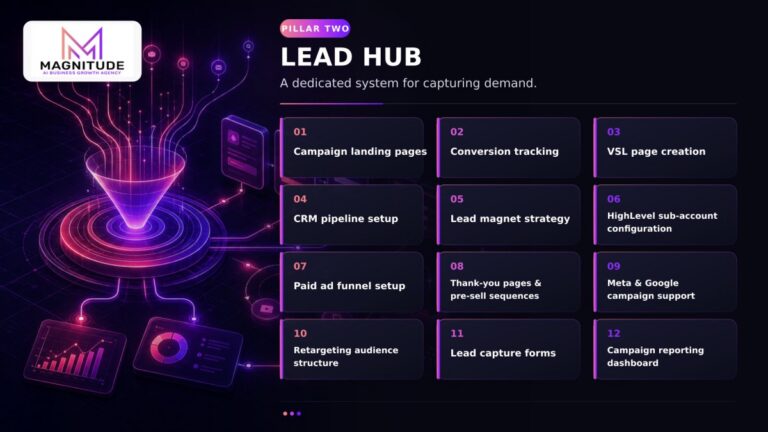
The Magnitude Lead Hub advantage is its ability to connect your hard-won Google Maps traffic directly into a high-converting sales pipeline. It’s an integrated system that ensures every lead is captured, nurtured, and tracked from the first click to the final invoice. It closes the loop between your marketing efforts and your revenue, providing a clear picture of your return on investment.
To maximize conversions in 2026, you must reduce friction. Your GBP “Message” and “Book” buttons are critical. Customers want immediate interaction. Enabling messaging and ensuring someone is responding within minutes is non-negotiable. Integrating a booking calendar for estimates can capture high-intent customers who are ready to move forward right now.
Measuring true ROI means moving beyond impressions and clicks. These are meaningless metrics. The only number that matters is signed contracts. By tracking leads from their source (e.g., a call from your GBP) all the way through your sales process, you can definitively measure the revenue generated by your Google Maps presence in Tucson and Phoenix.
The Conversion-Focused Landing Page
Never point the website link on your Google Business Profile to your generic homepage. This is a conversion killer. That link should go to a dedicated, high-converting landing page built for one purpose: to turn a searcher into a lead. This page must load instantly and answer the user’s core question immediately.
The essential elements of a high-converting contractor page are Speed, Social Proof, and a Clear Call-to-Action (CTA). The page must load in under two seconds. It must feature prominent five-star reviews, testimonials, and trust badges (like BBB or local affiliations). And it must have an unmissable “Click to Call” button and a simple contact form “above the fold” so the user doesn’t have to scroll to take action.
This page must be designed with a mobile-first approach. Over 90% of users who find you on Google Maps are on their smartphones. If your landing page is difficult to navigate on a small screen, if the phone number isn’t clickable, or if the form is clumsy to fill out, they will leave in seconds and call your competitor. Check out how we build funnels that book more leads.
Winning the Long Game: Database Reactivation
What happens to the leads that don’t book a job today? Most contractors let them go cold, lost in an old spreadsheet or a cluttered inbox. “Revenue Recovery” is the process of turning this database of old, unclosed leads from Google Maps into a fresh stream of revenue. A simple, automated email or text campaign can reactivate a surprising number of these old prospects.
Using the Magnitude Lead Hub, you can keep your brand top-of-mind for seasonal services automatically. An automated email to your entire customer list in the spring reminding them to schedule an AC tune-up, or in the fall for a furnace check, can fill your schedule with high-margin work before the busy season even begins. This is how you turn a one-time customer into a long-term, profitable relationship.
Stop letting high-intent local leads go to your competitors. Ranking on Google Maps is not a dark art; it’s the result of a disciplined, systematic approach to building a verifiable, responsive, and authoritative local presence. It’s time to stop being invisible. Audit your local visibility with Magnitude today.