AI Search Visibility: 2026 Competitive Edge for Contractors
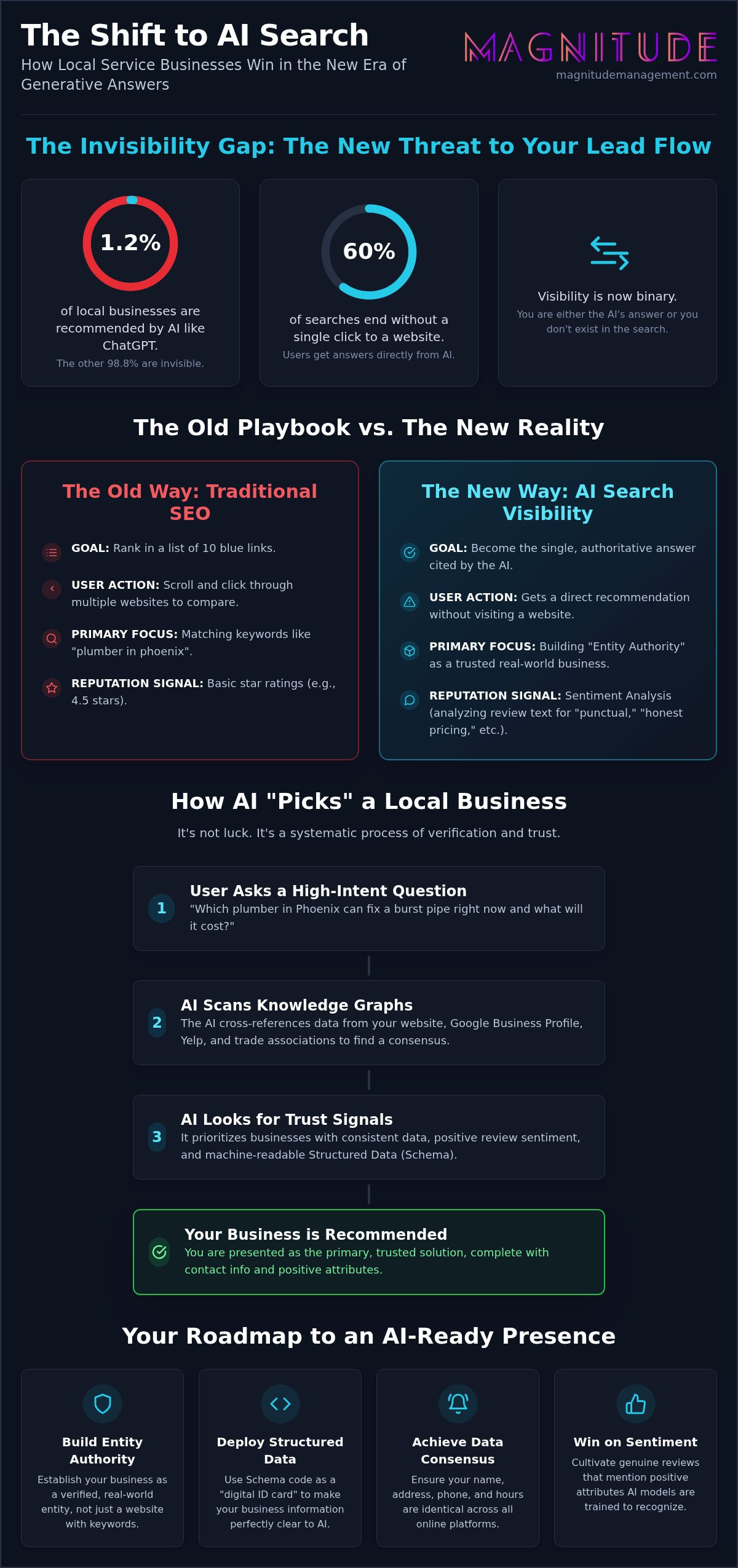
Did you know that ChatGPT currently recommends only 1.2% of the local businesses it evaluates? For the other 98.8%, this “invisibility gap” represents a silent drain on lead flow that traditional SEO can no longer plug. You’ve likely noticed your organic click-through rates stalling as Google AI Overviews and Perplexity provide direct answers that bypass your website entirely. It’s frustrating to realize that being “number one” on a search page doesn’t matter if the user never scrolls past the AI’s summary. With 60% of searches now ending without a single click, the old playbook for AI search visibility for local businesses is officially obsolete.
We’re here to help you bridge that gap and secure your spot as the primary recommendation in generative results. This article provides a clear, no-nonsense roadmap to positioning your HVAC, plumbing, or roofing company as the trusted authority that AI agents cite. You’ll learn how to transition from basic keyword targeting to building entity authority, the critical role of structured data in 2026, and how to use the Magnitude Lead Hub to capture and track leads driven by AI intent. It’s time to stop fearing the summary and start becoming the source.
Key Takeaways
- Shift your strategy from ranking in a list of links to becoming the definitive answer cited by generative search engines.
- Master AI search visibility for local businesses by deploying structured data that acts as a verified digital ID for your HVAC or plumbing company.
- Optimize your digital footprint for Natural Language Processing to ensure you’re the primary recommendation for specific, high-intent service queries.
- Learn how to use the Magnitude Lead Hub to capture AI-driven intent and turn search visibility into measurable revenue recovery.
What is AI Search Visibility and Why Does it Matter for Contractors?
AI search visibility for local businesses is the process of training generative engines to recognize your company as the definitive solution for a specific problem. It is no longer enough to rank for a broad keyword like “plumber.” In 2026, search has moved past the era of providing a library of links. Platforms like ChatGPT, Perplexity, and Google AI Overviews now provide direct, authoritative answers. For a contractor, this visibility is binary. You are either the answer the AI provides, or you are completely invisible to the user. There is no longer a “page two” to hide on; if you aren’t the cited recommendation, you don’t exist in that search session.
The Death of the “Blue Link” Era
The traditional model of local search engine optimization (local SEO) was built on the “Top 10” list. You fought for a spot in the blue links, hoping a homeowner would click your site among nine others. That model is dying because homeowners are clicking less. They are getting everything they need from AI-generated summaries. AI doesn’t just match keywords; it identifies “entities.” It understands that your HVAC company isn’t just a website, but a verified business with specific service areas, certifications, and a real-world reputation. If the AI cannot verify your entity authority, it will skip you in favor of a competitor who has better-structured data.
How Homeowners Use AI in 2026
Imagine a homeowner in Phoenix who discovers a pipe burst in their kitchen at midnight. They don’t want to scroll through a dozen plumbing websites to compare service fees while water ruins their flooring. They ask their AI assistant: “What is the average cost for emergency pipe burst repair in Phoenix, and which plumber can get here right now?” The engine filters these choices based on proximity, verified reviews, and real-time data. It provides a price range and recommends one or two specific companies. If your business isn’t mentioned in the “sources” or “citations” section of that AI answer, you have lost the lead before the user even saw your name. You cannot capture intent that never reaches your website. To understand how your business appears to these engines, you need a local search visibility audit to map your current digital footprint. This isn’t just a marketing exercise; it’s the core infrastructure of your lead flow. Without this visibility, your business is effectively locked out of the most high-intent conversations happening online today.
The Mechanics of AI Recommendations: How Chatbots “Pick” a Local Business
AI models don’t rely on luck or simple keyword density to recommend a contractor. They utilize “Knowledge Graphs,” which are massive databases of verified facts about the real world. When a homeowner asks an AI for a recommendation, the model cross-references your website with your Google Business Profile, Yelp, and even local trade associations like the ACCA or NRCA. It looks for a consensus. If your service hours on your site don’t match your directory listings, the AI views your business as unreliable. Achieving AI search visibility for local businesses requires a level of data consistency that most contractors currently lack. The AI isn’t just looking for your name; it’s looking for proof that you are a legitimate, trustworthy entity. This is precisely why citation building for local SEO is a foundational step — inconsistent business data across directories signals unreliability to the very engines you need to impress.
Structured Data (Schema) as Your Digital ID
Structured data is the underlying code that translates your business information into a format machines can digest. For an HVAC or roofing company, this means implementing LocalBusiness, GeoCoordinates, and Service schema. Think of this as your digital ID card. LocalBusiness schema is the primary language of AI bots. If your code is missing your specific service areas or opening hours, you effectively block AI discovery. The bot won’t guess if you’re open for emergency service; it will simply recommend the competitor who has that data clearly defined in their schema. This is where many contractors fail; they have a pretty website that is functionally illiterate to an AI engine.
The Reputation Flywheel and Sentiment Analysis
Stars are no longer enough. Modern AI models use sentiment analysis to read the actual text of your customer reviews. They can distinguish between a “reliable technician” and “the cheap guy.” This creates a trust score that dictates whether you’re the primary recommendation or a footnote. AI identifies specific attributes like “punctual,” “honest pricing,” or “expertise in heat pumps” to match you with specific user queries. If you want to dominate these results, you must follow a strict Google Business Profile Optimization: The 2026 Contractor’s Checklist to ensure your reputation data is accessible. The AI is looking for the “why” behind the five-star rating to ensure the homeowner gets the specific help they need. If you’re concerned your current digital footprint is working against you, it may be time to see how specialized growth strategies can clean up your data across the web.
AI Search vs. Traditional Local SEO: Understanding the Differences
Traditional SEO was a game of volume. You wanted to be one of ten blue links on a page, hoping your meta description was catchy enough to steal a click. AI search visibility for local businesses is a game of precision. We are moving from search engines to “Answer Engines.” In the old model, you optimized for “HVAC Tucson.” In 2026, you must optimize to be the specific answer to “Who can fix my Trane AC today?” The AI doesn’t want to give the user a homework assignment to research ten different companies. It wants to give them one solution. If your site is just a collection of keywords, you are a commodity. AI search prioritizes those who demonstrate unique authority over specific high-value jobs rather than those who simply repeat the same phrases as their competitors.
From Keywords to Entities
AI models have stopped counting how many times you say “plumber” on a page. Instead, they focus on “entities,” which are real-world objects with defined relationships. Your business is an entity. AI connects your brand to specific services like “tankless water heater installation” or “emergency roof tarping” based on your entire digital footprint. It understands the difference between a generalist and a specialist. If your content is generic, the AI won’t trust you with a specific request. The engine is looking for proof that you have the specific parts, the trained technicians, and the local history to handle a high-stakes repair during peak seasonality. Broad keywords are losing their value; specific service-area signals and technical expertise are the new currency of search.
The Competitive Shrinkage
The most dangerous shift for local pros is the shrinkage of available real estate. Traditional Google results gave you ten organic slots and a local pack. AI summaries usually provide only three to five citations. This is a winner-take-all environment. The field hasn’t just become more competitive; it has physically moved. If you aren’t in that top tier of recommendations, your lead flow for that specific query effectively drops to zero. You can’t survive on the “scraps” of page two because page two no longer exists in a generative summary. The cost of being “invisible” has never been higher for contractors who rely on steady emergency calls. While you still need to follow a Local SEO Guide 2026: Dominating Tucson & Phoenix to maintain your baseline presence, the real growth is in those few AI-cited spots. This shrinkage turns search into a high-stakes auction where trust and data authority are the only bids the engine accepts.
Building an AI-Ready Presence: A Practical Roadmap for Service Companies
Most contractors treat their website like a digital brochure. In 2026, that’s a liability. If you want to secure AI search visibility for local businesses, your digital presence must function as a structured data source for Large Language Models (LLMs). The AI isn’t browsing your site for inspiration; it’s mining it for facts to answer a user’s specific problem. This requires a shift from creative marketing to technical precision. You need to audit your current footprint to see how an AI “perceives” your brand. If the bot sees conflicting information about your service area or licensing across different platforms, it will simply exclude you from the recommendation set to avoid giving the user an inaccurate answer.
Content Optimization for Natural Language
Homeowners don’t search with fragments anymore; they ask full questions. Your content must mirror this shift. Instead of a generic “AC Repair” page, you need FAQ sections that solve real-world problems. Consider a homeowner asking, “Why is my AC leaking water inside?” During the peak of a 110-degree Phoenix summer, that is a high-ticket lead waiting for an answer. By providing a clear, scannable summary at the top of your service page, you give the AI a “snackable” piece of information it can quote directly. Avoid industry jargon like “evaporator coil freezing” unless you explain it in plain language. If the AI can’t understand your solution, it won’t recommend your business.
GEO (Generative Engine Optimization) Basics
GEO is the new discipline of optimizing for LLMs rather than traditional crawlers. It focuses on making your business the most “probable” answer for a query. This involves using location-specific content that goes beyond a simple city name. Mentioning specific neighborhoods, local landmarks, or even regional weather patterns helps the AI anchor your business to a specific “near me” prompt. For example, a roofer discussing hail damage repair after a specific local storm provides the temporal and geographic relevance AI engines crave. To see where your company stands in this new landscape, you should start with a Free Local Search Visibility Audit. This tool identifies the gaps in your data that are currently making you invisible to ChatGPT and Google AI Overviews.
Reputation management is the final pillar of your roadmap. AI sentiment analysis doesn’t just look at your average star rating; it looks for themes of reliability and professional conduct in your reviews. A steady stream of recent, detailed reviews about your HVAC installations or plumbing repairs provides the “social proof” the AI needs to vouch for you. If you’re ready to stop guessing and start dominating your local market, it’s time to partner with a digital marketing agency for HVAC and plumbing companies that understands the mechanics of revenue recovery in the AI era.
Magnitude’s AI Search Strategy: Turning Visibility into Revenue
Visibility is a vanity metric if your shop doesn’t have the infrastructure to turn a mention into a deposit. Most agencies stop at the “discovery” phase, leaving you with a list of impressions that don’t pay the bills. Magnitude rejects this fragmented approach. We recognize that AI search visibility for local businesses is only half the battle. If an AI engine recommends your HVAC company for a high-value furnace replacement during a mid-winter cold snap, that homeowner expects an immediate path to booking. If they hit a dead end or a slow-loading contact form, they’ll simply ask the AI for the next best option. We provide the digital systems that ensure you don’t just get found; you get hired.
Integrating AI Visibility with the Magnitude Lead Hub
Our strategy centers on the Magnitude Lead Hub, a system designed to bridge the gap between search intent and CRM entry. When a lead arrives from a generative engine, they often have higher intent than a standard click because the AI has already “vetted” your business. We use CRM automation to ensure these prospects are funneled directly into your sales pipeline without manual intervention. This is particularly vital for high-ticket roofing or kitchen remodeling projects where the job value justifies a sophisticated, multi-touch follow-up sequence. By establishing this infrastructure, you can conduct an Ad Waste Audit and realize how organic AI citations significantly reduce your reliance on bloated, expensive PPC budgets. We focus on the mechanics of revenue recovery, not just traffic volume.
Why “Visibility” is Useless Without Speed-to-Lead
The 5-minute rule isn’t a suggestion; it’s the standard for survival. AI users are accustomed to instant answers, and they expect the same from the service providers those engines recommend. If you wait an hour to respond to an inquiry for an emergency pipe burst, you’ve already lost the job to a competitor with better automation. Magnitude’s systems provide the automated follow-ups necessary to prevent lead leakage during peak seasons when your dispatchers are overwhelmed. We position ourselves as the partner that manages both the “Search” and the “Sale.” This ensures your investment in generative visibility translates into measurable growth rather than just superficial metrics. We build the systems that eliminate waste and prioritize profit. You focus on the trade; we focus on the growth infrastructure.
Secure Your Future in the Generative Search Era
AI search visibility for local businesses is no longer a “nice to have” experimental tactic. It’s the core infrastructure of your lead flow for 2026. You’ve learned that appearing in AI summaries requires a radical shift from basic keywords to verified entity authority. If your structured data and reputation sentiment aren’t perfectly aligned, you’re effectively handing high-ticket HVAC and plumbing jobs to your competitors. Visibility is binary in the world of answer engines; you are either the solution or you are invisible.
At Magnitude, we combine specialized trade expertise with real-world revenue recovery results. Our Magnitude Lead Hub automation ensures that once an AI engine recommends your business, the lead is captured and contacted within the critical five-minute window. We build the systems that manage both the search and the sale so you can focus on running your crews. Stop losing leads to AI and get your free Local Search Visibility Audit today. You have the technical skills to dominate your local market. We have the architecture to make sure the world’s most powerful AI models know it too.
Frequently Asked Questions
Is AI search visibility different from traditional SEO?
Yes, AI search visibility is a distinct discipline that focuses on becoming the singular recommendation in generative answers rather than just a link in a list. Traditional SEO targets search engine crawlers with keywords to rank on a results page. AI visibility targets large language models by building entity authority and providing structured data that engines like ChatGPT use to cite specific, trustworthy businesses.
How long does it take to see results from AI search optimization?
You should expect to see measurable changes in AI citations within 30 to 90 days of implementing technical optimizations. While traditional SEO can take six months to influence organic rankings, AI models update their knowledge graphs frequently as they crawl verified data. The speed of your results depends heavily on the consistency of your business information across the web and the depth of your existing reputation.
Will ChatGPT recommend my business if I don’t have reviews?
No, it is highly unlikely that a generative engine will recommend a business without a verified track record. AI models prioritize trust and safety to avoid recommending poor services to users. Reviews provide the sentiment analysis data these engines need to confirm your reliability. Without recent, positive feedback, the AI has no proof of your competence and will default to a competitor with verified social proof.
What is LocalBusiness schema and why do I need it for AI?
LocalBusiness schema is a specific block of code that acts as a verified digital ID for your company. It provides AI search visibility for local businesses by clearly defining your services, location, and hours in a language machines understand. Without this structured data, AI engines have to guess your operational facts. Most bots will simply skip your business in favor of a competitor who provides clear, verifiable data.
Can I track how many leads I get from AI search results?
Yes, but you need an integrated system like the Magnitude Lead Hub to do it accurately. Traditional analytics often miss “zero-click” leads where a user sees your number in an AI summary and calls you directly. By using specific tracking numbers and CRM automation, you can attribute leads to generative search sessions. This transparency is the only way to measure the real-world ROI of your AI visibility strategy.
Do I need to change my entire website for AI search visibility?
You don’t need a total redesign, but you must restructure your content to support natural language processing. This involves adding clear, scannable summaries and FAQ sections that answer the specific questions homeowners ask their AI assistants. Your website needs to transition from a digital brochure to a structured data source. The goal is to make your expertise easily extractable for engines like Perplexity and Google AI Overviews.
Why is my competitor being recommended by AI instead of me?
Your competitor is likely being recommended because they provide the AI with more certainty and less risk. AI engines pick the business with the most consistent data, the strongest review sentiment, and the most robust structured data. If your competitor has a cleaner “entity” profile across the web, the engine views them as a more reliable recommendation. It is a battle of data authority, not creative marketing.
How does Google AI Overview impact my local Maps ranking?
Google AI Overviews frequently pull data from the local pack, meaning your Maps presence is a primary feeder for AI citations. However, the AI summary can also highlight businesses outside the traditional “Top 3” if their content is more relevant to a specific query. Optimizing for AI visibility for local businesses actually reinforces your Maps ranking by forcing you to clean up the underlying data that Google’s algorithms prioritize.