Google Ads vs Facebook Ads: 2026 Contractor Profit Guide
Stop measuring your success by the volume of names in your inbox. If you’re an HVAC or roofing contractor, a cheap Facebook lead who never answers the phone is significantly more expensive than a high-intent Google click that turns into a $15,000 roof replacement. The debate over Google Ads vs Facebook Ads for contractors isn’t about which platform is “better” in a vacuum. It’s about identifying which one captures emergency demand during a Phoenix heatwave and which one builds a pipeline for your shoulder season. We’ve seen too many trade partners burn through five-figure budgets on “industry theater” metrics that don’t move the needle on revenue.
You already know the frustration of paying for clicks that don’t call or leads that don’t close. It’s time to stop the bleeding. This guide provides the 2026 blueprint for matching your ad spend to the specific urgency of your trade. We’ll examine why Google’s 40-60% close rates justify the higher entry cost and how to navigate Meta’s 50-conversion-per-week learning phase without wasting your margin. You’ll discover how to use an Ad Waste Audit to reclaim your budget and how the Magnitude Lead Hub provides the visibility you need to track every dollar from the first click to the final signed contract.
Key Takeaways
- Eliminate “industry theater” by shifting your focus from high click volume to measurable revenue and actual job close rates.
- Navigate the Google Ads vs Facebook Ads for contractors debate by choosing intent-based search for immediate emergencies and interruption-based social ads for visual authority.
- Align your ad spend with the specific urgency of your trade, prioritizing Google for high-ticket emergency calls like broken AC units or plumbing leaks.
- Stop the “leaky bucket” problem by using the Magnitude Lead Hub to automate lead follow-up and ensure no high-value opportunity is ignored.
- Conduct an Ad Waste Audit as your first step to identify exactly where your budget is being drained by low-quality “tire kicker” leads.
Why Most Arizona Contractors Waste 40% of Their Ad Budget
High click volume is the smoke and mirrors of the marketing world. Agencies love to present reports filled with rising graphs and “impressions,” but if those metrics don’t translate into signed contracts, you’re participating in industry theater. Choosing between Google Ads vs Facebook Ads for contractors is irrelevant if 40% of your budget disappears into the void before a technician even arrives on site. This waste usually stems from a fundamental misunderstanding of how digital auctions work in high-density markets.
In hyper-competitive hubs like Phoenix or Tucson, generic strategies are a death sentence for your margins. You’re competing against national franchises with massive budgets and local veterans who have optimized their bids for years. If your campaign isn’t surgically targeted to your specific service area and trade, you’re just subsidizing the platforms. The “leaky bucket” in your sales pipeline isn’t always the ad itself; it’s often the gap between the click and the conversation.
Your ad copy is secondary to your response time. In the home services industry, the first contractor to answer the phone wins the job 50% of the time. If your office takes two hours to return a call for a burst pipe or a broken AC during a July heatwave, your ad spend was a donation to your competitor. You need a system that prioritizes speed over aesthetics.
The High Cost of Poor Lead Tracking
Cost per lead is a vanity metric that hides the truth. If you pay $50 for a Facebook lead that never picks up the phone, that lead actually cost you $50 plus the opportunity cost of a lost job. While the foundational concepts of Online advertising suggest that more traffic equals more business, the reality for contractors is far more brutal. Untracked phone calls are the primary source of budget bleed. Without knowing exactly which keyword or ad creative triggered a booked appointment, you’re guessing with your capital. You can identify these specific leaks and stop the hemorrhaging by using our Ad Waste Audit to reclaim your margin.
Trade-Specific Economics: HVAC vs. Roofing
Your ad strategy must mirror the economics of your specific trade. A roofing contractor chasing a $20,000 full replacement can afford a higher cost per lead than an HVAC tech looking for a $200 tune-up. However, the HVAC business relies heavily on the lifetime value of a service agreement customer. Arizona’s extreme seasonality makes “set and forget” advertising a recipe for failure. You must pivot your messaging and budget allocation between the emergency demand of summer and the preventative maintenance focus of the shoulder seasons. Failing to adjust for these shifts ensures you’ll overpay for low-value clicks when the market is quiet.
Google Ads for Contractors: Capturing High-Intent Demand
Google Ads is an intent-based platform. This means you aren’t just buying traffic; you’re buying a solution to a specific problem at the exact moment it occurs. When a homeowner in Scottsdale discovers a flooded kitchen at 2:00 AM, they don’t open Facebook to scroll through their feed. They go to Google and type “emergency plumber near me.” This is the “Emergency Call” advantage. It’s the reason why Google leads for contractors typically close at a rate of 40-60%, significantly higher than the 15-30% seen on social platforms. As noted in a comprehensive review of advertisement platforms, search intent is the primary driver of immediate conversion in the service sector.
The reality of the Phoenix market is brutal. Cost-per-click (CPC) for high-value keywords like “AC repair Phoenix” can easily exceed $50 during the peak heat of July and August. At these prices, you can’t afford to be sloppy. You must decide whether to prioritize Local Service Ads (LSAs) or traditional Search Ads. LSAs operate on a pay-per-lead basis and appear at the very top of the page with a “Google Guaranteed” badge. While they offer high trust, traditional Search Ads allow for more aggressive brand building and specific service targeting. Most successful contractors in the Valley use a hybrid approach to dominate the search results page.
Dominating Local Search Visibility
Paid ads don’t exist in a vacuum. They work best when they supplement your existing Local Search Visibility. Your Google Business Profile acts as a trust signal; if your ad appears but your profile has a three-star rating, you’re throwing money away. Ensure your location pages match your ad keywords exactly. If you’re bidding on “water heater installation in Tucson,” your landing page shouldn’t just talk about general plumbing. It needs to be specific to that service and that city to maintain a high Quality Score and lower your CPC. If you’re struggling with these costs, maximizing your ad performance requires a tighter integration between your search presence and your landing pages.
Targeting the “Right” Keywords for ROI
Effective keyword targeting is about exclusion as much as inclusion. You must distinguish between service-based keywords and emergency-based keywords. Someone searching for “HVAC maintenance” is price shopping for the shoulder season. Someone searching for “AC compressor replacement” has a high-ticket problem that needs an immediate fix. Use negative keywords to block searchers looking for “DIY,” “cheap,” or “free” advice. In high-competition areas like Scottsdale or Paradise Valley, geo-fencing your service area is non-negotiable. Don’t waste your budget on clicks from neighborhoods you won’t drive to or where the property values don’t support your job minimums.
Facebook Ads for Contractors: Disrupting the Feed to Build Authority
If Google is the digital version of the Yellow Pages, Facebook is the digital version of a billboard in a homeowner’s living room. It’s interruption-based marketing. You aren’t waiting for a pipe to burst; you’re creating demand before the crisis occurs. While the Google Ads vs Facebook Ads for contractors debate often centers on lead quality, Facebook’s real power lies in its ability to stop the scroll with visual proof. A high-resolution before-and-after photo of a roof replacement or a sleek kitchen remodel creates an emotional response that a text ad simply cannot match.
The economics of Meta platforms are different. You’ll see a lower cost-per-click, often between $2 and $4, but you must prepare for a higher volume of “tire kickers.” These leads haven’t reached the point of search intent yet. They’re curious, not desperate. Because Facebook conversion rates for contractors typically hover around 1% to 2%, your follow-up system must be flawless. This is where Facebook becomes the king of retargeting. If a prospect visited your site through a Google search for “HVAC install” but didn’t book, a retargeting ad on Facebook keeps your brand in front of them until they’re ready to sign.
Building a Local Reputation Flywheel
Social proof is the currency of the feed. You can use Meta Ads to showcase your latest 5-star reviews and community involvement in neighborhoods like Arcadia or Catalina Foothills. Seeing a neighbor’s positive experience reduces the friction inherent in high-ticket sales. It transforms you from a faceless contractor into a trusted local authority. For those looking to scale this process, our Contractor Reputation Guide details how to automate review collection to fuel your ad creative.
Advanced Targeting for Homeowners
Facebook’s targeting capabilities allow you to be surgically precise with your budget. You can target users based on homeownership status, estimated home value, and specific zip codes in the Phoenix and Tucson metros. This ensures your $15,000 HVAC system ads aren’t being shown to renters. Beyond demographics, you should leverage Lookalike Audiences. By uploading your list of past high-value customers, Meta’s algorithm finds homeowners with similar profiles. Short, punchy video ads that humanize your technicians are particularly effective here. They build trust before the technician even knocks on the door.
The Breakdown: Which Platform Wins for Your Specific Trade?
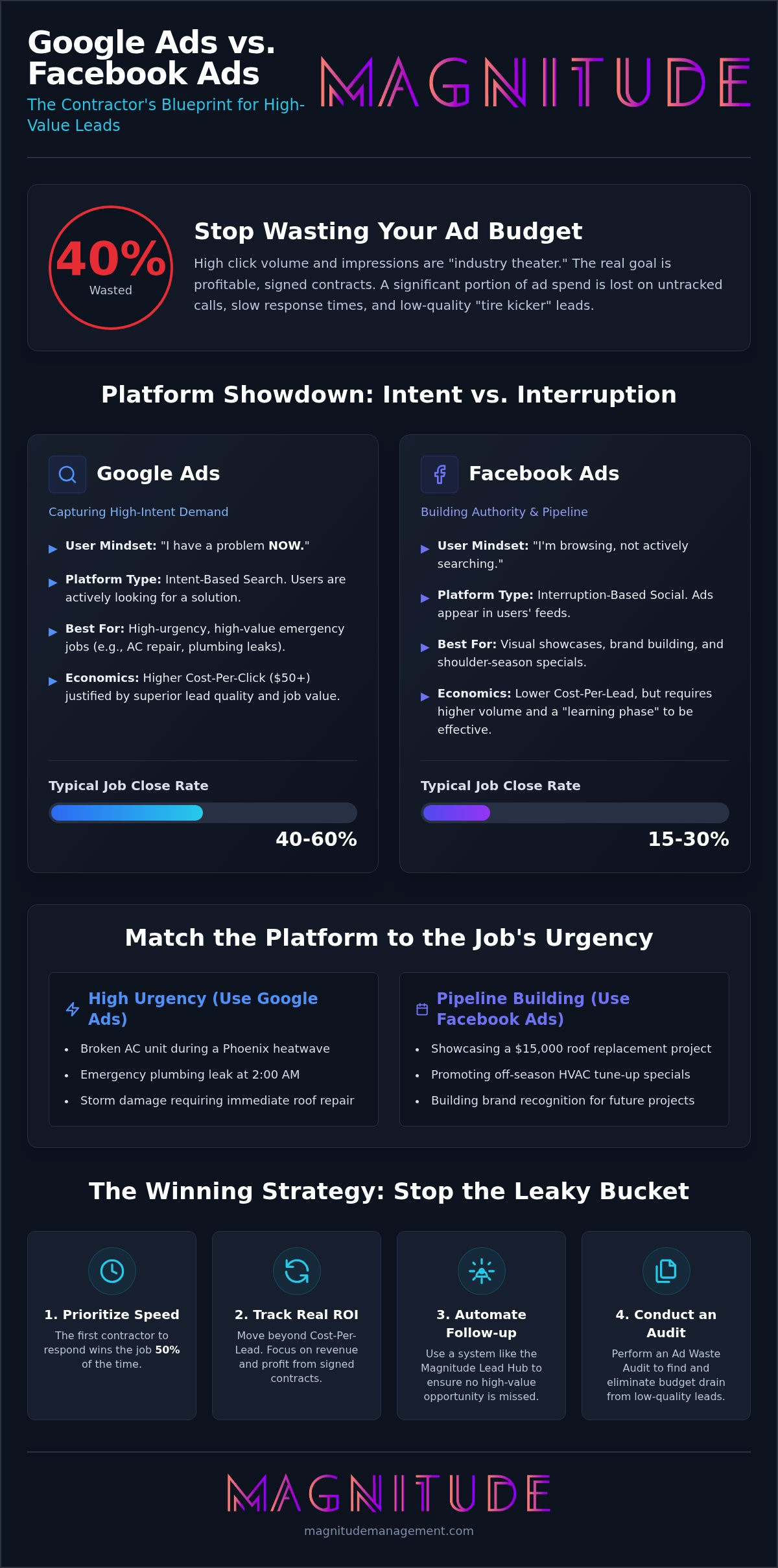
The choice between Google Ads vs Facebook Ads for contractors is rarely an “either/or” decision. It is a strategic allocation of capital based on the urgency of your service and the visual nature of your work. While Google captures the desperate homeowner, Facebook builds the brand that prevents them from shopping around when the crisis hits. For contractors looking to extend this brand presence into the physical world, We Mail America provides high-quality postcards and custom mailing services that keep your business top-of-mind. The following table breaks down the fundamental differences you must navigate to protect your margins.
| Feature | Google Ads | Facebook Ads |
|---|---|---|
| Primary Intent | Active (Immediate Problem) | Passive (Interest/Discovery) |
| Average CPC | High ($8.33 – $50+) | Low ($2 – $4) |
| Close Rate | 40% to 60% | 15% to 30% |
| Best Use Case | Emergency Repairs | Maintenance & Remodels |
You should go 100% Google when you operate in a high-competition emergency niche. If you’re an emergency plumber or a 24/7 HVAC provider, your revenue depends on being the first name seen during a crisis. Conversely, lead with Facebook for aesthetic remodels, seasonal tune-ups, or maintenance packages where visual proof and “interruption” can spark a desire that didn’t exist five minutes ago.
HVAC and Plumbing: The Urgency Factor
Google Ads is effectively the emergency room for service businesses. When a compressor fails in the Phoenix heat, the homeowner is not browsing social media for a solution. They are clicking the first “Google Guaranteed” ad they see. For 24/7 service providers, we recommend a budget split of 70% Google to capture immediate demand and 30% Facebook to maintain visibility. During the Arizona shoulder seasons, pivot your Facebook messaging to “preventative” maintenance and system upgrades to keep your trucks moving when the weather is mild.
Roofing and Landscaping: The Visual Factor
Roofing and landscaping rely heavily on curb appeal and social proof. Facebook wins here because it allows you to showcase the transformation of a property. After a monsoon storm, use Facebook to build awareness for storm-restoration services in specific zip codes. Simultaneously, use Google to capture the “roofer near me” searches that follow. If you want to scale your roofing operations effectively, you need a system for Paid Ads for Local Services that balances search intent with visual authority. If you are ready to stop guessing and start scaling, partner with a strategic agency that understands the specific economics of your trade.
The most profitable contractors use a hybrid approach. They use Google for high-intent capture and Facebook for retargeting. If a prospect searches for a new roof on Google but doesn’t convert, your Facebook retargeting ad should follow them with a video testimonial or a “before and after” gallery. This creates a multi-touchpoint presence that makes your brand feel omnipresent in your local market.
Beyond the Click: How the Magnitude Lead Hub Maximizes Every Dollar
An ad is nothing more than an open door. If no one is there to greet the customer when they walk through, the money you spent on that door is wasted. When navigating the Google Ads vs Facebook Ads for contractors debate, many business owners forget that the platform is secondary to the infrastructure waiting on the other side. An ad is only as good as the CRM behind it. Most contractors treat their marketing like a vending machine where they expect jobs to fall out the moment they insert cash. The reality is that digital leads are highly perishable. The Magnitude Lead Hub acts as the essential bridge between a high-intent click and a signed contract, ensuring that your hard-earned traffic doesn’t evaporate due to office delays or human error.
Speed is your greatest competitive advantage in the home services industry. Research into lead response times shows that responding to a prospect in under five minutes can increase your chances of conversion by 391%. In the brutal Arizona summer, a homeowner with a failed AC unit isn’t going to wait four hours for a return call. They’ll simply move down the search results to the next competitor who answers. We’ve built our systems to prioritize this urgency, turning your existing database into a revenue engine without requiring you to spend more on top-of-funnel ads.
Lead Response Automation
Lead decay is the silent killer of contractor profit margins. Automated SMS and email follow-ups prevent this by engaging the prospect the second their data hits your system. This isn’t about sending a generic “thanks for your interest” note. It’s about initiating a two-way conversation that secures the appointment before the lead cools off. Integrating your ads directly into an automated sales pipeline removes the bottleneck of manual data entry. You can follow the implementation steps in our Lead Response Automation Guide to start capturing these missed opportunities immediately.
Database Reactivation
The cheapest lead you’ll ever find is the one you’ve already paid for. Most contractors in Phoenix and Tucson are sitting on thousands of dormant leads from previous seasons that were never closed or followed up on. Mining this data is the fastest way to generate high-margin revenue. A Database Reactivation campaign uses targeted messaging to re-engage these homeowners, offering seasonal tune-ups or system inspections. This strategy complements your active ad spend by extracting every possible dollar of value from your historical marketing investment. It turns a “lost” lead into a loyal customer without the high cost of a new Google click.
Own Your Local Market Revenue
Success in the Arizona valley requires more than just picking a platform. It’s about matching your capital to the urgency of the job. Google Ads captures the immediate 2 AM pipe burst; Facebook builds the authority that keeps your brand top of mind when homeowners plan their next remodel. The debate over Google Ads vs Facebook Ads for contractors is won by those who integrate both into a single, cohesive revenue engine.
Stop settling for industry theater metrics that don’t pay the bills. Whether you’re in HVAC, plumbing, or roofing, your growth depends on speed to lead and radical visibility. Our AI-powered Lead Hub ensures no click is wasted. It’s time to reclaim your margins and dominate the Phoenix and Tucson markets with a system built for accountability. You’ve seen the data. Now, take control of your customer acquisition costs and turn your marketing into a predictable profit center.
Get Your Free Ad Waste Audit & Stop Burning Cash.
Your business is ready for the next level. Let’s build it.
Is Google Ads or Facebook Ads better for HVAC leads in Phoenix?
Google Ads is superior for capturing emergency demand during the Phoenix summer heat. When an AC fails at 110 degrees, homeowners search for an immediate fix. Facebook Ads work better for building brand authority and promoting preventative maintenance during the shoulder seasons. A hybrid Google Ads vs Facebook Ads for contractors strategy ensures you capture high-intent searchers while maintaining a steady pipeline of work throughout the year in the Arizona valley.
How much should a contractor spend on Google Ads per month?
Your monthly budget should reflect your revenue goals and the competitiveness of the Arizona valley. While entry-level budgets start around $2,500, top-performing contractors in Scottsdale or Mesa frequently spend $5,000 to $15,000 monthly. Focus on your cost-per-acquired-job rather than just total spend. We recommend a budget that allows for at least 50 conversions per week to move through the initial learning phase and optimize your ROI effectively.
What is a good cost-per-lead (CPL) for plumbing contractors?
A good cost-per-lead varies based on service urgency and local market competition. Emergency plumbing leads on Google often have a higher CPL but close at rates between 40% and 60%. Facebook leads usually cost less per click but require more follow-up, closing at 15% to 30%. You must prioritize the lead-to-job ratio over the initial lead cost to determine if your customer acquisition costs are sustainable for your plumbing business.