SEO for Solar Companies: Dominating Arizona Search and AI Visibility in 2026
Why are you still paying $300 for a shared lead that doesn’t even own a roof in Scottsdale? If your business isn’t dominating the Google Local Pack in Phoenix and Tucson, you’re effectively invisible to the high-intent homeowners who drive your revenue. In 2026, traditional SEO for solar companies has been disrupted by AI Overviews that can slash organic click-through rates by up to 61%. You probably feel the burn of rising lead costs and the exhaustion of filtering out low-quality inquiries from people who don’t qualify for the Arizona state tax credit. It’s a waste of your sales team’s time and your marketing budget.
We agree that the current reliance on third-party aggregators is a race to the bottom for your margins. This article promises a definitive strategy to bypass those middlemen by evolving your digital presence for AI-driven search and local dominance. You’ll learn how to build a predictable system for capturing exclusive inbound leads while navigating the shift from net metering to net billing. We’re moving past the industry theater to focus on the mechanics of growth. Here is the roadmap to owning the Arizona solar market through radical transparency and technical authority.
Key Takeaways
- Shift your focus from traditional keywords to “entities” and AI Overviews to maintain visibility in a 2026 search environment where Google synthesizes answers directly on the page.
- Stop sacrificing your margins to third-party aggregators by implementing a high-performance strategy for SEO for solar companies that generates exclusive, inbound leads.
- Master the 2026 Google Business Profile requirements, prioritizing weekly “freshness” signals to dominate the Local Pack in high-value Phoenix and Tucson zip codes.
- Adapt your content to address Arizona-specific economic shifts, including the move to net billing and the $1,000 state tax credit, to build authority with qualified homeowners.
- Implement the Magnitude Lead Hub to eliminate the “leaky bucket” in your sales pipeline, ensuring you capture and respond to high-intent leads with automated precision.
Solar SEO: Why Traditional Models Fail in 2026
SEO for solar companies is no longer about tricking an algorithm into ranking a blog post about “how solar works.” It’s about building a digital entity that Google trusts as a legitimate Arizona service provider. In 2026, the transition from simple keyword matching to entity-based authority is complete. If your website looks like a generic template and lacks local signals, you won’t appear in AI Overviews or the Local Pack. Traditional SEO models that prioritize high-volume, national keywords are fundamentally broken for local installers. They generate traffic that doesn’t convert and clicks from people who don’t own their homes. Understanding the broader state of the U.S. solar industry provides context, but your revenue depends on dominating specific Arizona zip codes.
The Death of the Generic Solar Keyword
Stop chasing “solar panels.” That term is a magnet for students and window shoppers. A Scottsdale homeowner ready to buy isn’t typing that into a search bar; they’re asking about “SRP battery storage incentives 2026” or “solar installers near me with battery backup.” These are intent-based queries. In 2026, commercial intent is the only metric that matters for your bottom line. If you aren’t answering specific questions about APS net billing rates or the $1,000 Arizona state tax credit, you aren’t capturing high-value leads. You’re just hosting a library for people who will never sign a contract. You need a strategy that targets the actual economic triggers of a solar purchase in the Phoenix market.
Local SEO vs. National Aggregators
National aggregators are the middlemen of the solar industry. They spend millions to rank for broad terms, capture the lead, and then auction it off to you and four of your competitors. It’s a race to the bottom that kills your margins. Owning your local territory in Tucson or Phoenix requires a shift toward proximity signals and authentic local engagement. Google’s 2026 updates heavily penalize inactive profiles. If you aren’t posting weekly updates to your Google Business Profile and proving your physical presence in the Valley, you’re handing your market share to companies that sell your own traffic back to you. To see where your current strategy is leaking money, run an ad waste audit to stop overpaying for shared leads that lack homeowner verification.
The Mechanics of AI Search Visibility for Solar Installers
Search Generative Experiences (SGE) have fundamentally changed the lead generation funnel. Google isn’t just a list of links anymore; it’s an answer engine. To dominate SEO for solar companies in 2026, you must optimize for Generative Engine Optimization (GEO). This means providing structured, authoritative data that AI models can digest and synthesize. If you don’t provide the clear, direct answer to how much solar costs in Tucson after the state tax credit, Google will find a competitor who does. AI search isn’t a black box for those who understand the mechanics of authority.
Building a Knowledge Graph for your solar brand is the digital priority. This involves using Schema.org structured data to define your service areas, project types, and professional credentials. It tells AI you aren’t just a website. You’re a verified entity with real-world authority in the Phoenix market. This technical infrastructure is the foundation of modern SEO for solar companies, ensuring your brand is cited as a trusted source when Google’s AI synthesizes a response about local installation options.
Winning the AI Overview Recommendation
AI Overviews prioritize content that directly answers complex homeowner questions. In Arizona, these questions now revolve around the expiration of the federal tax credit for homeowner-owned systems and the resulting shift toward solar-plus-storage. You must produce content that explains why battery storage is now essential under the APS net billing system, where excess energy is compensated at roughly $0.076/kWh. Cite federal support for solar businesses to ground your technical claims in authority. AI models look for these high-quality signals to decide which brand to recommend in the summary box. If your content lacks this specificity, you’re effectively invisible to the most informed buyers.
Entity-Based SEO for Solar Brands
Google now views your business as an entity, not a collection of keywords. This entity is defined by the relationship between your physical office in Mesa, your customer reviews, and your local citations. If your reviews mention “fast installation in Peoria,” AI connects your entity to that specific geography and service level. Leverage local Arizona landmarks and neighborhood names in your project descriptions to strengthen these proximity signals. This isn’t vanity. It’s architectural SEO. When these AI-driven leads hit your site, they need to be funneled into a system like the Magnitude Lead Hub to ensure zero lead decay. You can evaluate your AI search visibility with a partner who focuses on revenue outcomes rather than creative hype.
SEO vs. Lead Buying: Why Arizona Solar Pros Are Losing Margins
If you are buying leads from national aggregators, you aren’t growing a business; you’re funding theirs. The shared lead trap is the primary reason Arizona solar installers see their margins evaporate. When you pay for a lead that is simultaneously sold to five other contractors in Mesa, you’re forced into a price war before you even step on the roof. This model is unsustainable. High-quality, exclusive leads in 2026 can cost upwards of $300, but their value is zero if you’re the third person to call. Real SEO for solar companies focuses on building an asset you own, not renting traffic from Google or third-party brokers.
Renting traffic is a temporary fix for a structural problem. When you stop paying for ads, the phone stops ringing. Conversely, a disciplined SEO strategy builds a permanent infrastructure for lead generation. To understand the shifting costs of acquisition, look at the latest solar industry data regarding market pricing and deployment. You’ll see that as equipment costs stabilize, the real battle is won in customer acquisition costs (CAC). Reducing your CAC through organic dominance is the only way to protect your profit in a competitive Phoenix market. Stop the bleed by running an ad waste audit to identify exactly where your current lead acquisition is failing.
The Economics of Organic Solar Leads
In Phoenix, where an average residential solar installation ranges from $25,000 to $40,000, the ROI on organic visibility is unmatched. Organic leads typically close at a rate 3x higher than cold or shared leads because the homeowner sought you out based on your local authority. We define this as Lead Equity. It’s the long-term compounding value of your search rankings. Unlike an ad campaign that stops the moment you stop paying, Lead Equity continues to deliver high-intent inquiries for years. It’s the difference between being a tenant of Google and being the landlord of your own digital territory.
Fixing the Leaky Bucket with Magnitude Lead Hub
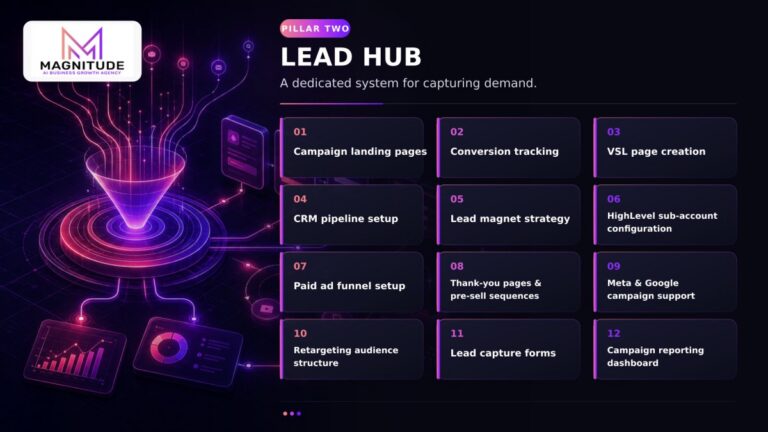
Visibility is a vanity metric if your intake system is broken. If your response time to a new inquiry exceeds 5 minutes, your chances of qualifying that lead drop by 80%. Most solar pros have a leaky bucket problem where organic traffic hits the site and disappears because there’s no immediate engagement. The Magnitude Lead Hub fixes this by integrating your SEO traffic directly into an automated CRM sales pipeline. We automate the follow-up for homeowners who just want a quote, ensuring no lead is left to die in an inbox. This system ensures that the technical gains from SEO for solar companies translate directly into scheduled site assessments and signed contracts.
5 Steps to Optimize Your Solar Google Business Profile
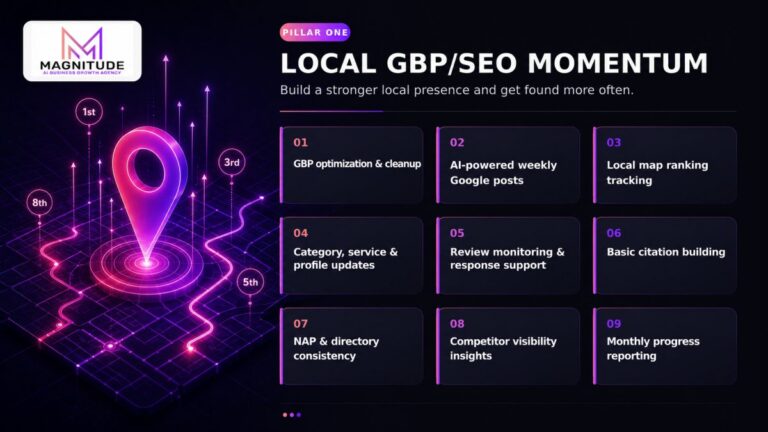
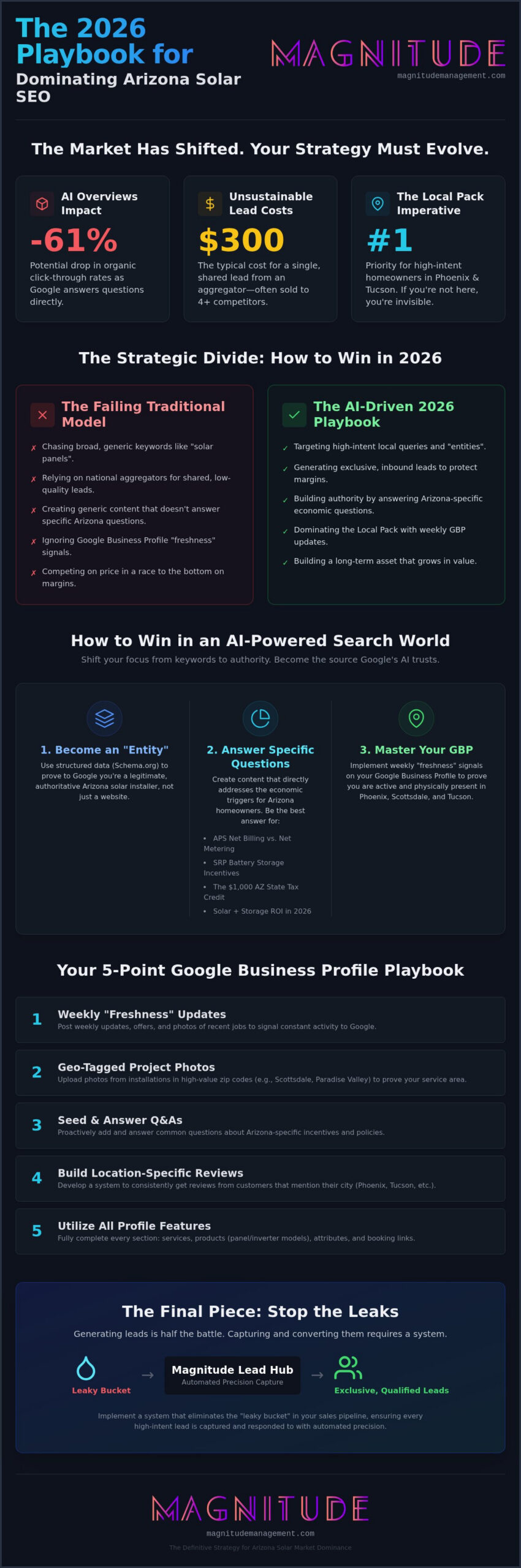
Your Google Business Profile (GBP) isn’t a digital business card. It’s your primary lead generation engine for the Phoenix and Tucson markets. In 2026, Google’s “Ask Maps” AI synthesizes local profile data to recommend installers based on real-world activity. If you’re invisible in the Local Pack, your website’s organic rank matters significantly less for immediate conversion. Effective SEO for solar companies requires a hyper-local approach that proves your physical presence in specific Arizona utility territories. You must treat your profile as a live broadcast of your operational success.
Start with precise categorization. Set your primary category to “Solar energy company” and secondary to “Solar energy equipment supplier.” Google prioritizes “freshness,” meaning profiles inactive for over 30 days are penalized in the rankings. Post weekly updates featuring geotagged photos from recent installs in Glendale or Oro Valley. This proves to the algorithm that you are active in the field, not just a desk-bound lead broker. Geotagging acts as a proximity signal that ties your brand to the high-value zip codes you want to dominate.
Manage your reputation with pragmatism rather than vanity. A perfect 5.0 rating often looks manufactured to savvy homeowners. In 2026, a 4.8-star rating with detailed, keyword-rich reviews is the gold standard for trust. Consumers look for authenticity in how you handle challenges. Respond to every review with directness. If a customer mentions the length of the utility interconnection process, explain the technical reality. This transparency builds authority that AI search models recognize and reward. It shows you understand the local infrastructure, a signal national competitors cannot replicate.
Mastering the Local Pack in Tucson and Mesa
Dominating “solar near me” queries in Tucson or Mesa depends on verified local signals. Use a local area code, not a 1-800 number. Your physical address must be a legitimate office where you actually conduct business, not a virtual PO box. Use GBP Posts to highlight territory-specific information, such as how current solar-plus-storage trends impact homeowners in Scottsdale. This level of specificity signals to Google that you are the local expert for that specific grid. When homeowners see you addressing their specific utility concerns, the click-through rate on your profile spikes.
Review Generation as an SEO Signal
Reviews are more than social proof; they are a data source for AI models. When a customer mentions “solar battery installation” or “efficient setup” in their review, it strengthens your entity’s association with those services. Automate your review requests to trigger immediately after the Permission to Operate (PTO) is granted. This is the moment of peak customer satisfaction. If you want to dominate the Arizona market, you need a system that captures this sentiment at scale. You can optimize your Google Business Profile for solar leads by partnering with a team that understands the local mechanics of search and lead conversion.
Scaling Your Solar Business: The Magnitude Strategy
Scaling a solar installation company in Arizona requires a shift from “doing marketing” to building a growth infrastructure. You don’t need another creative agency that prioritizes aesthetics over appointments. You need a strategic partner who functions as a Fractional CMO, focusing on the mechanics of revenue and operational efficiency. To see how professional coaching can support this evolution, visit Peter Montoya and explore strategies for achieving measurable market dominance. In 2026, SEO for solar companies is the engine, but your CRM and lead capture systems are the transmission. If they aren’t synchronized, you’re just burning fuel. Scaling means moving beyond a single office and dominating the entire Valley through a disciplined, multi-location framework.
Your location page strategy must go deeper than just swapping city names. To dominate Phoenix, Scottsdale, and Peoria simultaneously, each page must address the specific utility realities of that territory. A homeowner in an SRP-served area of Scottsdale faces different economic calculations than an APS customer in Peoria. Your content must reflect these nuances, explaining how net billing rates impact the ROI of a 13.64 kW system in their specific grid. This level of technical authority prevents your pages from being flagged as “doorway pages” and builds immediate trust with the reader. Use a Local Search Visibility Audit to identify where your competitors are currently leaving gaps in these high-value territories.
Your 2026 Solar Growth Roadmap
Success is a methodical progression, not a sudden event. We break your growth into three distinct phases to ensure the foundation can support the scale.
- Months 1-3: We fix the technical foundation and establish Google Business Profile dominance. This is about recovery. We remove the waste in your current setup and claim the Local Pack in your primary zip codes.
- Months 4-6: The focus shifts to content authority and AI search integration. We build the Knowledge Graph that ensures your brand is the primary recommendation in Google’s AI Overviews.
- Month 7+: We deploy Lead Hub automation and scale your ad spend based on proven organic data. This is where we reactivate your database and maximize the value of every lead.
Stop wasting your budget on systems that don’t talk to each other. Get an Ad Waste Audit today to see exactly how much margin you’re losing to inefficient SEO for solar companies and fragmented lead management.
Own the Arizona Solar Market or Be Replaced
The days of surviving on expensive, shared leads are over. In 2026, your profitability depends on whether Google’s AI recommends you or your competitor. Dominating SEO for solar companies requires more than just keywords; it demands a technical infrastructure that proves your local authority in Phoenix and Tucson. We’ve shown you the mechanics of AI visibility and the necessity of fixing your leaky sales bucket. Now, it’s time to stop the margin bleed and build an asset you actually own.
Magnitude provides the specialized growth strategy Arizona solar installers need to scale. Our approach combines AI-powered search visibility with the Magnitude Lead Hub CRM integration to ensure you never lose a qualified lead to a slow response. We’re specialized in Arizona home services and understand the specific economic triggers of the local grid. Don’t leave your revenue to chance or third-party brokers who sell your traffic back to you. Schedule Your Local Visibility Audit today and take control of your territory. Your future pipeline starts with a better system.
Frequently Asked Questions
How long does it take for a solar company to see results from SEO?
You should expect to see technical recovery and initial movement within 90 days, but true market dominance takes six to twelve months of consistent authority building. SEO is a long-term infrastructure project, not a light switch you flip for instant leads. Unlike paid ads that stop the moment your budget expires, organic visibility compounds over time. We focus on building Lead Equity so your cost-per-acquisition drops as your authority in the Phoenix market grows.
What are the best keywords for solar installers in Arizona?
The most effective keywords in Arizona are long-tail queries that signal high commercial intent. Stop chasing broad terms like “solar panels” and focus on specific utility concerns like “SRP battery storage incentives 2026” or “APS net billing changes.” These searches represent homeowners who are already educated and ready to buy. We target queries where your local expertise provides a direct answer that national competitors cannot replicate with generic content.
Do I need a separate SEO strategy for residential and commercial solar?
You absolutely need distinct strategies because the buyer intent and economic triggers are different. Residential SEO targets homeowners concerned with monthly savings and the $1,000 Arizona state tax credit. Commercial SEO focuses on tax depreciation, operational resilience, and large-scale energy offsets. Google views these as separate entities. We build specific content silos and structured data to ensure you rank for both high-value residential installs and lucrative commercial contracts.
How does Google’s AI search affect my solar business rankings?
Google’s AI search synthesizes answers directly on the results page, which can reduce clicks to websites that only provide surface-level information. To stay visible, your SEO for solar companies must evolve into Generative Engine Optimization (GEO). This involves using structured data and authoritative, data-backed content that AI models can easily cite. If you aren’t the primary source for local solar data, AI will recommend your competitors instead of your business.
Is Google Business Profile optimization more important than my website?
Neither is more important; they function as a single symbiotic ecosystem. Your Google Business Profile is the primary driver for “near me” searches and local map clicks in Tucson or Mesa. However, your website provides the deep topical authority that feeds AI Overviews and supports your GBP rankings. You need a high-performance website to convert the traffic that your profile generates. To ensure your digital foundation is robust, you can explore Разработка и продвижение сайтов with ProGroup to see how professional development drives conversion. Neglecting one effectively cripples the performance of the other.
The cost of SEO varies based on your market’s competitive density and the speed at which you want to scale. Instead of looking at a flat fee, calculate the investment against the $300 you might pay for a single shared lead from an aggregator. A professional strategy is designed to replace that high-cost lead buying with a predictable, exclusive inbound system. It is an operational investment in your company’s long-term lead infrastructure.
Can I do my own solar SEO or should I hire an agency?
You can attempt DIY, but you’ll likely spend more in lost opportunity costs than you save in fees. Managing technical Schema, AI search integration, and hyper-local citation building is a full-time discipline. Most solar installers are better served focusing on project management and sales. Hiring a specialized partner ensures your marketing isn’t a series of experiments but a disciplined system for revenue growth and market dominance.
How do I outrank national solar aggregators in my local market?
You outrank national aggregators by leveraging your physical proximity and local specificity. Aggregators have broad authority but zero local presence. By consistently uploading geotagged project photos from Mesa or Scottsdale and generating reviews from local homeowners, you send signals that a national site cannot match. Google prioritizes real-world activity. We use your actual local operations to prove you are the most relevant choice for Arizona residents.