Database Reactivation for Service Companies: Turning Dormant Leads into Arizona Revenue
Acquiring a new customer costs five to seven times more than reactivating an existing one. Yet, most Arizona contractors continue to dump thousands into Google Ads while their CRM sits like a digital graveyard. You’ve seen the cost per lead in Phoenix and Tucson climb every year. You’ve watched your sales team ignore “old” leads to chase the latest shiny notification. It’s a cycle of waste that kills your margins. You’re paying for the same gold twice. It’s time to stop.
Database reactivation for service companies is the most effective way to lower your blended customer acquisition cost. This isn’t about being spammy or desperate. It’s about infrastructure and radical accountability. We promise that once you implement a structured system to mine your existing assets, you’ll find immediate revenue you didn’t know existed. This article breaks down how to use the Magnitude Lead Hub to turn dormant leads into a predictable engine for seasonal revenue recovery. We’ll show you the exact mechanics of moving from expensive acquisition to high-margin recovery and why your existing database is your most undervalued asset.
Key Takeaways
- Stop overpaying for new customer acquisition and start recovering revenue from the “pre-paid gold” already sitting in your CRM.
- Implement database reactivation for service companies using a systematic approach to clean old data and protect your sender reputation.
- See how a structured AI outreach campaign can convert hundreds of “dead” leads into five-figure revenue injections in under 14 days.
- Use Arizona-specific seasonal triggers and lead segmentation to ensure your messages reach the right customers at the exact moment they need your services.
- Leverage the Magnitude Lead Hub to automate the technical heavy lifting, allowing your team to focus on closing jobs rather than chasing old phone numbers.
What is Database Reactivation for Service Companies?
Database reactivation for service companies is the systematic process of turning cold files into active revenue. It isn’t a “marketing campaign” in the traditional sense. It’s a structured recovery operation for your most valuable asset: your data. Most contractors in Phoenix and Tucson treat their CRM like a digital graveyard. Once a lead doesn’t close or a one-time repair is finished, the contact is forgotten. This is a massive operational failure. You’re effectively throwing away money you’ve already spent.
Think of every name in your Customer relationship management (CRM) system as a pre-paid asset. You’ve already paid the “admission fee” through previous Google Ads, SEO, or mailers. Paying $150 for a new HVAC lead while ignoring 500 unclosed estimates is the definition of insanity. The goal of database reactivation for service companies is simple. We want to convert that “lost” data into booked appointments and recurring service contracts without spending another dime on top-of-funnel acquisition. You stop being a lead-buyer and start being a revenue-collector.
The Economics of Dormant Leads
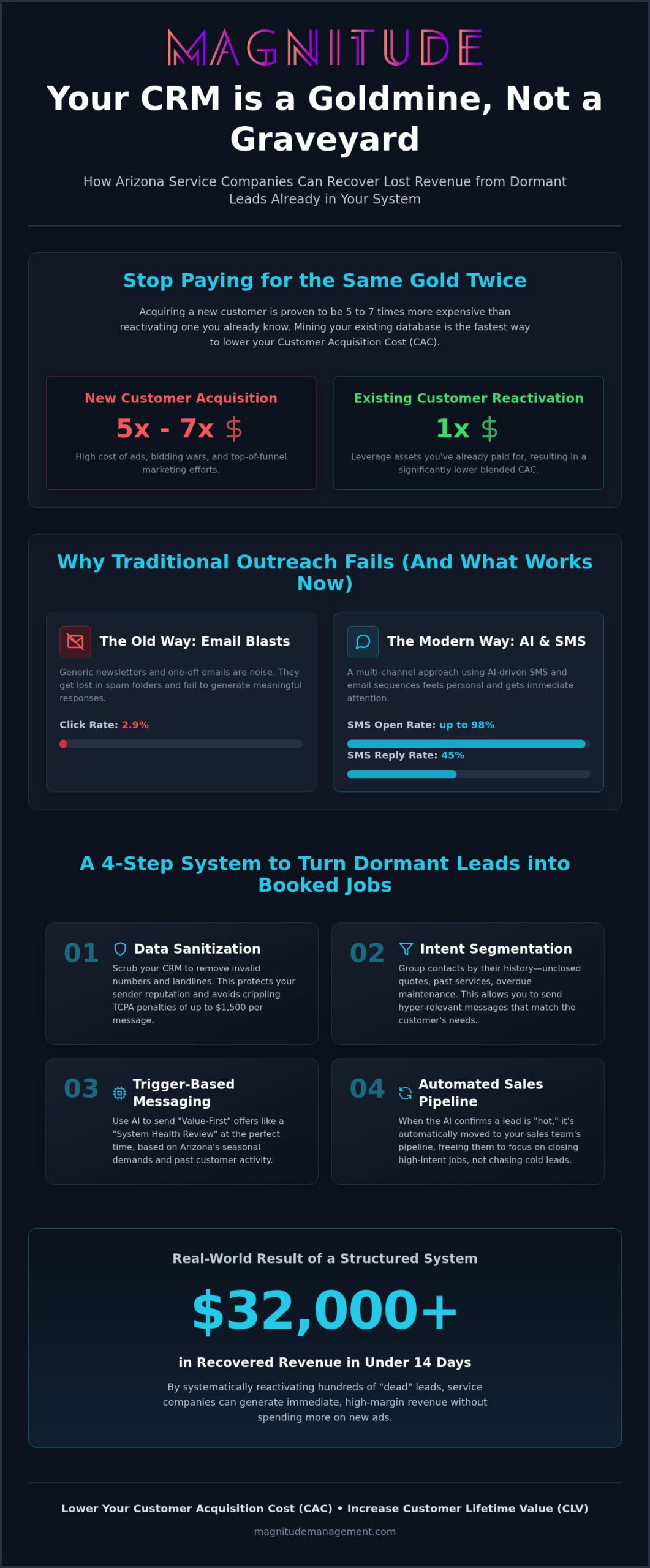
The “Hidden Cost of Neglect” is the revenue you lose by letting leads expire. Acquiring a new customer is five to seven times more expensive than reactivating one you already know. When you mine your existing database, your blended Customer Acquisition Cost (CAC) drops. You aren’t bidding against every other plumber in Arizona on a “clogged drain” keyword. You’re speaking directly to someone who has already invited you into their home. This process significantly increases Customer Lifetime Value (CLV) by moving customers from one-off fixes to predictable, high-margin maintenance agreements. If you want to see how much you’re currently losing, you can start by conducting an ad waste audit to compare your current spending against your untapped potential.
Why Traditional “Email Blasts” Fail
Most contractors think a monthly newsletter is “staying in touch.” It isn’t. It’s noise. Generic email blasts frequently fall into the spam filter trap, especially for service companies with poor sender reputations. Industry data from May 2026 shows that while B2B emails have a 37.4% open rate, the click rate is a dismal 2.9%. You can’t run a business on those numbers. Modern reactivation requires a multi-channel approach. SMS messages boast a 90-98% open rate and a 45% reply rate. If you aren’t using AI-driven sequences that combine text and email, you’re effectively invisible to your past customers. You need a system that feels like a personal follow-up, not a mass-marketing broadcast. Plumbing companies facing the same visibility challenges should explore how lead generation services for plumbing companies can complement reactivation by building a steady stream of exclusive inbound demand.
How does the Magnitude Framework re-engage leads without the spam?
The Magnitude Framework re-engages leads through a structured, AI-powered system that prioritizes data sanitization and intent-based segmentation. Unlike generic bulk messaging, this process uses the Magnitude Lead Hub to identify specific customer needs and deliver high-utility offers at optimal times. By automating the initial conversation, the framework filters for genuine interest, ensuring your team only spends time on “hot” prospects ready to book.
- Step 1: Data Sanitization. We scrub your lists for landlines and invalid numbers to protect your sender reputation. With TCPA penalties reaching $1,500 per message, you can’t risk a sloppy approach that triggers litigation or carrier blocks.
- Step 2: Intent Segmentation. We group contacts by their historical behavior, separating those who ghosted an install quote from those overdue for a standard tune-up. This ensures the message matches the homeowner’s specific situation.
- Step 3: Trigger-Based Messaging. AI determines the high-probability window for outreach, ensuring your message lands when the homeowner is most likely to respond based on seasonal demand and past activity.
- Step 4: The Sales Pipeline. When intent is confirmed through the automated sequence, the system moves the lead to your sales team for final scheduling and closing.
The “Value-First” Messaging Strategy
Most contractors fail because they lead with a discount. We lead with utility. By offering a “Maintenance Audit” or “System Health Review,” you solve a problem rather than begging for work. This is where Conversational AI is a tool that mimics human dialogue to filter intent. It handles the initial “Is this a good time?” and “What’s wrong with the unit?” questions before your office staff ever picks up the phone. This protects your team’s time and ensures a high-quality customer experience that feels personal, not automated.
Automating the Sales Pipeline
The Magnitude Lead Hub tracks every interaction from the first text to the final job completion. This visibility eliminates the manual guesswork that usually kills database reactivation for service companies. The real engine here is lead response automation for service business. When a lead re-engages, the system responds in seconds, not hours. By centralizing your lead data, you stop the leak in your sales funnel and start recovering revenue that was previously invisible to your team.
Can database reactivation generate $32,000 in 14 days?
Yes, database reactivation for service companies can generate five-figure revenue injections in under two weeks by targeting “lost” leads with value-based offers. By cleaning a list of 400 dormant HVAC leads and deploying automated SMS sequences during peak Arizona heat, contractors can book dozens of appointments and close high-ticket system replacements without spending a dollar on new lead acquisition.
Consider a typical HVAC contractor in Phoenix. Over three years, they’ve accumulated a list of 400 leads labeled as “Dead” or “No-Show.” These are homeowners who requested a quote for a new 5-ton unit but ghosted, or people who canceled a maintenance call and never rescheduled. Most owners see this list as a liability or a reminder of failed sales. We see it as a $32,000 opportunity. This process transforms these forgotten entries into immediate cash flow without the friction of cold acquisition. If your team is struggling with missed response windows, our complete guide on how to recover lost leads for contractors breaks down the exact automated framework you need to stop the bleed.
The Campaign Mechanics
Timing is everything in the Arizona market. We launched this specific campaign in late May, just as the first triple-digit heat spike hit the Valley. The messaging focused on a “Pre-July Reliability Audit” rather than a generic discount. This value-first approach resonated with homeowners who remembered the previous summer’s repair delays. Speed-to-lead was the deciding factor. When a lead replied to an automated SMS, the Magnitude Lead Hub engaged them in under five minutes.
Conversion rates were further bolstered by the contractor’s digital standing. High-quality reputation management for contractors ensures that when a past customer sees your name again, they’re met with a wall of recent, positive social proof. This eliminates the “Who are these guys?” friction and moves the lead directly to the “When can you get here?” stage of the conversation.
ROI Analysis and Lead Economics
The economics of this recovery are staggering. The contractor spent $0 on new lead acquisition for this $32,000 revenue injection. If they had attempted to generate 400 new HVAC leads through Google Local Services Ads in a competitive market like Phoenix, they would’ve easily spent $40,000 or more just on the clicks. Instead, they leveraged assets they already owned. Before committing to any new ad spend, contractors should consult a home service marketing agency buying guide to understand exactly what conversion-focused infrastructure they should demand from any partner they hire.
This revenue arrived during a shoulder season when call volume typically dips before the summer rush. It allowed the owner to keep their best techs busy and profitable without increasing the marketing budget. Database reactivation for service companies doesn’t just add revenue; it protects your margins by eliminating the high cost of starting from zero with every new customer.
How to Segment Your Database for Maximum Arizona ROI
Database reactivation for service companies is not a one-size-fits-all broadcast. If you treat your high-ticket install leads the same way you treat a one-off drain cleaning, you’re leaving money on the table. Effective revenue recovery requires surgical precision. You must segment your data based on intent, job value, and the “Last Touch” rule. A lead that hasn’t been contacted in 24 months requires a different re-introduction than one that ghosted you last quarter. Without segmentation, you’re just making noise.
In the Arizona market, timing is your biggest lever. Seasonality triggers dictate when certain segments will convert. For HVAC contractors in Phoenix or Tucson, launching a campaign in May aligns with the first triple-digit heat. Conversely, roofing contractors should weight their outreach toward the post-monsoon window to target homeowners with potential storm damage. By prioritizing replacement leads over minor repairs, you ensure your technicians spend their time on the most profitable jobs. Your CRM is a map; segmentation is how you find the gold.
Segment 1: The “Unclosed Estimate” Recovery
These are your most valuable dormant leads. They’ve already had a technician in their home, they’ve seen the price, and they’ve expressed a clear need. They just didn’t pull the trigger. Instead of a hard sell, use a “Reason for No” survey approach to restart the conversation. This allows the homeowner to voice concerns about financing or timing without feeling pressured. You can even use paid advertising for local service businesses to retarget these specific email addresses on Meta, keeping your brand top-of-mind while the AI handles the direct SMS follow-up.
Segment 2: The “Loyalty Maintenance” Sequence
Don’t let your past customers forget you exist. If a customer hasn’t had a service visit in 12 months, they’re at risk of switching to a competitor. Use local Arizona milestones as your hook. A message about “prepping for the 110-degree week” feels like a helpful reminder rather than a sales pitch. This sequence keeps your brand relevant and protects your recurring revenue. As these maintenance jobs close, the Magnitude Lead Hub automatically integrates review generation into the follow-up process. This feeds your local search visibility and builds a wall of social proof for the next campaign. Arizona contractors who want to stop losing ground to lead aggregators and inferior competitors should also invest in authority building for local contractors to ensure their digital presence reflects the expertise and licensing credentials that set them apart.
Ready to stop wasting the pre-paid gold in your CRM? Schedule a database audit to see how we segment your specific trade for maximum revenue recovery.
How do you scale revenue recovery with the Magnitude Lead Hub?
You scale revenue recovery by replacing manual office tasks with a centralized, AI-powered infrastructure that handles data sanitization, multi-channel outreach, and lead qualification 24/7. The Magnitude Lead Hub automates the connection between your CRM and your sales team, while a fractional CMO provides strategic oversight. This ensures your database reactivation for service companies remains compliant, repeatable, and capable of generating revenue without increasing your manual workload.
Scaling a service company in competitive markets like Phoenix or Scottsdale requires more than just a bigger ad budget. It requires an operational shift away from manual follow-ups. If your office manager is still trying to text old leads between answering dispatch calls, you have a bottleneck, not a system. Manual effort is prone to error and impossible to sustain as you grow from a handful of trucks to a regional powerhouse. You need a platform that treats your database with the same rigor as your top-of-funnel acquisition.
The Magnitude Lead Hub acts as the central nervous system for your recovery efforts. We handle the technical heavy lifting that stops most contractors from ever starting. This includes deep API integrations with your existing software and fine-tuning AI models to speak the language of your specific trade. This isn’t a “set it and forget it” tool; it’s a managed service. Having a fractional CMO for home service business means you have an expert overseeing your database health and navigating evolving SMS regulations, keeping your brand safe from litigation. Contractors evaluating whether to build this infrastructure in-house or partner with a specialist should review the 2026 home service marketing agency buying guide to understand the exact questions to ask and the red flags to avoid before signing any contract.
Infrastructure Over Tactics
Tactics are temporary; infrastructure is permanent. While a single text blast might provide a quick win, a scalable system ensures that every lead you pay for today is automatically nurtured for years. There’s a powerful synergy when your Local SEO, Paid Ads, and Reactivation systems work in concert. When a lead enters your ecosystem, the Lead Hub ensures they never leave it without a definitive outcome. To see how your current digital presence stacks up, start with a Local Search Visibility Audit to identify where you’re leaking opportunities.
Next Steps for Arizona Contractors
The path to scaling starts with a clear-eyed assessment of your “Database Alpha”, the segment of your list most likely to convert right now. This requires more than just an export of your CRM; it requires a strategic evaluation of lead age, job type, and historical interaction. We don’t guess with your data. We use proven lead-economics to predict where your next $30,000 is hiding. Your next move is to stop the bleed and stop paying for the same leads twice. Audit your ad waste and recover lost revenue today to see how much pre-paid gold is currently gathering dust in your database.
Stop Buying Leads and Start Recovering Revenue
You’ve already paid for the data sitting in your CRM. Letting it rot while you bid on expensive new leads is an operational failure you can’t afford in the Phoenix or Tucson markets. Database reactivation for service companies isn’t a luxury; it’s the infrastructure required to lower your blended acquisition costs and protect your margins. By utilizing the Magnitude Lead Hub for CRM automation and advanced call tracking, you turn “dead” files into active service contracts. This process works because it relies on radical accountability and proven mechanics rather than marketing fluff.
We’ve shown you that systematic re-engagement can inject five-figure revenue in as little as 14 days. You now understand that segmentation and Arizona-specific timing are the keys to avoiding the spam folder. Don’t let another season go by without mining the pre-paid gold in your own database. Your competitors are likely making the same mistake you were; now is the time to take that market share. Your database is a gold mine. It’s time to start digging.
Stop wasting your old leads. Get a Magnitude Lead Audit today.
Frequently Asked Questions
Is database reactivation considered spam under TCPA or CAN-SPAM laws?
Database reactivation for service companies is legal if you follow specific rules. Email falls under CAN-SPAM, which requires a clear opt-out mechanism. SMS is governed by the TCPA and requires documented, prior express written consent before sending automated messages. Violating the TCPA can cost you $500 to $1,500 per non-compliant text message. We prioritize data sanitization to ensure you stay compliant while recovering revenue from your existing assets.
How far back into my old leads should I go for a reactivation campaign?
We generally recommend mining leads from the last 24 to 36 months. Beyond three years, data decay makes it difficult to maintain high deliverability. People move, change phone numbers, or replace their systems with a competitor. The exact window depends on your trade’s specific lifecycle. A roofing contractor might go back further for storm damage, while an HVAC company focuses on the last two seasons of unclosed estimates.
What is the average response rate for a service company reactivation text?
SMS outreach in a reactivation campaign typically sees an open rate between 90% and 98%. The average reply rate is around 45%, which is significantly higher than the 2.9% click rate seen in traditional B2B emails. These numbers prove that direct, conversational outreach is the most efficient way to engage a dormant list. It forces a decision and filters intent much faster than a generic newsletter ever could.
Can I do database reactivation if I don’t have a modern CRM?
You don’t need a sophisticated CRM to start, but you do need an organized list. If you have your customer data in a spreadsheet or an older field service software, we can export that data into the Magnitude Lead Hub. The system acts as the central nervous system for your outreach. Once imported, we clean the list and begin the automated sequences, regardless of your original software’s limitations.
How much revenue can an HVAC company realistically recover from old leads?
Realistic recovery depends on your database size and lead quality. As seen in our case study, 400 dormant leads can generate $32,000 in just 14 days by focusing on high-intent segments like unclosed estimates. With an average success rate of 5% to 15% for re-engaging leads, even a relatively small list can produce a significant revenue injection. It’s about recovering the pre-paid gold you already bought.
Will database reactivation hurt my Google Business Profile ranking?
Reactivation actually improves your Google Business Profile ranking. By re-engaging past customers and closing new jobs, you create more opportunities to generate fresh reviews. Google prioritizes businesses with recent, frequent, and positive feedback. A structured recovery sequence includes an automated review request after the job is finished, which strengthens your local visibility and builds a wall of social proof that helps you dominate the Arizona market.
How often should I run a reactivation campaign for my service business?
Don’t over-saturate your list. Running a campaign once per quarter or during major seasonal shifts is the most effective strategy. For Arizona contractors, this means targeting HVAC in May or roofing after the monsoon season. Regular, meaningful contact keeps your brand top-of-mind without becoming a nuisance. If you message too often, your opt-out rates will climb and you’ll burn through your most valuable assets too quickly.
What is the difference between a drip campaign and a reactivation sequence?
A drip campaign is a passive series of messages sent on a schedule regardless of user action. A reactivation sequence is interactive and intent-driven. It uses AI to respond to replies and move leads through a sales pipeline in real time. While drips are for general awareness, database reactivation for service companies is for immediate revenue recovery. It’s the difference between sending a flyer and having a conversation.