Call Tracking for Contractors: The 2026 Truth About Your Marketing ROI
How much of your monthly ad spend is currently being swallowed by tire-kickers and wrong numbers while you wait for a booked job that never arrives? You’ve likely felt the sting of a marketing report that claims “record-breaking lead volume” while your dispatch board remains empty. It’s a common frustration for home service business owners who are tired of paying for clicks that don’t convert into revenue. You deserve to know exactly which dollar produces a profit and which one is simply gone.
Implementing call tracking for contractors is no longer a luxury; it’s a financial audit tool necessary for survival. Since Google removed native call history from Business Profiles and added friction to the mobile map pack in early 2026, flying blind is a recipe for bankruptcy. This article will show you how to stop the guessing game and start tracking the exact marketing channels that drive booked jobs. We’ll explore how to hold your agency accountable, recover up to 25% of wasted ad spend through LSA disputes, and use the Magnitude Lead Guard system to ensure no profitable call ever goes unanswered again.
Key Takeaways
- Learn how to distinguish between a high-value emergency plumbing call and a low-intent “tire kicker” to stop wasting your ad budget on unqualified leads.
- Implement call tracking for contractors using Dynamic Number Insertion (DNI) to see exactly which keywords trigger your phone to ring without hurting your Google Business Profile rankings.
- Stop relying on “total calls” as a success metric and start using AI-powered conversation intelligence to verify actual “intent to book” and job value.
- Hold your marketing agency accountable by auditing their performance reports against your actual dispatch board to eliminate the “black box” of marketing spend.
- Discover how the Magnitude Lead Hub uses revenue recovery systems to mine your existing lead data and capture unbooked jobs during seasonal lulls.
What is Call Tracking for Contractors and Why Does It Matter?
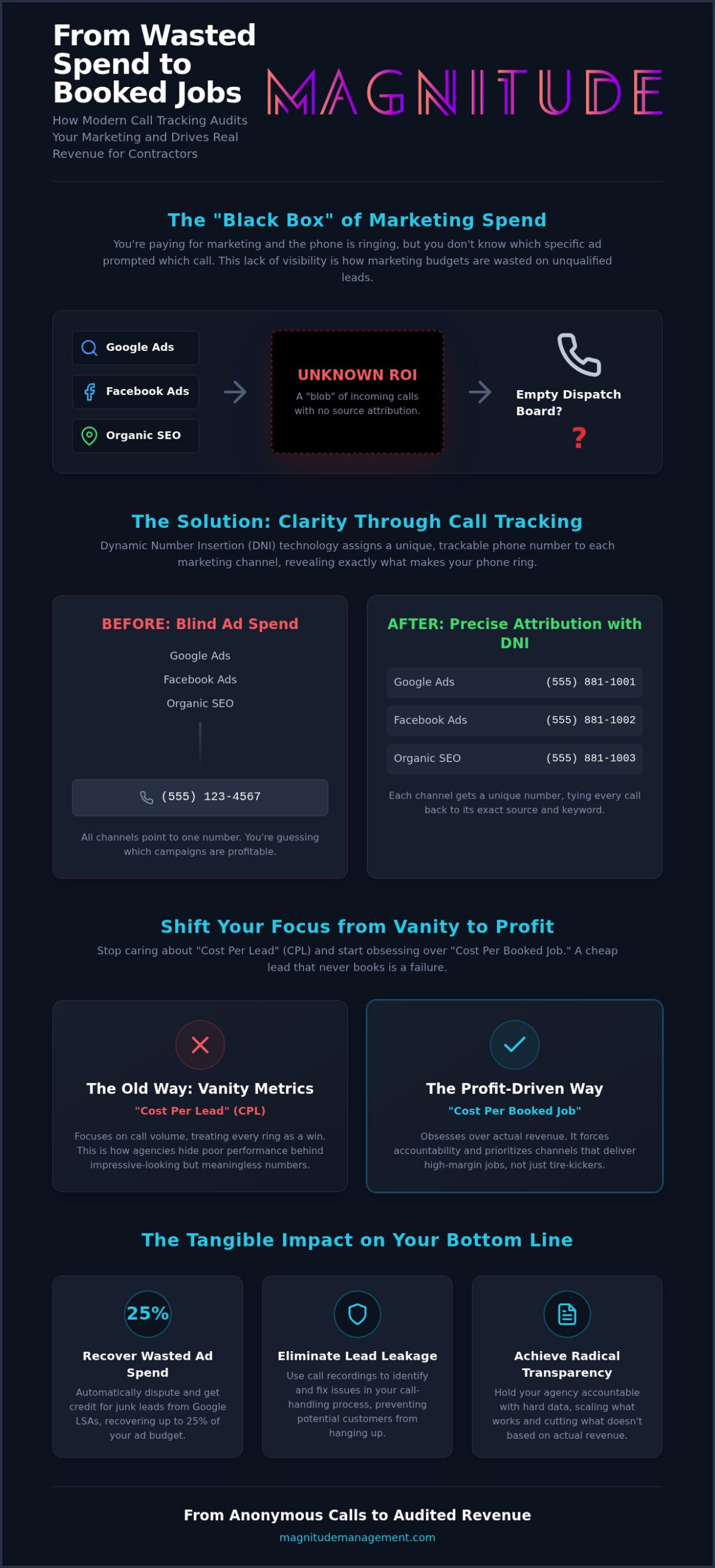
Most contractors treat their incoming phone calls like a black hole. You know the phone is ringing. You know you’re paying for marketing. But you don’t know which specific ad prompted the customer to dial your number. Call-tracking software is a system that assigns unique, trackable phone numbers to every marketing channel you use. It allows you to see if a caller found you through a Google Search, a Facebook ad, or a physical yard sign. Without this visibility, you’re looking at a “blob” of incoming calls. You can’t tell the difference between a high-intent $150 Google Ad lead and a $0 organic referral. This lack of clarity is exactly how marketing budgets are wasted.
This visibility is critical during the Phoenix summer HVAC surge. When temperatures hit 110 degrees, every contractor in Arizona is busy. The question isn’t whether your phone is ringing; it’s whether you’re busy with high-ticket system installs or low-margin capacitor swaps. Effective call tracking for contractors reveals which ads are driving the revenue-heavy jobs that actually grow your business. It forces a fundamental shift in your mindset. You stop caring about “Cost Per Lead” (CPL) and start obsessing over “Cost Per Booked Job.” If a channel produces cheap leads that never book, it’s a failure, regardless of what your agency’s report says.
Tracking the Source of Your Best Jobs
Stop pouring money into “dead” channels that only generate price-shoppers. If your Facebook ads generate 50 calls but zero booked jobs, that channel is a liability, not an asset. Call tracking lets you identify if your Google Business Profile is actually doing the heavy lifting for your revenue. It provides the hard data needed to hold your marketing agency accountable for results rather than “vanity metrics.” You need to know which specific campaigns produce profit so you can scale what works and kill what doesn’t. Radical transparency is the only way to ensure your marketing spend is an investment rather than an expense.
The Economics of Contractor Leads
Consider the real cost of a missed call during peak roofing season in Tucson. A single missed call for a full roof replacement could represent $15,000 in lost revenue. Call tracking identifies “lead leakage” in your office staff by recording calls and showing you exactly when and why potential customers are hanging up. Perhaps your front desk is too slow to answer during the lunch rush, or they aren’t following a proven booking script. Attribution is the direct link between an ad click and a signed contract. If you aren’t tracking that link, you’re just gambling with your ad spend. To see where your budget is disappearing, consider an ad waste audit to find the leaks in your current strategy.
How Call Tracking Works: From DNI to Attribution
Understanding the mechanics of how we analyze and improve marketing ROI requires looking past the hardware on your desk. You need a system that doesn’t just record audio but connects every ring to a specific ad dollar. Modern call tracking for contractors uses sophisticated software to bridge the gap between an anonymous web visitor and a booked appointment on your dispatch board. It’s the difference between hoping your marketing works and knowing exactly which campaigns are paying your mortgage.
The Magic of Dynamic Number Insertion
Dynamic Number Insertion (DNI) is the engine behind this visibility. When a user lands on your site, a small script automatically swaps your standard phone number with a unique tracking number. If they found you through a “burst pipe repair” search on Google Ads, they see one number. If they clicked an organic link for “water heater installation,” they see another. This allows you to identify the exact keyword that triggered the call. Relying on a single static number on your website is a recipe for “blind” ad spend. You’re essentially guessing which search terms are profitable and which are just draining your bank account while your competitors optimize for high-intent keywords.
LSA Dispute Recovery
Google Local Services Ads (LSAs) are a primary driver for home services, but they’re notorious for “junk” leads. You shouldn’t pay for a caller looking for a service you don’t provide or someone calling from outside your service area. Contractors who use call tracking to attribute calls to their marketing source recover an average of 15-25% of their Local Service Ad spending through disputing unqualified leads with Google. By using call recordings as evidence, you can prove to Google that a lead was invalid and get your money back. This isn’t just about tracking; it’s about active revenue recovery. It’s a necessary step to protect your margins during the competitive roofing seasons in Tucson or the HVAC rushes in Phoenix.
The final step is moving this data into your operational workflow. Your call data shouldn’t live in a silo. It needs to push directly into ServiceTitan, Jobber, or a centralized system like the Magnitude Lead Hub. This ensures your sales team has the context they need before they even pick up the phone. When you integrate your tracking with specialized contractor growth systems, you turn raw data into a repeatable sales pipeline. You stop managing your business by “feel” and start managing by the numbers that matter. This visibility allows you to hold your marketing agency accountable for booked jobs rather than just a high volume of ringing phones.
The Ringing Phone Trap: Why Standard Tracking Lies to You
Your marketing agency is likely lying to you. Not because they’re inherently dishonest, but because they’re measuring the wrong metrics. Most agencies count every single ring as a “conversion.” If a solicitor calls to sell you office supplies, it’s a conversion. If a customer hangs up after three seconds, it’s a conversion. This is the ringing phone trap. When you look at your reports, the numbers look fantastic. When you look at your bank account, the reality is much bleaker. You need to understand What Is Call Tracking And Why Is It Important in the context of actual revenue, not just noise.
Standard call tracking for contractors often stops at the point of connection. It tells you the phone rang, but it says nothing about what happened next. This creates a massive blind spot. You might be winning the “lead volume” game while losing the “booked job” war. This discrepancy is a primary reason Why Arizona Contractors Lose Leads Online and fail to scale despite heavy ad spending. You can’t manage what you don’t accurately measure.
Conversations vs. Rings
A “Qualified Conversation” is the only metric that matters. We define this as a call that lasts longer than 60 seconds or contains specific service keywords like “AC repair” or “roof leak.” Modern systems use AI-powered conversation intelligence to transcribe every call and score it based on “intent to book.” This allows you to see the truth behind the data. If your dashboard shows 100 leads but AI transcription reveals that 40 were wrong numbers and 30 were price-shoppers your team couldn’t close, you don’t have a marketing problem. You have a lead quality and sales training problem. Stop celebrating rings and start auditing conversations.
Lead Response Requirements
Speed to lead is a non-negotiable law in the home services industry. During a Tucson monsoon surge, a homeowner with a leaking roof isn’t going to wait. If you don’t answer within five minutes, they’re calling the next name on the list. Calls that go to voicemail are essentially burned cash. Call tracking reveals the “dead zones” in your coverage, such as weekend gaps or lunch-hour lulls where calls are consistently missed. You must connect your tracking data to lead response automation to ensure every high-intent caller gets an immediate response. If your team is too busy to pick up, an automated system must step in to capture that revenue before it disappears to a competitor.
Implementation Guide: Tracking Without Hurting Your Local SEO
Many contractors avoid call tracking for contractors because they fear losing their hard-earned rankings in the Google Map Pack. This fear is rooted in the “NAP Consistency Myth.” NAP stands for Name, Address, and Phone number. Traditional SEO advice suggests that if these three elements don’t match exactly across every corner of the internet, Google will penalize your visibility. While consistency matters, modern tracking technology has evolved. You don’t have to choose between data and rankings. You can have both if you follow a disciplined implementation process.
The first step is securing your Google Business Profile (GBP). This is your most valuable asset in the Tucson and Phoenix markets. To track calls without confusing Google, place your tracking number in the “Primary” phone slot of your GBP. Crucially, you must place your “Real,” long-term business number in the “Secondary” phone slot. This tells Google that the secondary number is still your official identity while allowing the tracking number to capture the data. It’s a simple configuration that prevents ranking drops while providing 100% attribution for your most important lead source. For a deeper look at your current performance, you should Get a Local Search Visibility Audit to ensure your setup is airtight.
Protecting Your Google Maps Ranking
Protecting your maps ranking requires understanding the difference between “hard-coded” and “dynamic” numbers. Your website should never have a tracking number hard-coded into the footer or contact page. Instead, use Dynamic Number Insertion (DNI). This script only swaps the number for human visitors based on their traffic source. When Google’s crawlers visit your site, they see your main, consistent business number. This maintains your SEO authority while giving you the ability to see the exact search term that led to a plumbing emergency call. If you have a long-term number that customers already know, you can “port” it into a tracking system to gain data capabilities without changing your public-facing identity.
The Citation Audit
Old data is a silent killer of local SEO. You must audit your citations across Phoenix, Scottsdale, and Mesa to ensure your primary business number remains the “source of truth.” This means cleaning up old or incorrect numbers on Yelp, Yellow Pages, and trade-specific directories like Angie’s List or HomeAdvisor. Inconsistent data creates “noise” that can lead to lower rankings. Tracking numbers should do the heavy lifting for your ads and website, but your core directories must remain stable. We recommend using the Magnitude Ad Waste Audit to find these leakage points where your brand identity might be fractured. Once your citations are clean, you can scale your marketing with total confidence in your data. To get started with a system built for high-stakes trades, partner with a strategic growth expert who understands the mechanics of contractor ROI.
The Magnitude Lead Hub: Beyond Attribution to Revenue Recovery
Attribution is the starting line, not the finish line. Most call tracking for contractors stops at identifying the source of a lead, leaving you with a spreadsheet and no clear path to profit. You don’t need more raw data; you need a system that converts that data into bankable revenue. The Magnitude Lead Hub is a centralized command center that combines advanced tracking with CRM automation and AI-driven visibility. It’s designed to help you scale from a one-truck operation to a multi-city Phoenix and Tucson powerhouse by focusing on the mechanics of growth rather than the theater of marketing metrics.
One of the most critical components of this system is the Lead Guard feature. In the high-stakes world of home services, a missed call is a gift to your competitor. Lead Guard provides an automated text-back for every missed call, ensuring that the homeowner who just searched for “emergency plumber” gets an immediate response before they dial the next name on the list. This isn’t just tracking; it’s active lead protection. It ensures that your ad spend isn’t wasted on calls that your team was too busy to answer during a summer heatwave or a monsoon surge.
Database Reactivation for Contractors
Your old call logs are a gold mine of unbooked revenue. Most contractors ignore leads that didn’t book on the first call, effectively throwing money in the trash. The Magnitude system uses revenue recovery to mine these logs, identifying customers who were in the market last summer but never signed a contract. By automating the re-engagement process, we turn “lost leads” into “new revenue” without requiring a single minute of your time. This process is a core part of our 2026 Sales Automation Blueprint, which provides a structured framework for capturing every possible dollar from your marketing efforts.
The Fractional CMO Advantage
Data without strategy is just a distraction. You can have the most sophisticated tracking in the world, but if you don’t know how to interpret the numbers, your business will stagnate. Magnitude acts as your strategic partner, functioning as a fractional CMO to help you navigate the complex economics of HVAC, roofing, and plumbing leads. We don’t just provide software; we provide the architectural systems needed to recover waste and accelerate growth. It’s time to stop managing your shop by “feel” and start making decisions based on radical accountability. To see exactly where your budget is leaking, you should stop wasting ad spend and start tracking revenue.
Stop Guessing and Start Growing
You’ve seen the evidence: continuing to spend blindly on marketing is a fast track to burned margins. Implementing call tracking for contractors isn’t about adding another software subscription to your overhead. It’s about installing a financial audit system that demands accountability from every ad dollar you spend. By shifting your focus from total call volume to actual booked revenue, you gain the clarity needed to dominate the competitive Phoenix and Tucson markets.
The Magnitude Lead Hub doesn’t just show you who called; it uses proprietary Lead Guard technology to recover missed opportunities and reactivate lost leads from previous seasons. This level of visibility ensures your roofing or HVAC shop scales based on hard data rather than gut feelings. It’s time to stop letting unqualified leads drain your bank account and start building a predictable sales pipeline that works as hard as your technicians do.
Ready to see exactly where your budget is leaking? Stop Wasting Your Ad Budget and Get an Ad Waste Audit Today. You have the tools to take total control of your business growth. Let’s get to work.
Frequently Asked Questions
Does call tracking hurt my local SEO or Google Maps ranking?
Call tracking does not hurt your SEO when you use Dynamic Number Insertion (DNI). DNI ensures that search engine crawlers see your main, consistent business number while human visitors see a unique tracking number. This protects your NAP consistency while providing the data you need to scale. You don’t have to sacrifice your Google Maps ranking in Tucson or Phoenix just to get visibility into your marketing ROI.
Can I track calls from my Google Business Profile safely?
You can safely track calls from your Google Business Profile by following a specific setup. Place your unique tracking number in the “Primary” phone slot and your standard business number in the “Secondary” slot. This configuration allows Google to maintain your business identity for verification purposes while giving you 100% attribution for the calls coming directly from your local profile. It’s the only way to hold your local SEO efforts accountable.
How much does call tracking software cost for a small contractor?
Industry pricing for call tracking for contractors typically starts around $30 to $55 per month for basic tracking. More advanced platforms that include AI transcription and lead conversion tools can range from $105 to $329 per month plus usage fees. While these costs are a factor, they are minimal compared to the thousands of dollars in ad waste you recover by identifying and killing non-performing marketing channels.
Is a ringing phone considered a conversion in call tracking?
A ringing phone is not a conversion; it’s just noise until it’s qualified. Standard tracking that counts every three second call as a lead is a lie that makes marketing reports look better than they are. A real conversion is a conversation that demonstrates an intent to book a job. You must use AI scoring to filter out solicitors and wrong numbers to get an accurate picture of your true marketing performance.
Do I need call tracking if I only use Google Local Service Ads?
Yes, you still need independent tracking even if you only use Google Local Service Ads. While Google provides a dashboard, it doesn’t integrate with your broader strategy or allow for sophisticated lead response automation. Third-party tracking provides the documentation needed to dispute junk leads and recover 15% to 25% of your LSA spend. It also ensures that your LSA data isn’t trapped in a silo away from your other marketing channels.
How does call tracking integrate with my CRM like ServiceTitan or Jobber?
Call tracking integrates with CRMs like ServiceTitan or Jobber through direct API connections. When the phone rings, the system pushes the caller’s data and marketing source directly into your dispatch screen. This gives your team the context they need to handle the call professionally. It also ensures that every lead is automatically logged in your CRM, preventing jobs from falling through the cracks of a busy office during a summer surge.
What is the “Speed to Lead” and how does tracking help it?
Speed to lead is the time it takes for your team to answer a call or respond to a message. In high stakes trades like roofing or HVAC, answering within five minutes is the difference between a booked job and a lost lead. Tracking identifies exactly when and where your team is failing to answer. Systems like the Magnitude Lead Hub use this data to trigger automated text backs, ensuring you never lose a lead to a competitor.
Can I record calls for training purposes with these systems?
Recording calls is a standard feature that is essential for training and quality control. You can listen to how your dispatchers handle emergency calls during a Phoenix heatwave and identify where they are losing the sale. These recordings provide an objective record of every interaction, allowing you to refine your booking scripts and improve your overall lead to job conversion rate. It’s the best tool you have for holding your staff accountable.