2026 Sales Automation Blueprint for Service Contractors
In 2026, the median cost per lead for home improvement has climbed to $90.92. You’re paying nearly a hundred dollars just for a name and a phone number, yet many of those leads never reach a booked appointment. If your technician forgets to follow up on a $15,000 replacement quote, you’re effectively setting your marketing budget on fire. Implementing sales pipeline automation for service businesses is the only way to stop these leaks. This article provides a blueprint to build an automated engine that converts high-intent leads into booked jobs without manual babysitting.
You understand that manual follow-up is a failing system. When your team is busy in the field, response times slip, and you lose jobs to competitors who call back in under five minutes. We’ll show you how to fix this by deploying a Lead Hub that acts as a guard against revenue leakage. You’ll learn how to increase ROI on your Google and Meta Ads spend while creating a predictable system for lead recovery and high-ticket closing. This is about moving away from industry theater and toward a disciplined, systematic approach to growth.
Key Takeaways
- Learn why missing the 5-minute response window for high-ticket service leads slashes your conversion rates by 400%.
- Discover how sales pipeline automation for service businesses eliminates manual follow-up errors and prevents technicians from losing track of open quotes.
- Calculate the true economics of lead leakage and the massive ROI potential found in automating your database reactivation.
- Deploy a 4-stage framework to map your customer journey from the initial search to the final invoice with zero manual babysitting.
- Use the Magnitude Lead Hub as a Lead Guard to ensure your marketing spend on Google and Meta actually results in booked jobs.
Why is manual sales pipeline management leaking revenue for service contractors in 2026?
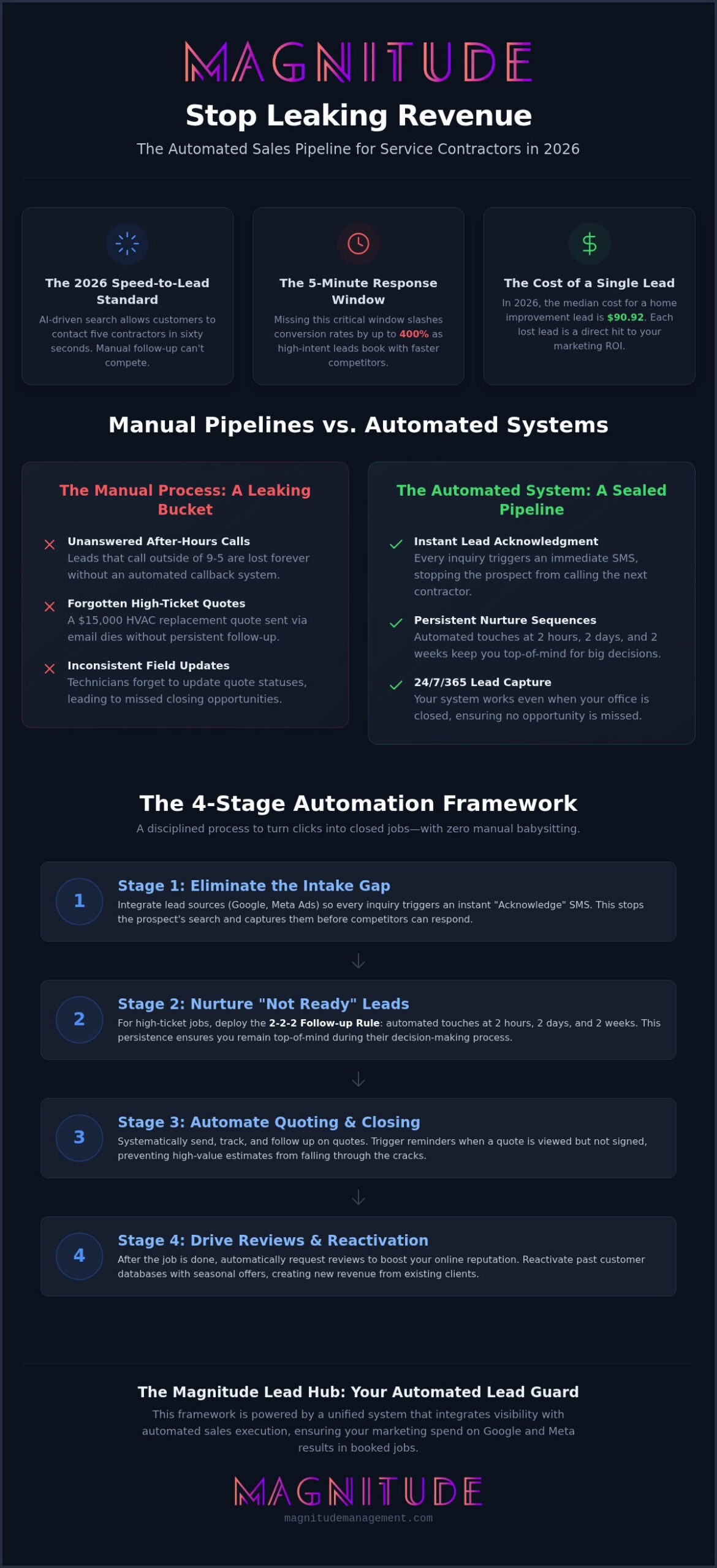
Manual sales pipelines leak revenue because they cannot meet the 2026 speed-to-lead standard. When contractors rely on human dispatchers to handle intake, response times often exceed the critical five-minute window, causing high-intent leads to book with faster competitors. Sales pipeline automation for service businesses solves this by using software-driven triggers to provide instant SMS responses, capturing prospects immediately and protecting marketing investments from the high cost of lead response failure.
The high cost of “Industry Theater” is the silent killer of profitability in the trades. You might see an office full of dispatchers typing into spreadsheets and assume the business is healthy. However, if those leads aren’t being touched within seconds, your team is just performing activity without outcome. In high-volume Arizona markets, manual data entry creates lead leakage that you simply cannot afford when lead costs are rising. Relying on a human to “get to it” after their lunch break is a strategy for losing $15,000 HVAC replacements to the guy down the street.
The brutal reality of the 2026 Speed-to-Lead standard
AI-driven search allows customers to contact five contractors in sixty seconds. Your staff cannot compete with an automated Lead Guard system that never sleeps and never takes a break. Think about a Tucson homeowner with a broken AC in July. Their house is 95 degrees. They don’t have brand loyalty; they have a crisis. If you don’t respond instantly, they’ll move to the next listing on Google Maps. Automation ensures you are always the first to respond, turning urgency into a booked appointment before your competitors even see the notification.
Identifying the ‘Leaks’ in your current sales process
Revenue disappears through specific, predictable cracks in a manual operation. These leaks often go unnoticed until you perform an ad waste audit to see where your money is actually going. Common points of failure include:
- Unanswered after-hours calls that never receive a return dial.
- High-ticket roofing or plumbing quotes sent via email that die because of zero follow-up sequences.
- Technicians forgetting to update the status of an open estimate while in the field.
Every lost lead is a sunk cost that inflates your acquisition expenses. You are likely sitting on a goldmine of unmined data in your current inbox. Stop guessing where your revenue went and start using a systematic approach to capture every opportunity that comes through your digital door.
The 4-Stage sales pipeline automation framework for contractors
Building a high-performance sales engine requires more than just a contact form on your website. You need a structured framework that handles the entire lifecycle of a lead, from the first click to the final review. Implementing sales pipeline automation for service businesses means moving away from a “hope and pray” model toward a disciplined, four-stage process that ensures no job is left on the table. This framework prioritizes speed, persistence, and visibility, allowing you to scale without adding more administrative staff.
Stage 1: Eliminating the intake gap
The moment a prospect finds you on a Google Business Profile or clicks a Meta Ad, the clock starts. If that data doesn’t land directly in your CRM, it’s already at risk. Stage one is about instant capture and multi-channel notification. You must integrate your lead sources so that every inquiry triggers an immediate SMS “Acknowledge” message. This text doesn’t just say “thanks”; it stops the homeowner from calling the next contractor on the list. The Magnitude Lead Hub acts as your Lead Guard, bridging the gap between a digital click and a real-world conversation before your competitor even sees the notification.
Stage 2: Nurturing the ‘Not Ready’ leads
High-ticket jobs, such as a $15,000 HVAC replacement or a full roof install, rarely close on the first call. You’re dealing with customers who need time to weigh their options. This is where most contractors fail by relying on manual follow-up that technicians inevitably forget. We recommend the 2-2-2 Follow-up Rule: automated touches at 2 hours, 2 days, and 2 weeks. This persistence ensures you remain top-of-mind during the decision-making process. You can learn why Arizona contractors lose leads online and how these automated sequences can recover thousands in “spoiled” revenue.
Stage 3 & 4: Closing the loop
A lead that books an appointment is still just an “opportunity” until the invoice is paid. Stage three focuses on pipeline visualization, ensuring a seamless handoff from the sales representative to the service technician. When a job is marked “Closed-Won” in the field, stage four triggers automatically. This includes review requests and referral prompts sent while the customer is most satisfied with your work. Automating this final step is critical for long-term growth. For more on maximizing your digital footprint, see The 2026 Guide to Contractor Reputation. If you want to see how these stages fit into your specific business model, you can explore our custom automation builds designed for the trades.
CRM automation vs. manual follow-up: How does the economics of a lost lead impact your bottom line?
CRM automation lowers your Customer Acquisition Cost (CAC) by maximizing the value of every lead you pay for. While manual follow-up relies on human memory, sales pipeline automation for service businesses ensures immediate response and consistent nurturing for high-ticket quotes. By increasing your lead-to-booked-job ratio, you stop wasting ad spend on leads that spoil due to slow response times, effectively adding six figures to your annual revenue without increasing your marketing budget.
| Performance Metric | Manual Follow-Up | Automated Pipeline |
|---|---|---|
| Average Response Time | 15 – 60+ Minutes | Under 60 Seconds |
| Follow-up Consistency | Inconsistent / Manual | 100% Reliable Triggers |
| Lead-to-Booking Rate | 10% – 15% | 35% – 50%+ |
| Customer Acquisition Cost | High (Wasteful) | Low (Optimized) |
Trade-specific lead economics: HVAC, Plumbing, and Roofing
In the HVAC world, the difference between a $200 repair and a $15,000 replacement often comes down to who followed up on the quote first. Automation allows you to prioritize high-value installation leads while your competition is still sorting through their inbox. For roofing contractors, the sales cycle is a marathon, not a sprint. You need automated touchpoints that span six months to stay relevant during insurance claims. Plumbing contractors face a different reality. You’re dealing with emergencies where automation acts as a 24/7 digital receptionist, capturing the midnight water heater leak before the homeowner calls the next guy on the list.
Stop wasting your ad budget on a broken bucket
If your lead response rate is stuck at 10 percent, doubling your ad spend is just pouring more money into a broken bucket. You don’t need more leads; you need a better system to catch the ones you have. The math is undeniable. A small 5 percent increase in your conversion rate can transform your profitability during the Arizona summer surge. You should perform an Ad Waste Audit to see where your money is going. Stop letting high-value opportunities slip through the cracks and start treating every lead like the $100 marketing investment it actually is.
How to build your automated sales pipeline: A step-by-step guide
Building sales pipeline automation for service businesses isn’t about buying a piece of software and hoping for the best. It’s about engineering a repeatable process that mimics your best sales rep on their best day. You don’t need a complex web of disconnected tools; you need a structured workflow that prioritizes speed and persistence. If your current system relies on a technician remembering to follow up on a $12,000 HVAC install quote, you don’t have a pipeline. You have a series of lucky breaks.
Mapping the high-intent journey
Start by identifying the critical points of failure where leads currently drop off. For most contractors, the biggest leak occurs in the “black hole” between sending an estimate and getting a signature. Map every touchpoint from the initial Google search to the final invoice. Your automated SMS and email templates must sound like a local expert, not a generic bot. If you’re a roofer in Arizona, your follow-up should mention the upcoming monsoon season or specific material availability. Set up internal alerts so your team knows the exact moment a prospect engages with a nurture sequence. This allows you to pick up the phone when the lead is most active.
Selecting and configuring your automation stack
Simple beats sophisticated every time. Don’t get trapped in over-engineered workflows that your team will eventually ignore. You need a CRM that natively supports multi-channel automation, including SMS, email, and voice. Integrating call tracking for contractors is non-negotiable. You must see which specific ads are driving automated deals so you can double down on high-performing campaigns. This visibility is what turns a marketing expense into a predictable profit engine. You can read more about these technical requirements in our guide on The 2026 Profit Engine: Lead Response Automation.
Follow these five steps to build your engine:
- Step 1: Map your customer journey from the first click to the final invoice.
- Step 2: Choose a CRM that supports SMS, email, and voice automation.
- Step 3: Build “Speed to Lead” triggers that fire within 60 seconds of a new inquiry.
- Step 4: Create long-term nurture sequences for open estimates that stretch at least 30 days.
- Step 5: Test your messaging and refine based on real-world response data.
If you’re ready to stop the manual babysitting and start scaling your revenue, book a strategy session with Magnitude today to see our Lead Hub in action.
Magnitude Lead Hub: Integrating visibility with automated sales execution
High visibility on Google Maps is a vanity metric if your phone rings and nobody answers. You can rank in the top three of the local pack, but if that traffic hits a dead-end contact form or a busy signal, you’re just providing free research for your competitors. Implementing sales pipeline automation for service businesses solves this by ensuring that every click from a local search result is captured and processed instantly. The Magnitude Lead Hub is designed to bridge the gap between high-level visibility and bottom-of-funnel execution. It doesn’t just get you seen; it gets you booked.
The ‘Lead Hub’ advantage for Arizona service pros
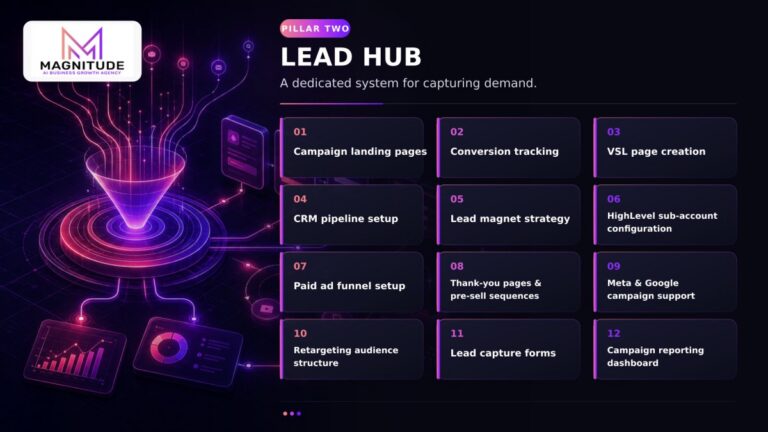
The Lead Hub provides conversion-focused landing pages that feed directly into your automated pipeline. For HVAC and plumbing contractors in the Phoenix and Tucson heat, this means catching emergency leads before they bounce to the next listing. We integrate advanced tracking for Google and Meta Ads so you can stop optimizing for “clicks” and start optimizing for actual profit. This visibility allows you to see exactly which ad spend resulted in a high-ticket replacement job versus a minor service call, and understanding the full picture of your call tracking for contractors marketing ROI is what separates profitable operators from those flying blind. Once the job is marked closed, the system triggers automated 5-star review requests. This builds the local authority needed to stay at the top of Google Maps, creating a self-sustaining growth cycle that feeds your sales pipeline automation for service businesses.
Scaling a service business requires more than just software; it requires strategy. This is where a Fractional CMO becomes essential for your growth. We don’t just hand you the keys to a CRM; we act as a disciplined strategic partner to refine your automation triggers based on real-world performance. Whether you’re managing seasonal surges in roofing or daily plumbing emergencies, your automation logic must evolve with your business. We help you move away from industry theater and toward a system built on radical accountability and measurable results.
Start with a radical accountability audit
Stop guessing about your marketing performance and start measuring your true lead-to-close ratio. You need to understand exactly where your revenue is leaking before you spend another dollar on ads. Magnitude helps HVAC, plumbing, and roofing companies dominate the competitive Arizona markets by replacing vague promises with measurable systems. You can’t fix a broken bucket if you don’t know where the holes are. Our process uncovers the uncomfortable truths about your current lead response times and provides a clear roadmap for recovery.
Get a Local Search Visibility Audit and see how your pipeline compares. This audit is the first step in building a Lead Guard system that protects your marketing investment and ensures every high-intent lead is handled with the precision your trade demands.
Stop Leaking Revenue and Build Your 2026 Sales Engine
The era of manual follow-up is over. If you’re still relying on technicians to track open quotes or dispatchers to return calls hours later, you’re handing your market share to competitors who understand the 5-minute rule. Implementing sales pipeline automation for service businesses isn’t a luxury; it’s the infrastructure required to survive a market where leads cost nearly $100 each. You’ve seen the math. A single lost HVAC replacement or roofing install costs more than the systems needed to prevent the leak.
By integrating AI-powered lead generation with specialized HVAC and plumbing growth strategies, you can turn your marketing spend into a predictable revenue stream. You don’t have to navigate this transition alone. Our Fractional CMO services provide Arizona contractors with the strategic oversight needed to refine every trigger and nurture sequence in the pipeline. It’s time to stop the industry theater and start operating with radical accountability.
Scale your service business with the Magnitude Lead Hub today and take control of your growth. Your future self will thank you for the systems you build today.
Frequently Asked Questions
What is sales pipeline automation for service businesses?
Sales pipeline automation for service businesses is a system of software-driven triggers that manage lead intake, nurturing, and follow-up without human intervention. This ensures that every high-intent lead from Google or Meta Ads is captured and tracked through a dedicated sales pipeline. It eliminates the manual babysitting of leads and prevents revenue leakage by keeping prospects engaged until they book a job. You stop guessing where leads went and start measuring your true ROI.
Does automation make my business sound like a robot to my customers?
No, provided you use templates that sound like a local expert rather than a generic bot. Effective sales pipeline automation for service businesses uses personalized SMS and email scripts that mimic your natural communication style. By mentioning specific trade details or local factors, you maintain a human touch while benefiting from the speed of an automated system. It’s about being fast, not feeling fake. You want to be the first to respond, not the most robotic.
How much time does it take to set up a sales pipeline for an HVAC or plumbing company?
A basic automated pipeline can be mapped and deployed in as little as one to two weeks. The initial phase involves mapping your customer journey from search to invoice and drafting your follow-up templates. While complex workflows take longer to refine, the goal is to start with a simple, high-impact “Speed to Lead” trigger. This immediate improvement in response time provides instant ROI for your marketing spend without adding more administrative overhead to your office.
Do I need a new CRM to start automating my sales process?
Not necessarily, but you do need a system that supports multi-channel automation like SMS, email, and voice. Many older industry CRMs lack the native triggers required for modern sales pipeline automation for service businesses. If your current software can’t text a lead within 60 seconds or run a 30-day nurture sequence, it’s time to consider a conversion-focused platform like the Magnitude Lead Hub. You need tools that prioritize sales execution over simple record-keeping.
Can sales pipeline automation help me get more Google reviews?
Yes, by closing the loop automatically once a job is marked “Closed-Won” in the field. The system triggers a review request via SMS the moment your technician finishes the work. This timing is critical because customer satisfaction is highest immediately after the service. Automating this process ensures you never forget to ask. It consistently builds the local authority needed to dominate Google Maps rankings while your team stays focused on the next service call.
What is the ‘5-Minute Rule’ in lead response?
The 5-minute rule is a benchmark stating that responding to a lead within five minutes increases your conversion probability by 400 percent compared to responding in six minutes. In the service trades, customers are often in an emergency state and will call the next contractor if you don’t answer. Automation ensures you hit this mark every time, even when your office staff is busy or off the clock. It’s the standard for winning in a competitive market.
How does automation help with seasonal surges in service calls?
Automation acts as a “Lead Guard” during peak seasons like the Arizona summer surge. When your call volume triples, your human staff will inevitably miss inquiries or forget follow-ups. Automated systems scale instantly, handling the heavy lifting of lead intake and initial qualification. This allows your team to focus exclusively on high-value jobs, such as $15,000 HVAC replacements, rather than getting buried in administrative tasks. You maintain control even when the schedule is completely full.
Will automation replace my office staff or dispatchers?
No, it empowers them to be more profitable. Automation handles the repetitive, low-value tasks like data entry and initial follow-up, which frees your staff to focus on complex scheduling and customer service. Instead of acting as manual data processors, your team becomes high-level coordinators. It’s about removing waste from your operations and ensuring your staff’s time is spent on activities that actually drive revenue. You are hiring a system to protect your team’s time.