Why Arizona Contractors Lose Leads Online: The Truth About Lead Leakage
Your marketing isn’t failing because your ads are bad. It’s failing because your business is a colander. You’re likely pouring thousands of dollars into Google and Meta ads in hyper-competitive markets like Phoenix and Scottsdale, only to watch that investment evaporate. It’s a common frustration for Arizona business owners who see high cost-per-lead metrics but empty schedules. The reality of why contractors lose leads online often has nothing to do with the quality of the traffic. Instead, it’s about a structural failure in your response infrastructure.
You already know that every missed call during a July HVAC surge in Mesa is a donation to your competition. We’re going to stop that waste. This guide identifies the five critical leaks in your lead-to-sale pipeline and provides the exact framework to plug them. You’ll learn how to move from a chaotic, manual process to a predictable sales pipeline using automated follow-up and the 5-minute rule. We’ll show you how to lower acquisition costs and build a resilient system that doesn’t rely on your office staff being perfect every time the phone rings.
Key Takeaways
- Stop overspending on Google Ads and start fixing the structural flaws in your sales pipeline. A small improvement in retention often generates more revenue than a massive increase in your marketing budget.
- Master the 5-minute rule to capture homeowners during their decision window. Waiting until the end of the day to return calls is effectively burning cash in competitive markets like Phoenix and Tucson.
- Understand why contractors lose leads online by identifying the gap between a generic digital brochure and a high-performing, conversion-focused landing page.
- Deploy automation to eliminate the missed call black hole. Every unanswered call during a peak HVAC surge represents thousands in lost installation revenue that your staff can’t recover manually.
- Leverage your existing customer list through database reactivation. Past clients are significantly easier to close than cold leads, providing the fastest path to recovered revenue without new ad spend.
Why do Arizona contractors lose leads they have already paid for?
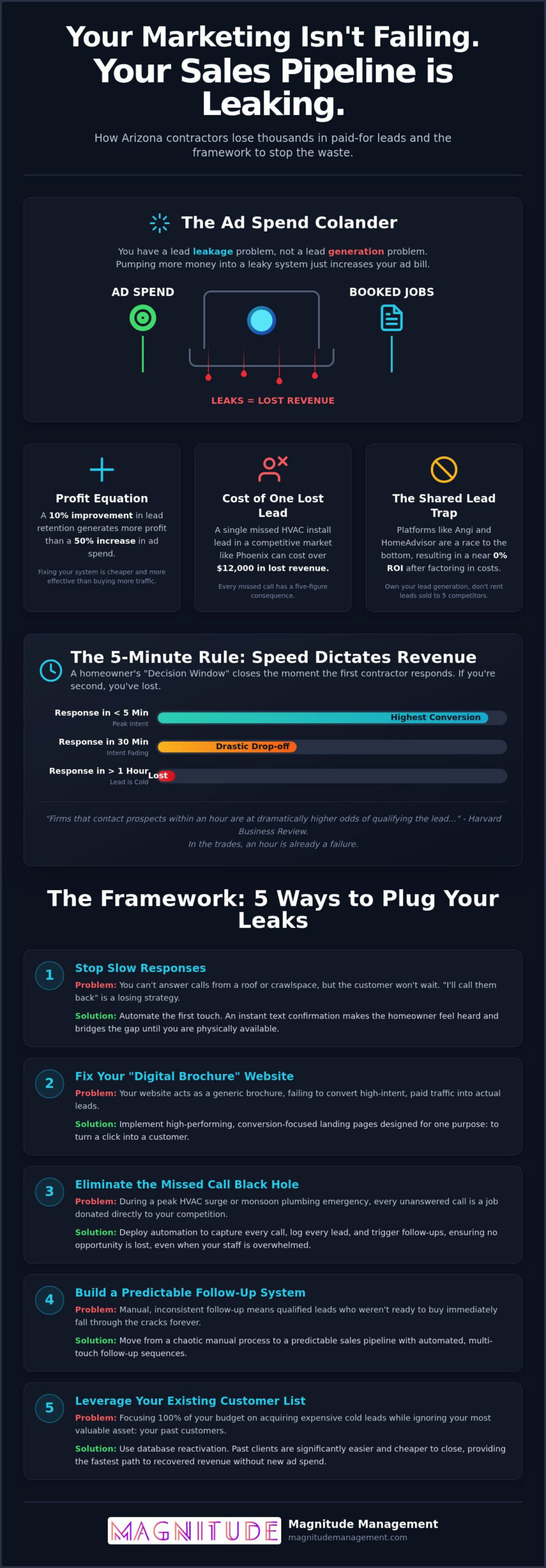
Most Arizona contractors are obsessed with lead volume. It’s a fundamental mistake. You likely don’t have a lead generation problem; you have a lead leakage problem. If your bucket is full of holes, pumping in more water just increases your monthly bill. This is the core reason why contractors lose leads online even when their Google Ads are technically performing well.
The math is brutal but simple. Improving your lead retention by just 10% typically generates more net profit than increasing your ad spend by 50%. Why? Because you’ve already paid for those leads. In a high-stakes market like Phoenix, where a single HVAC install can exceed $12,000, losing just one qualified prospect is a five-figure failure. You can see how this adds up by running an ad waste audit to find the specific gaps in your current spend. Real growth requires Lead Infrastructure, not more marketing hype.
The high cost of ‘Cheap’ lead platforms
Shared lead platforms like Angi or HomeAdvisor are often a trap for local pros. You’re paying for a race to the bottom where you compete with five other companies for a homeowner who is often price-shopping above all else. These high-intent leads go cold in minutes because the homeowner is bombarded by calls the moment they hit “submit.” Magnitude’s philosophy is clear: you must own the platform, not rent a lead that has already been sold to your competitors. Relying on shared platforms results in a 0% ROI when your overhead and the cost of competition are factored in.
Compounding leaks: The brutal math of contractor marketing
Lead leakage is the measurable loss of potential revenue occurring between initial contact and a booked appointment due to system failures. It’s rarely one single issue. It’s a compounding series of failures. A missed call during a Scottsdale monsoon or a slow response to a plumbing emergency in Mesa multiplies your acquisition costs instantly.
Phoenix contractors face some of the highest competition in the country. This intensity means the “cost of leakage” is significantly higher here than in smaller markets. Without a disciplined lead management process, you aren’t just losing a name and a phone number. You’re handing your local competitors a job that you already paid to acquire. Protecting your margins requires a system that captures every opportunity with surgical precision.
Does the 5-minute rule actually dictate your conversion rates?
Speed isn’t just a courtesy. It’s the difference between a booked job and a wasted lead. Homeowners in Tucson don’t browse when their AC dies in 110-degree heat or a pipe bursts in the middle of the night; they hunt. They operate within a narrow “Decision Window.” This window closes the moment the first qualified contractor answers the phone or sends a text. If you’re the second person to call, you’re usually too late. This frantic need for an immediate solution is a primary reason why contractors lose leads online when they lack an automated response system.
Research from Harvard Business Review shows that firms that contact prospects within an hour are at dramatically higher odds of qualifying the lead compared to those who wait. In the trades, “within an hour” is often already a failure. If you wait until the end of the day to return calls, you are effectively burning the cash you spent to get that lead in the first place. You’ve paid for the opportunity, but your slow response handed the revenue to a competitor who was faster on the draw.
The 5-minute rule vs. the reality of the job site
You can’t answer the phone while you’re in a crawlspace or balanced on a Scottsdale roof. It’s a physical impossibility. Yet, the market doesn’t care about your schedule or your workload. “I’ll call them back” is a losing strategy because, by the time you’re off the roof, the homeowner has already booked with the guy who texted them back in 60 seconds. The Magnitude Lead Hub solves this by automating that first touch. It ensures the homeowner feels heard immediately, even while you’re elbow-deep in a repair. This infrastructure protects your marketing investment by bridging the gap between a lead’s arrival and your physical availability.
Implementing speed-to-lead without hiring more office staff
Winning doesn’t require a massive call center. It requires systems. Instant SMS back-responses are the secret weapon for modern contractors. When a lead comes in from Google, an automated text goes out instantly to acknowledge the request. This stops the homeowner from scrolling back to the search results to find the next competitor. These automated sales pipelines keep the prospect engaged and warm while you’re driving between calls or finishing a job. You can learn more about Lead Response Automation to see how this fits into a modern growth strategy. By removing the dependency on human speed, you create a predictable revenue stream that doesn’t falter during peak season. If you want to see how your current response time stacks up, you can request a performance review of your lead infrastructure.
Why is your website leaking leads to Phoenix and Tucson competitors?
Stop treating your website like an art project. It’s a sales tool, but most Arizona contractors use it as a digital brochure. These sites are static, vague, and functionally useless for conversion. They leak leads because they force the user to work too hard. In a market where competition is cutthroat, a homeowner in Phoenix or Tucson won’t hunt for your contact info. If they can’t find a way to hire you in a few seconds, they’ll bounce back to the search results and click your competitor’s link instead.
Your site must mirror the desert’s reality. An HVAC site in July shouldn’t look the same as it does in January. If a Mesa homeowner is dealing with a 115-degree AC outage, they don’t want to read a long-winded “About Us” page. They want to know you’re available now. Similarly, a roofing site that doesn’t pivot to prioritize leak repairs during the monsoon season is failing its visitors. This lack of seasonal relevance is a primary reason why contractors lose leads online. Generic content kills urgency and makes you look out of touch with the local climate.
The 2-second test for contractor websites
Can a Scottsdale homeowner tell what you do, where you do it, and how to hire you in 2 seconds? If the answer is no, you’re burning your marketing budget. High-performing sites prioritize “above-the-fold” click-to-call buttons and lead forms that ask for three fields, not ten. Every extra field you add is a barrier that encourages a prospect to leave. To see where your site is currently failing, you can get a Local Search Visibility Audit to identify these specific conversion killers.
GEO Search and AI visibility for Arizona trades
Google’s Search Generative Experience (SGE) and modern AI models prioritize “helpfulness” and local authority. A single “Service Areas” page listing twenty cities isn’t enough to rank anymore. You need dedicated infrastructure for specific queries like “HVAC Repair in Peoria” vs. “AC Installation in Glendale.” Magnitude builds GEO-optimized systems that speak the language of Google Maps and AI search models. This isn’t just about keywords; it’s about demonstrating local relevance. This approach aligns with foundational research on lead response times, which proves that the faster a system facilitates a connection, the higher the conversion. If your website doesn’t facilitate that instant bridge through localized authority, it’s just an expensive business card that nobody sees.
How can automation prevent the missed call black hole?
Every time your phone rings and goes to voicemail, you are losing money. It is that simple. In the Arizona market, voicemail is effectively where contractor leads go to die. Most homeowners won’t leave a message. They will simply hang up and call the next listing on Google. If you are an HVAC contractor in Phoenix during a 115-degree July surge, a single missed call can represent a lost installation worth $10,000 or more. This “missed call black hole” is a leading reason why contractors lose leads online even when their marketing is generating plenty of interest.
Relying on office staff to be perfect is a recipe for failure. Humans get overwhelmed, take lunch breaks, and sleep. Your lead response system shouldn’t. By integrating calls directly into a CRM sales pipeline, you ensure that every interaction is tracked and followed up on immediately. This removes the guesswork and creates a safety net for your revenue. If you want to see exactly how much revenue is slipping through your fingers, you should audit your ad waste now to identify these specific system failures.
Turning missed calls into text conversations
The goal is to stop the homeowner’s search immediately. If you can’t answer the phone, your system must. We recommend a three-step automation process to capture these “lost” opportunities:
- Step 1: Implement an automated “Missed Call Text Back” system that triggers the second a call is missed.
- Step 2: Use that SMS to capture the lead’s intent. Ask them what they need and let them know you’re on it.
- Step 3: Automatically move that lead into a sales pipeline automation for service businesses so your team can track the status until the job is booked.
This process changes the dynamic. Instead of a frustrated prospect calling your competitor in Mesa, you have an engaged lead waiting for your follow-up. It buys you time without sacrificing the lead.
Call tracking: Stop guessing where your money goes
You can’t manage what you don’t measure. Most contractors have no idea which ad campaigns are actually making the phone ring. You need unique tracking numbers for Google Ads, Meta Ads, and your Google Business Profile. This level of visibility allows you to stop spending on campaigns that produce “lookers” and double down on the ones that produce “bookers.” Implementing call tracking for contractors is the financial audit tool that reveals exactly which marketing dollars are generating booked jobs versus which ones are being swallowed by tire-kickers and wrong numbers.
Analyzing call recordings is another critical step. It allows you to identify if your staff is actually closing the leads you pay for or if they’re leaking revenue through poor phone etiquette. In the high-stakes Arizona market, where seasonality dictates your entire year, you can’t afford to guess. You need a disciplined lead infrastructure that provides total transparency into your sales funnel. This data-driven approach turns your marketing from a gamble into a predictable engine for growth.
Why is database reactivation the fastest path to recovered revenue?
Stop chasing the next shiny lead from Google. You’re likely sitting on a list of hundreds or thousands of people who already know, trust, and have paid you. This is the ultimate hedge against rising ad costs in Mesa and Scottsdale. While your competitors are fighting over $115 leads, you can generate jobs for the cost of a text message. A major reason why contractors lose leads online is their total failure to nurture the back-end of their business. They focus on the front-end “hit” and ignore the goldmine already in their CRM.
Past customers are five times easier to close than cold prospects. They don’t need a sales pitch; they just need a reminder. Magnitude’s Revenue Recovery framework allows you to re-engage 1,000 past clients in under 24 hours. It’s about leveraging seasonality. Reach out to your Phoenix HVAC list in March for pre-summer tune-ups. Contact your roofing clients in June before the monsoon season starts. This proactive approach fills your schedule before the emergency calls even start coming in. In competitive markets, the cost of acquisition is only going up. If you aren’t mining your database, you are essentially leaving money on the table for your competitors to take.
Mining your old database for ‘Found Money’
Reactivation campaigns do more than just fill your calendar. They build your local authority. When you successfully re-engage a Tucson resident, your system should immediately trigger a review request. Fresh, localized feedback is what moves the needle on Google Maps. If you’re wondering why contractors lose leads online, it’s often because their local rankings have slipped due to a lack of recent reviews. Magnitude’s Lead Hub automates this entire recovery and reputation process, turning your past successes into future visibility. By connecting repeat service calls to automated review generation, you create a self-sustaining system that lowers your long-term marketing costs.
Plug the Leaks and Protect Your Profits
You’ve seen the evidence. Paying for more traffic while your response system is broken is just expensive theater. The fundamental reason why contractors lose leads online is a lack of infrastructure, not a lack of interest. By implementing the Magnitude Lead Hub and enforcing the 5-minute rule, you transform your operation from a leaky bucket into a high-performance revenue engine. You’ve already done the hard work of building a trade business in the Phoenix and Tucson metros. Now it’s time to protect that investment with proven GEO search visibility and automated follow-up.
Stop the missed call black hole and start focusing on the revenue you’ve already earned. Our specialized fractional CMO services help you move beyond marketing hype and into measurable growth. Your next big scaling phase is likely already sitting in your dormant database; you just need the systems to unlock it. Stop losing leads and start scaling with a free Lead Waste Audit from Magnitude today. We’re ready to help you build a predictable sales pipeline that works as hard as your crews do.
Frequently Asked Questions
How much lead response time is too much for a contractor?
Anything over five minutes is a failure. Arizona homeowners, especially those facing a broken AC in Scottsdale or a leak in Mesa, operate in a state of high urgency. If you don’t respond within that first five-minute window, your odds of qualifying the lead drop significantly. You aren’t just competing on price or skill; you’re competing on speed. If you aren’t first, you’re usually forgotten.
Why do my Google Ads leads never pick up the phone?
They didn’t stop their search just because they filled out your form. If you don’t call back instantly, they’ll simply click the next ad. This is a major reason why contractors lose leads online; the homeowner is in a “decision window” that only stays open for a few minutes. By the time you call an hour later, they’ve already booked an appointment with your competitor.
Is it better to have a high volume of leads or higher quality leads?
Higher quality leads are always preferable, but even the best leads are worthless without proper infrastructure. Most contractors try to solve revenue problems by buying more lead volume, which only increases their waste. Focus on capturing high-intent leads for profitable jobs, like full system replacements in Phoenix. Once your conversion system is tight, then you can scale the volume without burning your marketing budget.
What is the average lead conversion rate for HVAC companies in Arizona?
While specific numbers vary by trade and season, many Arizona HVAC companies report conversion rates between 15% and 25% for digital leads. If your rate is lower, you likely have a leakage problem in your sales funnel. High-performing contractors who use automated follow-up systems often see these numbers climb much higher. It’s less about the market and more about how effectively you manage the lead-to-sale pipeline.
Can CRM automation actually replace a full-time receptionist?
It doesn’t replace the person, but it makes them ten times more effective. Automation handles the repetitive, high-speed tasks like instant SMS back-responses that a receptionist might miss during a busy HVAC surge. It provides a 24/7 safety net that captures leads while your staff is on the phone or out of the office. It’s about building a system that doesn’t rely on human perfection to generate revenue.
How do I know if my contractor website is leaking leads?
Look at your conversion data. If your website has high traffic but low call volume, it’s leaking. Test your site on a mobile phone; if a Phoenix homeowner can’t find a click-to-call button within two seconds, they’ll leave. Generic “brochure” websites that lack localized GEO search pages or clear calls to action are the biggest culprits of lead loss in competitive Arizona markets.
What happens if I miss a call from a Local Services Ad?
You pay for the mistake twice. First, you’re billed for the lead even if you never spoke to them. Second, Google’s algorithm tracks your responsiveness. If you consistently miss calls from Local Services Ads, Google will lower your ranking in the search results. This makes your future leads more expensive and harder to get. Missing calls is a direct drain on your company’s profitability and visibility.
How can I recover leads from a database I haven’t touched in years?
Start a database reactivation campaign. This involves sending an automated, high-value offer via SMS or email to your dormant list. For example, offer a pre-monsoon roofing inspection to your past clients in Tucson. This process turns old data into “found money” without the high cost of new ad spend. It’s the most efficient way to recover revenue and fill your schedule during shoulder seasons.