Pest Control Advertising Ideas Peoria: Top High-ROI Strategies for 2026
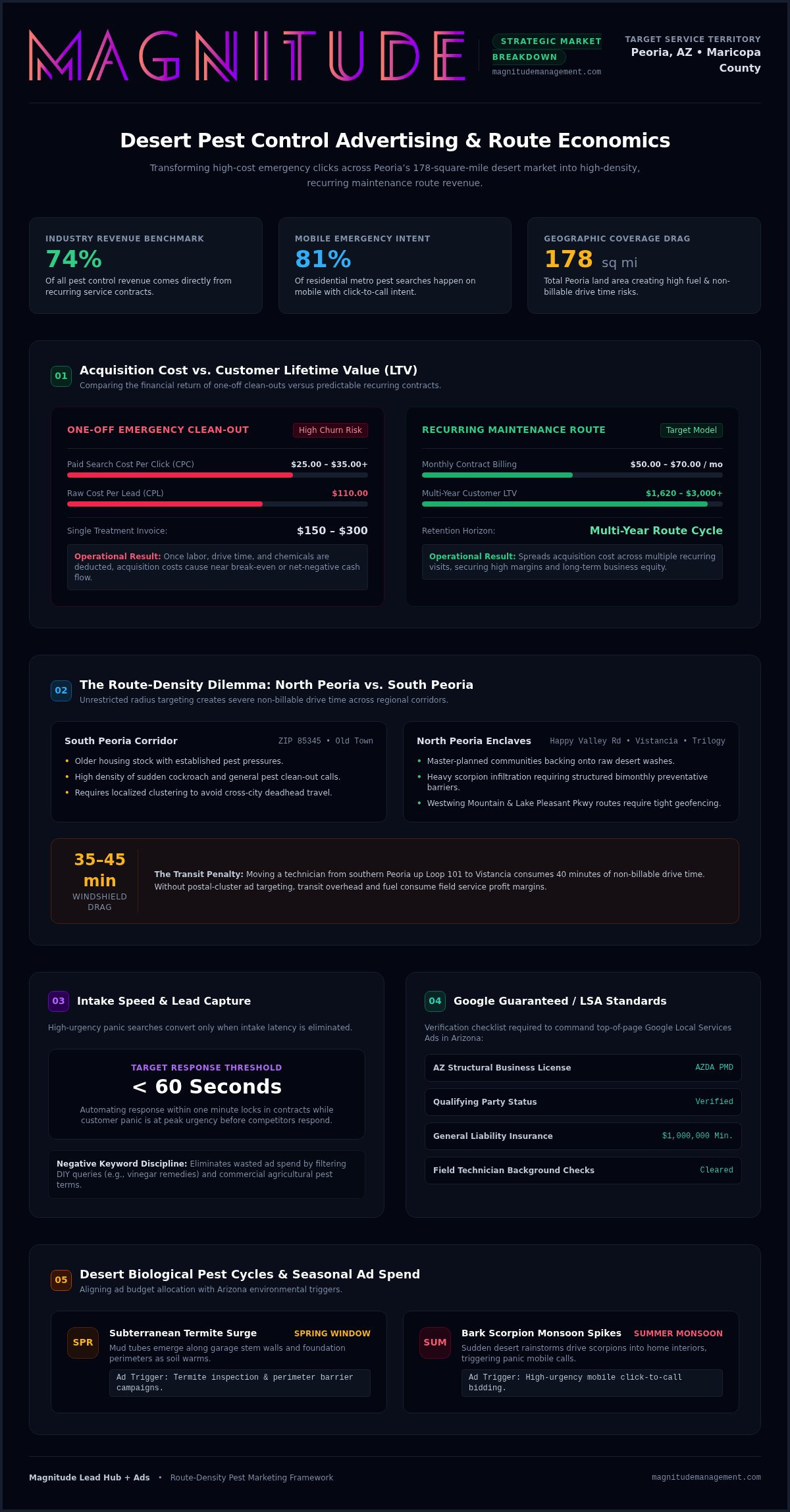
Seventy-four percent of pest control revenue comes from recurring contracts, yet most campaigns bleed cash paying steep costs per click just to chase frantic, one-time exterminations. If you are hunting for high-yield pest control advertising ideas Peoria operators can actually scale with, blasting generic ads across 178 square miles of desert simply burns your budget on windshield time.
You already know the seasonal frustration. When monsoon storms trigger sudden bark scorpion panics, calls flood in, but if your technician is stuck crawling up Loop 101 toward Vistancia, your profit margin disappears in transit. Slower intake speeds only make things worse, handing high-urgency emergency calls directly to your competitors while you foot the bill for the click.
Discover the highest-converting advertising channels in Peoria to turn desert pest emergencies into profitable recurring contracts. We will break down how to tighten ad spend around high-density North Peoria neighborhoods, automate emergency intake to capture immediate termite and scorpion leads, and convert one-off emergency panics into reliable route revenue that sustains your business year-round.
Key Takeaways
- Micro-targeting postal clusters prevents technician travel across Peoria’s 178-square-mile territory from eroding your service margins.
- Google Local Services Ads and targeted search campaigns capture high-urgency mobile calls before competitors can react.
- Applying proven pest control advertising ideas Peoria operators rely on shifts your customer acquisition from volatile one-off jobs to profitable recurring maintenance routes.
- Aligning ad spend with regional biological cycles lets you dominate subterranean termite activity in spring and bark scorpion spikes during summer monsoons.
- Automating lead response within sixty seconds plugs expensive funnel leaks and locks in service contracts while customer urgency is at its peak.
Why Most Peoria Pest Control Advertising Fails to Generate Route Density
Most local marketing campaigns treat every lead as an isolated transaction. You bid on a search term, dispatch a truck, and collect a one-off fee. That transactional mindset completely ignores the basic operational math of the pest control industry, where long-term business equity depends entirely on compact, predictable service runs.
Peoria covers 178 square miles. When your marketing lacks geographic discipline, a truck finishes an emergency cockroach spray near Old Town in ZIP code 85345, only for dispatch to send them 40 minutes north along Lake Pleasant Parkway to handle a spider clean-out in Vistancia. Non-billable drive time eats up technician capacity, spikes fuel overhead, and destroys field service margins. Effective pest control advertising ideas Peoria operators deploy must solve this operational drag by clustering recurring accounts into hyper-local neighborhood blocks rather than chasing scattered calls across Maricopa County.
The Route-Density Dilemma in North Peoria vs. South Peoria
A broad “Peoria pest control” search campaign treats the entire municipality as a monolith. That is an expensive mistake. The housing age, pest pressure, and travel logistics in older southern corridors differ drastically from the master-planned communities expanding north along Happy Valley Road.
- Travel Disconnect: Moving between southern hubs and northern enclaves like Trilogy or Westwing Mountain regularly consumes 35 to 45 minutes of unproductive windshield time per technician.
- Preventative Opportunities: High-density developments built against raw desert washes face heavy scorpion infiltration, making them prime targets for structured bimonthly preventative barriers.
- Boundary Bleed: Unrestricted radius targeting forces you to buy impressions in distant zip codes or unlicensed territories that your field crew cannot service efficiently.
Acquisition Cost vs. Customer Lifetime Value in Desert Pest Control
Buying emergency search clicks to secure a single $150 to $300 clean-out visit often results in net-negative cash flow. Paid search clicks on high-urgency keywords routinely range from $25.00 to over $35.00, pushing your raw cost per lead to $110.00. Factor in close rates, labor, and chemical supplies, and that initial invoice barely breaks even.
Real profitability kicks in when an ad campaign specifically targets and secures recurring service contracts, where a homeowner generating $50 to $70 monthly yields $1,620 to over $3,000 across a multi-year retention cycle. Stop paying premium auction rates for customers who churn after one treatment. Running an ad waste audit exposes the broad keywords and zero-converting search terms draining your cash, allowing you to refocus spend strictly on predictable, high-retention Peoria routes.
High-Intent Advertising Channels: Capturing Emergency Desert Pest Calls
Panic drives desert pest searches. When a Peoria homeowner spots an Arizona bark scorpion crawling up a nursery wall or finds subterranean termite mud tubes along their garage stem wall, they don’t browse blogs. They pull out a smartphone and dial the first licensed operator with strong reviews. Roughly 81% of residential pest searches across the metro area occur on mobile devices with immediate click-to-call intent. Your advertising must sit directly at that exact intersection of fear and necessity.
Testing unproven pest control advertising ideas Peoria competitors use often leads to wasted ad budgets on tire-kickers. Capturing emergency volume requires intercepting prospects at the top of the search engine results page, routing frantic callers straight to dispatchers without page latency, and utilizing rigorous negative keyword lists to filter out DIY queries like “how to kill scorpions with vinegar” or commercial agricultural pests.
Google Local Services Ads (LSA) for Peoria Exterminators
Google Local Services Ads command the absolute top spot above standard search ads. Securing the Google Guaranteed badge requires an active Arizona Pest Management Division (AZDA PMD) structural business license, proof of qualifying party status, $1,000,000 in General Liability insurance, and clear background checks for all field technicians.
- Pay per valid call: With verified LSA lead costs ranging between $20.00 and $65.00 per charged call, you only pay for actual customer conversations rather than unqualified clicks.
- Monsoon budget management: Raise your weekly LSA cap during peak summer humidity spikes when desert pest activity surges, keeping your badge pinned to the top three positions.
- Dispute bad leads: Regularly audit call recordings and dispute out-of-service-area zip codes or wrong numbers directly with Google to protect your spend.
Google Search Ads for Scorpions, Termites, and Rodents
Traditional search ads allow precise messaging tailored to specific desert biology and Integrated Pest Management principles. Never dump every pest service into a single ad group. Separate high-ticket subterranean termite treatments from emergency venomous scorpion jobs and winter roof rat exclusion projects.
High-converting ad copy directly addresses two massive customer concerns: rapid dispatch times and kid-safe, pet-friendly products. Setting up call-only campaigns during daytime service hours bypasses mobile landing pages altogether, instantly connecting panicked homeowners with your front desk. If you want to structure high-performing local campaigns that eliminate junk traffic, reviewing proven strategies for paid advertising for local service businesses will help keep your customer acquisition costs disciplined and predictable. For full-scale management, partner with experienced trade advertising specialists who understand Peoria’s regional pest economics.
Top Pest Control Advertising Ideas in Peoria: Channel Evaluation Breakdown
Every dollar in your marketing budget must produce predictable service routes. Relying on gut feel or vanity metrics like video views will drain your working capital. The most effective pest control advertising ideas Peoria companies implement evaluate channels based on close rates, customer acquisition cost, and long-term retention potential.
Synchronizing your channels pays compounding dividends. Trade data shows that home service contractors running coordinated multi-channel campaigns across search, maps, and social achieve 3.1 times higher conversion rates than operators depending on a single platform. The secret lies in assigning specific operational jobs to each channel rather than expecting one medium to do everything.
Hyper-Local Meta Ads for Preventative Neighborhood Subscriptions
Meta platforms excel at visual education rather than emergency response. Cold social leads convert at 5% to 10%, compared to 15% to 30% for high-intent search ads, making direct emergency pitches inefficient on Facebook or Instagram. Instead, use short video creative to demonstrate seasonal vulnerability, such as showing subterranean termite swarms penetrating weep screeds during spring rains.
Target specific postal boundaries like 85383 to reach master-planned communities. Present neighborhood-specific perimeter defense packages aligned with integrated pest management principles, encouraging adjacent homeowners to sign up for scheduled bimonthly maintenance blocks.
Local Map Pack Visibility and Customer Review Systems
Ranking in the top three Google Map results captures high-urgency local homeowners at zero incremental cost per click. If your listing is invisible outside your immediate physical yard, perform a structured local search visibility audit to isolate profile deficiencies and citation gaps.
Map pack rank relies heavily on review velocity and geographic relevance. Deploying an automated system for reputation management for contractors prompts satisfied clients immediately following service completion. Homeowners who mention their specific Peoria neighborhood and technician names build powerful local trust signals that lift your map ranking across adjacent zip codes.
Targeted Print and Community Sponsorships in High-Growth Subdivisions
Physical collateral still commands attention when delivered with precision. Direct mail works best when targeted exclusively at newly constructed homes where original pre-construction soil treatments are expiring.
- Targeted Postcards: Send recurring maintenance offers to recently completed subdivisions lacking established exterior repellent barriers.
- Local Sponsorships: Back Peoria Little League teams or community HOA events to build trust alongside digital campaigns.
- Trackable Routing: Print distinct QR codes on all physical mailers that drive traffic directly to dedicated neighborhood landing pages, ensuring clean tracking across offline channels.
Seasonal Campaign Scheduling: Aligning Your Peoria Ad Spend with Pest Cycles
Static marketing budgets fail in the Sonoran Desert. Pests respond directly to temperature thresholds and soil moisture, which means your ad spend must expand and contract alongside regional biology. Running an identical daily spend in November as you do during a July heatwave guarantees two outcomes: burning cash on low-intent clicks in winter and running out of budget by noon when summer panic peaks.
Smart pest control advertising ideas Peoria operators rely on treat marketing capital as an elastic resource. Spring requires heavy positioning around subterranean termite swarms (Heterotermes aureus), which emerge twice each year following early spring showers and late-summer storms. As temperatures cross triple digits, homeowner attention pivots immediately to venomous invaders seeking moisture indoors. Adjusting bids in lockstep with these cycles protects your margins while guaranteeing front-row visibility during peak search volume.
Monsoon Surge Strategy: Scorpion and Ant Advertising
High humidity and severe summer downpours between July and September drive Arizona bark scorpions straight into living spaces. Search volume spikes violently after major storm events. Your campaigns must react instantly.
- Daily Budget Escalation: Lift your daily Google Ads budget caps during active storm weeks to capture emergency surges without pausing midday due to depleted funds.
- Urgent Creative: Feature ad messaging emphasizing same-day blacklight inspections, targeted exterior repellent barriers, and rapid home sealing solutions.
- Database Monetization: Before monsoon rains begin, reactivate past one-time clients. Executing a systematic strategy for database reactivation for service companies turns dormant emergency contacts into recurring subscription revenue without paying current auction CPCs.
Winter Rodent and Pigeon Exclusion Campaigns
Pest activity does not stop when desert temperatures drop; it simply migrates upward. From October through February, roof rats exploit dense citrus groves and palm canopies throughout older neighborhoods, nesting inside warm attic insulation.
Pivot your paid campaigns away from general insect sprays toward high-ticket exclusion and wildlife proofing. Promote solar panel pigeon-proofing, roof-line mesh exclusion, and complete attic sanitization across master-planned developments. Simultaneously, use slower residential months to pitch commercial kitchen maintenance to restaurants and local facilities, locking in high-retention baseline revenue that keeps your technicians billable year-round. To calibrate your seasonal budget and capture urgent winter and summer demand, scale your paid campaigns with Magnitude.
Magnitude Lead Hub + Ads: Building a Dominant Peoria Pest Marketing Engine
Generating clicks is only half the battle. If an emergency lead sits in an unmonitored inbox for twenty minutes, that prospect has already booked an inspection with the contractor ranked right below you. Magnitude Lead Hub + Ads fixes that operational leak. We pair high-intent Google and Meta advertising with automated lead response and dedicated conversion infrastructure built specifically for field service companies.
Rather than letting expensive traffic bounce off generic website homepages, our system routes prospects to hyper-localized landing pages designed around single-service urgency. Applying modern pest control advertising ideas Peoria operators need requires closing the gap between ad click and technician dispatch, turning high-cost desert clicks into secured route density.
The Speed-to-Lead Advantage for Pest Contractors
Speed dictates close rates in emergency home services. When a homeowner discovers bark scorpions in their living room, their urgency decays rapidly with every passing minute.
- Instant Dispatch Bridging: Inbound form submissions trigger an immediate automated text to the prospect while simultaneously connecting your dispatch desk via an outbound bridge call within sixty seconds.
- Stopping Competitor Calls: Locking in immediate two-way communication prevents panicked homeowners from returning to Google search results to call your competitors.
- Automated Ingestion: Ingesting, qualifying, and assigning leads through structured lead response automation for service businesses ensures zero missed opportunities during peak call volumes.
Multi-Channel Tracking and Pipeline Attribution
Most marketing agencies deliver vanity metrics like raw impressions or unqualified phone clicks. We track revenue down to the closed service contract. Our attribution architecture shows you precisely which keyword delivered an initial termite inspection and tracks that customer through their second-year renewal.
Knowing your true return on ad spend by neighborhood allows for ruthless budget efficiency. If Google LSA delivers subterranean termite jobs at a lower customer acquisition cost in zip code 85383 while targeted Meta video ads build denser recurring general pest routes along Happy Valley Road, we shift ad spend dynamically to maximize route profitability.
Claim Your Competitive Edge in Peoria
Dominating your local market requires ending disjointed vendor management. Juggling separate freelancers for search ads, website updates, and review generation leads to disconnected data and wasted ad spend. Magnitude integrates paid ads management, local search visibility, and rapid lead intake into one unified engine built to grow your field service operation. To cut waste, build tight service routes, and scale predictable revenue, request your local visibility and lead audit with Magnitude.
Turn Desert Pest Emergencies into Scalable Peoria Route Equity
Running a profitable extermination business in the West Valley requires moving past disconnected marketing tactics. Implementing the most effective pest control advertising ideas Peoria operators use means trading scattered emergency calls for hyper-local route density, adapting your ad spend to monsoon scorpion surges and spring termite swarms, and plugging costly intake leaks. When you target tightly defined postal clusters and connect with frantic callers in under sixty seconds, high-urgency desert jobs become the foundation of multi-year recurring maintenance contracts.
You don’t need more random clicks; you need an integrated acquisition infrastructure. Backed by deep regional expertise in Arizona home service trade markets, Magnitude combines precision paid advertising, local search visibility, and customer reputation systems into a single engine. Magnitude Lead Hub ensures your team bridges inbound inquiries within sixty seconds, stopping competitors from stealing your pipeline. Take command of your service routes and build predictable equity in your territory. Accelerate your recurring pest control revenue with Magnitude today.
Frequently Asked Questions
How much should a Peoria pest control business spend on advertising each month?
Most established pest control businesses in Peoria allocate 5% to 9% of gross revenue toward advertising, while growing operators aiming to acquire route density often invest 10% to 15%. Your exact monthly budget depends on current truck capacity and customer churn rates. In a high-growth market like North Peoria, spending beneath the threshold needed to maintain steady Google Local Services Ads and search positioning simply hands emergency volume to dominant regional competitors.
Which generates better pest control leads in Peoria: Google LSAs or standard Google Ads?
Google Local Services Ads generally produce cheaper, higher-converting phone calls, but standard Google Ads provide greater control over targeting specific high-ticket pests like subterranean termites. LSAs excel at immediate pay-per-call emergency inquiries because verified badges build instant trust with cautious homeowners. However, standard search ads allow negative keyword filtering, customized landing pages, and micro-geotargeting around specific zip codes. Combining both channels delivers superior overall customer acquisition cost compared to relying on one.
How can Peoria pest control companies get more recurring service agreements?
You convert emergency callers into recurring agreements by using initial one-off services as entry points into automated retention workflows. Testing proven pest control advertising ideas Peoria contractors rely on starts at dispatch. When a technician resolves a bark scorpion scare, your system must immediately trigger automated SMS follow-ups offering bimonthly perimeter maintenance. Presenting regular service as preventative protection rather than an optional add-on locks homeowners into predictable annual subscriptions before their panic fades.
What are the most profitable pests to target with ads in Peoria, Arizona?
Subterranean termites and roof rats deliver the highest gross ticket values, while Arizona bark scorpions generate the highest volume of recurring maintenance contracts. Termite treatments and complete rodent exclusion jobs yield substantial upfront revenue through intensive physical labor and specialized structural barriers. Conversely, scorpion calls carry immense emotional urgency. Homeowners facing venomous pests readily sign twelve-month preventative agreements to safeguard children and pets, producing dependable recurring lifetime value.
Why is speed-to-lead critical for pest control advertising success?
Speed-to-lead determines your conversion rate because panicked homeowners rarely wait around for a callback; they immediately dial the next exterminator on the search results. Connecting with an inbound web inquiry within sixty seconds dramatically improves booking rates compared to waiting thirty minutes. Implementing automated intake and instant phone bridging stops lead leakage. If your dispatch desk doesn’t respond instantly to an emergency submission, you end up paying for an expensive click while a competitor secures the revenue.
How do seasonal monsoon rains in Peoria affect pest control advertising budgets?
Peoria’s July-to-September monsoon season causes a violent surge in pest activity, requiring business owners to increase their daily ad budgets by 30% to 50%. Intense desert rainstorms and humidity force bark scorpions, sewer roaches, and ants out of saturated ground and directly into homes. Exploring dynamic pest control advertising ideas Peoria companies use reveals that keeping budgets flat during monsoon months caps your visibility before midday, shutting off lead intake right when emergency search volume hits its annual peak.