Lead Response Automation for Service Businesses: The 2026 Profit Engine
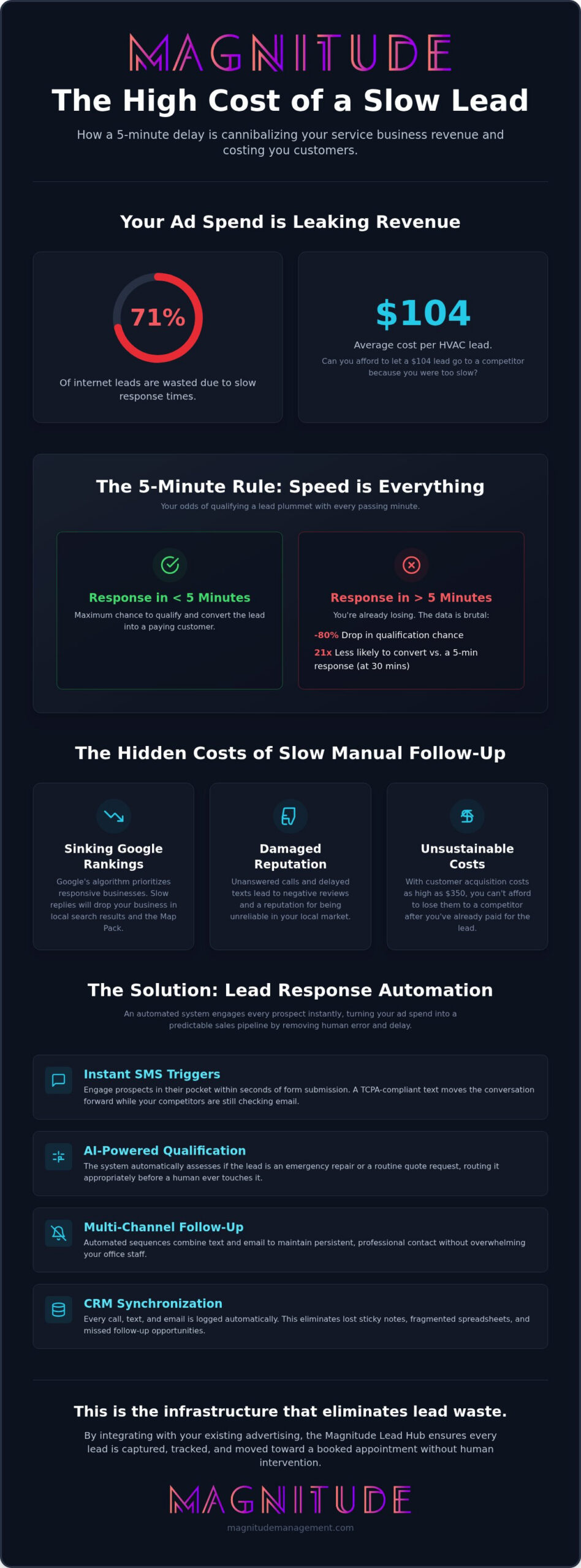
You’re paying an average of $104 for every HVAC lead that hits your inbox, yet 71% of those internet leads are wasted because your team can’t pick up the phone fast enough. If you wait 30 minutes to call back, you’re 21 times less likely to qualify that lead than if you responded in five. This isn’t a staff performance issue; it’s an infrastructure failure. Implementing lead response automation for service business is no longer a luxury for the top 1% of contractors. It’s the only way to protect your margins when customer acquisition costs have climbed as high as $350 per customer.
You know the frustration of watching high-intent homeowners choose a competitor simply because they were the first to answer a text. We’ve built this guide to show you how to stop the revenue bleed by deploying an automated system that engages every prospect in under five minutes. You’ll learn how the Magnitude Lead Hub transforms raw ad spend into a predictable sales pipeline by removing human error from the initial touchpoint. We’ll break down the 2026 TCPA compliance requirements, the mechanics of instant lead-to-call routing, and the specific framework you need to double your booking rates without hiring more office staff.
Key Takeaways
- Identify why responding after the five-minute window reduces lead conversion by 80% and how Google uses your responsiveness as a primary ranking factor for your local business profile.
- Learn to deploy instant SMS triggers and AI-driven qualification to engage high-intent prospects before your competitors can even open their email notifications.
- Implement lead response automation for service business to centralize leads from Google, Meta, and LSAs into a single, automated sales pipeline that eliminates manual entry errors.
- Calculate the ROI of automated infrastructure by comparing the high cost of office staff labor against the revenue recovered through instant, systematic follow-ups.
- Discover how the Magnitude Lead Hub integrates with your existing advertising to ensure every lead is captured, tracked, and moved toward a booked appointment without human intervention.
Why Slow Lead Response is Cannibalizing Your Service Business Revenue
You are likely throwing away thousands of dollars every month on leads that never stand a chance of converting. It’s called the “Leaky Bucket” syndrome. You pour money into Google Ads and local SEO, but because your follow-up is manual and slow, those prospects vanish before your office manager even picks up the phone. In 2026, the average cost to acquire an HVAC customer has reached nearly $350. Can you really afford to let a $104 Google lead go cold because your team was busy on another call? The math simply doesn’t work.
The data is brutal. If you don’t respond within five minutes, your chances of qualifying that lead drop by 80%. By minute six, you’ve essentially already lost the job. This is the foundation of modern lead management; speed is the only metric that matters. If you’re still relying on a “we’ll call them back later” strategy, you aren’t just losing a single job. You’re training Google’s algorithm to stop sending you business. In the high-stakes heat of Phoenix and Tucson, consumers have zero patience for callbacks. If you don’t answer, they’ll click the next listing in seconds.
The Mathematical Reality of a Missed Lead
Think about the lifetime value (LTV) of a single customer. For an HVAC contractor, a simple repair call today often leads to a $15,000 full system replacement next season. For a roofing company, missing one high-intent inquiry for a leak repair is a direct $15,000 hit to your top line revenue. When you fail to respond, you aren’t just losing that invoice; you’re damaging your local reputation. Ghosted prospects leave negative feedback, and word of unreliability spreads fast. You can see the extent of this damage by running an ad waste audit to see exactly how much potential revenue is slipping through the cracks of your current process.
Local Search Visibility and Response Speed
Google’s 2026 algorithm now places massive weight on your “Speed-to-Lead” metric. If your Google Business Profile shows a history of slow responses or missed messages, your map ranking will tank. Google wants to provide the best user experience, which means they’ll prioritize the competitor who answers in 60 seconds over you. Implementing lead response automation for service business is no longer optional. It’s a technical requirement for local visibility. In Arizona’s home service market, SMS response is mandatory. Customers want an immediate text confirmation, not a voicemail three hours later. Moving from “checking messages” to “executing systems” is the only way to stay at the top of the Map Pack. While speed is critical, pairing fast response with strong authority building for local contractors ensures Google’s algorithm recognizes your business as the most credible option in your territory.
The Mechanics of Lead Response Automation: Beyond Simple Auto-Replies
Stop thinking about auto-replies as a courtesy. They are a conversion tool. A basic “we’ll call you back” email is useless in 2026. True lead response automation for service business moves the conversation to the customer’s pocket instantly. While your competitors are still checking their inboxes, your system has already sent a text, qualified the request, and offered a booking link. This systematic approach is how you reclaim the 60% of time sales reps usually waste on non-selling activities like manual data entry and research.
Effective automation requires a multi-layered infrastructure to ensure no lead is ignored. It involves several moving parts working in a logical sequence:
- Instant SMS Triggers: Real-time engagement within seconds of form submission. These must include clear opt-out language to comply with TCPA regulations and avoid penalties of up to $1,500 per message.
- AI-Powered Qualification: Assessing if the prospect needs an emergency AC repair or just a routine quote before a human ever picks up the phone.
- Multi-Channel Sequences: Automated follow-ups that combine text and email to maintain persistence without exhausting your office staff.
- CRM Synchronization: Every interaction is logged automatically. This ends the era of lost sticky notes and fragmented spreadsheets.
Automated Sales Pipelines for Home Services
Your pipeline needs clear, logical stages: New Lead, Contacted, Quoted, and Follow-up. A “set it and forget it” mindset is a recipe for failure. You must monitor the automation to ensure the messaging stays relevant to your current service capacity. Integrating Google Business Profile messages into a single dashboard prevents your team from switching between multiple apps to find a customer. If you’re tired of seeing your ad spend disappear into a black hole of unreturned calls, it might be time to audit your current sales infrastructure for hidden waste.
The Role of AI in 2026 Lead Management
AI now categorizes prospect intent with high precision. It distinguishes between a homeowner with a flooded basement and someone looking for a general price list. This allows your team to prioritize high-value emergencies during peak seasons. Automated scheduling tools let motivated customers book their own appointments directly on your calendar, removing the friction of phone tag. AI-driven lead scoring removes the guesswork from your sales process, and in 2026, companies using these agentic workflows are 2.6 times more likely to hit their growth targets than those stuck with manual follow-up.
Calculating the ROI: Speed to Lead vs. Manual Follow-Up Waste
The real cost of your sales process isn’t the software; it’s the wasted labor. When you force office staff to manually dial every web lead, you’re paying for a low-yield activity that scales poorly. If your team spends 60% of their day on CRM updates and voicemails, they aren’t closing jobs. Lead response automation for service business eliminates this overhead. It converts your office from a call center into a closing department. By automating the initial touchpoint, you reduce your cost-per-acquisition because you’re finally closing the leads you already paid for.
Think about the $104 average cost per lead for HVAC and plumbing. If you only book 20% of those leads because your follow-up is slow, your actual cost per booked appointment is over $500. When you move to an automated infrastructure that contacts 100% of leads in under 60 seconds, your booking rate can double overnight. This isn’t magic; it’s just the result of being the first company to answer the phone. Since 78% of customers buy from the company that responds first, the math is clear: speed equals profit.
The Cost of Manual Inefficiency
Lead decay is the invisible profit killer in your trade. An HVAC lead that sits for 30 minutes is already 21 times harder to qualify than one handled in five. Most service businesses suffer from “one-and-done” follow-up. Your team calls once, leaves a voicemail, and moves on. That’s a mistake. Research shows that 79% of marketing leads never convert, largely due to poor follow-up persistence. Automation doesn’t get fatigued. It executes the second, third, and fourth follow-up with the same precision as the first. It also solves the “Double Booking” nightmare by syncing directly with your field service software, ensuring your technicians only see confirmed, qualified appointments on their boards. This level of precision is vital for specialized contractors—for example, you can check out Modic 無滴全防水解決有限公司 to see how a professional water leakage solution provider maintains service quality through systematic response.
Scaling a service business usually means hiring more dispatchers and office staff. It shouldn’t. With the right infrastructure, a two-person office can easily manage the lead flow of a 10-truck plumbing or roofing operation. Implementing lead response automation for service business turns your revenue into a repeatable math problem. When you eliminate the 40 to 47-hour average business response time, your booking rate climbs predictably. You stop guessing which ads work and start seeing which campaigns drive actual revenue. If you’re tired of subsidizing a leaky sales funnel, you need to see the data for yourself. Check your ad spend for leaks here to identify exactly where your profit is disappearing.
Building an Unbreakable Sales Pipeline for Arizona Service Pros
Stop managing your business from four different apps. When your leads are scattered across Google Local Services, Meta Ads, and your website, they are effectively invisible until it’s too late. The first step in building a resilient pipeline is centralization. You need every inquiry to land in a single, high-visibility dashboard. This isn’t just about organization; it’s about speed. By implementing lead response automation for service business, you create a system where the “Instant Call-Back” trigger fires the second a prospect hits “submit.”
Persistence is the second pillar. Most Arizona contractors stop after one failed call attempt. That’s a waste of ad spend. Understanding why contractors lose leads online is the first step toward building a pipeline that doesn’t hemorrhage revenue at every stage. Your pipeline must include a 48-hour persistent SMS nurture sequence that follows up at logical intervals. This keeps your brand top-of-mind without requiring your office manager to spend all day on the phone. Finally, you must use call tracking to attribute revenue to specific campaigns. If you don’t know which ad generated the $15,000 roof replacement, you’re just guessing with your marketing budget.
Phase 1: The First 5 Minutes
The “Missed Call Text Back” feature is your most valuable asset for after-hours leads. When a homeowner calls your plumbing shop at 9 PM on a Tuesday, they expect an answer. If you can’t pick up, an automated text should fire immediately. This response needs to match your local trade voice; it shouldn’t sound like a robot. Most importantly, it must include a clear next step, such as a link to upload a photo of the leak or a calendar to book a diagnostic visit. You can check how your current visibility holds up by running a local search visibility audit.
Phase 2: The Long-Term Nurture
Revenue isn’t just in the new leads; it’s in the follow-up. Automating reminders for unsigned quotes ensures you aren’t leaving money on the table simply because a customer got distracted. Seasonality triggers are equally critical for Arizona service pros. You should be mining your old leads for “gold” by sending automated AC tune-up reminders before the Phoenix heat peaks in June. Database reactivation for service companies can generate a massive surge in bookings without spending a single extra dollar on new ads. To start building this infrastructure for your company, partner with Magnitude Management to deploy a customized Lead Hub today.
Magnitude Lead Hub: Eliminating Lead Waste with AI-Powered Infrastructure
Most marketing agencies are comfortable selling you theater. They provide colorful charts of impressions and clicks while your revenue stays flat because your leads are dying in an unmonitored inbox. Magnitude is the antidote to this incompetence. We don’t just “do marketing”; we build operational infrastructure. Our systems are built by professionals who understand the trades for professionals who run them. By implementing lead response automation for service business, we ensure that your local SEO and paid ads aren’t just generating noise, but are fueling a high-velocity booking engine.
This integrated approach is the only way to protect your market share in hyper-competitive Arizona territories like Phoenix and Tucson. When every contractor is bidding on the same keywords, the winner isn’t the one with the biggest budget; it’s the one with the best system. We move your company from “Marketing Theater” to radical revenue accountability. If a lead doesn’t result in a booked appointment, we find out why. We track the entire journey from the first click to the final invoice, ensuring your ad spend is an investment rather than an expense. The structural reasons why contractors lose leads online in markets like Phoenix and Scottsdale are well-documented, and our infrastructure is built specifically to eliminate every one of those failure points.
Our Conversion-Focused Landing Page System
Your current website is likely a lead graveyard. If it’s a generic brochure, you’re paying to send customers to a dead end. High-intent prospects need specific destinations. If a homeowner searches for “Water Filtration,” they shouldn’t land on a generic plumbing page. They need a high-intent landing page that funnels them directly into the Lead Hub. Our system integrates advanced tracking so you can see exactly which campaigns are driving revenue and which are just wasting cash. This visibility allows you to cut the fat and double down on what actually works. Combining this conversion infrastructure with a proven authority building strategy for local contractors ensures that the traffic arriving at your landing pages already trusts your brand before they ever fill out a form.
Ready to Stop the Bleeding?
You can’t hire your way out of a broken system. Adding more dispatchers to a manual process just increases your overhead and compounds the risk of human error. Our fractional CMO services provide the strategic oversight needed to scale your trade business without the bloat. We position your company to dominate the 2026 AI search landscape, where responsiveness is the primary currency. The first step toward recovery is identifying the holes in your current funnel. Get a Local Search Visibility Audit today to see exactly where your profit is leaking and how to stop it.
Dominate Your Market with Automated Infrastructure
You can’t outwork a broken system. If your HVAC, plumbing, or roofing business is still chasing leads manually, you’re effectively subsidizing your competitors’ growth. The five-minute window is the only one that matters in 2026. By the time your office staff finds a missed call notification, the homeowner has already booked with the contractor who texted them back first. Infrastructure is the only way to scale without burning out your team or inflating your overhead.
Implementing lead response automation for service business isn’t just a technical upgrade; it’s a defensive wall around your revenue. The Magnitude Lead Hub provides a specialized CRM that replaces “guessing” with radical accountability. With AI-powered speed-to-lead triggers and detailed revenue attribution, you finally get visibility into which ads actually drive profit. It’s time to stop the bleeding and start recovering the jobs you’ve already paid for. If you’re ready to take the next step, the 2026 sales automation blueprint for service businesses provides the complete framework for converting high-intent leads into booked jobs without manual babysitting.
Stop wasting ad spend and start closing more jobs with the Magnitude Lead Hub. Your future growth depends on the systems you build today.
Frequently Asked Questions
Is lead response automation too impersonal for my local customers?
No, your customers actually value speed far more than a long, manual greeting. A prompt, helpful text message is better than a voicemail left three hours after the inquiry. You can customize the automated tone to match your brand’s voice. This ensures the interaction feels like a natural extension of your local trade business while maintaining the velocity needed to win the job before a competitor answers.
How fast should a service business respond to a new lead in 2026?
You must respond in under five minutes to maintain high conversion rates. Research shows that waiting even six minutes can reduce your qualification rate by 80%. In 2026, the gold standard for contractors is the “one-minute touch.” Achieving this requires lead response automation for service business because human staff cannot realistically monitor every digital channel 24/7 without significant delays or high labor costs.
Do I need a new CRM to implement lead response automation?
Not necessarily, but your current system must support modern API integrations or webhooks. Most legacy CRMs struggle with the real-time triggers required for instant follow-up. The Magnitude Lead Hub is designed specifically to sit on top of or replace inefficient systems. It centralizes leads from Google, Meta, and your website to ensure the automation fires the second a prospect submits their information.
Can automation handle emergency service calls for plumbing or HVAC?
Can automation handle emergency service calls for plumbing or HVAC?
Yes, automation is the most effective way to triage high-priority emergencies during your busiest seasons. Industry veterans like Fast Plumbing, LLC know that in a crisis, the first company to respond usually wins the job. You can set up workflows that detect keywords like “flood” or “no AC” and immediately route those leads to your on-call technician. This prevents high-value emergency jobs from sitting in an inbox while your team handles routine maintenance requests, ensuring the most urgent problems get the fastest response.
Google monitors your responsiveness as a primary ranking signal for your local business profile. If you consistently ignore messages or take hours to reply, Google will deprioritize your listing in the Map Pack. High responsiveness tells the algorithm that you provide a superior user experience. Fast response times directly correlate with higher visibility and more inbound calls for your service trade.
What is the ‘Missed Call Text Back’ feature and how does it work?
Missed Call Text Back is an automated sequence that triggers whenever your office is unable to answer a phone call. The system immediately sends a text to the caller’s mobile phone. This message acknowledges the call and provides a link to book an appointment or upload job details. It stops the customer from calling the next contractor on the list, effectively saving the lead.
Will automation help me recover leads from my old customer database?
Database reactivation is one of the most profitable uses of lead response automation for service business. You can send automated, personalized SMS sequences to customers who haven’t booked a service in over six months. This strategy mines your existing data for revenue without increasing your ad spend. It’s a highly effective way to fill your schedule during shoulder seasons by offering tune-ups to past clients. Learn how a structured database reactivation for service companies can turn your dormant CRM contacts into immediate Arizona revenue.