Home Service Review Generation: 2026 Comparison Guide
If your last 5-star review is more than 90 days old, 85% of your prospective customers already consider your business irrelevant. It’s a harsh reality for high-stakes trades where a single “public scar” from a difficult customer carries more weight than fifty silent, satisfied homeowners. You know the routine: technicians forget to ask for feedback at the doorstep, and your office staff is too buried in dispatching to chase down testimonials. Most software sold as a solution functions like a black box, offering vague metrics instead of the measurable ROI required for aggressive growth.
You can stop leaving 5-star revenue on the table by implementing a systematic approach to review generation for home service companies. This 2026 guide breaks down the mechanics of turning field performance into search engine dominance. We’ll compare the latest automated systems designed to help you dominate the local 3-pack in Phoenix and Tucson without adding a single task to your team’s plate. From navigating the latest FTC regulations to optimizing for AI-driven GEO search, you’ll learn how to build a reputation infrastructure that converts. It’s time to move past superficial metrics and start fueling your Google Maps rankings with radical accountability.
Key Takeaways
- Review velocity is the primary fuel for Google Maps rankings, directly reducing customer acquisition costs in competitive markets like Phoenix and Tucson.
- Effective review generation for home service companies requires CRM integration to capture feedback at the moment of peak customer satisfaction, rather than relying on standalone SMS tools.
- Modern AI search engines prioritize “Sentiment Scores” over star ratings, meaning the specific keywords customers use in their reviews dictate your local visibility.
- Automated triggers eliminate “Doorstep Hesitation” by removing the burden of asking for reviews from your technicians and placing it on a systematic pipeline.
- The Magnitude Lead Hub serves as the central nervous system for your reputation, turning every completed job into a repeatable opportunity for search engine dominance.
Why Review Generation is the Highest ROI Activity for Arizona Contractors
In the Phoenix market, your Google Maps placement isn’t a suggestion; it’s your lifeline. If you aren’t in the local 3-pack, you’re effectively invisible to the thousands of homeowners searching for emergency AC repair during a July heatwave. Effective review generation for home service companies creates a data signal that Google cannot ignore. It’s not just about looking good. It’s about feeding the algorithm the volume and frequency it demands to keep you at the top of search results. This process is a core pillar of online reputation management, ensuring that your digital footprint reflects your actual field performance rather than just the complaints of a few outliers.
Reviews act as “trust insurance” for high-ticket trades like roofing and HVAC. When a Scottsdale homeowner is looking at a $15,000 roof replacement, they aren’t just looking for the lowest price. They’re looking for proof that you won’t disappear halfway through the job. A single 1-star review can be a public scar that costs you tens of thousands in lost revenue. If that complaint is the first thing a lead sees, they’ll bounce to a competitor before you even get a chance to bid. Relying on manual review requests is a recipe for inconsistency. Your technicians are focused on the repair, not marketing. When you leave it to chance, you miss the 90% of satisfied customers who would have vouched for you if asked at the right moment.
The Economics of the 5-Star Flywheel
A steady stream of feedback does more than just build trust; it fundamentally changes your lead economics. High review counts significantly lower your Cost Per Lead (CPL) by increasing your conversion rate on every platform. On Google Local Services Ads (LSA), your review count and rating are primary drivers of your ranking and your total ad spend efficiency. If your profile is stagnant, Google will deprioritize your ads in favor of contractors with higher activity. Review velocity is the rate at which new, relevant feedback is posted to your profiles. Maintaining high velocity signals to search engines that your business is active, reliable, and currently satisfying customers in your service area.
Tucson vs. Phoenix: Local Market Trust Dynamics
Trust dynamics shift as you move between Arizona’s major hubs. In high-volume markets like Scottsdale or Gilbert, you’re competing on sheer volume and the speed of your response. In tighter-knit communities like Oro Valley or the Catalina Foothills, neighborhood mentions and local landmarks in your reviews boost your GEO visibility. Capturing feedback during the summer HVAC rush is critical for maintaining search dominance through the slower shoulder seasons. When a customer mentions “the heat in Tucson” or “our home in North Mountain,” they’re providing localized context that helps AI search engines connect your services to specific geographic queries.
Review Software vs. Managed Reputation Systems: Which Scales?
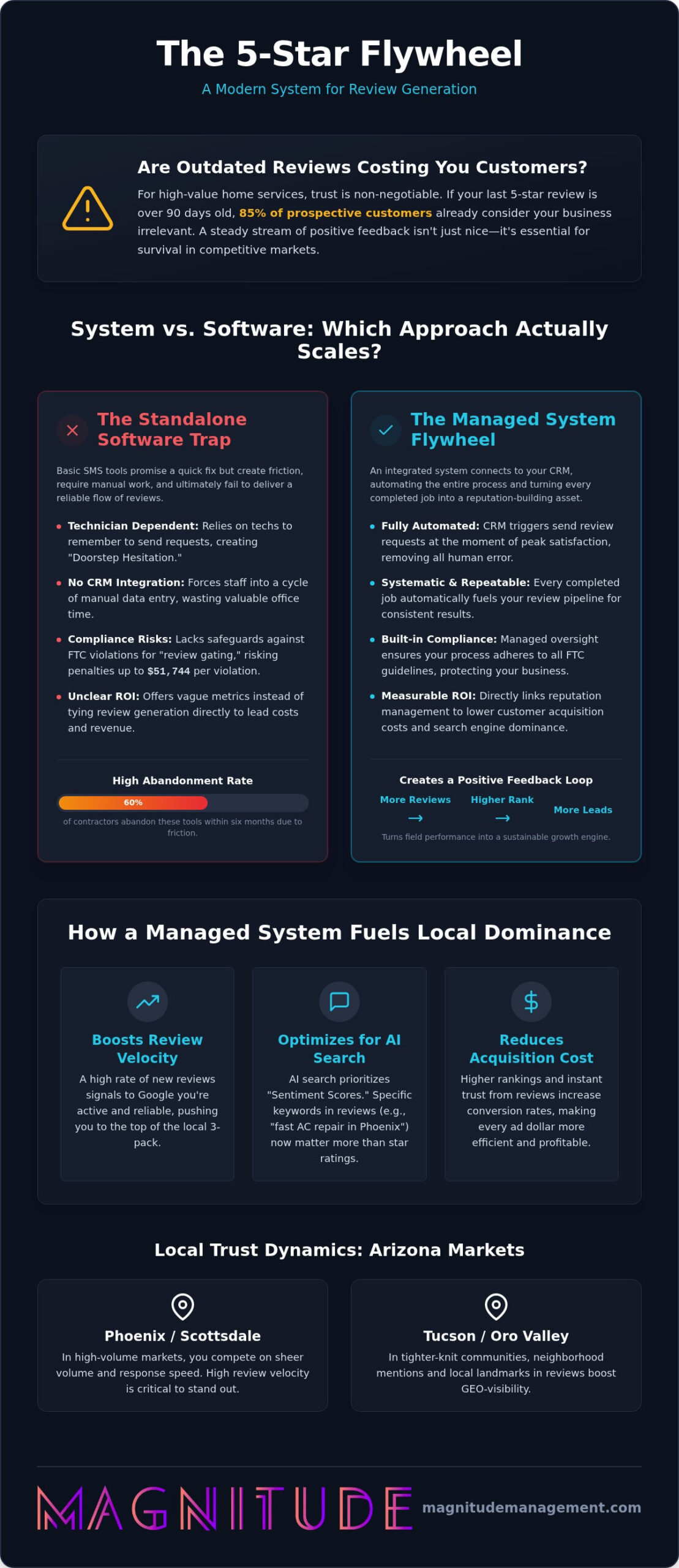
Software isn’t a strategy. It’s a tool. Many contractors buy “cheap” SMS tools hoping for a flood of reviews but get a trickle instead. Standalone tools require your technicians to remember to hit “send” while they’re packing up tools or talking to a homeowner about a $10,000 AC install. It doesn’t happen. High-performance review generation for home service companies requires a system that removes human error from the equation. If your process depends on a tired tech remembering a marketing task at 6:00 PM, your system is already broken.
Following FTC guidance on online reviews is non-negotiable in 2026. If your software doesn’t have built-in safeguards against deceptive practices, you’re risking civil penalties that can reach $51,744 per violation. Managed systems provide the professional mediation and compliance oversight that basic software lacks. You need a partner who understands the difference between authentic feedback and “review gating” that could land you in legal trouble with federal regulators.
The Standalone Software Trap
Why do 60% of contractors abandon standalone review tools within six months? Friction. Disconnected tools force your office staff into a cycle of manual data entry. If a tool isn’t talking to your CRM, it’s creating waste. Most “set it and forget it” software is eventually forgotten by the team because it lacks a feedback loop. There’s no professional mediation for negative experiences and no way to handle a disgruntled customer before their complaint becomes a permanent public record. You’re paying for a subscription that your team actively ignores.
Integrated CRM and Lead Hub Advantages
The Magnitude Lead Hub shifts the burden from your people to your systems. It triggers review requests automatically the moment a job is closed in your CRM, ensuring 100% consistency across every service call. You can link reviews to specific technicians, creating a transparent way to track performance and award bonuses based on actual customer satisfaction. This turns your field operations into a verifiable data source for your marketing efforts.
Effective review generation for home service companies starts with a clear understanding of your current standing. We use local search visibility audits to pinpoint exactly where your reputation is lagging behind competitors in your specific zip codes. This isn’t a black box; it’s a measurable growth pillar that turns your field performance into search engine dominance. If you’re tired of paying for software that doesn’t move the needle, it’s time to partner with a strategic reputation advisor who prioritizes revenue over superficial metrics.
How Reviews Impact AI Search and GEO Visibility in 2026
In 2026, ranking for keywords is secondary to ranking for reputation. AI search engines like Perplexity and Google’s Search Generative Experience don’t just count stars; they scan the natural language of your feedback to determine your “Sentiment Score.” This score is a weighted metric that evaluates the depth and detail of customer feedback to judge your reliability. If a customer writes a detailed paragraph about a complex HVAC install, AI tools prioritize that data over a simple five-star rating with no text. This is a radical shift from traditional SEO where you could “optimize” your way around a mediocre reputation through technical tricks.
Your reviews are the primary way you prove your service area to Google AI. When a homeowner in Mesa or Scottsdale mentions their specific neighborhood or a local landmark, they’re creating a GEO-tag that no backlink can replicate. This is how you win at review generation for home service companies in 2026. You aren’t just getting stars; you’re building a map of verified service locations that AI tools use to recommend you. With 45% of consumers now using AI assistants to find local businesses, your “reputation rank” often determines whether you appear in an AI-generated answer or get buried in the archives.
The Anatomy of an AI-Ready Review
A review that simply says “Great work” is nearly worthless for AI discovery. You need reviews that mention specific services, such as “emergency AC repair in Mesa” or “water heater replacement in Tucson.” These specific phrases act as non-branded keywords that AI assistants prioritize when answering conversational queries. AI extractors use the natural language found in your customer reviews to verify your business categories and service capabilities for conversational search queries. Encourage your customers to include photos of the finished job. Visual proof provides an extra layer of data that search engines use to confirm the job actually took place at a specific location, boosting your local authority.
Dominating the 3-Pack with Review Volume
In a high-stakes market like Phoenix, the threshold for visibility is rising. You can’t beat the “big guys” with a handful of reviews from two years ago. Review recency is critical for maintaining your spot in the local 3-pack. A 5-star review from 2023 is effectively invisible to 2026 algorithms because 85% of consumers believe reviews older than three months are irrelevant. You need a steady, weekly pulse of new feedback to stay competitive. Leveraging reputation management for contractors ensures your review pulse never drops, keeping your business top-of-mind for both human customers and AI assistants looking for the most active, reliable option.
The Technician Trap: Why Most Automated Review Systems Fail
Your technicians are the face of your brand. They are not marketers. Expecting a tech who just spent four hours in a 110-degree attic to deliver a polished marketing pitch is a fantasy. This is the “Doorstep Hesitation.” Even your best performers often feel like they’re begging when they ask for a review after a $1,200 repair or a $15,000 HVAC install. Most review generation for home service companies fails here because it forces a human to perform a repetitive, uncomfortable task. You must operationalize the ask by making it a mandatory step in your job completion checklist, but the actual delivery must be automated.
The danger lies in the difference between solicitation and customer experience surveying. When a tech asks for feedback on the quality of their work, it feels like professional accountability. When they ask for a Google review, it feels like a favor. Framing is everything. You want a system that captures the raw sentiment at the doorstep while the homeowner is still feeling the relief of a fixed unit or a leak-free kitchen. If you don’t remove the friction of the “ask,” your review volume will always be at the mercy of your crew’s mood.
Technician Incentives That Actually Work
Ditch the “$10 per review” model. It’s lazy and often leads to low-quality, generic feedback that AI search engines ignore. Build a culture of pride instead. Use review data in your weekly service meetings to highlight specific wins and shout out techs by name. When a plumber sees their name in a 5-star review for a job in Oro Valley, it reinforces their value. You must also train techs to identify “safe” versus “dangerous” requests. If a job had part delays or complications, the tech needs a simple way to flag that customer as “do not solicit” to protect your public rating.
Automating the Ask Without Losing the Personal Touch
The “Perfect Timing” window is the fifteen minutes after the tech leaves the driveway. This is when the customer’s relief is highest and the experience is fresh. An automated SMS that includes the technician’s name and photo feels like a personal follow-up, not a robotic marketing blast. It bridges the gap between the human interaction and the digital task. You can learn exactly how to automate customer reviews to ensure this sequence triggers every single time a job closes in your CRM.
Stop letting technician awkwardness kill your local visibility and search rankings. If you’re ready to turn your field crew into a high-performance review machine without the resentment, partner with Magnitude to deploy a managed reputation system that scales with your business.
Implementing a High-Yield Reputation Flywheel in Your Business
Building a reputation flywheel isn’t about luck. It’s about engineering. You need a structured, tiered implementation plan that moves your business from reactive damage control to proactive search dominance. Most contractors fail because they treat reviews as an afterthought. To win, you must make them a core operational output. Follow this five-step framework to turn your field performance into a repeatable revenue machine.
- Step 1: Audit. Use a local search visibility audit to identify where you’re losing to competitors in specific Phoenix or Tucson zip codes. You can’t fix what you haven’t measured.
- Step 2: Integration. Connect your CRM to a central Lead Hub. This ensures every completed job triggers an automated request without requiring a single click from your office staff.
- Step 3: Training. Implement the “Magnitude Method.” This is a protocol where your field team confirms customer satisfaction before leaving the driveway, setting the psychological stage for the automated SMS follow-up.
- Step 4: Optimization. Respond to every review. A review without a response is a conversation you’ve walked away from in public.
- Step 5: Monitoring. Track your AI search referral traffic and Google Maps rankings weekly. Adjust your strategy based on which service areas are lagging in review velocity.
The Response Strategy: Turning Negatives into Positives
Speed to response is just as critical as speed to lead. In the Arizona market, a 24-hour response window is the standard for high-performance trades. If you wait three days to address a complaint, you’ve already lost the public perception battle. Use your responses to reinforce your GEO visibility. Instead of a generic “Thanks for the review,” try “We’re glad we could resolve your Glendale plumbing emergency quickly!” This tells AI search engines exactly where you operate and what you do. For illegitimate “review bombers,” stay professional. State the facts and invite them to call the office. It shows prospective customers that you’re disciplined and focused on resolution.
Measuring ROI: From Stars to Dollars
Stop looking at stars and start looking at dollars. You can track the direct correlation between your review velocity and your organic lead volume. If you’re running Google Ads, use ad waste audits to see if a stagnant reputation is killing your click-through rates. A low rating on an LSA profile makes your ad spend significantly less effective, often doubling your cost per lead. High-quality review generation for home service companies builds a business that eventually sells itself. Social proof becomes your primary lead generator, lowering your long-term reliance on expensive, volatile paid channels.
Dominating the Arizona Market with a Reputation First Strategy
You can’t afford to treat your reputation as a passive metric. In the high-stakes world of HVAC, plumbing, and roofing, your public feedback is the engine driving your Google Maps placement and your customer acquisition costs. We’ve shown that modern review generation for home service companies requires moving beyond standalone tools and embracing integrated automation. If your system depends on a technician’s memory, it’s already failing you.
The Magnitude Lead Hub provides the CRM integration necessary to eliminate technician friction and capture the high-value sentiment data that 2026 AI search engines demand. It’s time to stop letting great jobs go unreviewed while competitors with half your skill take the top spots in Phoenix and Tucson. You’ve built a business based on performance; it’s time your digital footprint reflected that reality.
Take control of your local visibility today. Get your free local search visibility audit and see exactly where you are leaving 5-star revenue on the table. You’ve done the hard work in the field. Let us help you turn that effort into a repeatable, scalable source of new leads.
Frequently Asked Questions
Is it legal to offer incentives to customers for leaving a review?
No, offering incentives in exchange for reviews is a violation of FTC regulations unless the relationship is clearly disclosed. You cannot pay for positive ratings or offer discounts conditioned on a 5-star result. This practice invites civil penalties and erodes consumer trust. Focus on building a systematic approach to review generation for home service companies that captures honest, organic feedback through operational excellence instead of risky bribes.
How do I remove a fake or unfair 1-star review from my Google Business Profile?
You cannot unilaterally delete a review because it is unfair. You must flag the content for a specific violation of Google’s terms, such as harassment, spam, or conflict of interest. If the review is demonstrably fake, provide evidence to Google Support for mediation. Most negative reviews are best handled with a professional, fact-based response that demonstrates your commitment to resolution to any prospective lead reading the thread.
What is the best review generation software for small HVAC companies?
The most effective software isn’t a standalone tool but an integrated system that connects directly to your CRM. Standalone SMS apps often fail because they require manual input and create friction for your office staff. A managed solution like the Magnitude Lead Hub is superior because it automates the request the moment a job is closed. This ensures 100% consistency and yields a much higher ROI than disconnected tools.
How many reviews do I need to rank #1 on Google Maps in Phoenix?
There is no fixed number, but you must consistently outpace the review velocity of the top three competitors in your specific Phoenix zip code. Google prioritizes recency and frequency over total volume. If your competitors have 500 reviews but haven’t received one in a month, a steady stream of ten new reviews per week will quickly move you past them in local search visibility and map rankings.
Can I automate review requests through my existing CRM like ServiceTitan?
Yes, you can and should automate this process. By connecting your CRM to a central automation hub, you trigger review requests based on job completion status. This removes the burden from your technicians and ensures every homeowner is asked for feedback at the moment of peak satisfaction. Automation is the only way to scale your reputation without adding hours of administrative work to your office staff’s schedule.
Does responding to reviews actually help my local SEO rankings?
Yes, responding to reviews is a confirmed ranking factor for local search. It signals to Google that your business is active and values customer engagement. Use your responses as an opportunity to naturally include service keywords and neighborhood mentions. This adds geographic context to your profile, helping you rank higher for specific queries like “emergency plumbing in Scottsdale” while proving your reliability to both humans and AI bots.
What happens if a technician sends a review link to an unhappy customer?
Sending a request to a disgruntled customer is a common fear that stalls many automation efforts. A managed system avoids this by allowing technicians to flag “unsafe” jobs in the CRM before the trigger fires. This cooling-off period provides a window for professional mediation. Resolving a complaint privately is always better than letting a technician’s mistake turn into a permanent 1-star scar on your public profile.
How does review generation impact my Google Local Services Ads (LSA) cost?
Systematic review generation for home service companies directly lowers your customer acquisition cost on LSA. Google uses your star rating and review count to determine which contractors get the most prominent ad placement. Profiles with high ratings and high review velocity earn more clicks for every dollar spent. This efficiency makes your ad budget go further, effectively pricing out competitors who refuse to invest in their online reputation.