How to Get More HVAC Leads: A Strategic Framework for Arizona Contractors
Why are you still paying $149 for a non-branded search lead while your competitors are securing Google Local Services Ads for an average of $51? Most Arizona contractors treat marketing like a lottery ticket rather than a mechanical system. You’ve likely felt the frustration of paying for low-intent, shared leads on platforms like Angi, only to watch your technicians sit idle during the Phoenix shoulder seasons. If your leads go cold because your office staff can’t pick up the phone in seconds, you don’t have a marketing problem; you have a lead-response failure. This guide breaks down how to get more HVAC leads by shifting your focus from buying shared data to owning your local infrastructure.
We agree that the traditional model of relying on third-party lead aggregators is a race to the bottom that kills your margins. You’ll learn the systematic approach to dominating Google Maps, optimizing paid ad spend for 2026, and automating your response systems to ensure no high-ticket replacement opportunity slips through the cracks. We will preview the MAGNITUDE 5-minute rule for lead recovery, the specific economics of Arizona search volume, and the framework for building a predictable, automated revenue engine that doesn’t require a full-time office person to manage.
Key Takeaways
- Identify and plug “lead leakage” in your business to stop wasting up to 40% of your potential revenue before spending another dollar on ads.
- Dominate the Phoenix and Tucson service areas by aligning your Google Business Profile and location pages with Arizona’s specific 110-degree climate demands.
- Learn how to get more HVAC leads by prioritizing $51 Local Service Ads (LSAs) for emergency repairs over expensive, low-intent search keywords.
- Enforce the “5-Minute Rule” through CRM automation to capture high-ticket system replacements before your competitors can even pick up the phone.
- Recover lost revenue by mining your existing customer database for seasonal tune-ups, a strategy that costs a fraction of new customer acquisition.
The HVAC Lead Generation Framework: Why More Traffic Isn’t the Answer
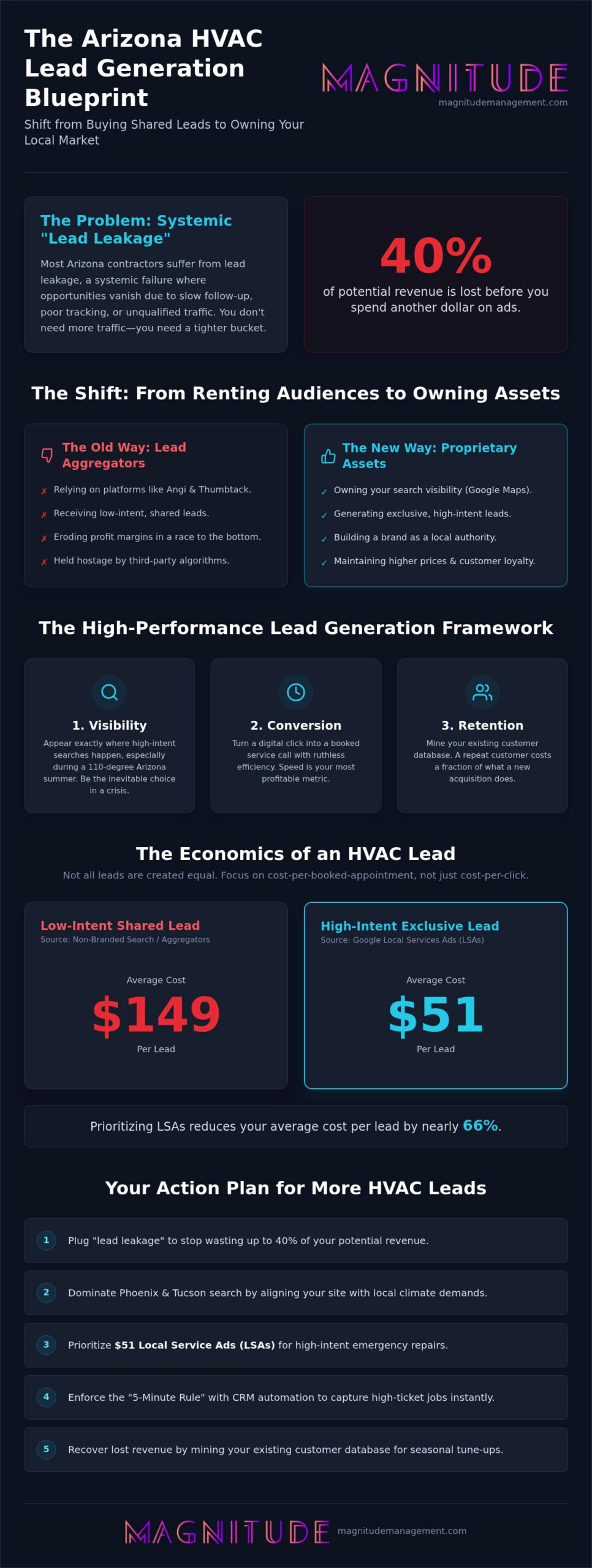
Stop treating lead generation like a faucet you turn on and off. It is a multi-channel infrastructure that requires constant pressure to function. Most Arizona contractors suffer from “Lead Leakage,” a systemic failure where 40% of opportunities vanish because of slow follow-up, poor tracking, or unqualified traffic. You don’t necessarily need more traffic. You need a tighter bucket. If you’re pouring money into ads while your office staff misses calls, you’re just subsidizing your competitors’ growth.
A high-performance framework rests on three specific pillars. First is Visibility: appearing exactly where the high-intent search happens. Second is Conversion: the mechanical process of turning a digital click into a booked service call. Third is Retention: mining your existing database to ensure that a customer remains a customer for a decade. You must distinguish between high-intent searches, like “emergency AC repair Phoenix,” and low-intent awareness, such as “AC maintenance tips.” One pays the bills during a 110-degree July; the other fills the calendar during the shoulder seasons. Understanding this distinction is the first step in learning how to get more HVAC leads that actually impact your bottom line.
Understanding HVAC Lead Economics
A bad lead costs far more than the initial ad spend. You have to account for the hidden drain on your operational resources. Technician drive time, dispatch fees, and fuel costs add up fast when your team is chasing low-quality tire kickers. You must track the progression from lead to booked appointment to sold system with radical transparency. If your average system replacement ticket is $15,000, your lead budget can be aggressive. However, this only works if your closing rate is disciplined and your “cost per set” is optimized. Many contractors use our Ad Waste Audit to identify exactly where their budget is evaporating into thin air.
The Shift from Lead Aggregators to Proprietary Assets
Relying on platforms like Angi or Thumbtack is a race to the bottom. You’re often competing with five other contractors on price alone, which erodes your margins and devalues your expertise. Owning your search visibility and customer data is the only sustainable way to scale. When you stop buying leads and start generating them through your own brand, you control the customer experience from the first click. This transition is essential for how to get more HVAC leads without being held hostage by third-party algorithms. You move from being a commodity to a local authority, which allows you to maintain higher prices and better customer loyalty.
Dominating Local Search Visibility in Phoenix and Tucson
Local SEO for HVAC is the process of matching local intent with verifiable proximity. If you aren’t visible the moment a homeowner in Scottsdale or Mesa realizes their unit has failed during a 110-degree July afternoon, you’ve already lost the job. Visibility is not about vanity rankings; it is about being the inevitable choice in a crisis. Since 84% of consumers search online before contacting an HVAC company, your digital footprint must be as heavy as your physical presence in the valley. Relying on broad local marketing strategies isn’t enough when your competitors are hyper-targeting specific neighborhoods.
To win in 2026, you must optimize for AI Search Visibility (SGE). Google’s AI Overviews now appear in over 25% of all searches, often summarizing the “best HVAC near me” before a user even looks at the standard results. Appearing in these summaries requires GEO-specific location pages that go beyond generic service descriptions. Your pages for Oro Valley or Peoria should address local climate challenges, such as monsoon-related electrical surges or extreme heat loads. This level of specificity signals to search engines that you are the local authority. It is a fundamental shift in how to get more HVAC leads by moving from general awareness to technical relevance.
Google Maps and the 3-Pack Strategy
The Google 3-Pack is the most valuable real estate in your business. Rankings here are dictated by three factors: proximity, prominence, and relevance. Your Name, Address, and Phone number (NAP) data must be identical across every citation on the web. Inconsistencies act as a red flag for Google’s algorithm. To boost prominence, upload high-quality photos of your branded trucks and technicians working in specific local neighborhoods. This provides visual proof of your service area that AI and search bots can verify. If you want to see where you stand, a professional local SEO strategy can help bridge the gap between your current position and the top of the map.
Winning the Reputation Flywheel
Review velocity is the speed at which you acquire new feedback. It is a critical ranking signal. A profile with 500 reviews from three years ago will lose to a profile with 50 reviews from the last month. You need keywords like “AC repair” or “new furnace installation” naturally embedded in customer reviews to improve relevance. Train your technicians to ask for reviews before they leave the driveway; it’s the moment of highest customer satisfaction. You can benchmark your current standing against competitors by using our Local Search Visibility Audit to identify exactly where your reputation is helping or hurting your ability to learn how to get more HVAC leads.
High-Performance Paid Ads: LSAs, Google Ads, and Meta
Paid advertising is not a slot machine. If you treat it like one, the house always wins. Most Arizona contractors lose money because they send high-cost traffic to a generic homepage that lacks a clear call to action. Success in 2026 requires a tiered approach to Small Business Marketing that balances immediate emergency calls with long-term brand awareness. You must distinguish between Google Local Service Ads (LSAs), which average $51 per lead, and traditional PPC, where a non-branded search lead can cost upwards of $149. Understanding these unit economics is the only way to learn how to get more HVAC leads without eroding your profit margins.
Stop paying for clicks that don’t convert. Traditional Google Ads are effective for targeting high-value replacement keywords, but they require precision. If your “Ad Waste” is high, it’s usually because you’re bidding on broad terms that attract people looking for “HVAC jobs” or “free AC parts” rather than homeowners in Scottsdale or Tucson with a dead compressor. You need conversion-focused landing pages that load in under two seconds and feature a single, dominant offer. Anything else is just a donation to Google’s bottom line.
Google LSAs: The Pay-Per-Lead Shortcut
The “Google Guaranteed” badge is a massive trust signal for Arizona homeowners who have been burned by fly-by-night operations. LSAs sit at the very top of the search results, even above traditional ads. You only pay when a customer actually calls or texts your business. However, Google tracks your responsiveness with radical transparency. If you don’t answer the phone every time, your ranking will plummet. To lower your cost-per-lead, keep your profile updated with recent reviews and ensure your background checks are current for 2026 requirements.
Meta Ads for HVAC: Targeting Homeowners Before They Break
While Google captures people already in a crisis, Meta Ads allow you to find homeowners before their system fails. Use lookalike audiences to target high-value zip codes in areas like Paradise Valley or Oro Valley. This is where you run seasonal tune-up offers or “peace of mind” maintenance plans to keep your technicians busy during the shoulder seasons. For a deeper dive into these strategies, see our Meta Ads for Contractors: 2026 Pipeline Guide. Retargeting is also critical here; if a homeowner received a $15,000 replacement quote but didn’t sign, a strategic retargeting ads for home service companies campaign can keep your brand in front of them until they’re ready to commit.
Stopping the Bleed with an Ad Waste Audit
You’re likely lighting money on fire. We frequently find contractors spending thousands on negative keywords that have zero chance of booking a job. Identifying these drains is a core part of how to get more HVAC leads efficiently. You shouldn’t be paying for clicks from people looking for DIY repair videos or competitor brand names if you aren’t prepared to win those specific battles. Use our Ad Waste Audit to scrub your current campaigns and reallocate that budget toward high-intent emergency searches that actually drive revenue.
Lead Response Systems: Why Speed is Your Most Profitable Metric
Speed isn’t a courtesy; it’s a financial requirement. Your chances of qualifying a lead drop 10x after the first five minutes. In a 110-degree Arizona summer, a homeowner with a broken AC isn’t waiting for a callback. They are calling the next person on the list. If you want to know how to get more HVAC leads that actually turn into revenue, you have to stop losing them to your own slow response times. Most contractors “leak” leads because they rely on human intervention during peak hours or after-hours. This is a mechanical failure in your sales process that no amount of ad spend can fix.
Centralizing your infrastructure is the only way to scale. The Magnitude Lead Hub provides a single source of truth for every inquiry, whether it comes from a Google LSA call or a Facebook form fill. Call tracking is the backbone of this system. It allows you to see which marketing channels are producing high-ticket system replacements versus simple tune-ups. This radical accountability ensures you aren’t just buying volume; you’re buying high-margin opportunities. You can centralize your lead management today to ensure no technician sits idle while your phone goes unanswered.
Automating the Initial Touchpoint
You must eliminate the friction between a “form fill” and a “scheduled appointment.” Instant SMS auto-replies should trigger the second a lead hits your system, especially for after-hours inquiries. AI-powered chatbots can qualify emergency calls versus non-emergency maintenance. This allows your team to prioritize the high-ticket repairs that keep the business profitable. This automation ensures your business is “open” 24/7 without the overhead of a full-time office person. It is a fundamental shift in how to get more HVAC leads by being the first to respond every single time.
The Sales Pipeline for HVAC Replacement
Tracking the journey from a simple “AC repair” lead to a $20,000 full system replacement is where the real money is made. You need a visible sales pipeline that alerts you when a high-value quote is sitting open. Most contractors fail to follow up on these open quotes, leaving thousands on the table. Using CRM automation to send professional reminders can be the difference between a lost lead and a closed deal. Your homepage often kills this momentum by being too cluttered and confusing; check out our guide on Conversion Landing Pages for Home Services to see why your current site might be sabotaging your sales ROI.
Revenue Recovery: Mining Your Existing Database for New Leads
Database Reactivation isn’t just a buzzword; it’s the process of re-engaging past customers who haven’t had service in 12 or more months. Most contractors treat every lead as a cold lead. They ignore the equity sitting in their CRM. This is a massive strategic error. The economics are undeniable. It is five to ten times cheaper to re-sell an existing customer than it is to acquire a new one through paid search or social media. If you’re wondering how to get more HVAC leads without increasing your ad spend, look at the list of people who already know your brand and trust your technicians.
In Arizona, your revenue shouldn’t fall off a cliff just because the temperature drops below 90. Use seasonal System Health Checks to drive predictable revenue during the spring and fall shoulder seasons. This keeps your technicians busy and your cash flow steady when emergency calls slow down. Position these checks as proactive maintenance rather than a sales pitch. Magnitude’s Revenue Recovery systems act as the final, sophisticated step in a mature marketing strategy. It moves you away from the feast or famine cycle of lead generation by focusing on the assets you already own.
Turning Old Leads into New Appointments
Stop letting dormant leads rot in your database. You can use automated email and SMS sequences to reach out to customers who haven’t booked in over a year. The goal is to present a no-brainer offer for a maintenance membership. These memberships build recurring revenue and ensure you’re the first call when a system eventually needs a full replacement. Don’t forget the Lost Lead campaign. Reach out to homeowners who received a quote six months ago but didn’t buy. A simple follow-up text asking if they’re still looking for a solution often results in a booked job. This is a low-cost way to learn how to get more HVAC leads by simply being persistent with the data you already have.
Building a Lifetime Value (LTV) Mindset
The first repair isn’t the goal. It’s just the entry point to a 10-year customer relationship. When you shift your focus to Lifetime Value (LTV), you stop worrying about the cost of a single click and start focusing on the total revenue a customer generates over a decade. Use reputation management to turn every successful job into three new referrals. A happy customer in a Mesa neighborhood is likely to tell their neighbors if you make the process easy. This creates a self-sustaining growth loop that reduces your reliance on expensive ad platforms. It’s time to stop chasing the next click and start building an asset. Scale your HVAC business with Magnitude’s Lead Hub to turn your existing database into a predictable revenue engine.
Building Your HVAC Revenue Engine for 2026
Lead generation is a mechanical problem. You can’t fix a broken bucket by pouring more water into it. We’ve established that plugging lead leakage and enforcing the 5-minute response rule are the highest-ROI moves you can make today. By dominating local search in Phoenix and Tucson and mining your existing customer database, you move from chasing expensive clicks to owning a predictable revenue system. Learning how to get more HVAC leads is about infrastructure, not just temporary ad campaigns. It’s about building a brand that homeowners trust when the temperature hits 110 degrees.
Magnitude provides the specialized HVAC SEO and Google Business Profile optimization you need to stay visible in a crowded market. Our AI-Powered Lead Hub automates your CRM so no replacement opportunity is wasted; our Fractional CMO services provide the strategic oversight required for high-stakes scaling. You have the technical expertise to fix any unit in the valley. Now it’s time to apply that same level of precision to your marketing operations.
Stop Wasting Your Marketing Budget and Start Scaling with Magnitude.
The Arizona heat isn’t going anywhere. Neither should your growth. Build a system that works as hard as your technicians do and take control of your market today.
Frequently Asked Questions
What is the best way to get HVAC leads for free?
The most effective way to secure free leads is through a fully optimized Google Business Profile and a disciplined referral program. By regularly posting high-quality photos of your branded trucks in neighborhoods like Gilbert or Scottsdale and collecting frequent reviews, you can rank in the local 3-pack without spending on ads. This organic visibility allows you to learn how to get more HVAC leads by leveraging the social proof of your existing customer base.
Are Google Local Service Ads (LSAs) worth it for HVAC companies in 2026?
Google LSAs remain the highest-ROI paid channel for Arizona contractors because you only pay for actual calls or texts. The “Google Guaranteed” badge builds immediate trust with homeowners in crisis, making it easier to close high-ticket system replacements. To stay competitive in 2026, you must pass updated background checks and maintain a high response rate. If you miss calls, your ranking will drop regardless of your total budget.
How much should an HVAC lead cost in Arizona?
While lead costs fluctuate based on seasonality, the 2026 blended average for HVAC leads is approximately $104. Google Local Service Ads offer a more affordable entry point at roughly $51 per lead, while non-branded search keywords on traditional PPC can climb to $149. You should evaluate your lead cost against your average ticket size; a $15,000 installation justifies a much higher acquisition cost than a simple $99 seasonal tune-up.
Why is my HVAC business not showing up on Google Maps?
Your absence from Google Maps usually stems from inconsistent NAP data or a lack of proximity to the searcher. If your business name, address, or phone number varies across the web, search engines lose trust in your location. Additionally, if you haven’t updated your profile with recent photos or keyword-rich reviews from specific Arizona cities, your prominence will suffer. Strengthening your local citations is a core part of how to get more HVAC leads organically.
How can I get commercial HVAC leads vs residential?
Commercial leads require a shift toward B2B platforms and high-intent long-tail keywords like “commercial rooftop unit repair” or “industrial chiller maintenance.” Unlike residential customers who search in a crisis, commercial decision-makers value long-term service contracts and technical expertise. You should optimize your website for these specific commercial service pages and use LinkedIn to connect with property managers and facility directors in the Phoenix metropolitan area to build long-term relationships.
What is the ‘speed to lead’ rule for HVAC contractors?
The “speed to lead” rule dictates that you must respond to every inquiry within five minutes to maximize your conversion rate. Your chances of qualifying a lead drop by 10x after this initial window. In the Arizona heat, homeowners are likely calling multiple contractors simultaneously. If you don’t use CRM automation or instant SMS replies to engage them immediately, you are essentially paying for leads that your competitors will book first.
How do I stop losing leads to my competitors?
You stop losing leads by fixing your internal infrastructure rather than just buying more traffic. This means implementing a rigorous follow-up process for open quotes and ensuring your technicians ask for reviews before leaving the driveway. Most contractors lose jobs because they fail to follow up on a $20,000 replacement quote within 24 hours. Using a centralized hub to track every interaction ensures that no high-margin opportunity falls through the cracks during busy seasons.
Can AI help me generate more HVAC leads?
AI is a powerful tool for automating the “middle” of your sales funnel. AI-powered chatbots can qualify emergency calls 24/7, while automated email sequences can reactivate dormant leads in your database without human intervention. Beyond lead capture, optimizing your content for AI Search Overviews (SGE) ensures you appear in the summaries Google provides to users. This technology allows you to scale your operations and how to get more HVAC leads without hiring additional office staff.