Retargeting Ads for Home Services: 2026 Revenue Guide
Why are you paying $150 for a single click in the Phoenix HVAC market just to watch 97% of those visitors vanish? Most contractors treat their ad budget like a slot machine. They pull the lever and hope for a jackpot on the first visit. If the lead doesn’t book immediately, the money is considered lost. This is a failure of infrastructure, not a lack of demand. You already know your market is competitive and your lead bucket is leaking. It is time to stop the waste.
By implementing strategic retargeting ads for home service companies, you can stop renting attention and start owning it. You’ll learn how to capture high-intent visitors who leave your site without booking a job and turn them into signed contracts. This 2026 revenue guide explains how to use the Magnitude Lead Hub to systematically warm up leads in markets like Tucson before they choose a competitor. We will navigate the new 2026 privacy regulations, explain why retargeting CPCs remain efficient at roughly $1.25, and show you how to lower customer acquisition costs through radical accountability and measurable data.
Key Takeaways
- Stop treating your ad budget like a slot machine by recovering the 97% of high-intent traffic that bounces without booking a job.
- Navigate the 2026 privacy landscape and pixel updates to ensure your tracking remains accurate and compliant under new state data laws.
- Use strategic segmentation in your retargeting ads for home service companies to deliver custom messages based on job value, from minor repairs to five-figure replacements.
- Eliminate “industry theater” by integrating your ad spend with the Magnitude Lead Hub, a system that automates the transition from a click to a signed contract.
- Master seasonal creative shifts in the Phoenix and Tucson markets to maintain brand authority as local demand moves from emergency AC repairs to winter heating services.
The Leaky Bucket: Why Home Service Ads Fail Without Retargeting
Stop obsessing over how many people see your ads. If you run an HVAC business in Phoenix, appearing on Google Maps is only half the battle. The real fight happens after the first click. Most contractors fall for the “One-Click Wonder” myth. They assume a visitor arrives, sees a logo, and calls. In reality, users comparison shop for high-ticket services like roofing or system replacements with ruthless efficiency. They are looking for reasons to disqualify you, not reasons to hire you.
The gap between Discovery and Decision is where your profit margin goes to die. Behavioral retargeting is the only way to bridge that gap. Without it, you are essentially paying to send leads to your competitors. If a homeowner finds your site but doesn’t book, and your competitor follows them around the web with a targeted message, who do you think gets the $10,000 contract? It is not about being found. It is about staying found.
The 97% Problem in Local Search
A typical Tucson homeowner visits three to five different websites before they ever pick up the phone to call a plumber. This behavior creates what we call Ad Theater. It is a performance where your agency shows you high traffic numbers while your dispatch board remains empty. You are paying for the privilege of being part of a consumer research project. Lead Leakage is the primary killer of contractor ROI because it represents the silent drain of high-intent prospects who were ready to buy but simply forgot you existed.
Calculating the Real Cost of a Lost Visitor
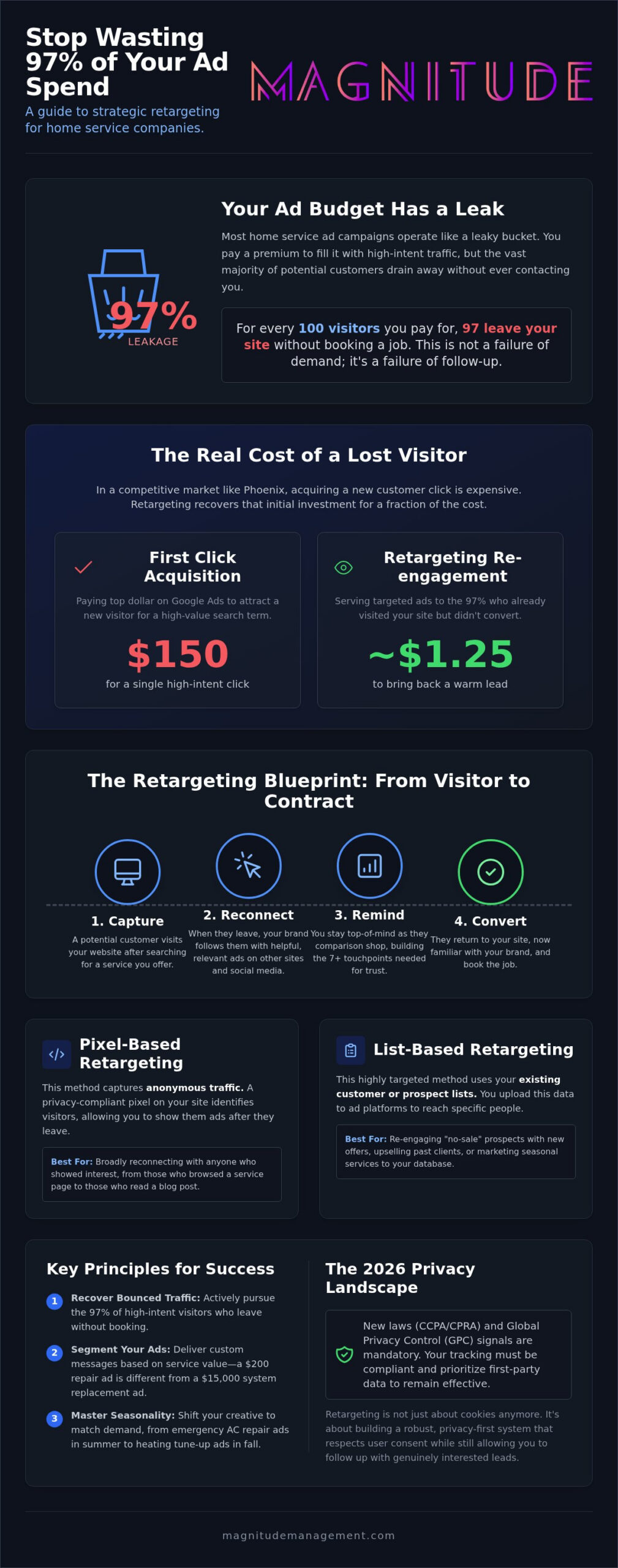
Consider the math in a competitive market like Phoenix. You might pay $150 for a single Google Ads click. If that visitor bounces, that money is gone forever. Conversely, a retargeting impression costs pennies. The Rule of 7 still applies in 2026. A prospect often needs seven touchpoints before they trust a roofing company enough to request a quote. If you aren’t using retargeting ads for home service companies, you are forcing your primary budget to do all the heavy lifting alone. You can use this Ad Waste Audit to see exactly where your budget is bleeding out.
How Retargeting Ads Work for Home Service Companies in 2026
Retargeting is a digital recovery system. It is a specific method that serves ads only to people who have already visited your service pages but left without booking. This process relies on the business case for multiple customer touchpoints. As noted by Forbes on retargeting, staying top-of-mind is critical when consumers are in the research phase. For a Tucson plumber or a Phoenix roofer, this means you aren’t just buying clicks; you are buying the ability to follow up automatically.
The technical landscape has shifted significantly as of 2026. New privacy laws in states like Oregon and expanded requirements under California’s CCPA/CPRA now mandate that Arizona contractors recognize Global Privacy Control (GPC) signals. The 2026 Pixel is no longer a simple tracking cookie. It is a sophisticated, privacy-first tool that prioritizes first-party data. While Meta retired the “Your activity off Meta technologies” setting in July 2026, which actually increased available audience sizes, you must still ensure your tracking is compliant. This is why the Magnitude Lead Hub is essential. It centralizes these touchpoints into a single environment, moving you away from “industry theater” and toward radical accountability.
Pixel-Based vs. List-Based Retargeting for Contractors
Pixel-based retargeting captures anonymous traffic. If a homeowner in Scottsdale browses your “AC Replacement” page but gets interrupted by a phone call, the pixel keeps your brand in their orbit. List-based retargeting is even more powerful for high-ticket remodelers. You can upload your “no-sale” database of old estimates directly into the ad platform. This allows you to serve specific “Why wait?” ads to people who already have a quote in their hand but haven’t signed the contract yet. Using both methods ensures you dominate the local market by capturing both new browsers and old prospects. You can see how your current visibility stacks up by reviewing your strategy with Magnitude Management.
The Multi-Channel Approach: Meta, Google, and Beyond
Effective retargeting ads for home service companies don’t just live on one platform. You need to be where your customers are. This might mean serving roofing ads on Facebook while a homeowner scrolls in the evening or placing display ads on local news sites in Mesa. The goal is to stay visible without being intrusive. On Meta platforms, authentic on-the-job content like before-and-after photos often outperforms polished agency ads by 3x to 5x. For a deeper dive into the specifics of social platforms, see our guide on Meta Ads for Contractors: 2026 Pipeline Guide. By spreading your presence across Google and Meta, you ensure that when the “emergency” happens, your company is the only logical choice.
Strategic Segmentation: Retargeting by Trade and Service Value
Stop treating every website visitor like they have the same problem. A homeowner looking for a $150 AC tune-up is not the same as a homeowner researching a $15,000 full-system replacement. If you serve them the same ad, you are wasting money. Effective retargeting ads for home service companies require surgical segmentation based on job value and intent. This is the difference between a high-performing system and expensive industry theater.
Seasonality also dictates your creative strategy, especially in the Arizona desert. In July, your Phoenix HVAC retargeting should hammer home emergency AC repair and immediate relief. By November, the focus shifts to heating reliability and furnace safety. Using the same generic message year-round is lazy. It ignores the reality of how your customers live. Your ad spend should follow the thermostat.
The Magnitude Lead Hub allows you to trigger ads based on “Deep Intent” rather than just a simple page view. If a user spends five minutes on your kitchen remodel gallery or visits your pricing page three times, they are a high-priority prospect. These visitors should be placed in a different bucket than someone who accidentally clicked a link and left in ten seconds. Job value must dictate your retargeting window. An emergency plumbing fix has a 3-day window; a major roof replacement might require a 30-day educational sequence.
HVAC and Plumbing: The Emergency vs. Maintenance Split
Emergency leads have a short shelf life. If someone’s water heater burst, they aren’t going to wait a month to see your ad. Your retargeting window for emergency services should be 24 to 48 hours with high frequency. Conversely, maintenance leads require a longer, educational approach. A visitor reading a blog about “Why Your AC is Blowing Warm” might need a 14 to 30-day window to move from research to booking. You can learn more about this in our guide on How to Get More HVAC Leads.
Roofing and Remodeling: The Long-Game Strategy
High-ticket trades require a different psychological approach. For roofing and remodeling, social proof is your most effective weapon. Use retargeting to show high-quality “Before & After” photos of local projects in Tucson or Mesa. This builds brand authority while addressing the primary objection: trust. Hesitant buyers often worry about financing or warranties. Serve them ads that explicitly mention your financing options or long-term guarantees to remove the friction from the decision-making process.
The Step-by-Step Blueprint for a High-Converting Campaign
Execution is where most local agencies fail. They treat retargeting ads for home service companies as a “set it and forget it” checkbox. This laziness leads to wasted spend and brand fatigue. A high-converting campaign requires a structured, logical sequence that prioritizes the user’s current stage in the buying cycle. If you want to move beyond industry theater, follow this specific blueprint.
- Step 1: Audit Your Conversion Tracking. Before spending a dollar, ensure your tracking is airtight. You must be able to identify who has already called your dispatch or filled out a form. There is no faster way to look incompetent than serving a “Book Now” ad to a customer whose furnace you repaired yesterday.
- Step 2: Address the ‘Why Not Now?’ Objection. Your creative shouldn’t just repeat your name. It needs to solve the hesitation. If they looked at a $15,000 roof replacement and left, serve an ad highlighting your financing options or your 25-year warranty.
- Step 3: Set Up Exclusion Lists. Protect your reputation by excluding current customers and recent converters. Use your CRM data to ensure you aren’t paying for impressions on people who are already in your service queue.
- Step 4: Align Ads with High-Converting Landing Pages. Never send a retargeting click to your homepage. If they clicked an ad about emergency drain cleaning, send them to a specific page that hammers home your response time and local Tucson reviews. Your homepage is often a conversion killer.
- Step 5: Monitor Frequency Caps. In a market like Phoenix, homeowner burnout is real. Limit how often your ads appear to avoid being perceived as a digital stalker.
Ad Creative That Converts in Arizona
Local trust is your biggest asset. Use specific neighborhood names or Tucson landmarks in your ad copy to prove you aren’t a national lead-gen mill. A “Limited Time” offer, such as a seasonal AC tune-up discount, provides the necessary friction to move a sluggish lead toward a booking. For a deeper look at why your site might be failing you, see our guide on Conversion Landing Pages for Home Services.
Avoiding the ‘Creep Factor’
Effective retargeting is about being helpful, not haunting. Set your frequency caps to ensure a single prospect doesn’t see your face twenty times in one afternoon. Use “burn pixels” to automatically stop serving ads the moment a lead is captured in the Magnitude Lead Hub. Bombarding a prospect with the same roofing ad dozens of times a day transforms your brand from a local expert into a digital nuisance. To build a system that respects your audience while maximizing revenue, scale your lead recovery system today.
Beyond the Click: Integrating Retargeting into the Magnitude Lead Hub
Standalone ads are industry theater. If your agency shows you a report full of impressions but your bank account hasn’t moved, you are participating in a performance, not a business strategy. Running retargeting ads for home service companies without a connected backend system is like installing a high-efficiency furnace without any ductwork. The heat is there, but it isn’t going anywhere. You need an environment where every click is captured, tracked, and nurtured until it turns into a signed contract.
The Magnitude Lead Hub provides this infrastructure. It automates the transition from a digital touchpoint to a sales pipeline by ensuring no lead falls through the cracks. This is especially critical for revenue recovery. Most contractors have a database of thousands of past customers or old estimates that have gone dormant. We don’t let that data sit idle. By integrating this first-party data into the Lead Hub, we can serve specific ads to win back old estimates or remind past customers that it’s time for their seasonal maintenance in Phoenix or Tucson.
A Fractional CMO does more than manage a budget. They audit your total lead economics to ensure every dollar spent on retargeting ads for home service companies is actually yielding a return. It isn’t just about the cost per lead; it’s about the cost per signed contract. If your marketing isn’t being viewed through the lens of operational efficiency, you are just guessing. You need an architect who understands the mechanics of a profitable trade business, not just a technician who knows how to buy ads.
CRM Automation and Retargeting Synergy
True efficiency happens when your CRM talks to your ad platforms. When a high-value lead for a system replacement in Glendale moves to a ‘Stalled’ status in your CRM, the Magnitude Lead Hub can automatically trigger a specific retargeting sequence. This isn’t just generic branding. It is a targeted response to a specific sales hurdle. This level of synergy allows you to track ROI from the very first click to the final invoice, providing a level of visibility that traditional agencies cannot match. You can see how your current strategy measures up by requesting a Local Search Visibility Audit.
The Magnitude Advantage
We provide no-nonsense, results-oriented management for Arizona contractors who are tired of marketing fluff. By eliminating waste through AI-powered visibility and precision retargeting, we protect your interests and your bottom line. We act as a disciplined strategic partner, focusing on the mechanics of success rather than superficial metrics. If you are tired of the theater and ready to see real substance in your lead generation, we are ready to build your system. Ready to recover your lost revenue? Book a strategy session with Magnitude.
Stop Renting Attention and Start Owning Your Local Market
The days of paying for expensive clicks and hoping for the best are over. You now understand that retargeting ads for home service companies aren’t an optional add-on; they’re the insurance policy your primary ad budget requires. By fixing the leaky bucket in your sales funnel and applying strategic segmentation to your trade, you transform anonymous website visitors into signed contracts.
Success in 2026 demands more than just a pixel. It requires a systematic approach that balances high-frequency emergency responses with long-term educational sequences for high-ticket replacements. Magnitude provides the local Arizona market authority and specialized home service expertise needed to navigate this complex landscape. Our AI-Powered Lead Hub Infrastructure ensures that every touchpoint is tracked and every lead is nurtured.
Don’t let your competitors capture the prospects you’ve already paid to find. It’s time to demand radical accountability from your marketing spend and recover the revenue you’re currently leaving on the table. Stop Wasting Your Ad Budget. Get a Professional Audit from Magnitude. Your business has the potential to dominate your local service area. Let’s build the system that makes it inevitable.
Frequently Asked Questions
Is retargeting for contractors expensive compared to standard Google Ads?
Retargeting is significantly more cost-effective than standard search ads because you aren’t bidding on expensive top-of-funnel keywords. While a Phoenix HVAC click can cost over $100, retargeting clicks often range from $0.95 to $1.25. You’re paying for impressions on a warm audience that already knows your brand. This makes it an essential tool for lowering your overall customer acquisition costs.
How long should I retarget a homeowner who visited my roofing site?
Your retargeting window should match the length of your specific sales cycle. For a high-ticket service like a full roof replacement, a 30 to 60-day window is appropriate as homeowners weigh financing and insurance options. Emergency repairs require a much shorter window of 48 hours. The goal is to stay visible until the decision’s made without becoming a digital nuisance.
Can I retarget people who visited my competitor’s website?
You can’t place your tracking pixel on a competitor’s site, but you can target their audience through custom segments. By using Custom Intent audiences in Google Ads, you can serve ads to people who’ve searched for your competitor’s brand name or visited similar URLs. It’s a strategic way to intercept high-intent leads who are currently comparison shopping in the Tucson market.
What is the difference between remarketing and retargeting for home services?
Retargeting focuses on serving display or social ads to visitors based on their web behavior. Remarketing typically refers to re-engaging past customers through email or direct mail campaigns. For most contractors, retargeting ads for home service companies are the primary driver for recovering anonymous website traffic. Both are necessary components of a mature revenue infrastructure but serve different stages of the funnel.
Do I need a special pixel to run retargeting ads on Facebook and Instagram?
You must install the Meta Pixel or use the Conversions API to track visitor behavior for social media platforms. This small piece of code allows you to identify which specific service pages a homeowner visited. In 2026, using the Conversions API is the preferred method for bypassing browser tracking limitations. It ensures your data remains accurate even as privacy regulations become stricter.
How do I stop my ads from showing to people who have already booked a job?
You stop ads for converted leads by setting up exclusion lists within your ad platform. By placing a burn pixel on your thank-you page or booking confirmation screen, you automatically remove those individuals from your retargeting pool. Integrating your CRM with the Magnitude Lead Hub automates this process. It ensures you don’t waste budget by advertising to someone who’s already on your schedule.
Will retargeting ads slow down my website’s loading speed?
Modern tracking scripts have a negligible impact on site speed when loaded asynchronously. This means the pixel loads in the background without blocking the visual elements of your page. If your site is sluggish, the issue is likely unoptimized images or poor hosting rather than your tracking code. We prioritize performance to ensure your technical SEO remains strong while your ads stay active.
Can I run retargeting ads if I only have a small monthly budget?
Retargeting is the most efficient way to spend a limited marketing budget because you only pay for a highly qualified audience. You don’t need thousands of dollars to see results. A modest budget of $500 per month can effectively re-engage hundreds of lost visitors. Using retargeting ads for home service companies is the best starting point for contractors who want to stop wasting their current traffic.