Meta Ads for Contractors: 2026 Pipeline Guide
Your Google Local Services Ads budget is effectively a tax on your inability to generate demand. While you’re fighting over the same high-intent “near me” searches that drive your cost-per-lead into the triple digits, your competitors are quietly owning the market before the homeowner even opens a search tab. Scaling Meta Ads for home service contractors in 2026 isn’t about collecting “likes” or chasing viral reach. It’s about engineering a system that manufactures jobs. You know the frustration of the Arizona shoulder seasons when the phones stop ringing and your best techs start looking for the exit. You need a way to force volume into your schedule without the low-quality “tire kicker” leads that usually plague social media.
This guide moves past the industry theater of “brand awareness” to focus on the cold mechanics of lead economics. We’ll show you how to stop hoping for leads and start building a predictable sales pipeline using the MAGNITUDE Lead Hub framework. You will learn how to implement high-friction filters to protect your sales team’s time and why raw, on-the-job content is currently outperforming polished ads by 5x. We are going to dismantle the failing campaigns identified in our typical Ad Waste Audit and replace them with a structured, automated process that delivers a measurable ROI. It’s time to stop gambling on lead aggregators and start owning your infrastructure.
Key Takeaways
- Learn how to scale Meta Ads for home service contractors by shifting from simple demand capture to proactive demand generation for high-ticket remodels and seasonal maintenance.
- Discover why adding strategic friction to your lead forms is the only way to filter out “tire kickers” and protect your sales team’s calendar for qualified opportunities.
- Stop wasting budget on polished agency videos and start using raw, technician-led walkthroughs that build immediate trust with Arizona homeowners through radical transparency.
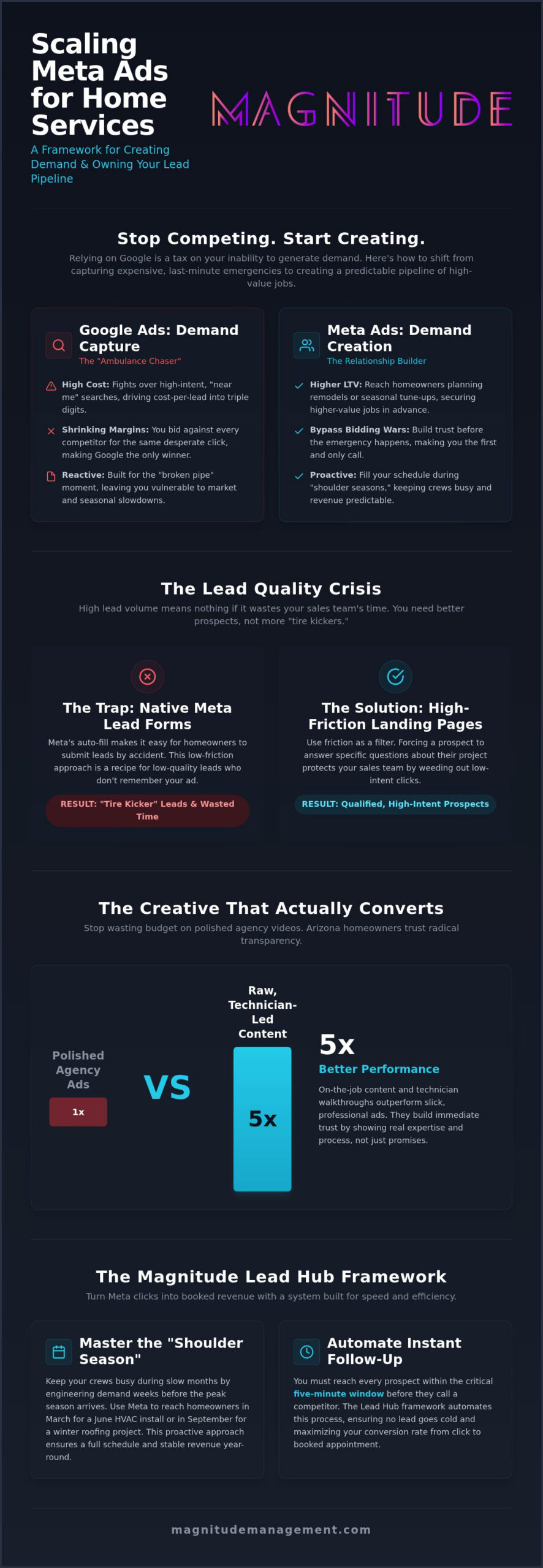
- Master the “Shoulder Season” strategy to keep your crews busy during slow months by engineering demand weeks before the peak heat or monsoon season arrives.
- Implement the Magnitude Lead Hub framework to automate instant follow-ups, ensuring you reach every prospect within the critical five-minute window before they call a competitor.
Google vs. Meta Ads: Capture vs. Create Demand
Google Ads is the digital equivalent of an ambulance chaser. It’s built for the “broken pipe” moment when a homeowner in Tucson is standing in three inches of water and needs a plumber immediately. This is demand capture. It is high intent, but it is also the most expensive real estate in Online advertising. Relying solely on Google Local Services Ads (LSA) in the Phoenix or Tucson markets is a recipe for shrinking margins. You are bidding against every other contractor for the same desperate click, driving your customer acquisition costs (CAC) toward a breaking point. When every competitor is fighting over the same five-mile radius, the only winner is Google’s bank account.
Meta Ads for home service contractors operate on a different logic: demand creation. Instead of waiting for the disaster, you use pattern interruption to reach homeowners when they are planning a bathroom remodel or considering a seasonal HVAC tune-up. You are building a relationship before the emergency happens. This shifts the power dynamic from being a commodity service provider to a trusted local authority. By the time the roof leaks or the AC fails during a 115-degree July day, the homeowner already knows your face, your trucks, and your value proposition. You’ve effectively bypassed the bidding war entirely.
The Economics of Intent: CAC vs. LTV
Meta leads typically come with a lower initial cost, but they require a more disciplined sales process than a “call now” Google lead. In the context of Arizona contractor competition, lead economics refers to the total financial impact of a lead, including the cost to acquire, the speed of follow-up required, and the eventual revenue generated over the customer’s lifespan. While a Google lead might close faster, a Meta lead captured in March for a June HVAC install often carries a higher lifetime value (LTV). You are securing the job before the summer rush when every competitor is bidding $30 per click. This proactive approach fills your schedule during the “shoulder seasons” when other shops are laying off techs or idling their fleets.
Hybrid Strategies: Using Meta for Retargeting
The most effective contractors don’t choose between platforms; they use Meta to follow Google searchers until the deal is closed. If a prospect visits your roofing site after a Google search but doesn’t call, they should see your project walkthroughs on Facebook within the hour. This “omnipresence” effect makes a small Tucson plumbing shop look like a market leader. A local search visibility audit often reveals that your Google presence is strong but your conversion rate is suffering because you aren’t staying top-of-mind during the decision-making window. We use the Ad Waste Audit to identify exactly where your retargeting is failing and where your budget is being incinerated by low-intent clicks that never convert. For roofing professionals, aligning these campaigns with standards from the National Roofing Contractors Association ensures your messaging remains authoritative while you dominate the local feed. Stop letting Google searchers forget you exist the moment they hit the “back” button.
Lead Forms vs. Landing Pages: Solving the Lead Quality Crisis
Native Meta Lead Forms are a dopamine hit for contractors who don’t understand lead economics. They offer high volume at a low cost per lead, but they are often a trap. Because Meta auto-fills user information, a homeowner can submit a lead accidentally while scrolling through their feed. This results in “tire kicker” leads who don’t remember clicking your ad when your dispatcher calls ten minutes later. If you are chasing $10,000 roofing replacements or complex HVAC installs, you don’t need more leads; you need better prospects. Effective Meta Ads for home service contractors require a system that prioritizes intent over raw volume.
The Magnitude Lead Hub replaces these low-intent forms with conversion landing pages for home services designed specifically for the Tucson market. We use “friction” as a tool. By forcing a prospect to answer specific questions about their home and service needs, we filter out the noise. We implement conditional logic to immediately disqualify renters or those outside your service area. This ensures your sales team only spends time on homeowners who are serious about their project. Adhering to FTC guidelines for online ads ensures these pages remain transparent and build the necessary trust for high-ticket sales. If you want to see how your current digital presence stacks up, our specialized marketing team can help you build a system that prioritizes revenue over raw lead counts.
The Case for High-Friction Landing Pages
Asking five or more specific questions might seem counterintuitive to a traditional marketer, but for contractors, it’s a necessity. It improves your lead-to-close ratio by ensuring the prospect is engaged. These pages must be built for mobile-first Tucson homeowners who are often browsing in high-heat conditions or during quick breaks. We integrate social proof, such as verified reviews and recent project photos, directly into the conversion path. This builds a “Source of Truth” before the lead even hits your CRM. When you increase the effort required to submit a request, you naturally increase the quality of the person on the other end of the line.
Tracking the Source of Truth
Meta’s on-platform tracking is designed to make Meta look good, not to make your business profitable. It will claim a “conversion” for every form submission, regardless of whether that person ever answers the phone. You need call tracking and CRM integration to verify which campaigns are actually driving booked appointments. Benchmarking your current performance with a local search visibility audit is the first step in moving away from vanity metrics. Meta Ads for home service contractors only work when you can trace every dollar spent back to a signed contract. Stop celebrating clicks and start measuring booked revenue.
Creative Frameworks: How Visual and Non-Visual Trades Win on Meta
High-production commercials are where marketing budgets go to die. Arizona homeowners don’t want a cinematic trailer for your plumbing company; they want to see the face of the person who will be entering their home. Meta Ads for home service contractors succeed when they prioritize authenticity over polish. Raw smartphone footage consistently outperforms professional videography by 3 to 5 times because it blends into the user’s feed rather than looking like a disruptive sales pitch. Your ad needs to feel like a recommendation from a neighbor, not a corporate broadcast.
The first three seconds of your video are the most critical. In the heat of a Phoenix summer or the peak of a Tucson monsoon, your hook must address a specific, immediate pain point. Opening with a question like “AC blowing warm?” or “Noticed a water spot on your ceiling after last night’s storm?” triggers an immediate emotional response. This is pattern interruption at its most effective. If your current creative isn’t stopping the scroll, an Ad Waste Audit can help identify which assets are failing to engage your target audience.
The Visual Trade Strategy: Landscaping and Roofing
For trades like roofing and landscaping, the work speaks for itself. Drone footage is the gold standard here, providing a sense of scale and professionalism that a ground-level photo cannot match. Use the “Project Walkthrough” formula where a project manager explains the specific challenges of a local job. A carousel ad featuring a “Before, During, and After” progression builds a narrative of competence that Tucson homeowners can trust. To scale these results, you can maximize your ROI by creating Lookalike Audiences based on your top 20% of high-value customers to find similar homeowners in affluent zip codes.
The Service Trade Strategy: HVAC and Electrical
Selling “invisible” services like HVAC repair or electrical panel upgrades requires a different approach. You aren’t selling a product; you’re selling the technician’s expertise. Humanizing your brand by putting your best techs on camera is essential. Mastering social media marketing for business in the service sector means providing educational snippets. A 60-second video explaining how to check a pilot light or when to replace an air filter positions you as the local Scottsdale expert. Once trust is established, use offer-driven creative, such as a “$49 AC Precision Tune-Up,” to drive the final conversion. If you’re unsure if your local visibility is strong enough to support these campaigns, benchmarking with a local search visibility audit ensures your foundation is solid before you spend another dollar on creative.
Timing the Arizona Market: Seasonality and Ad Spend Management
Arizona’s climate is a volatile asset, not a backdrop. If you treat your marketing budget as a fixed monthly expense, you’re losing money. The most successful Meta Ads for home service contractors in the Southwest are those that move in sync with the 7-day forecast. You need a dynamic allocation strategy that pivots before the weather does. This isn’t just about being present; it’s about being relevant when the pain point is most acute.
The “Shoulder Season” Strategy is your insurance policy against a quiet shop. During the mild Phoenix spring or the cooling autumn in Tucson, homeowner urgency vanishes. This is the time to manufacture demand. Running HVAC ads in March for June installs allows you to secure high-ticket replacements while your competitors are still waiting for the first 100-degree day. You win by being the first person at the kitchen table before the emergency calls begin to flood the market.
Managing the HVAC ‘Cooling Season’ Surge
Counterintuitive logic wins in the desert. When the heat hits 110°F, you should actually lower your Meta spend on general repairs. Your Google LSA and organic search volume will already be maxing out your dispatch capacity. You don’t need to pay for more repair leads when your phones won’t stop ringing. Instead, pivot your Meta creative toward high-margin system replacements. Use the visual nature of the platform to show why an old, inefficient unit won’t survive the night. Additionally, the busy season is the best time to run recruitment ads. Use Meta to target experienced techs who are feeling burnt out at over-leveraged shops. Show them your culture when they’re most likely to be looking for a change of pace. For a complete breakdown of how to get more HVAC leads through a systematic approach that goes beyond paid ads, our Arizona contractor framework covers the full spectrum of demand generation strategies.
Roofing and the Monsoon Pivot
Monsoon season in Mesa, Glendale, and Scottsdale requires a 24-hour creative pivot. You can’t wait for a weekly meeting to change your copy when a storm rips through a specific zip code. We recommend setting up “Rain Triggers” that activate emergency leak repair ads the moment the clouds break. The “Free Storm Damage Inspection” is a classic hook for a reason; it removes the barrier to entry immediately after a hail event. By leveraging local SEO data, you can narrow your Meta targeting to the exact neighborhoods hit hardest. This precision prevents you from wasting budget on dry areas where the sun is still out. If your current agency isn’t adjusting your spend based on the barometer, you need a comprehensive Ad Waste Audit to stop the bleeding. It’s time to start engineering your pipeline with a partner who understands the specific economics of the Arizona sun.
The Magnitude Lead Hub: Turning Meta Clicks into Booked Revenue
A lead generated through Meta is a perishable commodity. In the home services industry, the value of a prospect drops off a cliff after just five minutes of inactivity. If your dispatcher waits until the afternoon to return a morning inquiry, you’ve already lost the job. That homeowner has moved on, scrolled past three of your competitors, and likely clicked a Google LSA result to get an immediate answer. Meta Ads for home service contractors are only as effective as the follow-up system behind them. You aren’t just buying clicks; you are buying a seat at the kitchen table, and that seat is only reserved for the fastest responder.
The Magnitude Lead Hub solves the “Speed to Lead” crisis by automating the instant callback. We don’t rely on your team checking their email every ten minutes. Our system triggers a multi-channel response the second a lead is captured. This includes an immediate SMS to the homeowner, a follow-up email with social proof, and a ringless voicemail that makes your brand the first one they hear. We move beyond the “Lead” view to a “Sales Pipeline” view, where every interaction is tracked and measured against actual booked revenue. It’s about beating your competitors to the door through sheer operational efficiency.
CRM Automation for the Modern Contractor
Manual data entry is a waste of your office staff’s time and a primary source of lost revenue. We sync your Meta leads directly into your dispatch software, ensuring that your sales pipeline is always accurate and up to date. Not every lead is ready to book a $15,000 roof replacement today. Our system identifies “Not Ready Yet” prospects and moves them into long-term automated email sequences. We keep your brand top-of-mind so that when they are ready to pull the trigger, you are the only contractor they call. For a deeper look at how this fits into your total marketing strategy, consult our Paid Ads for Local Services: 2026 Guide to understand the full funnel context required for Arizona contractors.
The Fractional CMO Advantage
Managing high-performance Meta campaigns is not a “set and forget” task. It requires a level of strategic oversight that most local shops simply don’t have in-house. Our specialized fractional CMOs provide weekly optimization based on your actual revenue, not just vanity metrics like click-through rates or “likes.” We look at the cold mechanics of your lead economics to determine which zip codes are profitable and which are burning your budget. We act as a disciplined strategic partner, protecting your interests and ensuring every dollar spent is an investment in growth rather than a donation to Mark Zuckerberg. Stop wasting your budget on systems that don’t scale. Get your Magnitude Ad Waste Audit today and start engineering a predictable sales pipeline.
Stop Reacting and Start Dominating Your Market
Relying on the “broken pipe” urgency of Google search is a defensive strategy that leaves your schedule at the mercy of the weather and your competitors’ bidding wars. You’ve seen how Meta Ads for home service contractors can transform your business from a reactive service provider into a proactive market leader. By implementing conversion landing pages for home services and leveraging raw, technician-led creative, you filter out the noise and capture high-value jobs before they ever hit a search engine. The Arizona market rewards those who move with precision during the shoulder seasons and monsoon peaks; it doesn’t wait for those who are slow to adapt.
The Magnitude Lead Hub provides the infrastructure you need to turn social media interest into booked revenue. With our specialized contractor lead-economics framework and AI-powered sales pipeline automation, we ensure you never lose a prospect to a slow response. Our deep local Arizona market expertise means your budget is always directed where it generates the highest ROI. It’s time to stop gambling on lead aggregators and start building an asset you actually own. Scale your home service business with Magnitude’s Lead Hub and secure your pipeline for the seasons ahead. Your crew is ready to work; give them the schedule they deserve.
Frequently Asked Questions
Are Meta Ads better than Google Ads for HVAC contractors?
They aren’t better; they are different tools for different jobs. Google captures the “my AC is dead” emergency, while Meta Ads for home service contractors create demand for high-margin replacements and seasonal tune-ups before the crisis hits. You need Google for immediate volume and Meta to build a predictable, long-term sales pipeline that isn’t dependent on the next heatwave.
How much should a home service company spend on Facebook ads per month?
You should commit at least $1,500 per month as a starting point. This minimum spend is necessary for the Meta algorithm to collect enough data to learn which Arizona homeowners are actually likely to convert. If you spend less, the system won’t have the “fuel” it needs to optimize your campaigns, resulting in a higher cost per lead and wasted budget.
Why am I getting so many junk leads from my Facebook lead forms?
Junk leads happen because native lead forms are too easy to fill out. Meta auto-fills user data, allowing homeowners to submit a lead accidentally while scrolling. To fix this, we replace native forms with high-friction landing pages. By forcing prospects to answer five or more specific questions about their property, we filter out the “tire kickers” and protect your sales team’s time.
What is a good cost per lead (CPL) for roofing contractors in Arizona?
The average CPL for home services on Meta is approximately $34.00, though high-ticket roofing leads in the Phoenix market often exceed $115.00. You must look past the raw CPL and focus on your cost-per-booked-appointment. A more expensive lead that has been filtered through a high-friction form is always more valuable than a “cheap” lead that never answers the phone.
Do I need professional video production for my Meta ads?
No, professional commercials usually fail on social media because they look like ads. Research shows that raw, on-the-job video content captured on a smartphone can outperform polished production by 3 to 5 times. Homeowners in Tucson and Mesa want to see your real technicians and your actual work. Authenticity builds more trust than a cinematic trailer ever will.
How fast do I need to call a lead that comes from Instagram?
You need to call within five minutes. Lead value drops off a cliff after that window because the homeowner is likely still on their phone and hasn’t moved on to a competitor. Over half of your customers expect a response within the hour. If you don’t have the staff to handle this, you need the Magnitude Lead Hub to automate your instant follow-up.
Can I target specific neighborhoods in Phoenix with Meta Ads?
Yes, you can target by specific zip codes or a tight radius around neighborhoods like Paradise Valley or North Scottsdale. This is essential for roofing and HVAC companies that want to focus on areas with aging housing stock or higher property values. Precision targeting ensures your Meta Ads for home service contractors aren’t being shown to renters or people outside your service area.
What happens to my ads when the Arizona summer rush ends?
When the rush ends, you must pivot your creative from “Emergency Repair” to “System Replacement” or “Preventative Maintenance.” The shoulder season is for manufactured demand. Use this time to offer tune-ups that keep your crews busy while your competitors are sitting by silent phones. This shift in strategy ensures your revenue remains stable even when the temperature drops.