How to Get Commercial Plumbing Leads in Tucson: A Practical Guide
More inquiries won’t fix a pipeline filled with residential calls and poor-fit jobs. If you’re searching “how to get commercial plumbing leads Tucson,” focus on reaching the right buyers, making your commercial capabilities clear, and following up before a solid opportunity goes cold.
Start by choosing the work you want, whether that means tenant improvements, planned maintenance, or larger project bids. General contractors, property managers, and facility teams need to see that your company handles commercial work, understand where you operate, and have a clear way to contact you. Without those basics, more traffic can mean more wasted time.
This guide lays out a practical approach for plumbing businesses serving Tucson and nearby markets, including Phoenix, Oro Valley, Scottsdale, Mesa, Glendale, and Peoria. You’ll learn how local SEO and Google Maps visibility can help commercial buyers find you, when paid search may fit your services, and how to track leads from first inquiry through qualification, estimate, and booked work. The goal is a system for measuring which channels bring opportunities your team can pursue.
- Match target jobs and buyers to your team’s capacity when planning how to get commercial plumbing leads Tucson.
- Compare local SEO, Google Business Profile, paid search, referrals, and customer reactivation based on buyer intent and follow-up capacity.
- Make your commercial services clear so property managers, facility teams, and business owners can assess whether your company fits their needs.
- Use consistent intake questions to qualify inquiries and move suitable opportunities toward estimates.
- Track results beyond clicks and calls, through qualified opportunities, estimates, and booked work.
How to get commercial plumbing leads in Tucson without chasing poor-fit jobs
If you’re asking how to get commercial plumbing leads Tucson, start by defining what “qualified” means for your company. A qualified lead matches the plumbing work you perform, comes from a relevant buyer, falls within your service area, and is ready to discuss a real need. More inquiries aren’t automatically better if they can’t become suitable, schedulable work.
Commercial opportunities can come from property managers, facility teams, general contractors, and business owners, not just homeowners calling about a leak. Their needs may involve a repair, planned maintenance, a larger project, or ongoing service. Track these inquiries separately from residential calls so you can judge whether your marketing attracts the work you want and your crews can take on.
Inquiry count alone can hide the real picture. A campaign may generate calls but few that fit your service scope, location, or dispatch availability. Lead generation is the process of attracting and developing prospective customers. For your business, the test is what happens after someone responds. Use a simple sequence: define target jobs, choose channels, build trust, capture inquiry details, qualify opportunities, and measure estimates and booked work. If local discovery is the weak point, a local search visibility audit can help identify areas to investigate.
Which commercial plumbing jobs should your Tucson business target?
Start with your actual service scope, not a list of tempting keywords. Separate urgent repairs from planned maintenance, larger project work, and recurring service opportunities. Then check each against crew capacity, dispatch availability, service radius, and the customer mix you already support. A lead is a fit only if your team can realistically respond and deliver the work.
Who hires commercial plumbers, and what do they need to see?
Property managers may need a provider who can address a building issue and communicate clearly. Facility decision-makers and business owners may look for service details that match their needs, credible reviews, and a clear way to make an inquiry. Make your commercial capabilities easy to distinguish from residential services.
Hypothetical scenario: A Tucson property manager searches for help with a plumbing issue at a commercial site. A page that clearly describes the relevant commercial service and explains how to inquire gives the buyer a better basis for assessing fit than a generic residential service page. An inquiry form can ask about the property location, type of work, and requested timing, helping your team decide what to do next.
Which Tucson marketing channels can generate commercial plumbing leads?
For Tucson plumbers asking “how to get commercial plumbing leads Tucson,” channel choice should follow the work you want, how buyers search, and your team’s ability to respond. Local SEO and Google Business Profile support ongoing local discovery. Paid search can reach people actively looking for a service. Referrals and customer reactivation build on existing relationships. Choose based on fit, not clicks alone.
| Channel | Best suited to | Strength | Limitation | How to track | Good starting condition |
|---|---|---|---|---|---|
| Local SEO | Buyers researching commercial plumbing providers | Builds visibility for relevant services over time | Results take time and aren’t fully controllable | Track service-page inquiries and qualified opportunities | You can clearly describe target services and coverage |
| Google Business Profile | Nearby buyers checking local providers | Shows business details, services, and reviews in Google Search and Maps | Profile visibility alone doesn’t guarantee a suitable inquiry | Review calls and messages alongside lead records | Your information and commercial service details are accurate |
| Google Ads | Buyers searching for a specific need now | Targets searches such as “commercial plumber for a business” | Spend can be wasted if targeting or follow-up is weak | Use call tracking and record lead quality | You have relevant landing pages and capacity to respond |
| Referrals | General contractors, property managers, and existing business contacts | Builds on direct relationships and trust | Volume and timing can be difficult to control | Record referral source and resulting estimates | You have a deliberate process for maintaining relationships |
| Customer reactivation | Past commercial customers with potential follow-on needs | Reconnects with people who already know your work | Not every past customer has a current need | Track responses, qualified work, and booked jobs | Your customer records are organized and follow-up is appropriate |
When should a Tucson plumber prioritize local SEO and Google Maps?
Prioritize local visibility when commercial buyers need to find and assess providers in the areas you serve, from Tucson to Phoenix, Oro Valley, Scottsdale, Mesa, Glendale, and Peoria. Describe commercial services accurately, keep business information consistent, and maintain a complete Google Business Profile with relevant service details and credible reviews. Clear, consistent information can also help search engines and AI tools understand your services, though it doesn’t guarantee visibility or leads. A local search visibility audit can help identify gaps.
When do Google Ads and other paid campaigns make sense?
Paid search can fit urgent, clearly expressed needs, such as a business seeking a commercial plumbing repair provider. Match each campaign to a relevant page, then use call tracking to identify its inquiries and assess whether they fit your services. For a broader channel comparison, see Paid Ads for Local Services: 2026 Contractor’s Guide.
For a practical review of channel fit and lead handling, explore Magnitude’s plumbing marketing services.
How do you turn Tucson plumbing visibility into qualified commercial inquiries?
Turn visibility into qualified inquiries by connecting each target job to a relevant page, asking for the details your team needs to assess fit, and tracking what happens next. For a Tucson plumbing company, align service descriptions and campaigns with accepted work, then record each lead’s service type, location, urgency, and decision-making role through estimate and booking.
Use this sequence to build a reliable path from search to sales:
- Define the work: Choose the commercial services and job types your team can take on.
- Align the message: Match each page or campaign to the service a buyer is searching for.
- Capture useful details: Give prospects a clear way to call or submit an inquiry, and prompt them to describe the need.
- Qualify consistently: Check service fit, site location, urgency, and whether the contact can make or influence the decision.
- Track the outcome: Record whether the inquiry was qualified, estimated, booked, or declined.
Lead quality improves when targeting and intake questions reflect the work your business accepts. Broad messaging may attract more inquiries, but it can also leave your team sorting through residential calls or commercial jobs outside its scope. Specificity helps the right prospect recognize a fit and gives your staff a useful starting point.
What should a commercial plumbing landing page make clear?
A commercial page should state the services you provide, the Tucson-area locations you cover, and the next step for a prospective customer. Use a clear call or inquiry option, and make it easy to explain the plumbing issue or project. If a campaign targets a particular commercial service, the page should address that same need rather than sending the prospect to generic residential copy.
Keep the intake practical. Ask for the service needed, property location, timing or urgency, and the contact’s role. These answers help your team route the inquiry and decide what follow-up makes sense without turning the form into a barrier.
How should your team qualify and follow up on new leads?
Use the same intake steps whether a prospect calls or submits a form. Record the source, confirm commercial fit and location, clarify urgency, and note whether the contact is the decision-maker or coordinating for someone else. Then update the record as the opportunity moves from first contact to qualification, estimate, and booked or declined status.
A CRM pipeline, meaning a shared record of each lead’s sales stage, helps prevent inquiries from disappearing between marketing and estimating. For more follow-up-system ideas, see Lead Response Automation for Service Businesses: The 2026 Profit Engine. If you want help connecting visibility, lead capture, and tracking, explore Magnitude’s plumbing lead-generation services.

How can Tucson plumbing companies measure lead quality and marketing performance?
Measure performance beyond visibility and inquiry volume. For a Tucson plumbing company, useful reporting shows which channels generate commercial inquiries, which fit your services and service area, which reach an estimate, and which become booked work and revenue. Call tracking and CRM records connect the source of an inquiry to its sales progress, helping you make decisions based on outcomes rather than clicks alone.
Separate the numbers into stages:
- Visibility: Search impressions, profile views, and ad clicks show whether buyers are encountering your business.
- Inquiries: Calls and form submissions show that someone took action, not that the lead is qualified.
- Qualified opportunities: Record commercial or residential fit, service type, service area, urgency, and whether the contact can make or influence the decision.
- Sales outcomes: Track estimates, booked work, declined opportunities, and revenue where available.
Which metrics help separate useful leads from noise?
Use consistent labels for every inquiry, whatever its source. A simple reporting record might include channel, service requested, location, commercial fit, qualification status, estimate status, and final disposition. This is an illustrative reporting framework, not a Magnitude result or an industry benchmark. It helps expose gaps, such as a channel producing calls that rarely match your commercial service mix.
Call tracking assigns calls to a marketing source, while a CRM keeps the lead’s details and progress in one record. Together, they can show whether a paid search call turned into a qualified commercial opportunity, whether an estimate was sent, and whether the work was booked. For form inquiries, capture the same source and outcome details so comparisons stay useful.
How can you compare channels without misleading yourself?
Apply the same definition of a qualified lead and the same outcome stages to organic search, paid campaigns, referrals, and reactivated customers. Then assess each channel against four operating questions:
- Channel fit: Does it reach the buyers and service needs you want?
- Service mix: Are inquiries for work your company accepts?
- Dispatch capacity: Can your team serve the locations and respond to the demand?
- Sales follow-up: Are qualified inquiries consistently progressing to estimates and decisions?
Don’t rank channels by raw contact totals. A lower inquiry count may still deserve attention if it produces better-fit opportunities and booked work. If paid campaigns lack clear source-to-outcome tracking, use the paid ad waste audit to help identify where measurement or spend may need review. To connect campaign tracking with lead handling, explore Magnitude’s plumbing lead-generation services.
How to get commercial plumbing leads in Tucson?
To get commercial plumbing leads in Tucson, begin with the work your company wants and can handle. Check how buyers currently find you, choose channels that match their needs, make commercial services clear, and track inquiries through qualification, estimates, and booked work. A larger lead count isn’t progress if calls fall outside your service scope, service area, or available crew capacity.
Use this order to turn the strategy into an operating plan:
- Choose target work: Identify the commercial services and customer types that fit your team.
- Assess local visibility: Review whether Tucson buyers can find accurate information about those services.
- Select channels: Match local SEO, Google Business Profile, paid advertising, referrals, or customer reactivation to buyer intent and your ability to follow up.
- Improve intake: Capture the service needed, property location, urgency, and contact’s role.
- Measure outcomes: Track qualified opportunities, estimates, booked work, and revenue, not just impressions or calls.
What should you prepare before evaluating a lead-generation partner?
Bring a clear picture of your operation. List your target commercial services, preferred customer types, service radius, crew capacity, and the job types you want to prioritize. Gather whatever records you have for lead sources, calls, estimates, and booked work. The records don’t need perfect attribution to start a useful conversation, but acknowledge gaps rather than hiding them.
Ask how reporting will distinguish qualified commercial opportunities from residential calls, out-of-area requests, and work your team doesn’t accept. Agree on what counts as a qualified lead and which sales stages matter. Clear definitions make it easier to judge whether marketing is supporting the business you intend to build.
How can Magnitude help build a measurable lead system?
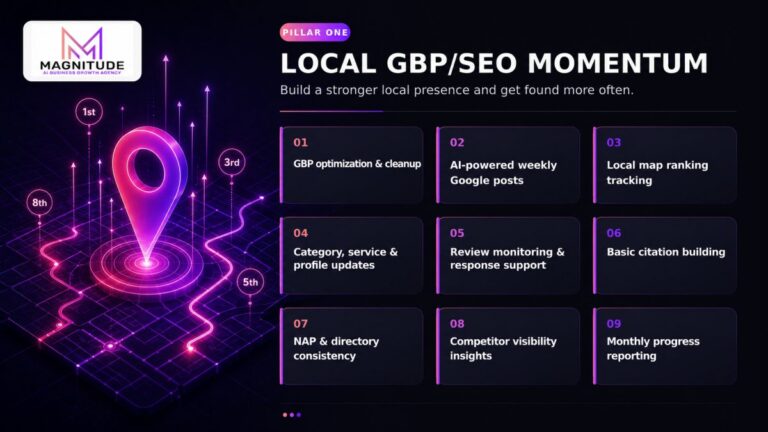
Magnitude supports plumbing companies with local SEO, Google Business Profile and Google Maps visibility, paid advertising, and lead-generation systems. Landing pages can align the message with the service being promoted. Call tracking, campaign tracking, and CRM automation can help connect inquiries to follow-up and sales stages. The right combination depends on your goals, capacity, and current gaps.
These systems support execution and accountability. They don’t guarantee search rankings, lead volume, or booked work. For a practical next step on local discovery, request a local search visibility audit and discuss how it fits your commercial lead priorities.
Build a Tucson pipeline around the work you want
A practical answer to how to get commercial plumbing leads Tucson is to focus on fit, not raw inquiry volume. Choose the commercial jobs your crews can take on, make those services clear to local buyers, and select channels that match how they search. Then capture the details needed to qualify each opportunity and track it through estimates and booked work.
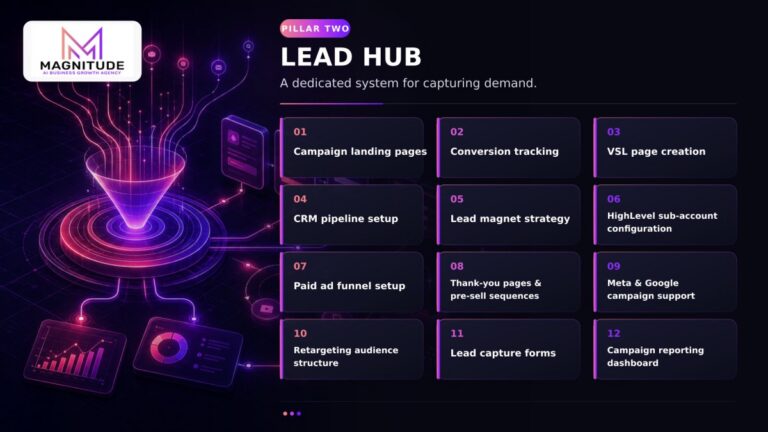
Local SEO, Google Business Profile optimization, and Google Maps visibility can support local discovery. Magnitude’s Lead Hub connects landing pages, CRM automation, sales pipelines, and campaign tracking so you can follow inquiries beyond the first call. These tools support a measurable process, not guaranteed rankings or lead volume.
Bring your target services, preferred customer types, service radius, crew capacity, and available lead records into the planning conversation. That gives you a practical starting point for deciding what to improve and how to evaluate progress.
Discuss your commercial plumbing lead strategy with Magnitude, and take the next step toward a more focused, accountable pipeline.
Frequently Asked Questions
How do I get commercial plumbing leads in Tucson?
To get commercial plumbing leads in Tucson, define the jobs and buyers you want, then make your commercial services easy to find and understand. Improve local visibility, compare organic search with paid channels, and create inquiry paths that ask for useful details. Track each lead through qualification, estimates, and booked work. The right marketing mix depends on your service scope, crew capacity, and follow-up process, not a promised lead count.
Which marketing channel is best for commercial plumbers in Tucson?
There’s no single best channel for every commercial plumber in Tucson. Local SEO and Google Business Profile can support discovery, while paid search can reach people actively looking for plumbing services. Compare channels against your target job types, buyer intent, service coverage, budget, and ability to respond and qualify inquiries. A channel that generates attention but attracts poor-fit jobs may be less useful than one producing fewer, better-matched opportunities.
Are Google Ads worth it for a commercial plumbing company?
Google Ads may be worth testing if campaigns target commercial services your company accepts and you can track the resulting inquiries. Send searchers to a relevant landing page, use call tracking to identify campaign calls, and record whether each lead is commercially qualified, estimated, and booked. Then assess actual campaign and sales data before deciding whether to adjust or continue. Paid search can create opportunities, but it doesn’t guarantee a return.
How can a Tucson plumber attract property managers and facility teams?
Make your commercial plumbing capabilities and coverage across Tucson, Phoenix, Oro Valley, Scottsdale, Mesa, Glendale, and Peoria easy for property managers and facility teams to understand. Build local visibility with accurate business information, clear service descriptions, and credible reviews. Provide a straightforward way to request service or discuss ongoing needs, then follow up consistently and qualify each inquiry. Buyers have different responsibilities and processes, so tailor your information to the work you handle rather than assuming every organization chooses a provider the same way.
How do I know whether a plumbing lead is commercially qualified?
A plumbing lead is commercially qualified when the request fits your commercial service scope, service area, capacity, and preferred job types. Capture the service needed, property location, urgency, and contact’s role when appropriate. Then track whether the inquiry progresses to an estimate, booked work, or a declined opportunity. A completed form or phone call is only an inquiry. Qualification depends on whether the opportunity fits your business and can move forward.
How should a plumbing company track where commercial leads come from?
Record the source of each call or form inquiry, then follow it through qualification, estimate, and booked or declined status. Call tracking can identify the marketing source of calls, while CRM records keep lead details and sales progress together. Use the same lead definitions across organic search, paid campaigns, and referrals. Clicks and impressions can show visibility, but they don’t tell you whether an inquiry became booked plumbing work.
Can local SEO generate commercial plumbing leads in Tucson?
Local SEO can help relevant buyers discover a plumbing company through local search in Tucson, but visibility doesn’t guarantee inquiries or booked work. Make service information relevant and accurate, keep business details consistent, maintain a useful Google Business Profile, and build credible reviews. Give prospective customers a clear next step. Measure qualified commercial inquiries alongside visibility so you can see whether local discovery is reaching buyers whose needs match your services.