Getting Landscaping Clients in Glendale: A Practical Growth Plan for 2026
Clicks don’t fill a crew schedule. Qualified estimates do. If you’re getting landscaping clients in Glendale through scattered referrals or marketing that attracts the wrong jobs, it’s difficult to plan crews, protect estimate time, and build steady revenue.
Which deserves attention first: local search, ads, reviews, or referrals? The answer depends on the services you want to sell, the areas your crews can reach, and how much capacity you have. A recurring maintenance route has different lead needs from a drought-tolerant planting project or a larger outdoor-living installation.
This guide explains how to compare those channels and connect local visibility to a reliable estimate process. You’ll learn how service-specific pages and a well-managed Google Business Profile can help Glendale prospects find relevant services, how advertising can support demand, and how reviews and referrals can build trust. You’ll also see how to track the steps from inquiry to qualified estimate, booked job, and revenue, so you can judge marketing by what it produces, not just by clicks.
Key Takeaways
- Getting landscaping clients in Glendale starts with matching local visibility to the services, locations, and project types your company can handle.
- Compare Maps visibility, paid ads, referrals, directories, and social advertising by prospect intent, tracking needs, and fit with crew capacity.
- Prioritize inquiries by service match, location, project scope, timing, travel, and potential for recurring maintenance.
- Use a consistent process to capture inquiries, qualify prospects, schedule estimates, and track outcomes through booked work and revenue.
- Connect local SEO and advertising to lead management so you can see which marketing efforts produce qualified estimate opportunities.
Getting landscaping clients in Glendale starts with the right local demand
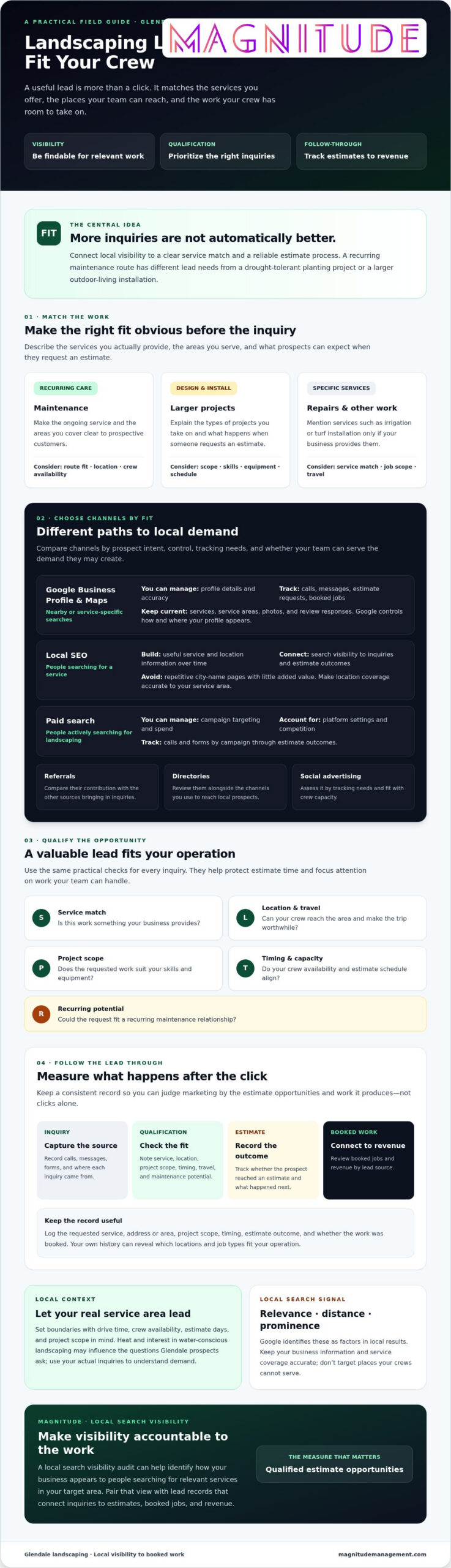
Getting landscaping clients in Glendale takes three things working together: relevant local visibility, a clear match between the advertised service and the work you perform, and reliable follow-up when someone inquires. More inquiries aren’t automatically better. A qualified landscaping client needs a service, location, and project scope that your team can handle.
That definition filters out leads that seem promising but don’t fit. A homeowner seeking a full installation has different needs from someone looking for recurring yard maintenance or a small repair. Project messaging should explain the types of work you take on and what prospects can expect when they request an estimate. Maintenance messaging should make the ongoing service and areas you cover clear. Google explains how relevance, distance, and prominence affect local results in its guidance on local ranking.
Set realistic service boundaries before expanding your targeting. Consider drive time, crew availability, the days you can conduct estimates, and whether the likely project scope justifies the trip. Your local visibility should reflect where you can serve, not every nearby place a marketing platform lets you select. If your business serves multiple markets, including Tucson, Phoenix, Oro Valley, Scottsdale, Mesa, Glendale, and Peoria, make sure your coverage is accurate for each location. A local search visibility audit can help identify how your business appears to people searching for relevant services in your target area.
Which Glendale landscaping customers should your marketing attract?
Separate design and installation prospects from maintenance customers and smaller repair requests. Each group may need different service descriptions, examples, and estimate questions. Mention irrigation or turf installation only if your business provides those services. Compare each type of work with your team’s skills, schedule, equipment, and business priorities. The goal isn’t to attract every homeowner. It’s to make the right fit obvious before an inquiry reaches your estimate calendar.
How seasonality and service radius shape landscaping demand
Seasonal patterns can shift the mix of project requests, maintenance inquiries, estimates, and available crew hours. Rather than assume a calendar pattern applies to your business, review your own inquiry and scheduling history. Heat and interest in water-conscious landscaping may influence the questions Glendale prospects ask, but confirm demand through actual inquiries. Track each lead’s location and job type to identify service pockets that fit your travel time and crew capacity.
Use a consistent review process. Record the requested service, address or area, project scope, timing, estimate outcome, and whether the work was booked. Over time, these records can show which locations and job types deserve more visibility, and which inquiries repeatedly strain scheduling without fitting your operation.
How can Glendale landscapers compare local SEO, referrals, and paid ads?
No single channel works best for every landscaping company. Local SEO helps nearby prospects find and assess your services. Referrals bring trust from an existing relationship, while paid ads give you more control over where and when your message appears. Choose based on your service mix, competition, budget, follow-up process, and crew capacity. Then measure which sources lead to estimates and booked work.
| Channel | Audience intent | Control | Tracking needs | Fit and operational considerations |
|---|---|---|---|---|
| Google Business Profile and Maps | Often looking for a nearby provider or a specific service | Control your profile details, not how or where Google displays it | Track calls, messages, estimate requests, and booked jobs | Keep services, service areas, photos, and review responses accurate and current |
| Local SEO | Searching for a service, such as landscape installation or yard maintenance | Build useful service and location information over time | Connect search visibility to inquiries and estimate outcomes | Needs accurate, distinct content, not pages that repeat a city name with little added value |
| Paid search | Actively searching for a landscaping service | Set campaign targeting and manage spend, subject to platform settings and competition | Track calls and forms by campaign through estimates and booked work | Works best when advertised services match landing-page details and available estimate capacity |
| Referrals | Referred by someone who knows your work | Limited control over timing and volume | Ask how the prospect heard about you and record the answer | Trust can help, but referrals still need to fit your services, travel radius, and schedule |
| Directories and social advertising | Varies: directory users compare providers; social audiences may discover a service before actively searching | Depends on the platform and campaign setup | Use source tracking and ask whether inquiries become qualified estimates | Directory listings need accurate details; social ads need relevant creative and prompt follow-up |
When local SEO and Google Business Profile make sense
Use your profile to help prospects judge whether your business is a fit. List the services you actually provide, define your service area accurately, add genuine project photos, and respond professionally to reviews. Support that visibility with useful Glendale service content that explains what a project involves. Avoid publishing near-identical pages that only swap in different neighborhood names. A local search visibility audit can help uncover gaps in how your business appears locally.
When paid advertising can support landscaping lead flow
Paid search can put your business in front of people actively looking for a service you offer. Meta advertising can introduce your work to people who may not be searching yet, so it depends more on relevant creative and a clear next step. Both channels need a dependable response process. Even when crews are booked, a new inquiry needs a timely, useful reply.
Clicks and impressions are diagnostic signals, not proof of profitable work. Track each opportunity from source to qualified inquiry, estimate, booked job, and revenue. That’s the difference between getting landscaping clients in Glendale and simply buying attention. If you’re weighing local visibility against advertising, explore Magnitude’s landscaping marketing services as one way to assess your options.
What makes a landscaping lead valuable enough to pursue?
A landscaping lead is worth pursuing when the requested service matches your capabilities, the property is within a workable service area, the project scope suits your business, and the timing fits your schedule. Check whether you can arrange an estimate and complete the work with available crews. Inquiry volume alone isn’t a useful measure. Follow each opportunity through to its estimate, booked job, and revenue.
Priority depends on more than the potential size of a project. A one-time installation may offer a larger job, while recurring maintenance may provide repeat work. But travel time, crew availability, season, and estimate preparation all affect whether either opportunity suits your operation. Don’t assume one type is automatically more profitable. Compare them using your own costs, schedule, and job outcomes.
How to qualify landscaping inquiries before an estimate
Capture enough information to choose a sensible next step, without interrogating the prospect. Ask for:
- The service requested and the property location
- The project goal or maintenance needs
- Their preferred timing
- Contact details needed to respond and arrange an estimate
Use those answers to separate work outside your service area or scope from jobs your team can fulfill. Don’t request unnecessary personal details or make assumptions about someone’s budget. If the scope is unclear, ask a focused follow-up question before committing estimate time.
How to compare lead sources without trusting vanity metrics
Record inquiries by source, then track how many are qualified, receive estimates, become booked jobs, and generate revenue. Where appropriate, call tracking can help identify which campaign or listing prompted a call. Confirm that tracking is set up correctly before launch so calls and forms aren’t misattributed or missed.
Compare recurring maintenance and one-time installation or renovation separately. Their estimate effort, scheduling needs, crew requirements, and revenue patterns may differ. Impressions, clicks, and raw inquiries can help diagnose visibility or campaign activity, but they don’t establish business value.
Hypothetical lead-economics example: Use your own figures to compare two opportunities. For a one-time installation, enter expected job revenue, direct job costs, travel, and estimate time. For recurring maintenance, enter expected revenue and costs over the period you use to assess recurring work, plus travel and servicing time. Subtract costs from revenue for each opportunity, then consider crew capacity and schedule fit. This is a comparison framework, not a forecast. More inquiries only help if they turn into work your company can deliver profitably.
How should a Glendale landscaping company turn inquiries into estimates?
Turn each inquiry into a tracked next step: capture the request, check service and location fit, assign a team member, schedule an estimate when appropriate, and record the outcome. A consistent process helps you manage estimate visits, preparation time, crew dispatch, and seasonal workloads. It also shows whether marketing inquiries are becoming real jobs, instead of leaving the team to rely on memory.
A practical inquiry-to-estimate workflow
Give every call or form submission an owner and a clear next action. A simple pipeline might include stages such as new inquiry, qualification needed, estimate to schedule, estimate completed, and won or lost. Keep the stages practical enough for your team to update during a busy workday.
- Capture: Record the requested service, property location, lead source, contact details, and date received.
- Qualify: Confirm the work is within your services and service area, and ask about project goals and preferred timing.
- Plan: Check estimate availability, travel, site-visit time, estimate preparation, and current crew capacity before offering a slot.
- Follow up: Log contact attempts and agree on a follow-up expectation your team can consistently meet.
- Close the record: Mark whether an estimate was scheduled and completed, then record the final outcome.
For example, imagine a landscape renovation request arrives while the team is visiting another property and preparing estimates. If nobody owns the new inquiry, the prospect may not hear back until available estimate slots have shifted. The delay doesn’t prove the job was lost, but it can make scheduling harder for both sides. Assigning a responsible person and recording the next action makes the handoff visible.
Where CRM automation and call tracking can help
A customer relationship management system, or CRM, stores inquiry details and shows where each opportunity stands. Reminders can flag a promised follow-up, while pipeline stages help the team see what needs attention. Automation supports the process, but it can’t decide whether a project fits your crews or replace a useful conversation with the property owner.
Call tracking can connect calls to the advertising source that prompted them, giving you more context than a click count alone. Confirm that calls and form submissions are recorded correctly before relying on campaign reports. Magnitude’s lead management tools include CRM automation, sales pipelines, lead capture, and call tracking to support inquiry follow-through.
Make the handoff measurable, from first contact to estimate and final outcome. If Glendale visibility is bringing inquiries but the next step is unclear, review your local search visibility. To explore support for organizing and tracking landscaping leads, review Magnitude’s lead management services.
How Magnitude can help Glendale landscapers build a measurable client pipeline
Getting landscaping clients in Glendale is a connected process, not a visibility task in isolation. Magnitude’s approach is to assess local discovery, focus marketing on services and locations your company can serve, improve the path from inquiry to estimate, and measure what happens next. That work can include local SEO and Google Business Profile optimization, paid advertising, lead capture, and tracking. Magnitude also works on GEO and AI search visibility, helping businesses make their services and locations clearer for AI-powered search experiences. No specific placement or business result is guaranteed.
What a landscaping marketing assessment should examine
Start with the basics. Are your Glendale service boundaries accurate? Can local prospects find your business for the work you perform? Does your Google Business Profile describe those services clearly? Does your service-specific content help prospects understand whether they’re a fit and how to take the next step?
Then check what happens after someone responds. Review whether calls and forms are captured, attributed where possible, routed to someone responsible, and followed through to an estimate outcome. Account for estimate availability, crew capacity, seasonal workload, travel, and services your company doesn’t offer. More demand won’t solve a scheduling bottleneck or a mismatch between advertised work and your crews.
Choosing support based on the problem you need to solve
If local discovery is weak, local SEO and Google Business Profile optimization can strengthen how your business presents relevant services and coverage. If paid campaigns generate activity but results are unclear, advertising review and conversion tracking can connect campaign activity with inquiries and booked work. If leads are missed, capture systems and CRM automation can support a consistent follow-up process. The right mix depends on competition, budget, service fit, operations, and execution.
Magnitude provides these marketing services for landscaping businesses, including strategies for local and AI search visibility. Measure the path from discovery to inquiry, qualified estimate, booked job, and revenue. Request a local visibility review to assess how your Glendale presence supports that process.
Build a client pipeline you can plan around
Getting landscaping clients in Glendale isn’t about collecting the most clicks or inquiries. It’s about attracting prospects who need work you actually perform, fit your service area and crew capacity, and can move through a clear estimate process.
Choose channels based on the jobs you want, then track inquiries through qualified estimates, booked work, and revenue. That gives you a practical way to decide whether local visibility, paid advertising, referrals, or stronger follow-up needs attention next.
Magnitude provides local SEO and Google Business Profile optimization for landscaping businesses, alongside paid advertising, lead capture, call tracking, and CRM automation. These services can support a more measurable path from local discovery to estimate, but outcomes depend on competition, budget, service fit, operations, and execution. No channel can guarantee results.
Request a local visibility review to assess how your Glendale presence supports the work you want to win. With clear priorities and consistent tracking, you can make better growth decisions and build a pipeline that works for your business.
Frequently Asked Questions
How can I get more landscaping clients in Glendale?
Getting landscaping clients in Glendale starts with promoting the services you actually provide, appearing in relevant local searches, and following up consistently. Make your service area clear, describe project types accurately, and help prospects understand how to request an estimate. Track inquiries through estimates and booked work, then use the results to refine your marketing. If you serve nearby areas such as Phoenix or Peoria, target them only if they fit your operations.
What is the best way for a landscaper to get leads in Glendale?
The best lead source depends on your services, budget, competition, estimate availability, and crew capacity. Local SEO and an accurate Google Business Profile can help people find and assess your company. Referrals can bring trust, while paid search can reach people actively looking for a landscaping service. Compare channels by qualified inquiries, estimates, booked jobs, and revenue, not clicks alone. Choose sources that can send work your team is prepared to complete.
Does Google Business Profile help landscapers get local clients?
Yes. A complete, accurate Google Business Profile can help Glendale prospects understand what landscaping services you offer, where you work, and what your finished projects look like. Keep service details and coverage current, add genuine project photos, and respond to reviews professionally. A profile supports local discovery, but visibility alone doesn’t guarantee inquiries or jobs. Make sure the next step is clear, and track calls or estimate requests through to their outcomes.
Should a Glendale landscaping company use Google Ads or local SEO?
Use local SEO to build useful service and location information that supports discovery over time. Google Ads can put your business in front of people searching for a landscaping service, with campaign activity tied to an advertising budget. The right choice depends on how quickly you need to test demand, your competition, and your ability to handle estimates and jobs. Track both channels through qualified inquiries and booked work before judging performance.
How do I know whether a landscaping lead is worth pursuing?
Check whether the requested service matches your skills, the property is within your service area, and the project scope and timing fit your schedule. Consider travel, site-visit and estimate-preparation time, potential job revenue, and available crew capacity. Recurring maintenance and one-time installations may have different operational value, so compare them using your own job costs and outcomes. Don’t assume a prospect’s budget. Ask relevant questions to understand the work requested.
How quickly should landscapers follow up with estimate requests?
Follow up as soon as your team can respond usefully, and set a consistent expectation you can meet. There’s no need to promise a specific response time unless your operation can support it. Assign each inquiry to a responsible person, record contact attempts, and agree on the next action. During busy periods, clear communication about estimate availability helps prevent scheduling confusion and keeps requests from being forgotten among site visits and crew coordination.
Can a landscaping company use paid ads when crews are already busy?
Yes, but advertising should reflect your actual capacity. If crews are booked, review which services, locations, or project types you promote and whether new estimate requests can be handled. You might adjust campaign targeting or spending rather than attract work that cannot be scheduled. Keep tracking inquiries and outcomes as conditions change. Paid ads can support demand, but they can’t resolve a capacity bottleneck or guarantee that incoming work will fit your schedule.