Retargeting Campaign Examples for Contractors: Stop Wasting Your Ad Spend in 2026
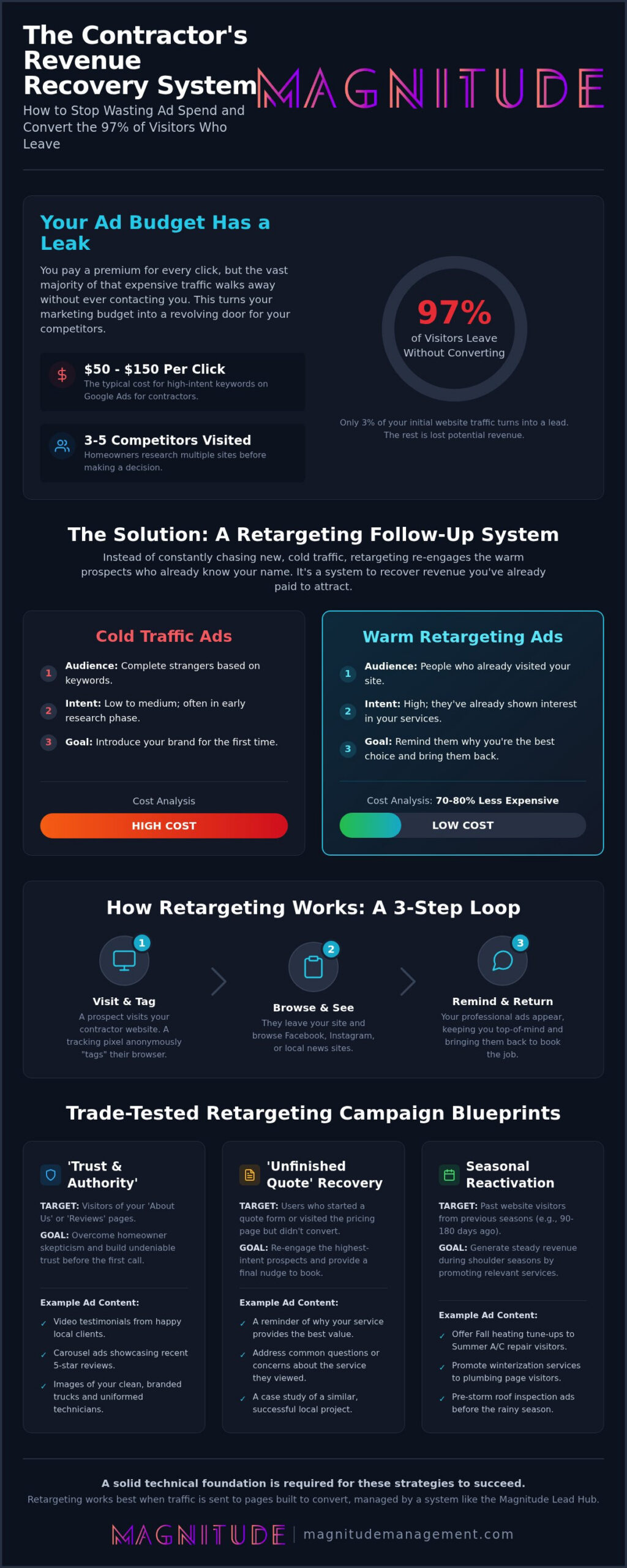
Stop treating your website traffic like a revolving door where 97% of your potential revenue walks out and never returns. You are likely paying $50 or even $150 per click on Google Ads, only for prospects to visit your site, get distracted by a text message, and eventually book with a competitor who happened to pop up later. It’s a massive waste of capital. We’ve seen how leads go dark after a quote because there’s no system to bring them back. This guide provides specific retargeting campaign examples for contractors that act as a revenue recovery system rather than just more advertising noise.
You probably agree that winning a job is harder when you’re constantly chasing new, cold traffic instead of closing the people who already know your name. I promise to show you the trade-tested sequences that turn those hesitant window shoppers into booked HVAC, plumbing, and roofing jobs. We’ll examine the mechanics of the Magnitude Lead Hub and how to build a professional brand presence that follows your prospects until they’re ready to buy. You’ll learn how to lower your customer acquisition costs by focusing on the high-intent traffic you’ve already paid for.
Key Takeaways
- Stop hemorrhaging money on expensive Google Ads clicks by installing a recovery system that captures the 97% of visitors who leave your site without calling.
- Use specific trust-building assets like video testimonials and branded trucks to differentiate your company and eliminate the common homeowner fear of “shady” contractors.
- Deploy these trade-tested retargeting campaign examples for contractors to automatically re-engage prospects who abandoned their quote requests or pricing page visits.
- Leverage seasonal reactivation sequences to generate steady revenue during shoulder seasons by targeting past visitors who haven’t engaged with your site in months.
- Recognize that standalone ads fail without proper infrastructure; use the Magnitude Lead Hub to ensure your retargeted traffic lands on pages designed to convert.
What is a Retargeting Campaign for Contractors?
A retargeting campaign is a digital follow-up system designed to keep your brand in front of prospects who have already engaged with your HVAC, plumbing, or roofing website. It’s a precision-engineered recovery system. Most homeowners will visit three to five different contractor sites before they ever pick up the phone. If you aren’t retargeting, you’re essentially paying for their research and letting a competitor reap the reward. In 2026, retargeting functions as the ultimate revenue recovery tool for contractors who refuse to let high-intent traffic evaporate into thin air.
The economics of this system are undeniable. While a “cold” search click on Google Ads for a term like “emergency plumber” can cost a fortune, retargeting clicks often cost 70% to 80% less. You’ve already paid the “entry fee” to get them to your site once. Retargeting ensures that the initial investment isn’t wasted by staying top-of-mind until the homeowner is ready to book. Reviewing successful behavioral retargeting strategies shows that this isn’t about broad brand awareness; it’s about closing the loop on existing interest.
How Retargeting Works in Plain Business Language
Think of retargeting as a digital shadow that follows your prospects across the web. When someone visits your site, a small piece of code called a pixel or an API connection tags them anonymously. This isn’t “black box” magic. It simply allows your ads to appear on Facebook, Instagram, and local news sites specifically for that visitor. This cross-platform visibility creates a professional brand presence that makes your local company look like a market leader.
There’s a fundamental difference between “cold” ads and “warm” retargeting ads. Cold ads target strangers based on keywords or location. Warm retargeting ads target people who have already seen your work, read your reviews, or looked at your service pages. You aren’t introducing yourself for the first time. You are reminding them why you’re the best choice for the job while they are still in the decision-making phase.
Why Arizona Contractors Need This Now
The home services markets in Phoenix and Tucson are hyper-competitive. You cannot afford to pay for the same visitor twice. If a prospect leaves your site to check a competitor’s reviews, retargeting brings them back before they settle for a lower-quality option. It’s about protecting your lead inventory.
Seasonality also makes this essential for operational efficiency. As Arizona shifts from blistering summer AC repairs to winter heating tune-ups, your retargeting can pivot instantly. You can show specific ads to people who visited your cooling pages months ago, offering them a priority heating inspection before the first cold snap. If you suspect your current strategy is leaking money, you should audit your current ad waste here to see exactly where your budget is disappearing. Implementing effective retargeting campaign examples for contractors allows you to stop the bleed and start capturing the revenue you’ve already earned.
The ‘Trust & Authority’ Retargeting Example
Homeowners aren’t just looking for a service; they’re looking for a reason to trust you. Most contractors fail here because they treat every visitor like a generic lead. The ‘Trust & Authority’ model is one of the most effective retargeting campaign examples for contractors because it directly attacks the ‘shady contractor’ stereotype. Instead of bombarding people with ‘Book Now’ buttons, you show them why you’re the safe choice. You target visitors who spent at least 30 seconds on your ‘About Us’ or ‘Reviews’ pages. These are the researchers. They are looking for a red flag. Your job is to give them green lights instead.
Digital platforms collect and use your information to help businesses reach specific audiences; we use this data to serve undeniable proof of quality. This isn’t about vanity metrics. It’s about building a reputation before you ever step foot on the property. At Magnitude, we integrate your 5-star growth strategy directly into the ad creative. We don’t just say you’re good; we show you’re the local standard through video testimonials and clean, branded trucks.
Example 1: The ‘Review Carousel’ Ad
Social proof is your strongest weapon in competitive markets like Scottsdale or Oro Valley. A Review Carousel ad features high-resolution screenshots of recent 5-star reviews specifically from the prospect’s neighborhood. It lowers the psychological barrier to booking. When a plumber or electrician appears alongside a glowing recommendation from a neighbor, the ‘Trust Gap’ shrinks. This isn’t fluff. It’s operational necessity for any contractor who wants to dominate their local zip codes.
Example 2: The ‘Expertise Video’ Ad
Authority isn’t claimed; it’s demonstrated. Imagine a 30-second clip of your lead technician explaining exactly why a Tucson AC unit might be icing up in the middle of July. You aren’t selling a repair yet. You’re providing value. By the time the homeowner realizes they need a professional, you’re the only name they associate with the solution. This is one of the better retargeting campaign examples for contractors because it builds a relationship before the first phone call. It positions your business as a consultant rather than a commodity provider.
If your current ads are just noise without authority, you’re leaving money on the table. You can audit your current ad waste here to see where your trust-building efforts are falling short. For a deeper look at your local standing, consider a comprehensive digital strategy that turns your existing traffic into revenue.
The ‘Unfinished Quote’ Recovery Sequence
People don’t always leave your pricing page because your rates are too high. They leave because the dog barked, the Wi-Fi dropped, or they simply weren’t ready to pull the trigger on a $15,000 roofing contract while standing in the checkout line. This is the “abandoned cart” of the home services world. Most marketing agencies ignore this because it requires deeper integration with your sales process. However, implementing a quote recovery sequence is one of the most profitable retargeting campaign examples for contractors because it targets the highest-intent traffic in your ecosystem. A strategic $500 investment in a recovery sequence like this can be the single factor that saves a $15,000 roofing contract from disappearing into a competitor’s CRM.
Running these sequences requires a commitment to transparency and professional standards. We structure every campaign to align with the Digital Advertising Alliance’s Self-Regulatory Principles. This ensures your brand remains professional and compliant while maintaining the persistent visibility necessary to close high-ticket jobs like full HVAC system installs or complete roof replacements. You aren’t just running ads; you’re managing your local reputation.
Step 1: The ‘Gentle Reminder’ (Days 1-3)
Your first move isn’t a hard sell. It’s a reminder that you’re still available to solve their problem. Ad copy like “Still need help with your roof? We’re ready when you are” works because it addresses the prospect’s need without being pushy. You’re offering a bridge back to the conversation they already started. Every ad in this phase must link directly to a dedicated, conversion-focused landing page where the quote process can be finished in two clicks. This is one of the essential retargeting campaign examples for contractors who want to maintain a helpful presence.
Step 2: The ‘Value Add’ (Days 4-5)
If they haven’t clicked by day four, they need a reason to prioritize your quote over others. Add a small, high-value incentive that doesn’t cannibalize your margins but tips the scales. For instance, you might offer a free duct cleaning with any full HVAC install booked this month. This adds tangible value to the specific job they were researching. If you’re unsure where your traffic is leaking, get a local search visibility audit to see how many of these high-intent prospects you’re currently losing.
Step 3: The ‘Scarcity/Urgency’ (Days 6-7)
By day six, it’s time to leverage real-world operational constraints. Don’t invent fake deadlines; use your actual crew availability. Copy like “Our Phoenix install schedule is filling up for next week. Claim your spot” triggers a final decision. This approach is effective because it forces a choice. Either they need the work done now, or they’ll move to a lower-priority list. This protects your ad budget from being wasted on people who aren’t ready to buy and ensures your technical resources are focused on ready-to-book leads.
Seasonal & Database Reactivation Retargeting
Your existing customer list is likely sitting in a dusty CRM, gathering virtual cobwebs while you overpay for new leads. This is a strategic failure. During shoulder seasons, like the HVAC changeover in spring and fall or the peak of Arizona’s landscaping spring cleanups, your primary goal should be turning old visitors and past customers into immediate revenue. These are people who already know your brand. They’ve invited you into their homes before. You don’t need to convince them of your quality; you just need to remind them of your existence.
By targeting people who haven’t visited your site in over six months, you’re fishing in a pond where you already have the advantage. When looking for retargeting campaign examples for contractors, database reactivation stands out as the most cost-effective way to fill your schedule during slow months. We use the Magnitude Lead Hub to bridge the gap between your CRM data and ad platforms like Meta and Google. It creates a seamless loop that identifies dormant leads and serves them relevant, seasonal offers without human intervention.
Mining Your Old Database for New Jobs
Think of your customer list as a dormant gold mine. It costs significantly less to reactivate a past client than to acquire a new one from a cold Google search. By uploading these “dormant leads” into a custom audience for Facebook Ads, you can stay visible to people who are already predisposed to trust you. This is one of the most effective retargeting campaign examples for contractors because it leverages data you already own. If you want a deeper dive into this process, read our guide on database reactivation for Arizona revenue.
The ‘Maintenance Reminder’ Example
Plumbing and HVAC systems require consistent upkeep, yet homeowners rarely remember until something breaks. Use retargeting to serve “Annual Inspection” or “Filter Change” reminders. Ad copy like “It’s been a year since your last plumbing check-up; avoid the Scottsdale emergency call rates” creates a sense of urgency tied to cost savings. This isn’t just about one service call. It’s about increasing the long-term Customer Lifetime Value (CLV) by becoming their permanent service provider. It protects your business from the “one and done” trap that keeps most contractors broke.
This systematic approach ensures your trucks stay moving even when the phone isn’t ringing off the hook with emergency repairs. It turns a reactive business into a proactive revenue machine. To see how we can help you implement these strategies, explore our full suite of digital marketing services.
Implementing Retargeting with the Magnitude Lead Hub
Standalone retargeting is a half-measure that often leads to more waste. You can run the most creative ads in the world, but if that traffic lands on a generic homepage or a slow-loading contact form, you’re just paying for the privilege of being ignored a second time. The Magnitude Lead Hub is the infrastructure that makes these retargeting campaign examples for contractors actually profitable. It’s the difference between brand awareness theater and measurable revenue recovery. If your digital destination doesn’t convert, your ads are just a donation to the platforms.
The Lead Hub automates the “Speed to Lead” process. When a prospect clicks a retargeting ad at 9:00 PM on a Tuesday, they shouldn’t wait until Wednesday morning for a call. Our system triggers immediate responses; this ensures you are the first contractor to speak with them. We call this the Lead Guard system. It creates a safety net around your ad spend, ensuring that no high-intent lead falls through the cracks due to operational friction or human delay. You’ve already paid to get them back; don’t lose them to a slow response.
The Infrastructure of a Winning Campaign
Knowing exactly which retargeting ad led to a phone call is non-negotiable for serious growth. Advanced call tracking allows us to see the entire journey from the first Google search to the final retargeted click. Simultaneously, deep CRM integration ensures operational efficiency. Once a prospect books a job, they are automatically removed from the retargeting loop. You stop paying to show ads to people who have already signed a contract. This level of Lead Response Automation is the profit engine for the modern trade business.
Your Next Steps for Arizona Scaling
Scaling a trade business in Phoenix or Tucson requires more than just a marketing guy. It requires a Fractional CMO strategy that treats your ad spend like a capital investment. You must measure success by ROI and customer acquisition cost; ignore vanity metrics like impressions or clicks. Clicks don’t pay the payroll; booked jobs do. Every dollar you spend on retargeting campaign examples for contractors must be held accountable to the bottom line. If you are ready to stop wasting ad spend, it’s time to build your Lead Hub and start recovering the revenue you’re currently donating to your competitors.
Secure Your Local Market Dominance
Every visitor who leaves your site without calling is a lost opportunity that your competitors are eager to catch. You’ve seen the power of trust-based ads, quote recovery sequences, and seasonal reactivation. These aren’t just ideas; they’re the retargeting campaign examples for contractors that separate market leaders from those struggling to keep their trucks moving during the slow months.
Success in 2026 requires more than just creative ads; it requires the technical infrastructure of the Magnitude Lead Hub. We provide advanced call tracking and attribution alongside CRM automation built specifically for home services. Our Arizona-specific market expertise in Phoenix and Tucson ensures your budget is optimized for local demand and real revenue. It’s time to stop donating your traffic to the competition and start recovering the revenue you’ve already earned.
Stop Wasting Your Ad Budget—Build Your Magnitude Lead Hub Today
You’ve done the hard work of getting them to your site. Now, let’s make sure they stay until the job is booked.
Frequently Asked Questions
Is retargeting for contractors expensive?
Retargeting is remarkably cost-effective because you only pay to show ads to a small, pre-qualified audience. While cold Google Ads clicks in Phoenix can be costly, retargeting clicks typically cost a fraction of that price. You aren’t bidding against every contractor in the city for a broad term; you’re bidding for a specific person who already knows your brand. It represents a high-ROI revenue recovery strategy rather than a massive new expense.
Will retargeting ads annoy my potential customers?
Ads only become annoying when they lack variety or appear too frequently. We use frequency caps to ensure your brand remains professional rather than intrusive. By rotating through different retargeting campaign examples for contractors, such as trust-building reviews or helpful tips, you provide value instead of just shouting for a sale. When a homeowner in Scottsdale sees your clean trucks and 5-star reviews across different platforms, it builds familiarity and local authority.
Do I need a large amount of traffic for retargeting to work?
You don’t need thousands of visitors, but platforms like Meta and Google require a minimum audience size, usually around 100 people, to serve ads. Even if you only get a few hundred visitors a month to your plumbing or HVAC site, retargeting ensures you don’t lose those high-value prospects. It’s actually more critical for low-traffic sites because every single visitor represents a larger percentage of your potential monthly revenue.
Can I retarget people who visited my competitors’ websites?
You cannot place your tracking pixel on a competitor’s site, but you can target people based on their search behavior and interests. Google allows you to show ads to users who have searched for your competitors’ brand names or visited similar sites. This is technically competitor conquesting rather than traditional retargeting. It’s a bold way to insert your brand into the decision-making process when a homeowner is still shopping around for quotes.
What is the best platform for contractor retargeting: Google or Meta?
The best strategy uses both platforms to create a cohesive brand presence. Google Display is excellent for keeping your name visible on local news and weather sites while homeowners browse the web. Meta platforms, like Facebook and Instagram, are superior for visual storytelling, such as video testimonials or crew clips. Using a mix of these retargeting campaign examples for contractors ensures you reach prospects wherever they spend their time online, whether they’re in Peoria or Mesa.
How long should I retarget a prospect after they visit my site?
The duration depends on the specific service. For an emergency AC repair in Tucson, a 7 to 14-day window is usually sufficient because the decision happens quickly. For high-ticket items like a full roof replacement or a kitchen remodel, the decision cycle is much longer. In those cases, we might maintain visibility for 30 to 90 days. We adjust the urgency of the ads as the prospect moves further from their initial visit.
Do I need a special ‘pixel’ on my site for this to work?
You need tracking code installed on your site, but the traditional pixel is no longer enough on its own. To comply with 2026 privacy standards and cookie restrictions, we use the Magnitude Lead Hub to implement server-side tracking and Conversions APIs. This infrastructure ensures your tracking remains accurate even as browsers block standard cookies. It’s a necessary step to maintain visibility and accurately measure the ROI of your advertising spend in the Arizona market.