Contractor Reputation Repair: 2026 Revenue Recovery Guide
A single unverified one-star review isn’t just an insult; it’s a silent revenue leak that can cost an Arizona roofing or HVAC contractor tens of thousands in lost seasonal contracts. You’re likely tired of watching competitors dominate the Map Pack because their profiles look cleaner. This guide provides the systematic framework to repair your reputation by turning feedback into a high-performance Authority Engine. You’ll learn exactly how to respond to negative reviews for contractors to reclaim your brand authority and ensure your official website stays at the top of Google.
We’ll move beyond simple damage control to address the 2026 reality where AI search engines use review sentiment as a primary discovery signal. We’ll break down the April 2026 Google Business Profile updates and the FTC’s crackdown on review manipulation. By integrating the Magnitude Lead Hub approach, you can automate review generation and improve your speed-to-lead metrics. It’s time to stop losing high-value contracts to unfair feedback. Start treating your reputation as the measurable growth asset it is.
Key Takeaways
- Quantify the financial impact of a “revenue leak” by understanding how one negative review during peak Arizona seasons can cost an HVAC contractor $50,000 in lost high-value jobs.
- Implement a systematic framework for how to respond to negative reviews for contractors to neutralize unfair feedback and promote authoritative brand signals on the first page of Google.
- Adapt to 2026 AI search requirements by optimizing for Generative Engine Optimization (GEO) to ensure bots recommend your services to local Peoria or Phoenix leads.
- Link your reputation to operational speed, as Google now correlates your 60-second lead response time with your position in the local Map Pack.
- Deploy an “Authority Engine” that automates review generation and integrates your CRM to turn customer feedback into a permanent discovery signal for AI search.
Why Bad Reviews Are a Revenue Leak in the Arizona Market
Reputation repair isn’t a vanity project. It’s essential business infrastructure. In the home services sector, Online Reputation Management is the systematic suppression of negative digital assets and the promotion of authoritative brand signals. For an Arizona contractor, your star rating is your most visible financial metric. It dictates whether a homeowner trusts your crew to enter their property or clicks on your competitor instead.
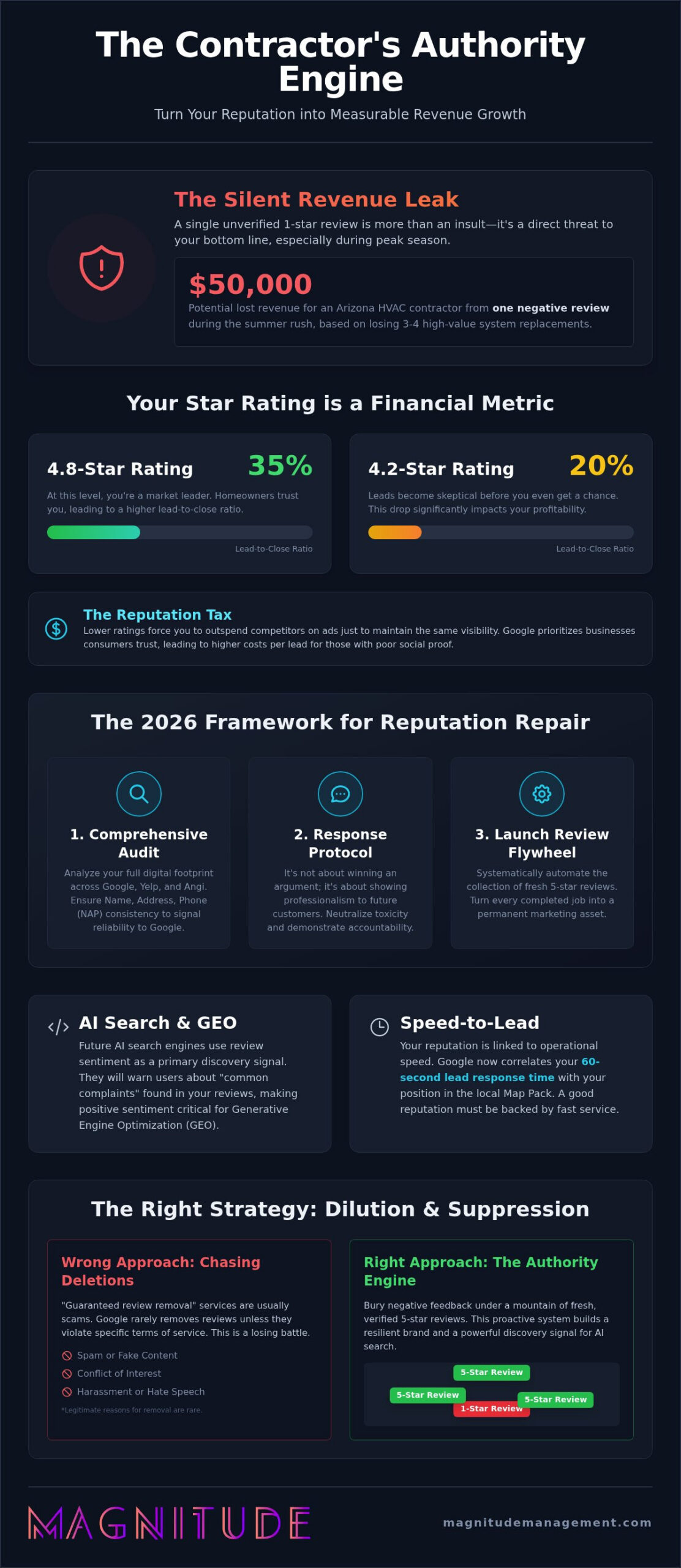
Consider the Tucson Summer effect. When temperatures hit 110 degrees in July, HVAC demand spikes. A single one-star review claiming a “failed AC repair” appearing at the top of your profile can divert dozens of emergency calls. If your average ticket is $15,000 for a full system replacement, losing just three or four of those high-value contracts means you’ve leaked $50,000 in seasonal revenue. While you “wait and see” if the review settles, your competitors in Phoenix are aggressively claiming that market share. This passive approach is the fastest way to fund your competitor’s growth.
Trust also has a mathematical value in Google Local Service Ads (LSA). Contractors with lower ratings often see higher costs per lead. Google prioritizes businesses that consumers trust. If your rating lags, you’re forced to outspend the competition just to maintain the same visibility. Learning how to respond to negative reviews for contractors ensures you aren’t just reacting to fires but building a resilient brand that lowers your customer acquisition costs.
The Literal Cost of a 1-Star Rating
The difference between a 4.2 and a 4.8 rating is the difference between a struggling roofer and a market leader. At a 4.8 rating, your lead-to-close ratio might sit at 35 percent. Drop to a 4.2, and that ratio often plunges to 20 percent because homeowners are skeptical before you even step on the roof. Google’s 2026 AI search summaries now penalize contractors with high negative sentiment. The AI will literally warn users about “common complaints regarding punctuality” or “hidden fees.”
The Reputation Tax is the additional ad spend required to overcome poor social proof and convince a skeptical lead to call you.
Why Review Deletion is Usually a Scam
Many agencies promise “guaranteed review removal.” This is usually a scam. Google has strict Terms of Service. Most of these services fail because they don’t understand the platform’s mechanics. There are only three legitimate ways to get a review removed: spam, conflict of interest, or harassment. If a review is a genuine expression of a customer’s frustration, Google will not move it.
Knowing how to respond to negative reviews for contractors is a better long-term strategy than chasing deletions. Magnitude uses an Authority Engine approach. Instead of fighting a losing battle against Google’s TOS, we focus on dilution and suppression. We bury the negative noise under a mountain of fresh, verified 5-star reviews. If you’re unsure where your brand stands, a local search visibility audit can identify where your revenue is leaking.
The 2026 Framework for Contractor Reputation Repair
Repairing a damaged brand requires a structured offensive. It’s not about hiding; it’s about outshining the noise with a disciplined system. Your first move is a comprehensive audit of your digital footprint across Google, Yelp, and trade-specific sites like Angi or HomeAdvisor. Many Phoenix roofing contractors ignore Yelp, only to find a three-year-old complaint is the first thing a high-value lead sees. You must claim and optimize every local citation to ensure Name, Address, and Phone (NAP) consistency across the Phoenix metro area. Inconsistent data signals to Google that your business is unreliable and can suppress your rankings in competitive service zones.
Next, you need a protocol for how to respond to negative reviews for contractors. This isn’t about winning an argument; it’s about demonstrating professionalism to the next 500 people who read that thread. Mastering how to respond to negative reviews for contractors allows you to neutralize toxicity before it scales into a public relations crisis. Once your defense is set, launch a Review Flywheel. This Magnitude framework automates the collection of fresh 5-star reviews, turning every completed job into a marketing asset. This systematic approach ensures that one bad day on a job site doesn’t define your business for the next decade.
Suppressing Negative Search Results
Negative forum posts or outdated news articles don’t have to stay on page one. You can use high-authority location pages to push these assets down. By creating specific pages for Scottsdale or Mesa, you occupy more search real estate with content you control. Video testimonials are even more effective. A video of a satisfied homeowner in Peoria discussing their new roof captures prime real estate that a text review cannot. The first step in this recovery process is a Local Search Visibility Audit to see exactly what your potential customers are seeing.
Winning the Google Maps Battle
For a plumber in Scottsdale or Mesa, your Google Business Profile (GBP) is your most valuable digital asset. It’s the gatekeeper for local leads. Ranking in the local 3-pack depends heavily on Review Velocity, which is the frequency and consistency of incoming reviews. If you haven’t had a new review in three months, Google assumes your business is stagnant. You must also guard against competitor review-bombing. Use official Google redressal forms to report suspicious activity immediately. If you need help building a more resilient profile, consider a comprehensive reputation strategy that protects your bottom line.
Beyond Reviews: AI Search and GEO Visibility for Trades
AI search engines like Perplexity and Google’s AI Overviews have changed the rules for high-end remodeling and electrical contractors. They don’t just count your 5-star reviews; they analyze the sentiment and context of every word written about your business. This shift toward Generative Engine Optimization (GEO) means these bots are now the gatekeepers for your most profitable leads. If an AI engine identifies consistent complaints about your “speed-to-lead” or “hidden costs,” it won’t recommend you as the best electrician in Peoria, regardless of your keyword density. Understanding how to respond to negative reviews for contractors is now a technical SEO requirement for maintaining visibility in these summaries.
Traditional SEO focused on being findable. Modern visibility requires being recommendable. AI search aggregates sentiment from across the web to build a profile of your brand as an “entity.” If you want to dominate the Arizona service sector, your brand must have Entity Authority. When you master how to respond to negative reviews for contractors, you aren’t just doing damage control; you’re feeding the AI engine the data it needs to verify your business as a professional, reliable entity that resolves conflict effectively. This context is what allows a bot to distinguish a legitimate service provider from a low-quality competitor.
Optimizing for the AI Answer Box
To win in this environment, you must structure your website to speak directly to bots. This starts with a technical FAQ that answers specific, high-value queries like “what is the average cost of a roof replacement in Scottsdale after monsoon damage?” Schema markup is equally vital. It defines your service area and expertise in a language AI understands. AI search prioritizes contractors with consistent, high-quality citations across authoritative platforms over those who rely solely on a high volume of unverified reviews.
GEO Visibility: Dominating Localized AI Search
Localization is no longer just about adding “near me” to your headers. AI discovery relies on location-specific content for Glendale, Mesa, and Oro Valley to verify your physical presence and service history. You need to be mentioned in local Arizona news or trade publications to build the off-page authority that AI trusts. This is a core component of the Contractor Reputation: 2026 Guide to 5-Star Growth. By positioning your brand as a recognized local authority, you ensure that when a user asks for a “reliable solar installer in Tucson,” your business is the definitive answer provided by the AI engine.
Speed to Lead: Turning Reputation into Revenue
A 5-star reputation is a vanity metric if you don’t answer the phone within 60 seconds. In the competitive Phoenix home services market, your digital authority only gets you to the starting line. Once a homeowner clicks your profile, the clock starts. Google now tracks your responsiveness as a core ranking signal. If you consistently miss calls or take hours to reply to messages, your visibility in the local Map Pack will tank regardless of your star rating. While your primary focus might be how to respond to negative reviews for contractors to keep your profile clean, those efforts are wasted if your operational response time is sluggish.
Magnitude’s Lead Hub bridges this gap by automating the follow-up process. When a high-value lead from Mesa or Scottsdale hits your system, our infrastructure ensures they receive a response before they can call the next contractor on the list. You can also use your hard-earned reputation as a sales closer. Train your team to leverage your status during the estimate process. Showing a homeowner a curated list of local 5-star success stories while standing in their living room can justify a higher project bid and increase your close rate. It transforms your reputation from a passive asset into a direct revenue driver.
Automating the Review Flywheel
The most effective way to maintain an Authority Engine is to integrate review requests directly into your CRM. The moment a technician marks a job complete in the field, the system should trigger a request. This ensures the experience is fresh and the customer is motivated. You can incentivize technicians to collect these reviews by offering performance bonuses based on positive mentions, provided you don’t violate platform policies regarding gated feedback. Remember the 5-Minute Rule. If you don’t engage a new lead within five minutes, your chances of conversion drop by 80 percent. Your response time is the ultimate indicator of your brand’s actual reputation.
Lead Guard: Protecting Your Ad Spend
Running Google Ads or Local Service Ads with a 3.5-star rating is essentially lighting money on fire. You’re paying for clicks that will never convert because the social proof isn’t there to support the spend. Using Magnitude’s Ad Waste Audit allows you to identify exactly where reputation issues are killing your ROI. This diagnostic tool highlights the disconnect between your marketing budget and your brand’s public perception. For a deeper dive into operational efficiency, read our guide on Lead Response Automation for Service Businesses: The 2026 Profit Engine. If you’re ready to stop the leak, connect with our strategic partners to build a lead-conversion system that actually works.
Magnitude’s Reputation Recovery System: Direct Action
Magnitude doesn’t just manage reviews. We build systems that make negative feedback mathematically irrelevant. For contractors scaling from 7 to 8 figures in the Phoenix market, a reactive approach is a death sentence. You need a Fractional CMO who understands that your reputation is a core operational asset, not a side project. We integrate GEO visibility, AI search optimization, and automated review generation into a single, cohesive system. This proactive stance ensures you dominate the local conversation before a competitor can even enter the frame. Do not let a few bad actors or unfair 1-star reviews dictate your company’s future value or market position.
The Magnitude Lead Hub Advantage
The Magnitude Lead Hub acts as the central nervous system for your reputation and sales pipeline. Unlike manual processes that are slow and disconnected, our hub tracks every call and lead back to the specific review or search result that generated it. If a customer mentions a specific technician in a 5-star review, we link that sentiment directly to the conversion data. This visibility allows you to see exactly how your response strategy influences your bottom line. Understanding how to respond to negative reviews for contractors is only half the battle; you must also have the infrastructure to capture the resulting traffic. For more on how to vet a partner for this journey, consult our 2026 Home Service Marketing Agency Buying Guide.
Getting Started: Your Local Visibility Audit
Stop guessing where your leads are going. A Magnitude audit provides hard data on your search leaks and reputation gaps without the marketing fluff. We identify exactly which negative assets are suppressing your rankings and which high-authority signals are missing from your profile. The timeline for recovery is structured. We address critical fires, like how to respond to negative reviews for contractors that are currently hurting your LSA performance, within the first 30 days. The long-term authority build follows, creating a permanent barrier against competitor encroachment. If you’re ready for a personalized scaling strategy, it’s time to take direct action. We don’t offer industry theater. We offer measurable growth.
Reclaim Your Local Dominance in the Arizona Market
Your reputation isn’t just a collection of stars; it’s a technical signal that dictates whether AI search engines recommend your HVAC or roofing business. Mastering how to respond to negative reviews for contractors is the foundational step to plugging revenue leaks during high-stakes Arizona seasons. By integrating speed-to-lead automation and a systematic Authority Engine, you turn passive feedback into a discovery machine that captures high-value leads before your competitors can even pick up the phone.
Magnitude provides the infrastructure you need to scale from 7 to 8 figures in the Phoenix and Tucson markets. As specialized partners for plumbers, electricians, and remodelers, we replace industry theater with measurable results. Stop losing revenue and repair your reputation today with Magnitude. It’s time to take command of your digital assets and build a brand that remains bulletproof in the 2026 search environment. You’ve built the business; let’s ensure the market recognizes its value.
Frequently Asked Questions
How long does it take to fix a bad online reputation for a contractor?
Initial stabilization of a damaged profile in Phoenix or Tucson typically takes 30 to 60 days. This involves neutralizing the immediate revenue leaks by burying negative assets under fresh, verified reviews. However, building a permanent Authority Engine is an ongoing operational commitment. You aren’t just fixing a one-time error; you’re establishing a repeatable system that ensures your brand remains the dominant choice in a competitive local market.
Can I legally sue a customer for a fake 1-star review in Arizona?
Litigation is rarely the most efficient path for Arizona contractors. While you can technically sue for defamation, state anti-SLAPP laws and high legal fees often make it a poor investment. A better strategy is focusing on suppression. By flooding search results with positive customer stories and high-authority location pages, you make the fake review mathematically irrelevant to your bottom line without the public drama of a courtroom battle.
Does Google prioritize contractors with more reviews or better reviews?
Google prioritizes Review Velocity and sentiment over raw volume. A roofing company with 100 recent 5-star reviews will outrank a competitor with 500 reviews that are over a year old. Freshness tells Google your crew is active and reliable in the current season. In the 2026 search environment, the recency of your feedback is a primary signal for both the local Map Pack and AI discovery engines.
What is the difference between reputation management and reputation repair?
Reputation management is the proactive maintenance of your brand’s digital health. Reputation repair is the surgical suppression of active negative assets that are killing your lead flow. Repair requires a disciplined framework for how to respond to negative reviews for contractors to stop the immediate bleeding. Once the crisis is stabilized, you transition back to management to ensure your search visibility remains high and your ad waste stays low.
How do I get Google to remove a review from a competitor?
To remove a competitor’s review, you must document a clear violation of Google’s Prohibited and Restricted Content policy, specifically regarding conflicts of interest. Submit your evidence through the official Google Business Profile redressal form. Don’t engage in a public argument; simply state the facts of the violation. Google’s 2026 AI enforcement tools are faster at detecting these patterns, but manual reporting remains the most effective way to protect your profile.
Will improving my reputation help me rank higher on Google Maps in Phoenix?
Improving your reputation is the fastest way to climb the local 3-pack in Phoenix. Google’s algorithm uses star ratings and review text to determine which HVAC or plumbing company is the most recommendable. Higher ratings lead to better click-through rates from the Map Pack to your website. This increased engagement signals to Google that you’re the authority in your service area, creating a self-reinforcing cycle of visibility and leads.
What are the most important review sites for HVAC and plumbing companies?
Your Google Business Profile is the most critical asset for capturing local search traffic. For trades like HVAC and plumbing, secondary sites like Angi and Yelp still influence high-intent homeowners in Scottsdale and Oro Valley. However, your Authority Engine should focus 80 percent of its effort on Google. It’s where the majority of your leads start their search, and it’s the primary data source for AI search engine recommendations.
How does AI search change the way contractors should manage their reputation?
AI engines analyze the actual text of your reviews to determine your Entity Authority. They don’t just count stars; they look for proof of reliability and conflict resolution. Learning how to respond to negative reviews for contractors provides the AI with the context it needs to see you as a professional business. This shift makes authentic, detailed customer feedback a technical requirement for appearing in AI Overviews and conversational search results.