Exclusive vs. Shared Contractor Leads: The 2026 ROI Truth
Why are you paying for a lead that was sold to four of your competitors before you even finished your coffee? The reality of exclusive vs shared contractor leads in 2026 is that the “cheaper” option is often a fast track to wasted margins. You’re exhausted by the “first to call” race and the stress of paying for homeowner data that’s already gone cold. It feels like you’re renting your growth from a landlord who raises the rent every month while the quality of the house declines. You’re tired of the lack of transparency and the predatory math that treats your business like a commodity.
We agree that the current lead mill model is broken. It’s designed to keep you on a treadmill of high-stress, low-margin jobs. This article will identify the systemic failures of shared lead platforms and provide a clear roadmap for transitioning from renting leads to owning your local search infrastructure. We’ll examine why exclusive leads often result in a significantly lower cost per closed deal, even when the initial price seems higher. You’ll learn how to build a predictable sales pipeline that puts you back in control of your marketing assets and your future.
Key Takeaways
- Stop evaluating lead sources by upfront price and start calculating the predatory math that drives up your cost per closed deal.
- Learn the critical ROI differences between exclusive vs shared contractor leads to identify which model builds equity in your brand rather than your competitor’s.
- Prepare for the 2026 search shift by using Generative Engine Optimization (GEO) to ensure AI platforms prioritize your local authority over generic directories.
- Master a specific two-step vetting process to avoid “black box” agencies that withhold access to your ad accounts and marketing data.
- Build a sustainable, predictable sales pipeline by owning your search infrastructure and dominating Google Maps in your local service area.
What are the red flags of contractor lead generation companies to avoid?
Most lead providers are selling you a lie. They promise volume but deliver noise. If your provider hides the mechanics of their system, you aren’t a partner. You’re a source of passive income for them. The industry is full of theater designed to distract you from the only metric that matters: your bottom line. Stop settling for vague promises. You need radical accountability and systems that you actually own.
The shared lead trap: why you lose on price
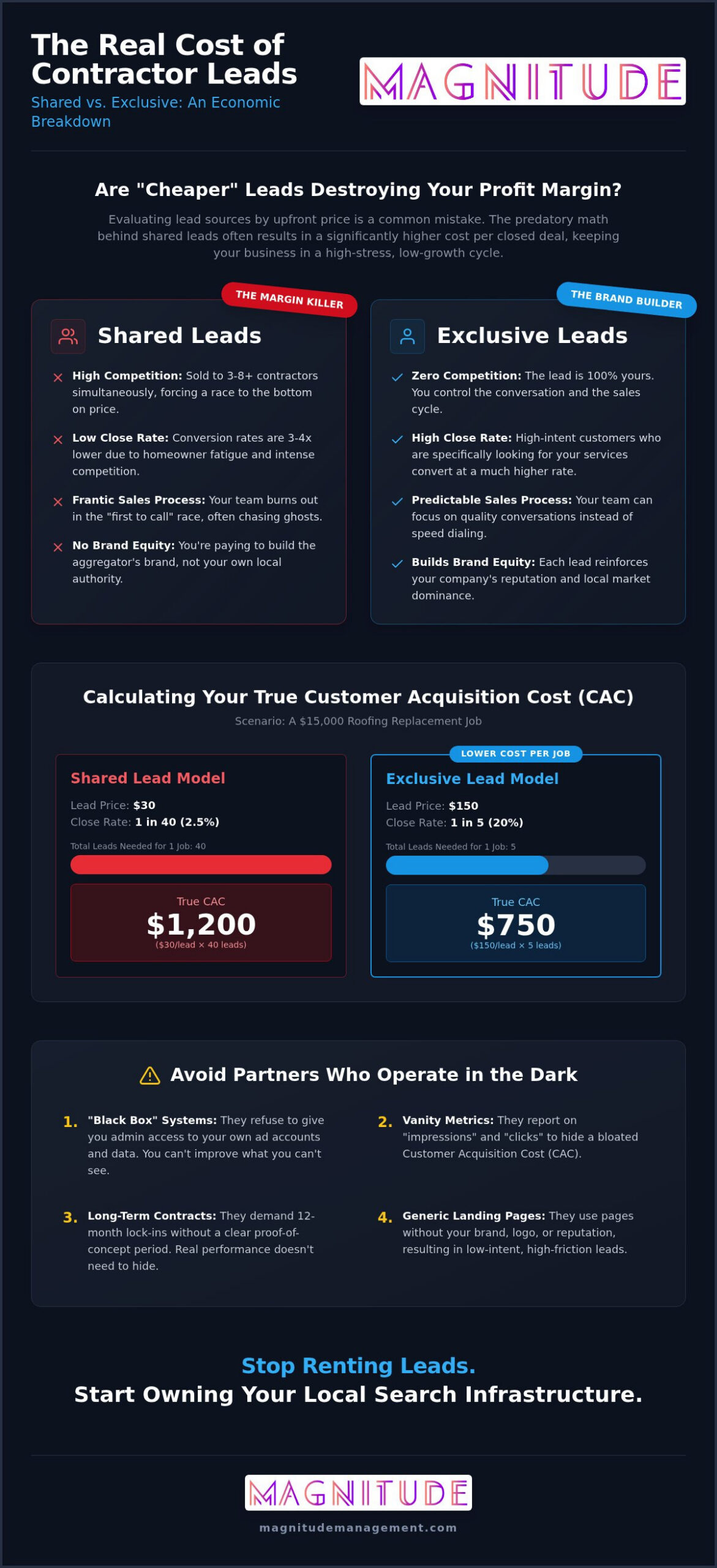
When you buy from a directory, you’re entering a gladiator pit. Lead generation shouldn’t be a race to the bottom. In the debate of exclusive vs shared contractor leads, shared leads are the ultimate margin killer. These platforms sell the same homeowner’s data to three, five, or even eight contractors simultaneously. What happens next? A frantic sprint. Your sales team burns out trying to be the “first to call.” Even if you win the race, you’re forced to slash your price to beat the other four guys standing on the porch. Shared leads often close at a rate 3 to 4 times lower than exclusive, intent-driven calls. It’s predatory math that keeps your business small and your margins thin.
Lack of transparency in ad spend and reporting
Stop letting agencies treat your marketing like a “black box.” If you don’t have direct admin access to your Google Ads or Meta accounts, you’re being robbed. Many providers operate on arbitrage. They charge you a flat fee, spend the bare minimum on low-quality traffic, and pocket the difference. This is why you need an ad waste audit. Watch for vanity metrics like “impressions” or “clicks.” These hide a ballooning Customer Acquisition Cost (CAC). You must own your digital assets. This includes your website and your Google Business Profile. If an agency demands a long-term contract without a 30-day proof-of-concept, walk away. Genuine performance doesn’t need to hide behind a 12-month lock-in.
Be wary of “Lead Mills” that use generic, non-branded landing pages. They capture homeowners who have no idea who you are. This results in low-intent traffic and high friction during the sales process. You want leads that are specifically looking for your brand, not just any contractor with a truck. If the landing page doesn’t have your logo, your phone number, and your reputation front and center, you’re just renting someone else’s leftovers.
Shared leads vs. exclusive leads: what is the real cost?
Don’t get blinded by the sticker price of a lead. Analyzing exclusive vs shared contractor leads requires looking past the invoice and into your actual bank account. A $30 shared lead looks like a bargain until you realize you’re the fourth person to call. By the time you reach the homeowner, they’re either annoyed or have already booked your competitor. You aren’t just paying for the lead. You’re paying for the wasted labor hours your team spent chasing a ghost. This is the “Lead Renting” trap. You’re paying aggregators to build their brand while yours remains invisible.
Calculating your true Customer Acquisition Cost (CAC)
Stop guessing and start measuring. Use this formula: Total Marketing Spend / Total Booked Jobs = True CAC. This is the only number that tells you if your business is actually healthy. For a $15,000 roofing replacement, an exclusive lead costing $150 that closes one in five times results in a $750 CAC. That’s a sustainable win. However, a $30 shared roofing lead that only closes one in forty times creates a $1,200 CAC. You’ve spent more money and forty times the effort for the same result. For smaller jobs, like a $250 plumbing service call, the math is even more brutal. A high CAC on a low-ticket job doesn’t just hurt; it bankrupts you. If you want to stop the bleeding, you need to see exactly where your money is disappearing with an ad waste audit.
Seasonality in Arizona adds another layer of complexity. During 115-degree Phoenix summers, HVAC lead competition explodes. Aggregators jack up prices for shared leads because they know you’re desperate for the volume. You end up paying premium prices for the privilege of fighting five other contractors for a single repair job. Owning your infrastructure through the Magnitude Lead Hub allows you to bypass this bidding war. You aren’t renting space on someone else’s platform; you’re dominating your own local market.
The lifetime value of an organic customer
Customers who find you through Google Maps or your Google Business Profile have higher intent. They aren’t just looking for the lowest bidder on a directory app. They’re looking for a local authority they can trust. These organic customers are more loyal and less price-sensitive because they’ve already “vetted” you through your online presence. This is where Contractor Reputation: 2026 Guide to 5-Star Growth becomes essential. A robust reputation increases the conversion rate of your exclusive leads, making every dollar of your spend work harder. When you own the search results, you own the customer relationship from day one. It’s time to stop renting your future and start building your own marketing infrastructure.
How does AI search and GEO visibility change lead generation in 2026?
The search environment has fundamentally shifted. Traditional SEO was about fighting for a spot on page one. In 2026, the battle is about being the cited answer in an AI overview. This is the core of Generative Engine Optimization (GEO). It isn’t just a technical buzzword. It’s the survival strategy for contractors who want to win the exclusive vs shared contractor leads debate once and for all. GEO is the process of optimizing your digital footprint so that AI models like ChatGPT and Google AI recognize your business as a verified entity. They don’t want to browse a list. They want a solution. Middlemen add friction. AI removes it.
Why aggregators are losing ground to local authority
Lead aggregators are facing a terminal decline. They’ve spent decades acting as middlemen, but AI search thrives on efficiency. Google and Meta are now prioritizing direct business-to-consumer connections to improve user experience. Homeowners don’t want to download an app or fill out a form just to have their phone ring ten times in five minutes. They want a direct answer and an instant booking. AI provides this by pulling data directly from local experts. If you’re “The Local Expert” in Scottsdale or Mesa, the AI cites you. If you’re just a name on a directory list, you’re a commodity. Aggregators are becoming friction points that modern search engines are designed to bypass. When you dominate these results, the choice between exclusive vs shared contractor leads becomes irrelevant because you are generating your own high-intent calls without a middleman.
Dominating Google Maps and AI search results
Your Google Business Profile is now your most valuable marketing asset. It’s often more critical than your website for capturing high-intent leads in the Tucson and Phoenix markets. The shift from “keywords” to “entities” means search engines are looking for the relationship between your services, your location, and your verified reputation. You can’t just spam the word “plumber” anymore. You have to prove you are a licensed, trusted entity in a specific service area. This requires location-specific pages for every neighborhood you serve, from Chandler to Gilbert. These local search visibility audits reveal the technical gaps preventing you from appearing in the “Map Pack” or AI citations. To stay ahead, you must implement a comprehensive Authority Building: 2026 Strategy for Arizona Trades. Stop guessing. Start building. You need to own the search results that drive your revenue.
How to vet a marketing partner before you sign a contract?
Signing a marketing contract shouldn’t feel like a leap of faith. It should be a calculated investment based on radical accountability. Most agencies hide behind “black box” reporting because they don’t want you to see the waste. To secure your growth, you must demand transparency. Start by asking the hard questions about exclusive vs shared contractor leads. If an agency can’t guarantee that every lead generated is for your brand alone, you’re just funding their ability to sell your data to your competitors. Vetting a partner is about moving from a “pay and pray” model to a system of predictable growth.
- Verify Lead Exclusivity: Confirm you aren’t paying to be part of a round-robin system. If the lead is shared, your ROI is already compromised.
- Demand Trade-Specific Proof: Ask for data on HVAC seasonality or roofing storm cycles. If they don’t know how these cycles impact your cash flow, they can’t manage your spend.
- Audit the Infrastructure: Request a Lead Waste Audit to find the leaks in your current funnel before you commit more capital.
- Asset Ownership: Ensure you retain 100% ownership of your Google Ads, Meta accounts, and website. Never let an agency hold your digital assets hostage.
The Magnitude 5-Minute Rule: testing their response systems
A lead’s value drops by 80% after the first five minutes. If your agency doesn’t have a plan for immediate engagement, they’re wasting your money. Ask them: “How will your system reduce my speed-to-lead without increasing my overhead?” The Magnitude Lead Hub uses Lead Response Automation for Service Businesses to trigger instant SMS and email follow-ups. This ensures you’re the first voice the customer hears, effectively ending the race before it starts. If they rely on your office staff to manually check an inbox, they aren’t a strategic partner. They’re a liability.
Trade-specific expertise: the HVAC and Plumbing litmus test
A “one-size-fits-all” marketing strategy is a recipe for failure in specialized trades. Does the agency understand the urgency of a 2:00 AM plumbing emergency versus a scheduled kitchen remodel? In Arizona, the climate dictates the marketing message. An HVAC strategy that works in Seattle will fail miserably in the 115-degree heat of a Phoenix summer. A generalist agency won’t understand that a cooling lead in August is worth ten times a lead in October. They don’t grasp the nuanced sales cycle of a full system install or the high stakes of a burst pipe. You need a partner who understands local regulations and the specific job values that drive your profitability. Stop settling for generalists and partner with a strategic architect who understands your business mechanics.
The Magnitude approach: owning your lead infrastructure
Most contractors are tenants in their own market. You pay “rent” to lead aggregators who own the relationship with the homeowner while you take all the operational risk. Magnitude flips this power dynamic. We build your own local search infrastructure so you can stop competing in the gladiator pit of third-party directories. When you analyze exclusive vs shared contractor leads, the ultimate goal isn’t just a lower cost per lead. It’s the total ownership of the customer journey. We focus on Google Business Profile optimization and Google Maps dominance for Arizona contractors because that’s where high-intent homeowners actually look for help.
From lead renting to lead ownership
The Magnitude Lead Hub is a system designed for capturing, tracking, and converting exclusive leads in real time. It’s not just about getting your phone to ring. It’s about ensuring every call is an asset you own. We build digital equity by increasing your local search visibility, creating a marketing engine that grows in value over time. Unlike a lead mill that stops producing the second you stop paying, an owned infrastructure continues to generate revenue. We don’t care about “brand awareness” or generic clicks. We focus on measurable revenue and booked jobs. By integrating automated reputation management, we ensure your organic lead volume increases as your 5-star reviews stack up. This creates a compound interest effect for your HVAC, plumbing, or roofing business.
For companies looking to scale beyond the $5M mark, our fractional CMO services provide the high-level strategy required for sustainable growth. You don’t just need more leads. You need a disciplined strategic partner to architect your systems and eliminate waste. We look at the mechanics of your success, from CRM automation to technician sales training, ensuring your infrastructure can handle the volume we generate.
Stop the leak: your next steps for 2026
Your first step toward reclamation is identifying where your current budget is being siphoned off by middlemen and poor tech stacks. You must audit your current ad spend for hidden waste and predatory arbitrage. Most Tucson and Phoenix pros are shocked to find that 30 percent or more of their budget is spent on non-performing traffic. We recommend starting with a professional Google Business Profile audit to see exactly where you stand in the local Map Pack. If you aren’t in the top three, you’re invisible to the most profitable customers in your service area.
Stop being a source of passive income for lead mills. It’s time to reclaim your margins and your market. Request an Ad Waste Audit today to see the truth about your current funnel. We’ll show you exactly how to stop the leaks and start building a predictable, owned sales pipeline for 2026.
Reclaim your margins and own your market
The decision between exclusive vs shared contractor leads determines if you’re a tenant or an owner in your own market. Renting leads from aggregators builds their brand while yours remains a commodity. You’ve seen the red flags and calculated the true cost of chasing shared data. Now it’s time to build a system that prioritizes your bottom line. Stop letting middlemen siphon off your profits and start building equity in your own digital assets.
Magnitude specializes in Tucson and Phoenix local SEO. We deliver proven results in Google Maps and AI search visibility. Our AI-powered Lead Hub for HVAC and plumbing contractors provides the infrastructure you need to stop the race to the bottom. You don’t have to settle for the predatory math of lead mills anymore. We focus on measurable revenue and booked jobs, giving you the control you need to scale with confidence.
Take the first step toward reclaiming your territory. Stop wasting money on garbage leads—Get your Ad Waste Audit today. You have the tools to transition from renting leads to owning your local search infrastructure. Your future revenue depends on the systems you build today.
Frequently Asked Questions
Is buying leads from Angi or HomeAdvisor worth it for contractors in 2026?
Buying leads from these platforms is rarely worth it for Phoenix contractors looking for sustainable growth. These platforms operate as shared lead mills, meaning they sell the same homeowner’s data to multiple competitors simultaneously. You end up in a high-stress race to the phone and a bidding war that slashes your profit margins. Instead of renting leads from a middleman, you should invest in building your own search infrastructure to capture high-intent customers directly.
What is the real difference between shared and exclusive contractor leads?
The fundamental difference in exclusive vs shared contractor leads is ownership of the sales process. Shared leads are sold to several contractors, forcing a race to the bottom on price. Exclusive leads, generated through your own Google Business Profile or landing pages, belong solely to you. These leads carry higher intent because the customer specifically chose your brand. Owning the lead means higher conversion rates and a significantly lower cost per closed deal.
How much should a contractor spend on lead generation in the Arizona market?
Marketing spend in the Tucson and Phoenix markets should be viewed as an investment in infrastructure rather than an expense. Most successful home service companies allocate a percentage of their gross revenue to customer acquisition. The goal is to maintain a healthy Customer Acquisition Cost (CAC) relative to your average job value. In a competitive desert climate, focusing your spend on local SEO and Google Maps dominance often yields a better long-term ROI than buying generic leads.
Why are my contractor leads so low quality lately?
Your lead quality is likely dropping because homeowners are shifting away from generic directory apps toward AI-powered search results. Aggregators often use non-branded landing pages that capture low-intent traffic, leading to “window shoppers” who aren’t ready to book. If you’re relying on shared leads, you’re also dealing with “lead fatigue” where the homeowner has already been called by three other plumbers in Peoria or Mesa before you even dial.
How do I know if a marketing agency is scamming me with shared leads?
Transparency is the only way to verify lead exclusivity. If your agency refuses to grant you direct admin access to your Google Ads or Meta accounts, they might be practicing lead arbitrage. This is where they buy cheap traffic and resell it to you at a markup. Demand to see the specific landing pages and tracking numbers used. If the leads aren’t coming through your own branded assets, you’re likely paying for shared leftovers.
What is GEO and how does it help my HVAC or plumbing business?
Generative Engine Optimization (GEO) is the process of making your HVAC or plumbing business the “cited source” for AI search engines. When a homeowner in Scottsdale asks an AI for the best AC repair near them, GEO ensures your business is recommended. It prioritizes your local authority, reviews, and structured data over generic directory lists. This allows you to bypass middlemen and capture exclusive leads by being recognized as a verified local expert.
Can I get exclusive leads without a massive advertising budget?
You don’t need a massive ad budget to generate exclusive leads if you focus on local SEO and Google Business Profile optimization. By dominating the Google Maps pack in areas like Glendale or Gilbert, you can attract organic traffic that carries zero per-lead cost. Building your own reputation and local authority creates a permanent digital asset. This strategy allows you to stop renting visibility and start owning the search results that drive your revenue.
How does speed-to-lead affect my conversion rate for plumbing and HVAC?
Speed-to-lead is the single biggest factor in closing plumbing and HVAC jobs. A lead’s value drops by 80 percent after the first five minutes of silence. If you don’t respond immediately, the homeowner in Phoenix will simply call the next contractor on the list. Using the Magnitude Lead Hub for CRM automation ensures instant engagement via SMS or email. This stops the “first to call” race by making sure you are always first.