Marketing Analytics for Contractors: Stop Guessing and Start Scaling in 2026
How many times have you stared at a monthly report full of “impressions” and “click-through rates” while your phone stays silent during the peak Phoenix cooling season? It’s frustrating to pay for leads that never convert into a $15,000 HVAC install or a full roof replacement. You know that traditional marketing analytics for contractors often feels like a black box designed to protect an agency’s ego rather than your bottom line. We agree that if a metric doesn’t show up on a final invoice, it simply doesn’t matter.
You deserve radical accountability for every dollar spent. This guide will show you how to move past vanity metrics and build a data-driven system that tracks every marketing dollar from the first click to the final payment. We’ll explore how the Magnitude Lead Hub acts as your central nervous system, how to conduct an Ad Waste Audit to stop burning cash, and how to align your spend with the actual economics of your trade.
Key Takeaways
- Stop valuing “impressions” and start measuring the Cost Per Booked Job to ensure your marketing spend results in actual revenue.
- Implement dynamic call tracking and CRM automation to identify exactly which keywords lead to high-value $15,000 service calls.
- Learn why effective marketing analytics for contractors requires moving past jargon-heavy reports and focusing on radical lead-to-invoice transparency.
- Use the Magnitude Lead Hub to bridge the gap between digital clicks and real-world results, effectively eliminating the “marketing theater” that drains your budget.
- Discover how a Fractional CMO helps trades scale past common revenue ceilings by applying disciplined lead economics to every marketing campaign.
What is Marketing Analytics for Contractors and Why Does It Fail?
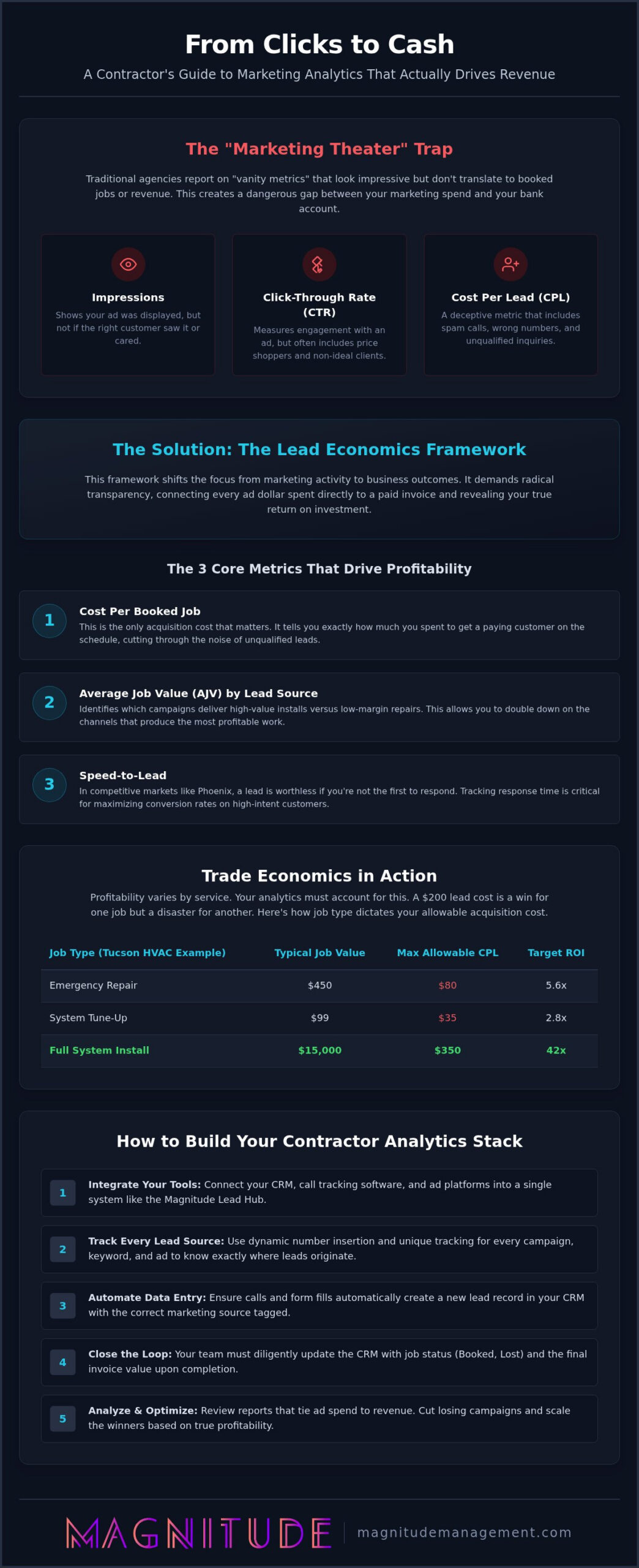
Marketing analytics for contractors is the disciplined process of tracking, measuring, and optimizing the entire path from a local search query to a paid service call. It’s the bridge between a homeowner typing “roof repair near me” and your crew finishing a job. Most businesses think they’re doing this, but they’re actually just collecting noise. If your data doesn’t tell you which specific ad led to a $15,000 HVAC install, your analytics system is broken. True analytics requires a direct line of sight from the first click to the final invoice.
The industry is plagued by “Marketing Theater.” This occurs when an agency presents a report glowing with 50,000 impressions and a 4% click-through rate while your dispatch board remains empty. Impressions don’t pay the payroll for a Phoenix roofing crew; booked jobs do. When you prioritize vanity metrics over core business outcomes, you create fragmented data silos. These silos lead to “Revenue Leaks,” where you spend thousands on leads that are out of your service area or looking for services you don’t even provide.
The Cost of ‘Flying Blind’ in the Arizona Market
Operating without precise data is a recipe for stagnation. In the Tucson market, HVAC companies often lose 30% of their ROI to unoptimized ad spend during shoulder seasons because they fail to adjust their strategy when demand shifts. You can’t scale from two trucks to ten by guessing which neighborhood produces the highest-value jobs. Marketing Theater is the act of reporting data that doesn’t correlate with bank deposits. Without a system like the Magnitude Lead Hub, you’re essentially gambling with your marketing budget and hoping for a return that may never materialize.
Why Traditional Agencies Hide Behind Jargon
Standard agencies love to hide behind “black box” terms like CPM (cost per thousand impressions) or CTR (click-through rate). These metrics are distractions. They shift the focus away from your actual Cost Per Lead (CPL) and, more importantly, your Cost Per Booked Job. A “Lead Volume” report that includes spam calls, price shoppers, and inquiries for work you don’t do is worse than useless; it’s deceptive. It makes the agency look busy while your bank account stays stagnant. We believe in radical transparency. Through our Ad Waste Audit, we strip away the creative vanity and focus on the mechanics of growth. Marketing analytics for contractors must be rooted in operational reality, not agency storytelling.
- Stop counting clicks: Focus on the revenue those clicks generate.
- Eliminate waste: Identify and kill campaigns that produce high volume but zero profit.
- Demand visibility: Ensure every dollar spent is tied to a specific customer interaction.
The Lead Economics Framework: Measuring What Books Jobs
Most contractors evaluate their marketing by the number of leads they receive. This is a fundamental mistake that leads to wasted capital. A “lead” is nothing more than a potential transaction; it’s not revenue. To move beyond the basics of What Is Marketing Analytics?, you must implement a Lead Economics Framework. This system evaluates marketing based on job profitability rather than raw volume. If you aren’t tracking which campaign produced a $15,000 HVAC install versus a $99 tune-up, you’re flying blind.
Effective marketing analytics for contractors relies on three key metrics. First is the Cost Per Booked Job. Cost Per Lead (CPL) is a vanity metric if those leads don’t close. If you pay $100 per lead but only book one in ten, your acquisition cost is $1,000. Second is the Average Job Value (AJV) by lead source. You might find that Google Local Services Ads bring in high-margin replacements while Facebook Ads primarily drive low-value repairs. Finally, you must track Speed-to-Lead. In the Phoenix heat, a homeowner with a broken AC won’t wait. If you don’t respond in minutes, that lead is dead.
Calculating Your Real ROI by Trade
Profitability varies wildly by service type. A $200 lead for a whole-home repipe is a massive win; that same $200 lead for a simple drain cleaning is a financial disaster. Your analytics must account for these trade economics. You also need to adjust for seasonality. In Tucson, your tracking should distinguish between “Maintenance” leads in the spring and “Emergency” leads in the summer. Use the table below to see how job type dictates your allowable acquisition cost.
| Job Type (Tucson HVAC) | Typical Job Value | Max Allowable CPL | Target ROI |
|---|---|---|---|
| Emergency Repair | $450 – $800 | $80 | 4x – 6x |
| Full System Replacement | $8,000 – $18,000 | $350 | 15x – 25x |
| Seasonal Maintenance | $99 – $150 | $25 | Break-even (LTV Focus) |
The 5-Minute Rule: The Analytics of Lead Decay
Lead decay is the silent killer of contractor growth. Research consistently shows that your chances of closing a lead drop by 80% after just five minutes of silence. If your analytics show high lead volume but low bookings, the problem is likely your response time. Tracking this metric reveals exactly where your sales pipeline is leaking revenue. Implementing Lead Response Automation for Service Businesses ensures you capture every opportunity before a competitor does. If you’re tired of seeing good leads go to waste, it’s time to audit your lead response infrastructure and reclaim your ROI.
Attribution Secrets: Tracking the Path from Google Maps to the Bank
Attribution isn’t a theoretical concept. It’s the technical reality of identifying which specific marketing touchpoint convinced a homeowner to trust you with their property. In the Arizona market, the path to the bank almost always starts with a Google Map listing. Whether you’re an HVAC tech in Phoenix or a roofer in Tucson, your Google Business Profile (GBP) is often the final gatekeeper before a customer picks up the phone. High-performing marketing analytics for contractors must account for the fact that a customer might see your Facebook ad on a Tuesday, browse your website on a Wednesday, and finally click your Map listing on a Thursday. If you only track the last click, you’re making decisions based on incomplete data.
You need to implement dynamic call tracking to distinguish between a “price shopper” looking for a $99 drain cleaning and a “ready-to-book” customer needing a full $15,000 repipe. This level of granularity is the foundation of Marketing Analytics: What it is and why it matters in a service-based business. Without this visibility, you might accidentally kill a Facebook campaign that is actually feeding your high-intent Google searches. Attribution is about connecting the dots across the entire customer journey to ensure your budget is fueling growth, not just vanity metrics.
Google Maps and Local Visibility Metrics
In 2026, “Direction Requests” and “Click-to-Calls” are the highest-intent signals you can track. These aren’t just clicks; they are digital handshakes from homeowners who need immediate help. You must also measure how your reputation management efforts—such as the velocity and recency of your Google reviews—impact your local ranking. If your Map listing isn’t appearing in the top three results when the 110-degree heat hits, you are losing thousands in potential revenue every hour. If you aren’t sure where you stand, you should start with an Arizona Local Search Visibility Audit to identify your current gaps.
AI Search Visibility for the Modern Contractor
The landscape of search is shifting toward AI-generated answers. “GEO Optimization” is the new standard for 2026 analytics stacks. This involves tracking your presence in AI Overviews for queries like “best plumber near me” or “emergency AC repair Tucson.” AI models prioritize businesses with high topical relevance and verified local data. This makes Authority Building for Local Contractors a critical component of your long-term strategy. You can’t just buy your way to the top anymore; you have to prove your authority to the algorithms to stay visible in voice search and AI-driven results.
- Track high-intent signals: Focus on direction requests and direct calls from your GBP.
- Monitor multi-touch paths: Understand how different channels work together to drive the final booking.
- Optimize for AI: Ensure your business data is structured so AI models can easily find and recommend you.
How to Set Up Your Contractor Analytics Stack in 5 Steps
Building a robust infrastructure for marketing analytics for contractors isn’t about buying every tool on the market. It’s about creating a closed loop where your marketing spend is directly tied to your bank deposits. Most Arizona trades fail because their data lives in separate buckets that don’t talk to each other. You need a unified stack that tracks a homeowner from their initial search to the final signature on a $15,000 HVAC replacement. Follow these five steps to stop the guessing game.
- Implement Dynamic Call Tracking: You must identify which specific keywords are ringing your phone. Standard tracking tells you that “someone called.” Dynamic tracking tells you they called after searching for “emergency AC repair Phoenix.”
- Connect Your CRM for Offline Conversion Tracking: Link the Magnitude Lead Hub to your Google and Meta ad accounts. This allows you to send “Closed-Won” data back to the ad platforms so they learn which clicks actually turn into revenue.
- Deploy Conversion-Focused Landing Pages: Stop sending traffic to your homepage. Use pages that pass attribution data directly to your sales team so they know the customer’s intent before they even say hello.
- Perform an Ad Waste Audit: Identify and kill keywords that drive high call volume but zero booked jobs. This is the fastest way to recover your budget. You can start this process with a Magnitude Ad Waste Audit.
- Establish a Weekly Lead-to-Revenue Review: Sit down every week to adjust your budgets based on job profitability. If your roofing leads are cheaper in Tucson but close at a higher rate in Scottsdale, your budget should reflect that reality immediately.
The Role of the Magnitude Lead Hub
The Lead Hub acts as the central nervous system for your business operations. It automates the tracking of your entire sales pipeline, capturing every interaction from the first click to the final invoice. Instead of logging into four different platforms, you get a no-nonsense view of your Google Business Profile, Facebook Ads, and Local SEO performance in one place. This visibility allows you to see the “Revenue Leak” in real time and fix it before it drains your monthly profit. If you want to see how your current visibility stacks up, schedule a strategy session with our team today.
Integrating CRM Data with Paid Advertising
In 2026, the secret to a lower Cost Per Lead isn’t better ad copy; it’s better data. By sending your actual sales data back to Google Ads, you train their AI to find more customers who look like your highest-value jobs. You can also use your existing customer database to create “Lookalike” audiences, ensuring your ads reach homeowners who are likely to need full system replacements rather than just minor repairs. For a deeper dive into this strategy, check out our Paid Ads for Local Services Pillar. Using your own data to fuel your advertising is the only way to maintain a competitive edge in a crowded market.
Scaling with Data: The Role of a Fractional CMO
Most contractors hit a definitive revenue ceiling between $2 million and $5 million. It’s not because they lack skill or work ethic. It’s because they lack the strategic visibility required to manage a larger operation. At this stage, your business outgrows the “marketing guy” who simply manages your Google Ads account. You need a partner who understands trade economics and can translate marketing analytics for contractors into a roadmap for expansion. Scaling requires moving from survival-based marketing to a system of radical accountability where every decision is backed by hard numbers.
A Fractional CMO doesn’t just look at lead volume. They look at your capacity, your profit margins, and your market opportunity. They use predictive analytics to prepare your team for the brutal Phoenix summer rush or the Tucson winter lull. Instead of reacting to a slow month, you use data to forecast revenue and adjust your spend before the phone stops ringing. This transition from reactive to proactive is what separates a local shop from a dominant regional player.
Strategic Growth for Arizona Trades
Data should dictate when you hire your next technician or finance your next truck. A Fractional CMO uses analytics to identify high-margin service areas, showing you exactly how ROI differs between a job in Scottsdale versus one in Mesa. You might discover that while Scottsdale has a higher cost per lead, the average job value for a $15,000 HVAC install is significantly more consistent there. This location-based ROI data prevents you from wasting budget in zip codes that don’t produce profit. Implementing a Fractional CMO for Home Service Business gives you this level of executive-level insight without the burden of a full-time executive salary.
Your 2026 Analytics Roadmap
Your roadmap for 2026 must focus on proactive revenue forecasting. You’ve already learned that response time is a critical analytic for local search ranking; now you must use that data to optimize your dispatching and sales follow-up. As you move toward a data-driven culture, your focus shifts from “how many leads did we get?” to “how much profit did we secure?” This is the final step in building a business that scales predictably and profitably. If you’re ready to stop guessing and start leading, review our 2026 Home Service Marketing Agency Buying Guide to ensure your partners are as committed to your ROI as you are.
Stop Guessing and Own Your Arizona Market
You’ve seen how “Marketing Theater” drains your budget without filling your schedule. Real growth in 2026 requires more than just impressions. It demands a disciplined Lead Economics Framework that tracks every dollar from a Google Map search to a final $15,000 HVAC install. By implementing a robust system for marketing analytics for contractors, you move from reactive survival to proactive scaling. You stop paying for spam calls and start investing in the high-intent keywords that actually ring your phone.
Magnitude specializes in helping HVAC, plumbing, and roofing companies in the Phoenix and Tucson markets dominate their local service areas. Our AI-powered local SEO and the Magnitude Lead Hub provide the radical accountability you need to eliminate waste and hire your next technician with confidence. It’s time to stop letting unoptimized ad spend leak out of your business. Stop guessing and start scaling; get your free Ad Waste Audit today. Your revenue shouldn’t be a mystery. Let’s build the system that makes your success inevitable.
Frequently Asked Questions
What is the most important marketing metric for a contractor?
The Cost Per Booked Job is the single most critical metric you can track. While many agencies focus on impressions or clicks, those numbers don’t pay your technicians in Scottsdale or Mesa. You need to know exactly how much marketing spend was required to secure a signed invoice. By shifting your focus to this metric, you align your marketing analytics for contractors with the actual revenue goals of your trade business.
How much should a contractor spend on marketing analytics?
You should view marketing analytics as an infrastructure investment rather than a standalone cost. Effective tracking typically accounts for a small fraction of your total ad budget but can recover thousands in lost ROI. For contractors in the Phoenix market, the goal is to eliminate ad waste. Investing in a system like the Magnitude Lead Hub ensures every dollar you spend on Google or Meta is measured against real world job profitability.
Can I track which Google Map clicks turned into actual jobs?
Yes, you can track this path with high precision using dynamic call tracking and CRM integration. When a homeowner in Tucson clicks your Map listing, a unique tracking number identifies that specific session. By connecting the Magnitude Lead Hub to your dispatch software, you can see exactly which GBP interaction resulted in a high value service call. This visibility allows you to double down on the neighborhoods that drive your best jobs.
What is a ‘good’ cost per lead for an HVAC company in Phoenix?
A “good” cost per lead depends entirely on your average job value and trade economics. For a Phoenix HVAC company, a lead for a full system replacement can justify a much higher acquisition cost than a simple tune up. Instead of chasing the lowest CPL, you should focus on the lead quality. High intent leads from local SEO often have a higher initial cost but close at a significantly better rate than cheap, generic inquiries.
Do I need a CRM to track my marketing ROI?
A CRM is the essential bridge between your marketing spend and your bank account. Without a central system like the Magnitude Lead Hub, your data remains fragmented and useless. You need a CRM to capture lead source data and carry it through to the final invoice. This connection is the only way to calculate true ROI and identify which campaigns are actually fueling your growth in the Arizona market.
What is ‘Ad Waste’ and how do I find it in my contractor business?
Ad waste is any marketing spend that generates clicks or calls without producing a booked job. In a contractor business, this often looks like paying for out of area inquiries or generic keywords that only attract price shoppers. You find this waste by performing a rigorous audit of your campaign data. Identifying these leaks allows you to reallocate that capital into high performing channels that drive measurable revenue.
How does speed-to-lead affect my marketing analytics?
Speed-to-lead is a massive conversion variable that can skew your entire analytics report. If your tracking shows high lead volume but low bookings, the problem is often a slow response time rather than poor lead quality. In the competitive Phoenix and Tucson markets, failing to respond within five minutes often results in the homeowner calling the next contractor on the list. Tracking this metric reveals the true efficiency of your sales pipeline.
Is Google Business Profile data accurate for tracking phone calls?
Google Business Profile data provides a helpful baseline but is often incomplete for precise tracking. It only counts clicks on the “Call” button within the app, missing customers who manually dial the number shown on the screen. To get an accurate view, you must use dynamic call tracking numbers. This ensures you capture every single interaction, providing the radical accountability needed to optimize your local search visibility and GBP rankings.