Home Service Business Growth Strategy: The 2026 Systems-First Blueprint
Did you know that 78% of customers buy from the first business that responds to their inquiry? If you’re an HVAC or plumbing contractor in Phoenix or Scottsdale waiting thirty minutes to call back a lead, you’ve already lost the job. During the peak summer cooling season in Arizona, a missed lead isn’t just a lost contact. It’s thousands of dollars in lost replacement revenue. Relying on erratic word-of-mouth isn’t a scalable home service business growth strategy; it’s a gamble with your overhead. You’re likely feeling the sting of rising lead costs while your team struggles to keep up with inquiries that go cold before the first dial.
It’s frustrating to watch your competitors dominate the Google Maps three-pack in Mesa or Tucson while your brand remains invisible. You know you provide better service, but in 2026, technical skill is secondary to operational discipline. This article provides a systems-first blueprint to transform your business into a predictable growth engine. We’ll examine how to leverage the Magnitude Lead Hub for automated follow-up, optimize for AI-driven search visibility, and finally understand your exact marketing ROI. By the end, you’ll have a clear roadmap to dominate the Arizona market through visibility, capture, and recovery.
Key Takeaways
- Stop wasting budget on “Marketing Theater” and focus on a system that integrates visibility, lead capture, and revenue recovery for measurable ROI.
- Dominate Arizona search results by aligning your Google Business Profile with the 2026 local hierarchy, including Google Maps and emerging AI answer engines.
- Implement a systems-first home service business growth strategy by prioritizing the 5-minute rule to prevent lead quality from dropping by 80%.
- Utilize the Magnitude Lead Hub to automate instant lead acknowledgment and mine your existing database for high-margin maintenance jobs.
- Transition from reactive ad spending to a disciplined investment model by using a Fractional CMO to manage your marketing infrastructure.
Why Your Home Service Growth Strategy Is Stuck in 2020
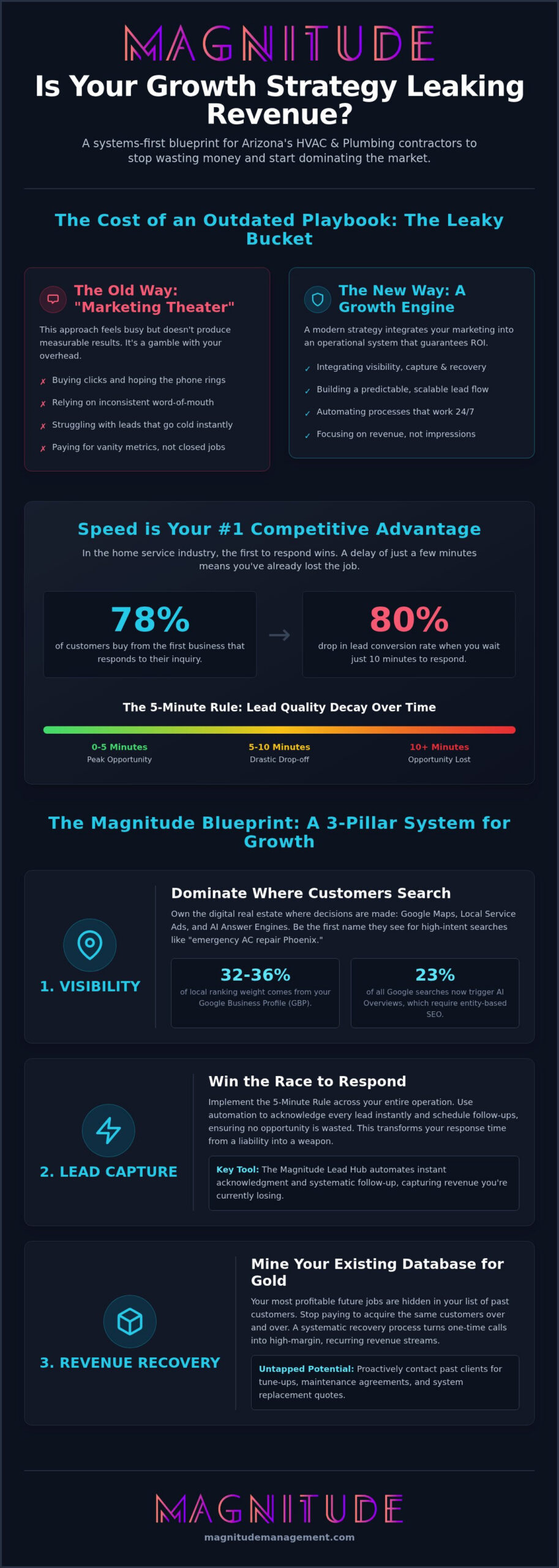
Many contractors are still running their businesses on a 2020 playbook. They buy clicks, hope the phone rings, and pray that word-of-mouth fills the gaps. This isn’t a strategy; it’s marketing theater. If you’re an Arizona plumber, impressions and high click-through rates don’t pay for your fleet’s fuel. Revenue comes from closed tickets, not vanity metrics. A modern home service business growth strategy requires a shift from chasing volume to building a system. Systemic growth is the integration of visibility, lead capture, and revenue recovery.
Most owners are operating with a leaky bucket. You spend thousands on ads to get leads, but if your office takes twenty minutes to respond, that lead is already calling your competitor in Scottsdale. Data shows that waiting just ten minutes can drop your conversion rate by 80%. You’re effectively throwing half your marketing budget in the trash. This systemic failure is exactly why technical expertise isn’t enough to scale anymore. You need a process that works when you aren’t looking.
The Death of Traditional Word-of-Mouth
Relying on a neighbor’s recommendation is a slow way to die. When a homeowner in Mesa has a burst pipe at 2 AM, they don’t wait for a text back from a friend. They go to Google. Digital search has replaced the backyard fence as the primary source of truth. Your business needs instant digital credibility through services marketing strategies that prioritize social proof and rapid response. Systemic growth is the elimination of operational waste in marketing.
Identifying Lead Waste in Your Current Pipeline
Visibility is the first point of failure. If your Google Business Profile isn’t optimized for high-intent searches like “emergency AC repair Phoenix,” you’re invisible during the most profitable weeks of the Arizona summer. Every missed call is a “ghosting” lead that carries a high acquisition cost. You’ve already paid for the visibility; failing to capture the contact is pure waste. To see where you’re losing ground, you should perform a local search visibility audit. Stop guessing and start measuring the true cost of your missed opportunities.
Dominating Local Visibility: From Google Maps to AI Search
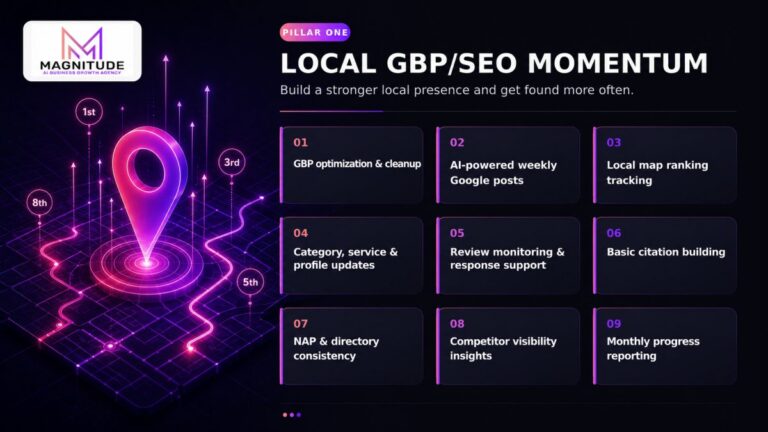
Visibility in 2026 isn’t just about ranking on page one. It’s about owning the digital real estate where decisions are made instantly. For a successful home service business growth strategy, you must dominate the three pillars: Google Maps, Local Service Ads (LSAs), and AI Answer Engines. Google Business Profile (GBP) signals now account for 32-36% of local ranking weight. If you aren’t optimizing your profile for high-intent queries like “emergency AC repair Tucson,” you’re conceding the most profitable jobs to your competitors before the phone even rings.
Beyond the GBP, your website needs a robust geographic infrastructure. Build GEO-specific location pages for Scottsdale, Mesa, and Peoria. These shouldn’t be generic “contact us” pages. They must demonstrate local authority through specific project highlights and neighborhood-level details that prove you’re the local expert. A well-executed location page SEO for service areas strategy ensures Google recognizes your business as the dominant provider across every city you serve. This expansion aligns with the SBA guide to business growth, which emphasizes market expansion as a core component of scaling. Finally, maintain consistent citations across the Arizona service corridor to solidify your prominence in the eyes of search algorithms.
The Rise of GEO and AI Search Visibility
AI Overviews now appear for 23% of all Google searches. These LLMs don’t just look for keywords; they look for entities. They recommend contractors who have established a footprint of trust across the web. For roofing and landscaping companies, this means your brand must be mentioned in context with your trade and your city. Entity-based SEO replaces simple keyword density by focusing on how your business relates to other trusted sources. You can learn more about how Tucson plumbers stay ahead in this shifting environment where AI dictates who gets the click.
Winning the Google Maps War in Phoenix and Tucson
The local 3-pack is governed by proximity, prominence, and relevance. You can’t change your proximity to a searcher in Phoenix, but you can maximize your prominence. Upload high-quality, geo-tagged images of your fleet at jobs in specific zip codes. This proves to Google that you are active in that area. When managing multi-location SEO, ensure each office has a unique, verified address to avoid spam flags. If you want to refine your approach, consider working with a specialized digital marketing agency for HVAC companies to ensure your technical setup is flawless. This disciplined approach to visibility is the foundation of any sustainable home service business growth strategy.
Lead Capture and the 5-Minute Rule: Speed to Lead Economics
Generating a lead is only the first half of a profitable home service business growth strategy. The second half is capturing it before it goes cold. In the HVAC and plumbing trades, speed is the ultimate differentiator. Research shows that businesses responding to leads within five minutes are 100 times more likely to make contact than those that wait thirty minutes. If your office takes ten minutes to dial back an inquiry, your conversion rate has already cratered by 80%. In a high-stakes market like Phoenix, where an HVAC install can be worth $15,000, that five-minute delay is an expensive operational failure.
You can’t rely on manual effort to solve this. Humans are inconsistent; they take lunch breaks, get stuck on other calls, or simply forget to check the inbox. A systems-first approach removes the human bottleneck by using automated infrastructure to ensure every inquiry receives an instant response. This isn’t just about being polite. It’s about being the first business to “claim” the customer’s attention before they continue scrolling through Google. Remember, 78% of customers buy from the first business that responds to their inquiry. If you aren’t first, you’re last.
The Magnitude Lead Hub Advantage
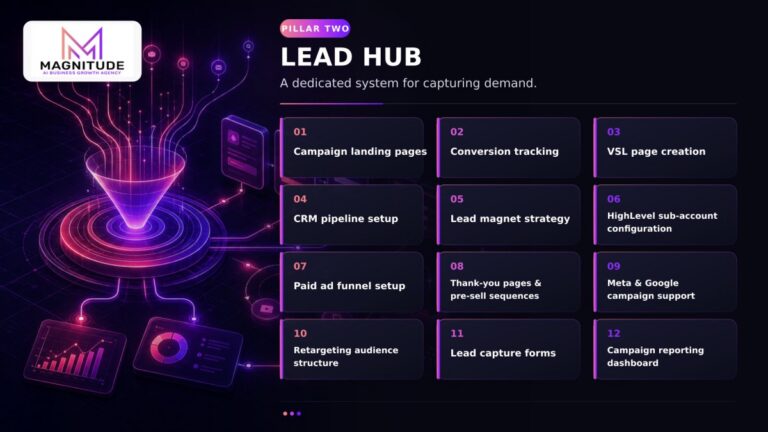
The Magnitude Lead Hub replaces the traditional, messy process of tracking leads in a spreadsheet or a cluttered email inbox. While most contractors lose track of where their leads come from, the Lead Hub uses advanced call tracking and analytics to attribute every job to a specific ad dollar. You’ll know exactly which campaign generated that high-margin water filtration install. Generic websites focused on “About Us” content often fail to convert visitors. High-performing landing pages integrated with the Lead Hub ensure that every click has a clear path to a booked appointment. If you’re unsure where your budget is disappearing, you should stop wasting ad spend with an ad waste audit.
Automating the Sales Pipeline
Moving a lead from an initial inquiry to a booked job shouldn’t require manual data entry. We implement “Lead Guard” protocols that instantly acknowledge every lead via SMS and email. This immediate engagement stops the customer from calling the next plumber on the list. For leads that aren’t ready to book during a shoulder season, automated nurture sequences keep your brand top-of-mind until they need a repair. This level of lead response automation for service businesses ensures that no opportunity falls through the cracks, turning your marketing spend into a predictable profit engine.
Revenue Recovery: Mining Your Existing Database for New Jobs
The most expensive mistake in your home service business growth strategy is ignoring the customers you’ve already won. You’ve spent thousands of dollars on Google Ads and Local Service Ads to get a truck into a driveway. If that interaction ends when the technician leaves, you’re leaving half your profit on the table. The cheapest lead you’ll ever get is the one you already paid for two years ago. A one-time AC repair shouldn’t be a closed file; it should be the start of a ten-year service relationship. Maximizing Customer Lifetime Value (CLV) is the difference between a business that survives and one that scales.
Revenue recovery is about mining your existing database for high-margin maintenance and replacement work. Most contractors have hundreds of dormant leads sitting in their CRM. These are people who know your brand but haven’t heard from you in months. By implementing automated recovery systems, you can turn those silent contacts into booked jobs without spending an extra dime on lead acquisition. It’s about efficiency and the elimination of waste in your sales pipeline.
Turning Dormant Leads into Arizona Revenue
In Arizona, seasonality dictates your cash flow. You shouldn’t wait for the first 110-degree day in Phoenix to start booking HVAC tune-ups. A well-timed database reactivation campaign uses automated SMS and email sequences to offer pre-summer inspections to your past clients. This fills your board during the shoulder seasons and prevents your crews from sitting idle. You can learn more about database reactivation for service companies to see how we turn dormant files into active revenue. This systematic approach ensures your business remains profitable year-round, regardless of external market fluctuations.
Automating Your 5-Star Reputation
Your reputation is a flywheel that either accelerates your growth or grinds it to a halt. In 2026, having a 4.8-star rating isn’t enough; you need review velocity. Google’s algorithm prioritizes businesses that receive fresh, consistent feedback from local customers. You can’t leave this to chance or expect your technicians to remember to ask every time. You need to integrate review requests into your post-job workflow automatically. For a deeper look at this process, read our contractor reputation guide. Automating your social proof builds authority on autopilot, making it easier for new leads to trust your team. If you’re ready to stop losing money to poor follow-up, it’s time to partner with a digital marketing agency for HVAC companies that understands the mechanics of revenue recovery.
Strategic Advisory: Scaling with a Fractional CMO
When your home service business hits the $2M revenue mark, the “hustle” that got you there becomes your biggest bottleneck. You can’t just buy more clicks and expect the chaos to resolve itself. At this stage, a sustainable home service business growth strategy requires a high-level architect, not just an ad manager. This is where a Fractional CMO becomes essential. A Fractional CMO is a strategic partner in operational growth who moves your company from “buying ads” to “investing in a marketing system” with disciplined, high-level oversight.
Instead of guessing which marketing channel works, you use real-time dashboards to steer your growth. Data-driven decision making replaces gut feelings. Magnitude provides specialized growth strategies for HVAC, plumbing, and electrical pros that focus on the mechanics of success. We don’t care about “impressions” if they don’t lead to booked service calls and high-ticket installs. You need to know exactly how much each dollar invested contributes to your bottom line. It’s about moving from reactive spending to a proactive investment model.
The Antidote to ‘Black Box’ Marketing
Too many agencies hide behind “Black Box” marketing jargon to mask poor performance. You deserve radical accountability and transparency from your marketing partner. At Magnitude, we reject the industry theater of vanity metrics. Likes, shares, and generic traffic don’t pay the bills in the Arizona service corridor. We focus on revenue and booked jobs because those are the only metrics that actually scale a multi-crew operation. If an agency can’t show you the direct line from an ad to a completed HVAC repair or a new water heater install, they’re wasting your money. The same principle applies to roofing contractors who want to understand how to get more roofing leads without relying on shared lead aggregators that pit you against four other companies before you even pick up the phone.
Your Next Steps for 2026 Scaling
Scaling your business requires a definitive conclusion to the cycle of erratic leads. Start by auditing your current visibility. Are you losing high-value jobs to competitors in Tucson or Phoenix because of an invisible Google Maps profile or a slow response time? Once the leaks are identified, we implement the Magnitude growth framework through a 90-day roadmap. This is a methodical, thorough process designed to build a stable and repeatable profit engine. This home service business growth strategy ensures you dominate your local market through superior systems rather than just superior technical skill.
Don’t let another season pass with an unoptimized system. It’s time to take control of your market position and eliminate lead waste once and for all. You should schedule your Local Search Visibility Audit today to see exactly where your current strategy is failing and how to fix it.
Own the Arizona Market with a Systems-First Approach
Transitioning from a reactive operation to a market leader requires more than technical skill. It requires a disciplined home service business growth strategy that prioritizes infrastructure over vanity. You’ve seen how the 5-minute rule and AI search visibility can redefine your profit margins; now it’s time to execute. We specialize in the Arizona market, providing proven growth strategies for HVAC and plumbing companies that demand measurable results. Our AI-powered Magnitude Lead Hub ensures no lead goes cold, while our systems-first approach eliminates the operational waste that kills your ROI.
Don’t let your competitors own the Scottsdale or Mesa market while you’re stuck in an erratic word-of-mouth cycle. Take the first step toward a predictable and scalable future today. By automating your follow-up and dominating local search in Tucson and Phoenix, you reclaim control over your revenue. Stop wasting your ad budget; schedule your 2026 Local Search Visibility Audit. You have the tools and the blueprint. Now, build the growth engine your business deserves.
Frequently Asked Questions
What is the best growth strategy for a small home service business?
The best home service business growth strategy for small operations is building a scalable system rather than just buying more leads. You must integrate visibility with automated lead capture and revenue recovery. This removes the human bottleneck in your sales office. Instead of relying on erratic word-of-mouth, you create a predictable engine that converts high-intent searches into booked jobs. Focus on fixing your leaky bucket before you pour more money into marketing volume.
How much should an HVAC or plumbing company spend on marketing?
Most successful trades spend 7 to 10% of gross revenue, but the amount matters less than the efficiency of the spend. If you lack a system to capture leads within five minutes, you’re effectively wasting half that budget. Focus on your marketing ROI rather than just the total dollar amount. Efficient spending on Google Ads and Local SEO in Arizona markets like Mesa or Peoria requires a system that handles leads instantly.
Why is my home service business not showing up on Google Maps?
Your business is likely missing from Google Maps because of weak prominence or relevance signals. Google prioritizes profiles with high engagement, fresh reviews, and consistent citations across the web. If you haven’t uploaded geo-tagged images of your trucks in Tucson zip codes, Google may not recognize your local service area. GBP optimization is the most critical factor for local visibility, often outweighing technical website SEO for HVAC and plumbing companies.
What is the 5-minute rule in lead generation for contractors?
The 5-minute rule is a data-driven standard where responding to an inquiry within five minutes increases contact rates by 100 times compared to a 30-minute delay. In the home service industry, 78% of customers buy from the first business that responds. If you wait ten minutes, your conversion rate craters. Implementing automated SMS responses ensures you claim the lead immediately, preventing them from calling the next plumber on the search results list.
Can I grow my service business without relying on HomeAdvisor or Angi?
Relying on lead aggregators is a race to the bottom that forces you to compete solely on price. You can grow faster by owning your visibility through Local SEO and Google Business Profile optimization. This builds long-term brand equity and keeps you in control of the customer relationship. Direct leads from your own website or Google Maps listing have higher conversion rates and don’t require you to fight three other contractors for the same job. Roofing contractors facing this exact challenge can explore proven alternatives in our guide on how to get more roofing leads through exclusive, high-margin channels in Arizona.
How do I recover lost leads from my old customer database?
Recovering lost leads requires a systematic database reactivation campaign. Use automated sequences to reach out to past customers who haven’t booked in over twelve months. In Arizona, timing these offers with the pre-summer heat or winter cooling periods is highly effective for HVAC maintenance. Since you already paid for these contacts years ago, every booked job from this list represents pure profit with zero additional lead acquisition cost.
What are the benefits of a Fractional CMO for a local contractor?
A Fractional CMO acts as a strategic architect for your marketing operations, moving you beyond the cycle of reactive ad spending. For businesses scaling past $2M, this role provides the data-driven oversight needed to manage complex systems like the Magnitude Lead Hub. They eliminate marketing theater by demanding radical accountability for every dollar spent. This high-level guidance ensures your marketing infrastructure supports long-term revenue goals rather than just temporary spikes in call volume.
How does AI search visibility affect local service businesses in 2026?
AI search visibility shifts the focus from ranking for keywords to establishing your business as a trusted entity. AI Answer Engines recommend contractors who have a consistent digital footprint across reviews, citations, and authoritative content. If your home service business growth strategy doesn’t account for how LLMs interpret your brand’s prominence in Phoenix or Scottsdale, you risk becoming invisible. You must ensure your business data is structured and consistent everywhere to be featured in AI-generated answers. Contractors who invest in location page SEO for service areas gain a significant advantage by signaling to AI engines exactly which cities and ZIP codes they serve.