Location Page SEO: 2026 Guide to Local Search
Why is your HVAC or roofing business invisible the moment you drive ten minutes away from your office? It’s a common frustration; you have the trucks and the techs to handle the next county over, but Google treats your service area like a tiny island. With 46% of all Google searches now carrying local intent, relying on a single homepage to rank across twenty different ZIP codes is a recipe for wasted ad spend and stagnant growth. To dominate the Google Maps 3-pack and appear in the new Gemini-powered Ask Maps results, you need a sophisticated strategy for location page SEO for service areas.
You know that the most profitable high-value jobs often come from the affluent suburbs just outside your immediate reach. We’re going to show you how to capture those leads by building high-converting location pages that act as digital storefronts for every city you serve. You’ll learn how to navigate Google’s 2026 doorway page policies while creating the technical infrastructure needed for the Magnitude Lead Hub to manage lead-response requirements and turn traffic into revenue. This guide breaks down the transition from thin landing pages to the authoritative, AI-ready assets your business requires to outpace the competition.
Key Takeaways
- Learn how to secure rankings in the local map pack for every city you serve, even if you do not maintain a physical office address in those specific ZIP codes.
- Discover the specific technical requirements for location page SEO for service areas that satisfy Google’s strict anti-doorway page policies while boosting visibility in AI search environments.
- Identify a data-driven framework for mapping your service areas based on average job value and competitor density to prioritize high-margin suburbs over low-performing territory.
- Understand how to integrate localized social proof and project data to convert cold search traffic into high-intent leads for your HVAC, plumbing, or roofing business.
- See how connecting your location pages to the Magnitude Lead Hub ensures that top-tier rankings translate into revenue through automated lead capture and rapid response times.
What is location page SEO for service areas?
Stop treating your website like a digital brochure that only works within sight of your office. Location page SEO for service areas is the systematic process of building high-value, unique web pages for every city or neighborhood your business serves. It’s the technical infrastructure that serves as the foundation for the Magnitude Lead Hub, ensuring every click is captured and converted. By leveraging local search engine optimization, you signal to Google that your expertise isn’t confined to a single ZIP code.
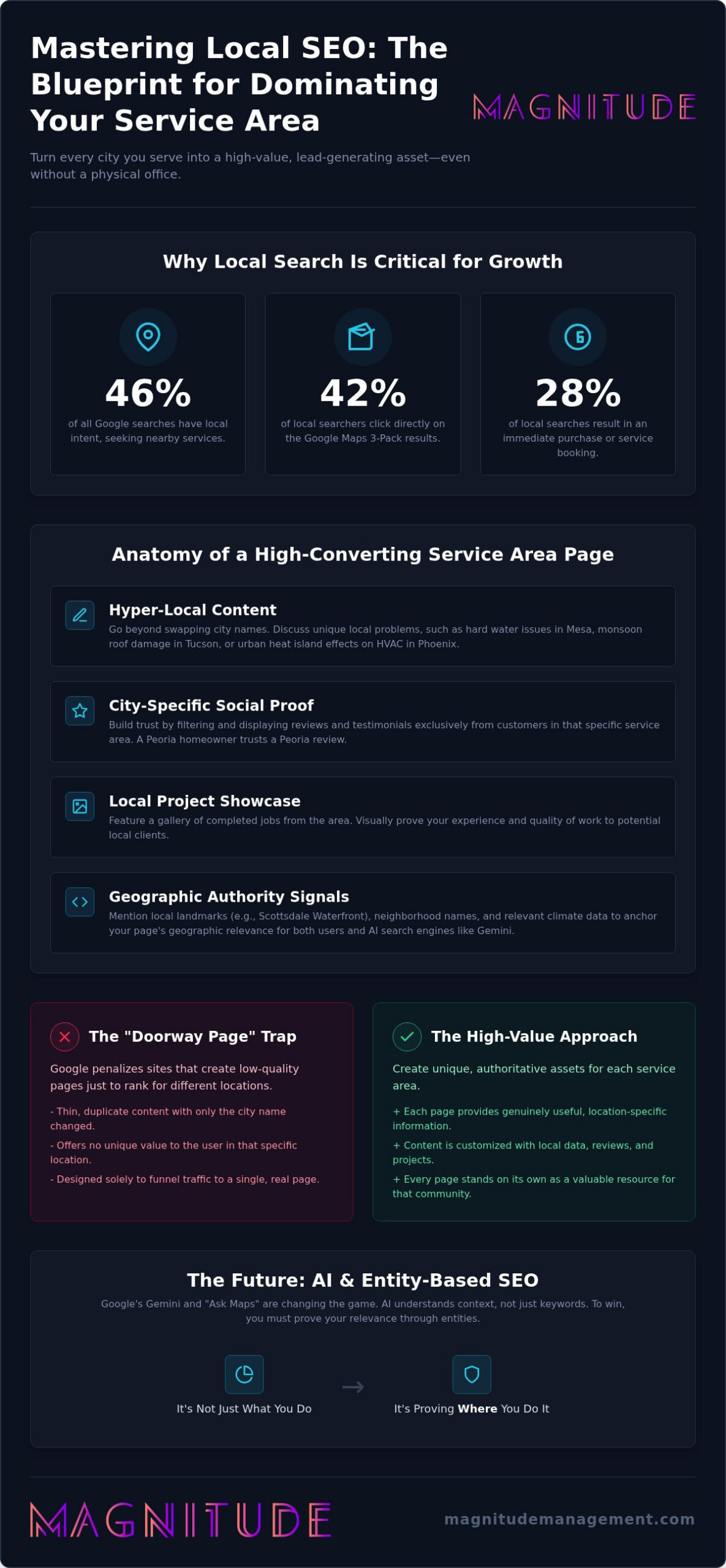
The objective is simple but critical: secure rankings in the local map pack and organic results without maintaining a physical storefront in every town. Research shows that 46% of all Google searches have local intent, and 42% of those searchers click directly on Map Pack results. If you aren’t visible in the “near me” results for high-value areas like Scottsdale or Oro Valley, you’re effectively handing those leads to competitors. Before you build new pages, run a local search visibility audit to see where your current coverage gaps exist. This data-driven approach captures the 28% of local searches that result in an immediate purchase.
Location Pages vs. Service Area Pages (SAPs)
Confusion between these two assets often leads to wasted marketing budgets. A physical location page is tied to a verifiable office with a Google Business Profile. In contrast, a Service Area Page (SAP) is designed for the Service Area Business model, where you travel to the customer. For most growth-minded contractors, a hybrid “hub and spoke” model is the standard. You maintain one central hub with a map pin and use SAPs to expand your footprint into surrounding territories where you don’t have a physical lease.
The Role of GEO in Modern Local Search
In 2026, simple keyword matching is dead. Google’s Gemini-powered “Ask Maps” feature uses Generative Engine Optimization (GEO) to understand service boundaries through entities, not just text. AI search engines now scan your pages for specific local signals like neighborhood names, local landmarks, and even climate-specific factors. Implementing location page SEO for service areas using an entity-first approach is no longer optional. For a Tucson HVAC contractor, this means your Oro Valley page must address the specific cooling demands of that micro-climate and reference local landmarks to prove geographic relevance. Entity-based SEO ensures that when a homeowner asks an AI assistant for a “reliable plumber near me,” your business is the logical answer.
The Anatomy of a High-Converting Service Area Page
High rankings are worthless if they don’t convert. A high-performing asset for location page SEO for service areas isn’t just a list of keywords; it’s a conversion engine. Most contractors fail here by using the same generic text for every city, simply swapping the town name in the H1. This laziness often triggers Google’s Quality Guidelines regarding doorway pages. You need a layout that feeds precise data to AI search crawlers while proving to a local homeowner that you’re the authority in their specific neighborhood.
Localized Content: Beyond “Find and Replace”
If your Mesa page looks exactly like your Glendale page, you aren’t providing value. AI search engines now look for entity-specific details to verify your presence. For a plumber in Mesa, this means discussing the specific hard water issues that plague East Valley water heaters. For a Tucson roofer, it means detailing monsoon damage repairs and the impact of desert UV on shingle life. For a Phoenix HVAC technician, localized relevance means demonstrating an understanding of how urban heat island effects in specific downtown neighborhoods impact cooling system lifecycles. Mention local landmarks like the Scottsdale Waterfront or Peoria’s P83 District to anchor your geographic authority in the eyes of both Google and the customer.
Social Proof and Local Authority
Trust is local. A homeowner in Peoria doesn’t care about a review from someone fifty miles away in Scottsdale. They want to see that you’ve solved problems for their neighbors. Building this authority requires specific evidence:
- City-specific reviews: Filter your review feed to show testimonials only from that specific service area.
- Recent Work galleries: Post photos of a roof replacement in Peoria or a water heater install in Scottsdale.
- Municipal credentials: List your local business licenses or community partnerships within that specific city council district.
Behind the scenes, your page must speak “robot.” Use LocalBusiness and AreaServed schema markup to tell search engines exactly which neighborhoods you cover. This structured data is what Gemini and other AI tools use to verify your service boundaries. On the front end, prioritize speed-to-lead. Include prominent click-to-call buttons and lead capture forms that feed directly into your sales pipeline. If you aren’t sure if your current pages are leaking leads, you can partner with a strategic team to audit your conversion infrastructure. This ensures that the traffic generated by location page SEO for service areas actually turns into booked jobs.
How to Map Your Service Areas for Maximum Profit
Most contractors make the mistake of trying to be everywhere at once. They create a hundred thin pages for every tiny suburb and wonder why their domain authority collapses. Profitability in local search requires a surgical approach. You need to identify the high-value ZIP codes where the average job size justifies both the marketing spend and the technician’s drive time. For an HVAC company, this means prioritizing system replacements in established neighborhoods over minor repairs in distant, low-margin areas. Effective location page SEO for service areas starts with a map, not a keyboard.
Analyzing Lead Economics by Territory
Consider the logistics of your specific trade. A plumber in Tucson should prioritize Oro Valley over a more distant suburb because the property values and typical project complexity, like full repipes, offer a higher ROI. You shouldn’t guess which areas are profitable. Use a Local Search Visibility Audit to find the exact gaps in your current search coverage. By calculating the potential revenue of a high-converting service area page based on local search volume and your specific margins, you turn SEO into a predictable revenue system. If the drive time eats your profit, that ZIP code doesn’t deserve a dedicated page.
Competitive Mapping and GEO Gaps
You need to track your “share of voice” across different Phoenix-area suburbs. Look for “SEO deserts.” These are affluent areas where your competitors have weak or non-existent location pages. If you find a suburb with high search volume for “roof replacement” but no competitor has a dedicated, high-quality page for that city, that’s your low-hanging fruit. Grouping smaller, adjacent neighborhoods under a single “Power Page” allows you to concentrate your ranking power rather than diluting it across dozens of near-identical URLs. This concentration of authority is essential for location page SEO for service areas to survive Google’s 2026 helpful content filters.
This isn’t just about ranking; it’s about disciplined expansion. Your home service business growth strategy should dictate your SEO roadmap. If you’re looking to scale, prioritize territories that align with your highest-margin services, such as full roof installs or HVAC system upgrades. This ensures your trucks aren’t just busy, but are actually driving toward maximum profitability. Mapping turns your website into a strategic asset that dictates where your next high-value lead comes from, rather than just waiting for whatever the algorithm throws your way.
Avoiding the “Doorway Page” Trap: Google’s Quality Guidelines
Google isn’t stupid. If you think you can trick the algorithm by publishing fifty identical pages where only the city name changes, you’re building a house of cards. This is the “doorway page” trap. These pages exist solely to capture search traffic without providing unique value to the user. In 2026, Google’s enforcement against these tactics is aggressive. A site-wide penalty won’t just hide your expansion pages; it can tank your primary office rankings as well. To succeed with location page SEO for service areas, your content must be as useful as a conversation with your best technician.
The 2026 standard for E-E-A-T requires a demonstration of actual experience. Google’s AI now looks for proof that you’ve set foot in the neighborhoods you claim to serve. This means moving beyond generic descriptions of “professional service” and into the granular reality of local work. If you’re a roofer, don’t just talk about shingles. Talk about the specific building codes in Scottsdale or the unique wind-load requirements for homes in the foothills. This level of detail proves your authority and satisfies the “Experience” component of modern search quality standards.
Adding Real Value to Every City Page
Every page you build should have a distinct purpose for the homeowner. Include links to local municipal permit offices or city utility companies. For a Phoenix-based HVAC company, this might mean providing seasonal maintenance schedules that align with the local monsoon season. High-quality authority building for local contractors requires these unique city-level insights. When you provide a local guide rather than a sales pitch, you create a page that search engines want to show to their users. It’s the difference between a helpful local resource and a spammy landing page.
Internal Linking and Site Architecture
Your location pages shouldn’t be “islands” floating in your site’s navigation. They must be integrated into a logical hierarchy. Link your main service pages (like “AC Repair”) to your specific location pages (like “AC Repair in Mesa”). Use breadcrumbs to help crawlers understand the relationship between your hub and your spokes. A “Cities We Serve” section in your footer is a standard requirement, but it must be managed carefully. Don’t overwhelm the user with a wall of links. Instead, group them by region to maintain a clean experience. This structured approach supports your on-page efforts and ensures Google can crawl your expansion pages efficiently.
Managing a growing network of service area pages requires constant technical oversight to avoid quality flags. If your current site feels like a collection of thin templates, it’s time to build a more resilient infrastructure. You can schedule a strategy session with Magnitude to audit your current architecture and ensure your expansion doesn’t lead to a penalty. Proper location page SEO for service areas is about building a sustainable asset that produces leads for years, not just until the next algorithm update.
Scaling Your Revenue with the Magnitude Lead Hub
Ranking at the top for “AC repair Scottsdale” is a vanity metric if your phones aren’t ringing or if those calls go to voicemail. High search visibility is only the first step in a much larger machine. The ultimate goal of location page SEO for service areas isn’t just to occupy space on a screen; it’s to build a predictable revenue engine. If you secure the top spot in the Map Pack but take three hours to return a call, you’ve effectively paid to generate a lead for your competitor. Magnitude bridges this gap by connecting your localized traffic directly to an automated conversion system.
The Magnitude Lead Hub acts as the central nervous system for your digital expansion. It integrates your location pages with automated sales pipelines that capture and qualify leads 24/7. This ensures that every bit of authority you’ve built through technical SEO translates into a booked job. By using sophisticated call tracking, we identify exactly which ZIP codes are driving your highest-margin repairs and replacements. This level of transparency allows you to stop guessing and start investing in the territories that actually produce profit.
Speed-to-Lead: The 2026 Conversion Standard
In the home services industry, your response time is the single biggest factor in closing roofing leads and HVAC inquiries. A homeowner with a leaking roof or a broken furnace isn’t going to wait for your office manager to get back from lunch. They’ll call the next listing. The Magnitude Lead Hub automates the first touchpoint for every inquiry, providing an immediate response that stops the customer’s search. This system also helps in reducing ad waste by syncing SEO data with your paid campaigns. When your organic presence and paid landing pages work in harmony, your cost-per-acquisition drops significantly.
Measuring Success Beyond Traffic
Stop looking at clicks and start looking at customer lifetime value by territory. We track conversion rates by city to refine your geographic targeting strategy in real time. If your data shows that customers in Oro Valley have a 20% higher average job size than those in central Tucson, your location page SEO for service areas should pivot to reflect that reality. Implementing lead response automation allows you to scale your operations into new territories without doubling your office headcount. It’s about operational efficiency. You don’t need more people; you need a better system that ensures no lead is left behind as you dominate the Arizona search landscape.
Build a Local Search Engine That Actually Converts
Your business doesn’t grow by accident. It grows because you’ve built a technical infrastructure that captures demand where it lives. By implementing location page SEO for service areas, you stop being a local secret and start becoming the dominant authority in every high-value ZIP code you serve. You now understand that unique, entity-rich content and strategic internal linking are the only ways to satisfy 2026 search standards without risking a doorway page penalty. Rankings are a start; revenue is the finish line.
Magnitude specializes in HVAC, Plumbing, and Roofing SEO, providing the AI-Powered Lead Hub technology necessary to turn clicks into booked jobs. We’ve delivered proven results across the Phoenix and Tucson markets by focusing on lead economics rather than empty traffic metrics. Stop letting competitors siphon off the most profitable jobs in your territory. Get Your Free Local Search Visibility Audit today and see exactly where your visibility ends and your growth begins. You have the trucks and the talent. It’s time your digital presence matched your operational capacity.
Frequently Asked Questions
Is it better to have one page for all service areas or a separate page for each city?
Separate pages for each major city are required if you want to maximize your local visibility. While a single page is easier to manage, it lacks the geographic relevance needed to rank for specific city-plus-service keywords. To capture high-value leads in affluent suburbs, you must build unique assets that Google recognizes as local authorities. This granular approach is the backbone of effective location page SEO for service areas.
How much unique content do I need on each location page to avoid a Google penalty?
You need at least 300 to 500 words of unique, city-specific content to satisfy current helpful content standards. Avoid the find and replace trap. Each page should include localized details like neighborhood names, local landmarks, and specific regional pain points, such as the mineral content in a city’s water supply. If your pages are 90% identical, you risk a site-wide doorway page penalty that tanks your primary office rankings.
Can I rank in the Google Maps 3-pack for a city where I don’t have an office?
You cannot rank in the traditional Google Maps 3-pack without a physical address and a verified Google Business Profile in that specific city. However, high-quality location pages allow you to dominate the organic results directly below the map. These pages also feed data to AI search features like Ask Maps, which can recommend your service even if you don’t have a local pin, provided your geographic relevance is clearly established.
What is the best way to handle reviews on a service area page?
Filter and display reviews specifically from customers located in that target city to build immediate trust. A homeowner in Scottsdale wants to see that you’ve successfully completed roofing or plumbing jobs for their neighbors, not someone across the state. Using schema markup to highlight these localized testimonials proves your technicians are active in the area. It provides the social proof necessary to convert cold search traffic into high-intent leads.
How long does it take for a new location page to start ranking in local search?
A well-optimized location page typically takes 90 to 120 days to gain significant traction in organic search. This timeline depends on your existing domain authority and the competitor density in that suburb. While you wait for organic rankings to mature, you can use these pages as landing assets for targeted Facebook or Google Ads. This strategy ensures your marketing spend starts generating revenue while the SEO infrastructure builds long-term authority.
Should my location pages be in my main navigation menu or the footer?
Place your primary service areas in a Locations or Areas We Serve section in your footer to keep your main navigation clean. If you have a few high-priority cities that drive the majority of your revenue, consider adding those to a dropdown menu in the header. This structure helps search engine crawlers find and index your expansion pages quickly without creating a confusing or cluttered experience for your website visitors.
Do I need a separate phone number for every city I target with a location page?
You don’t need a unique local phone number for every city, but you must use call tracking to measure ROI. A single main office number is acceptable for your location pages as long as your business data remains consistent across the web. However, using distinct tracking numbers allows the Magnitude Lead Hub to identify which specific service areas are producing the most profitable leads, enabling more accurate data-driven marketing decisions.
How does AI search (GEO) change the way I should write my city-specific content?
AI search requires an entity-based approach that focuses on context rather than just keyword density. Instead of repeating phrases like plumber in Tucson, you should discuss local landmarks, neighborhood names, and climate-specific challenges. AI models use these details to verify your presence. Writing for location page SEO for service areas in 2026 means proving you understand the local environment, such as how desert heat impacts HVAC lifecycles in specific East Valley communities.