Painting Contractor Marketing in Phoenix: A Practical Growth Plan
More inquiries don’t automatically mean more painting jobs. If they come from outside your service area, arrive when crews are booked, or never turn into estimates, the marketing isn’t doing its job. A practical painting contractor marketing Phoenix plan connects local visibility to the projects your crews can take on.
Phoenix painting contractors manage changing demand for exterior and interior work, while homeowners and commercial buyers may compare several estimates before choosing a painter. The answer isn’t simply to spend more or chase every lead. Focus on the service areas and project types that fit your business, track which inquiries become estimates and completed jobs, and adjust campaigns to match job mix and crew capacity.
This article explains how to connect local search visibility, Google Business Profile and Maps, paid advertising, lead capture, and follow-up. You’ll learn what to measure beyond clicks and calls, and how to build a repeatable plan that supports clear decisions as demand and availability change.
Key Takeaways
- Measure marketing by qualified estimates and completed jobs, not just clicks, calls, or total inquiries.
- Build Phoenix visibility around accurate service-area information, useful local pages, and a credible reputation.
- Choose local SEO, Google Ads, and reputation activity based on buyer intent, job mix, crew capacity, and follow-up.
- Use a five-step process to connect target jobs and service coverage with inquiry capture and outcome tracking.
- Effective painting contractor marketing Phoenix connects local discovery to organized follow-up through tools such as Magnitude Lead Hub.
What should Phoenix painting contractor marketing accomplish?
Phoenix painting contractor marketing should generate qualified local inquiries that can become profitable painting jobs. Attract homeowners, businesses, and property managers in the areas your crews serve, for projects that fit your schedule and service mix. Then move suitable prospects toward an estimate and booked work. Traffic and lead counts show activity, but the business outcome is work you can complete profitably with the capacity you have.
Local visibility helps suitable buyers find and assess your business. Lead capture records who contacted you, what they need, and where the project is. Follow-up moves a suitable inquiry toward an estimate and records whether it becomes a job. Together, these parts make marketing measurable beyond clicks and calls.
Which painting jobs should a Phoenix marketing plan prioritize?
Set priorities by job type, buyer, service area, and crew availability. Residential exterior repaints, interior projects, and commercial work can call for different messaging and estimate conversations. Track each category separately instead of treating every request as the same opportunity. A homeowner planning an interior refresh may be weighing the scope and schedule, while an exterior project may require a different discussion about the surfaces and work involved.
Commercial and property-management work may involve repeat projects or ongoing relationships, with decisions made by a property manager, facilities contact, or another buyer rather than an individual homeowner. Make room for that distinct sales process in your marketing and follow-up. Before expanding a campaign, ask whether the project fits your crews, whether the location is practical for your service radius, and whether you can handle the resulting estimate requests.
Why do impressions and lead counts fail as growth measures?
An impression shows that an ad or listing appeared. A lead count shows that people made contact. Neither tells you whether the inquiry is in your service area, matches your work, receives an estimate, or becomes a profitable signed job. The broader mix of channels and tactics in digital marketing becomes useful to your business when you connect activity to those outcomes.
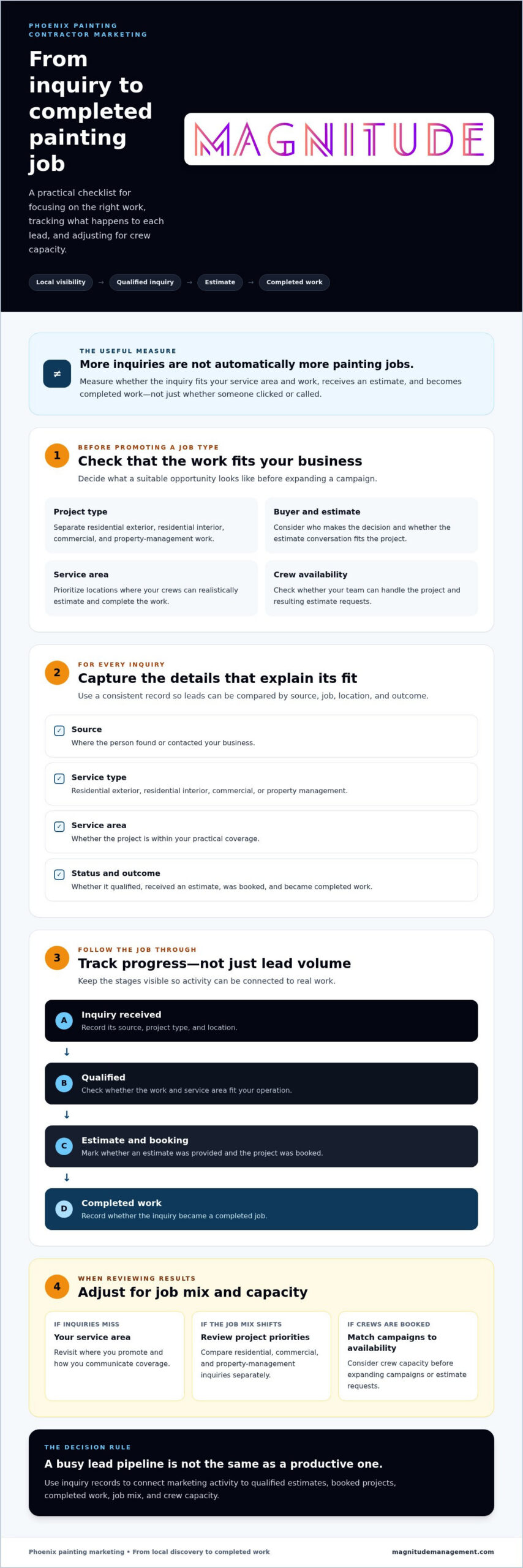
Track each inquiry with a consistent set of details:
- Source: where the person found or contacted you.
- Service type: residential exterior, residential interior, commercial, or property management.
- Service area: whether the project is within your practical coverage.
- Status and outcome: whether it qualified, received an estimate, was booked, and became completed work.
This record helps you distinguish a busy lead pipeline from a productive one, then adjust campaigns when job mix or crew capacity changes. For a focused review of local visibility, use Magnitude’s local search visibility audit.
Takeaway: Marketing performance matters when you can connect it to qualified opportunities and sales outcomes.
How should Phoenix painting companies build local visibility?
Build local visibility with accurate service information, useful pages about your painting work, and credible reputation signals. A complete Google Business Profile can help potential customers discover your company through Google Search and Maps. Clear website content helps them understand whether you serve their area and handle their project type. Visibility supports discovery, but it doesn’t guarantee a particular placement or a qualified estimate.
What should a painting contractor’s local presence communicate?
Your online profiles and website should tell the same straightforward story: who you serve, what painting services you offer, where you work, and how a prospect can reach you. Keep business details consistent across key profiles. Make it easy for homeowners, commercial buyers, and property managers to find information that matches their project.
Explain exterior painting, interior painting, and commercial work separately. Each page or service description should help a potential customer recognize the right fit, understand the work you handle, and take the next step. Use real project examples and customer feedback accurately. Don’t invent reviews, credentials, or outcomes. Credibility depends on claims you can support.
Trade-specific education can also help you develop useful, accurate customer content. The Painting Contractors Association provides painting-industry resources.
How should Phoenix service areas and painting demand shape content?
Define your service area by where your crews can realistically estimate and complete projects, not by how many nearby locations you can name. A location page should offer useful local context and clearly connect that area to the services you provide. Thin pages that swap one place name for another give prospects little reason to trust your coverage.
For painting contractor marketing Phoenix, treat exterior and interior demand as planning considerations, not assumptions about fixed seasonal patterns. Review your own inquiry and job history to see when each project type comes in, which areas produce suitable estimates, and how crew availability changes. Then make your local content and visibility efforts reflect those operational realities.
Use a local search visibility review to identify gaps in how your business appears across local search. Magnitude’s local marketing support connects visibility work with a broader marketing system.
Which marketing channels fit a Phoenix painting contractor?
Choose channels based on buyer intent, job economics, timing, service area, and your ability to follow up. Local SEO helps buyers discover your business as they research painters. Google Ads can target people actively looking for painting services. Reputation activity helps prospects assess your work. No channel wins by default. The right mix supports suitable projects and a manageable volume of estimate requests.
| Channel | Buyer intent | Role | Useful measures |
|---|---|---|---|
| Local SEO | Researching painters, services, or providers in an area | Builds discoverability through relevant service and location information over time | Relevant local visits, calls and inquiries by service area, qualified estimates |
| Google Ads | Actively searching for a painting service | Pursues current demand with campaigns focused on selected services and coverage areas | Spend, inquiries by service and location, estimate status, booked jobs |
| Reputation activity | Comparing contractors and assessing credibility | Shows accurate customer feedback and supports confidence in the decision | Review activity, inquiry quality, estimates and job outcomes associated with referrals or profile visits |
When do local SEO and paid search serve different needs?
Paid search can put your offer in front of people already looking for a painter, while local SEO makes useful service and location information easier to discover during research. Paid campaigns can be adjusted as priorities change. Local SEO is an ongoing effort, not a switch for immediate visibility. Neither guarantees placement, lead volume, or a specific return.
Set campaign boundaries around the places your crews can serve, the kinds of jobs you want, and the estimate appointments you can handle. If exterior projects are filling the schedule, review whether new campaigns should emphasize interior work or pause expansion until capacity opens. Use this paid advertising waste audit to consider whether campaign spend and lead quality are aligned.
How do reviews and follow-up affect channel performance?
People considering a repaint may compare estimates and look for evidence that a contractor has handled similar work. Accurate, current feedback can help them assess your business, but reviews don’t replace a clear scope or a useful estimate process. Keep reputation activity grounded in real customer experiences.
Then make sure inquiries don’t disappear after discovery. Record the source, requested service, location, and next step. Assign responsibility for follow-up and update the outcome when an estimate is sent or a job is booked. A painting contractor marketing Phoenix strategy becomes more useful when channel data connects to that sales process, not just to a dashboard of clicks and calls.
How can you launch and measure painting contractor marketing in Phoenix?
Launch painting contractor marketing Phoenix with a defined job target and a measurement process that follows inquiries through estimates and completed work. Choose the projects you want, confirm where your crews can serve, and review how customers find you. Then make sure each inquiry is captured and assessed consistently. This turns marketing from disconnected activities into a system you can adjust.
What should the first marketing review examine?
Before changing campaigns, inspect the full path from discovery to inquiry. Review your local search presence, Google Business Profile details, service pages, customer reviews, active ads, and the forms or phone routes prospects use to reach you. Compare what those channels produce with the painting work you want and can complete.
A focused Phoenix-area search visibility review can help surface gaps in local discovery. Then use this five-step process:
- Define target jobs: Decide which exterior, interior, or commercial projects fit your business priorities.
- Map service coverage: Identify the locations where crews can estimate and complete the work.
- Assess visibility: Check whether your profiles, pages, reviews, and ads clearly represent those services and areas.
- Capture inquiries: Record each prospect’s contact details, project type, location, and source in a consistent system.
- Review outcomes: Follow each suitable inquiry through scheduled estimate, estimate result, and job outcome.
Which measures help distinguish useful leads from noise?
Don’t treat every call or form submission as a qualified opportunity. Track total inquiries separately from those that match your service area and job criteria. Then count scheduled estimates and record what happened after each one. Where your team can track it reliably, include completed job outcomes too.
Use the same reporting periods and definitions each time. Note changes in crew availability, service priorities, and demand patterns before comparing results. Otherwise, a shift in estimates might reflect a change in capacity or project mix, not a change in marketing performance.
Hypothetical example: A Phoenix contractor receives inquiries for both exterior repainting and interior projects. The team tags each inquiry by service type and location, then records whether it qualifies, receives an estimate, and becomes booked work. If exterior inquiries rise while crews have limited room for those projects, the contractor can assess interior estimates separately and adjust campaign priorities to fit available capacity.
To connect lead capture to an organized sales pipeline, review Magnitude’s painting contractor lead-generation support.
How can Magnitude support Phoenix painting contractor marketing?
Magnitude brings local SEO, Google Business Profile and Maps visibility, paid advertising, reputation management, and lead generation into a practical marketing system for painting contractors. Accurate business details and useful service information can also help search engines and AI-powered search tools understand what you do and where you work. That supports AI-search visibility, though it doesn’t guarantee that your business will appear in specific results.
What should a painting contractor expect from a marketing partner?
Expect a plan built around your business, not a generic channel checklist. Magnitude supports painting contractors with SEO, local search visibility, Google Ads, reputation management, and lead generation. Priorities should distinguish residential exterior from interior work and account for commercial opportunities, practical service areas, estimate scheduling, and crew capacity.
Reporting should show what’s happening from initial inquiry through estimate and job outcome. That means defining useful measures, explaining what the data does and doesn’t show, and coordinating marketing decisions with how your team handles new opportunities. No ranking or lead-volume promise can replace that operational clarity.
How does Magnitude Lead Hub connect marketing to sales?
Visibility is only the start. Magnitude Lead Hub connects conversion-focused pages with CRM automation, sales pipelines, and campaign tracking. In plain terms, it helps organize where an inquiry came from, what service the prospect needs, and what step should happen next. That gives you a clearer way to monitor leads as they move toward an estimate, rather than leaving calls and forms in separate reports.
For painting contractor marketing Phoenix, this connection matters when you need to compare inquiry types and locations with the work your crews can take on. A useful system can help you see where follow-up slows down, which projects fit your priorities, and what adjustments deserve attention.
What is the next step for a Phoenix painting business?
Start with your current bottleneck. Is it local discovery, inquiries outside your service area, inconsistent follow-up, or limited visibility into which estimates become jobs? Assess those pieces together, then set priorities that match your actual service mix and capacity.
Magnitude’s local marketing support can connect visibility, lead handling, and conversion measurement.
Build a Marketing System Around the Work You Want
For painting contractor marketing Phoenix, the practical advantage comes from connecting local visibility to the jobs your crews can complete and the estimates your team can handle. Choose channels for your residential exterior, interior, or commercial priorities, then track whether inquiries progress into estimates and booked work. Clicks and calls are signals, not the finish line.
Magnitude supports painting contractors with SEO, local SEO, advertising, reputation management, and lead generation. Magnitude Lead Hub connects landing pages, CRM automation, sales pipelines, and campaign tracking so marketing activity can be followed through the sales process. The plan should fit your actual services, service area, estimate workflow, and crew capacity, without relying on promises of rankings or lead volume.
If your visibility, inquiry handling, or reporting feels disconnected, make that the focus of your next conversation. Discuss a local growth plan for your painting business and take a practical step toward marketing you can measure and manage.
Frequently Asked Questions
How can a painting contractor get more leads in Phoenix?
A painting contractor marketing Phoenix plan should start by defining the jobs and service areas your crews can support profitably. Align local search visibility, useful exterior, interior, or commercial service pages, credible reputation signals, and paid campaigns with those priorities. Track qualified inquiries and scheduled estimates, not clicks alone. Lead volume depends on the market, offer, budget, and follow-up, so don’t build your plan around a fixed number.
Is local SEO worth it for a Phoenix painting company?
Yes, local SEO can help a painting company become easier to discover when nearby customers research painting services. An accurate Google Business Profile, useful service-area content, and credible reviews help prospects understand what you do and where you work. Rankings aren’t guaranteed, so assess local SEO alongside qualified inquiries, estimate activity, and the projects your crews can serve. Visibility matters most when it supports practical business outcomes.
What marketing works best for painting contractors in Phoenix?
No single channel works best for every painting contractor. Local SEO can support ongoing discovery, paid search can reach people actively looking for painting services, and reputation and follow-up can influence a buyer’s decision. Choose a mix based on job type, service area, timing, budget, and estimate capacity. Compare channels by qualified estimates and completed work, not impressions alone, and adjust as your project mix or crew availability changes.
How should painting contractors market exterior and interior painting differently?
Give exterior and interior painting separate service messaging and track their inquiries independently. Customers may have different project needs, timing, and scheduling considerations, and separate records help you see which work attracts suitable prospects. Treat Phoenix heat and seasonal timing as planning considerations, not universal rules for campaign dates. Review your own inquiry and job patterns, and verify current local market claims before using them to set seasonal schedules.
Should a Phoenix painting company use Google Ads or SEO?
Google Ads and SEO support different parts of local discovery, so compare them by buyer intent, timeframe, investment, and your ability to respond to inquiries. Ads can support paid visibility while SEO develops useful organic presence over time. Neither guarantees booked jobs. Track each channel from inquiry through estimate and sale, then use those outcomes alongside campaign investment to guide budget decisions rather than shifting spend based on clicks alone.
How can painting contractors tell whether marketing leads are profitable?
Record each lead’s source, painting service, service area, qualification status, estimate status, and eventual job outcome. Where your business data allows, compare completed work and its revenue contribution with campaign investment. Raw lead totals can hide poor-fit inquiries, locations you can’t serve, or missed follow-up. Use consistent tracking and treat attribution as a useful guide, not perfect proof that one channel alone caused a sale.
What should a Phoenix painting contractor look for in a marketing agency?
Look for a clear process, painting-specific understanding, transparent reporting, and attention to your service areas, estimate handling, crew capacity, and job outcomes. Magnitude supports painting contractors with local SEO, Google Business Profile optimization, advertising, reputation management, and lead systems. Its service region includes Phoenix, Tucson, Oro Valley, Scottsdale, Mesa, Glendale, and Peoria. Expect plain-language explanations, useful measures, and no guarantees of rankings or lead volume.