Citation Building for Local SEO: The Arizona Contractor’s 2026 Action Plan
Why is a competitor with a slower website and fewer reviews consistently outranking your HVAC or plumbing business on the Google Map Pack? The answer isn’t a secret algorithm; it’s usually a failure of digital infrastructure. If your business name, address, and phone number are inconsistent across the web, Google’s AI models view you as a high-risk recommendation. Effective citation building for local SEO is the process of fixing this fragmented data to prove you’re the dominant authority in Phoenix or Tucson. You already know that being invisible on Google Maps means losing high-value emergency calls to the guy down the street.
In this 2026 action plan, you’ll learn how to build and manage local citations that force search engines to trust your business data. We’ll move past basic directory listings to focus on the Magnitude Lead Hub ecosystem, ensuring your Arizona Registrar of Contractors (ROC) license is prominently displayed to meet state advertising regulations while boosting your authority. This guide outlines the exact steps to clean up conflicting info, dominate local search rankings, and finally see a measurable return on your marketing spend through higher lead volume.
Key Takeaways
- Learn why citation building for local SEO is the essential digital infrastructure that validates your business’s physical presence to search engines and AI models.
- Master the “NAP+W” framework to ensure your business data is identical across all platforms, satisfying Google’s strict requirements for ranking HVAC and plumbing contractors in Arizona.
- See how accurate citations integrate with the Magnitude Lead Hub to move beyond superficial vanity metrics and focus on measurable lead economics and service calls.
- Identify exactly where your business data is broken using our Local Search Visibility Audit tool to reclaim lost authority and fix conflicting listings that confuse potential customers.
- Follow a structured 5-step action plan to audit, clean, and scale your citations, turning local search visibility into a consistent source of high-value roofing and HVAC leads.
Why Local Citations Are the Foundation of Arizona Contractor Visibility
A local citation is any online mention of your Name, Address, and Phone number (NAP). For a roofing or HVAC contractor in Phoenix, these aren’t just entries in a digital phone book. They are the structural pillars of Local search engine optimization. Google uses these mentions to verify that your business actually exists in the physical world. If you claim to be a plumber in Tucson but your address is inconsistent across the web, Google won’t risk its reputation by recommending you to a user. It simply hides you.
The cost of this invisibility is absolute. Inconsistent data kills lead flow because it triggers a trust failure in the algorithm. Research indicates that 46% of all Google searches have local intent. If your NAP data is fragmented, you’re effectively handing those high-value emergency calls to your competitors. Citation building for local SEO is the process of creating a unified, ironclad digital identity that forces Google to recognize your authority. You can check the current state of your digital footprint with our Local Search Visibility Audit tool.
The Direct Link Between Citations and Google Maps Ranking
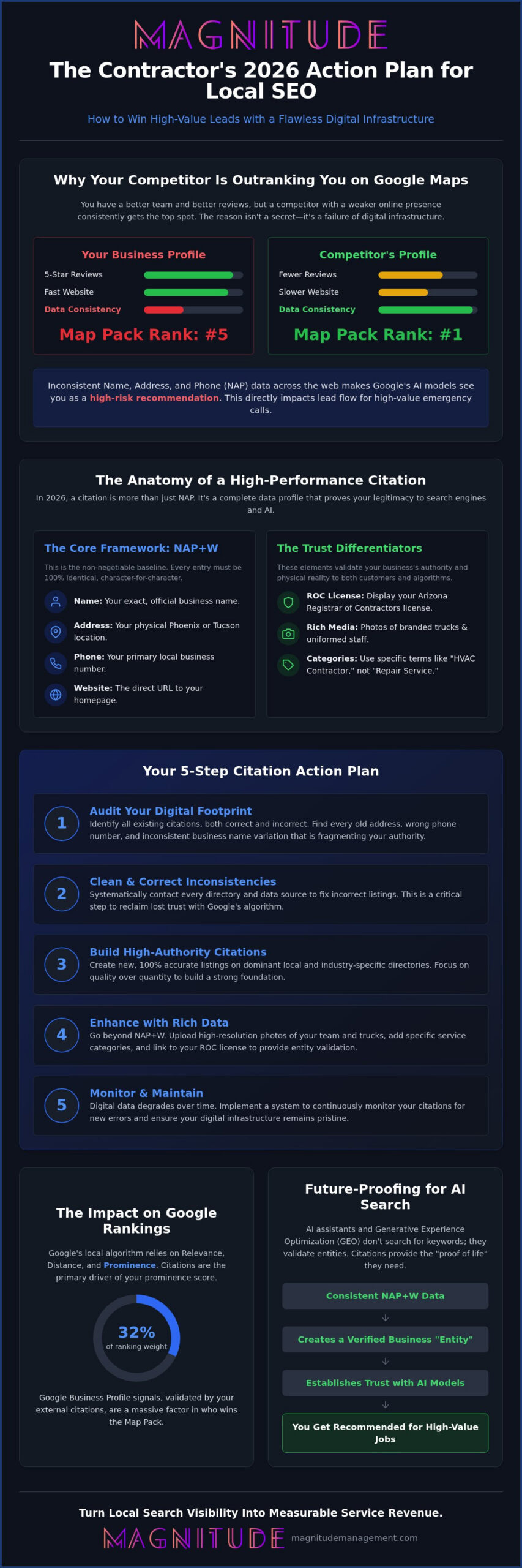
Google’s local algorithm relies on three factors: relevance, distance, and prominence. Citations drive prominence. The search engine cross-references your website data with third-party directories, social profiles, and government records like the Arizona Registrar of Contractors. When this data matches character-for-character, your prominence score rises. Google Business Profile signals now account for 32% of the total local ranking weight, but those signals are validated by your external citations. If a single digit in your phone number is wrong on an old directory, your trust score drops. This minor discrepancy is often the reason a high-quality contractor gets buried on page two while a mediocre competitor takes the top spot in the Map Pack.
Citations in the Era of AI Search and GEO
In 2026, the game has shifted from simple keyword matching to entity validation. AI search models and Generative Experience Optimization (GEO) don’t just look for the words “best HVAC repair.” They look for verified entities. Structured data and consistent citations provide the “proof of life” these AI models require to generate an answer. Moving your strategy from “keyword stuffing” to “entity validation” ensures that when a Phoenix homeowner asks their AI assistant for a recommendation, your business is the one it trusts. This infrastructure is the first step in the Magnitude Lead Hub ecosystem, turning raw visibility into measurable service revenue.
The Anatomy of a High-Performance Citation in 2026
In 2026, a citation is no longer just a digital business card. It is a data point in a vast entity graph that Google and AI search models use to verify your legitimacy. The “Big Three” of Name, Address, and Phone number (NAP) remain the baseline requirement. However, high-performance citation building for local SEO now demands the “NAP+W” framework. Including your Website URL is non-negotiable. Without it, you lose the link equity that connects your third-party authority to your primary lead-generation asset. If your website doesn’t prominently display your Arizona Registrar of Contractors (ROC) license as required by law, Google’s trust in your digital entity will plummet before a human even sees your page.
Rich media has become the ultimate differentiator for HVAC and roofing contractors. AI vision models now scan directory photos to verify the physical reality of your business. Uploading high-resolution images of your branded service trucks and uniformed team members does more than build consumer trust; it provides “entity validation” that a generic stock photo cannot replicate. This level of detail is exactly what we look for when performing a Local Search Visibility Audit. Every image and category selection must be intentional. Choosing “HVAC Contractor” instead of a generic “Repair Service” ensures you appear in the specific queries that drive high-value emergency calls.
Structured vs. Unstructured Citations
Structured citations are the entries you find in organized business directories like Yelp, Angi, or the Yellow Pages. They are the easiest to build but offer the lowest competitive advantage because everyone has them. Unstructured citations are mentions of your business in Phoenix news articles, local community blogs, or trade-specific publications. These carry significantly more weight for home service authority. A mention of your roofing company in a Tucson Sentinel article about monsoon prep is worth more to your ranking than a dozen generic directory listings. It proves you’re an active participant in the local economy, which is a primary signal for local SEO services for plumbers and other trades.
Vertical-Specific Directories for Home Services
Generic directories are the floor, not the ceiling. To dominate your local market, you must focus on vertical-specific platforms that your competitors are likely ignoring. Listings on trade-specific associations or platforms like Houzz and HomeAdvisor provide a relevance boost that generic sites can’t match. An HVAC-specific directory listing signals to Google that you aren’t just a business, but a specialized expert in your field. This relevance, combined with distance and prominence, forms the core of the local search algorithm. By securing these niche mentions, you build a defensive moat around your rankings that a simple NAP cleanup can’t touch.
Manual Building vs. Automated Tools: Choosing the Right System
Choosing between manual entry and automated software isn’t a matter of preference. It’s a strategic decision about asset ownership. Manual citation building for local SEO is the “own it forever” approach. You put in the labor once to secure your spot on core Arizona directories, and that data remains yours without a monthly ransom. Automated tools like Yext or BrightLocal offer undeniable speed, but they operate on a subscription model that can become a permanent liability if you ever decide to cut costs. If the goal is long-term authority, you want to own your infrastructure, not rent it.
Data aggregators like Foursquare and Data Axle serve as the ecosystem’s foundation. These platforms distribute your business information to thousands of smaller sites and GPS systems. If your data is wrong at the aggregator level, it will proliferate across the web like a virus, undermining your rankings in every zip code you serve. At Magnitude, we prioritize systems that eliminate industry theater. We don’t care about the number of “active syncs” shown in a software dashboard. We care about whether Google sees a consistent, authoritative entity that justifies a top-three ranking in the Phoenix market.
The Problem with Automated ‘Rent-a-Listing’ Services
Many agencies sell automated listings as a shortcut, but they rarely mention the risk of data reversion. When you stop paying for these services, the software often releases the API control. Your listings can revert to old, incorrect data or disappear entirely. This inconsistency triggers a trust failure in Google’s AI models. For your “Big 50” listings, manual control is essential. It ensures that your most powerful trust signals are locked in and permanent, protecting your lead flow from software billing cycles.
Scalability for Multi-Location Arizona Businesses
If you’re managing separate offices in Phoenix, Mesa, and Scottsdale, the complexity of your digital footprint multiplies. Duplicate listing penalties are a silent killer of local visibility. Google sees two listings for the same brand in the same city and doesn’t know which one to trust, so it often hides both. Effective citation building for local SEO requires a clean, systematic separation of location-specific data. You should use the Magnitude Lead Hub to track the specific economics of each location. This system allows you to see which markets are producing high-value leads and which ones are being throttled by fragmented data. Visibility without measurement is just vanity.
How to Build and Audit Your Citations: A 5-Step Execution Guide
Most agencies treat citations as a “set and forget” checklist item. That’s a mistake that costs you money. In the Arizona market, data is constantly shifting as directories update their databases or aggregators scrape old records. Effective citation building for local SEO requires a structured, five-step execution plan to ensure your roofing or HVAC business remains the dominant authority in Phoenix and Tucson. This isn’t just about being “listed.” It’s about being verified by every relevant entity in the search ecosystem.
- Step 1: Perform a Comprehensive Citation Audit. You can’t fix what you haven’t found. Identify every existing mention of your brand to uncover the “ghosts” of old addresses or disconnected phone numbers.
- Step 2: Clean up inconsistent NAP data. Start with your Google Business Profile. This is your anchor. Every other listing must mirror this data character-for-character to avoid algorithm confusion.
- Step 3: Build your “Primary” listings. Secure your presence on the Big Four: Google, Bing, Apple Maps, and Yelp. These provide the foundational trust signals that smaller directories look to for verification.
- Step 4: Target “Niche” and “Local” directories. Focus on Tucson-specific sites and trade associations like the Arizona Registrar of Contractors. These vertical-specific mentions carry the most weight for home service authority.
- Step 5: Implement a monitoring system. Catch “data decay” before it hurts your rankings. Automated scrapers can overwrite your correct data with old info; you need a system to revert these changes instantly.
The Audit: Finding the Ghosts of Businesses Past
Search for every phone number or address your business has ever used. You’ll likely find old listings from when you were operating out of a home office or a previous shop in Mesa. These “ghost” listings confuse Google’s AI and split your ranking power. Use our Local Search Visibility Audit to find these gaps and identify duplicate listings that need to be merged or deleted. Cleaning up this debris is the fastest way to see a jump in your Map Pack position.
Competitor Gap Analysis
Success leaves clues. If a competitor is outranking you for “roofing repair Phoenix,” they likely have citations you don’t. You must reverse engineer their digital footprint to find where they are listed. Tools can help you identify these specific directories, but the goal isn’t just to match them. You need to exceed their citation count and quality. By securing niche trade listings they’ve overlooked, you create a prominence gap that is difficult for them to close. Ready to stop guessing and start dominating? Let us build your authority with local SEO services for HVAC contractors that deliver measurable lead volume.
Scaling Beyond Citations: Converting Local Visibility into Service Revenue
Visibility is vanity. Revenue is reality. You can have the most consistent NAP data in Arizona, but if your digital infrastructure doesn’t convert that visibility into a booked service call, you’ve wasted your time. Citation building for local SEO is the foundation, not the finish line. Its primary job is to ensure that when a homeowner in Phoenix experiences an AC failure during a 115-degree July heatwave, your business is the one Google trusts to show them first. If your phone number is wrong or your landing page is broken, that high-intent lead will click the next contractor in the Map Pack within three seconds. Speed to lead starts with data accuracy.
To turn visibility into a dominant market position, you must integrate your citations with a reputation flywheel. This means your verified listings must be paired with a constant stream of high-quality reviews. Google’s AI models look for the intersection of proximity, prominence, and praise. When your citation data confirms your location and your reviews confirm your expertise, you move from “being found” to “being hired.” This is the core philosophy of the Magnitude system: we eliminate industry theater and focus on the mechanics of lead generation that actually impact your bottom line.
The Lead Economics of Local Search
Consider the math of a single $10,000 roofing replacement in Tucson. If your business drops out of the top three Map Pack positions because of a fragmented citation profile, you aren’t just losing “clicks.” You’re losing five-figure revenue opportunities. Losing just one lead due to a disconnected phone number or an incorrect address pays for an entire year of professional SEO services. Most contractors are bleeding money through these invisible gaps without realizing it. We recommend using our Ad Waste Audit to see if these structural visibility issues are quietly killing your ROI and inflating your customer acquisition costs.
Dominating the Arizona Market in 2026
The contractors who win in 2026 won’t just be the ones with the most citations; they’ll be the ones who dominate the entity graph. This requires combining your citation building for local SEO with aggressive AI search visibility tactics. AI assistants and search engines now prioritize businesses that provide a complete, verified picture of their operations. Your strategy must include comprehensive Google Business Profile optimization to act as the central hub for all your local data. Don’t let your competitors take the leads that should be yours. Stop being invisible and start dominating your service area today.
Take Control of Your Digital Infrastructure Today
Owning your business data is the difference between being a market leader and being invisible. We’ve established that manual control, entity validation, and niche directory targeting create a defensive moat around your rankings. For HVAC, plumbing, and roofing contractors in Phoenix and Tucson, citation building for local SEO is the essential first step toward reclaiming lost revenue and stopping the leak of high-value leads to competitors. Google’s AI search models in 2026 don’t reward appearances; they reward verifiable substance and character-for-character consistency.
At Magnitude, we provide specialized growth strategies and AI-powered visibility for the trades. Our systems focus directly on lead generation and revenue recovery, moving you from being “found” to being hired. Don’t let another emergency call go to the guy down the street because your data was too fragmented for the algorithm to trust. It’s time to move past industry theater and build the infrastructure your business deserves. Get Your Local Search Visibility Audit and Dominate Arizona Search. Your service area is ready for a dominant authority.
Frequently Asked Questions
What is the most important citation for a local business?
Your Google Business Profile is the single most important citation for any Arizona contractor. It serves as the primary source of truth for the local algorithm and directly feeds the Map Pack results. While Apple Maps and Bing are necessary for a complete footprint, Google Business Profile accounts for 32% of total local ranking weight. Neglecting this profile while building other listings is a waste of resources. It must be perfectly optimized with your ROC number prominently displayed to comply with state law.
How long does it take for citation building to impact my SEO rankings?
You should expect to see measurable results within four to twelve weeks of starting citation building for local SEO. Search engines don’t update their indexes instantly. They require time to crawl new directories and cross-reference that data with your existing digital entity. If your business has a long history of fragmented NAP data, the recovery phase may take longer. The algorithm needs to resolve conflicting information from the past before it fully trusts your new data.
Do I need to pay for every directory listing?
You don’t need to pay for the vast majority of directory listings to see a significant ranking boost. Most high-authority platforms like Yelp, Bing, and Facebook offer free basic profiles that provide the necessary trust signals for your business. However, specialized trade associations or premium directories in the roofing and HVAC sectors often require a membership fee. We prioritize high-authority free listings first before recommending any paid placements that offer a clear, measurable ROI for your lead flow.
Is citation building still relevant for local SEO in 2026?
Citations are more relevant in 2026 than ever before because they power the entity validation required by AI search models. AI assistants don’t just guess which contractor is the most reliable; they look for verified data points across the web to confirm your physical presence. If your business isn’t cited across a broad network of reputable sites, you remain an unverified entity. Citation building for local SEO ensures that AI search models have the structured data they need to recommend you.
What is NAP consistency and why does it matter for my HVAC business?
NAP consistency is the character-for-character matching of your business Name, Address, and Phone number across every digital platform. For an HVAC business, even a minor discrepancy like “St.” versus “Street” can create a trust gap in Google’s AI. This consistency is a pass/fail requirement for local search visibility. If the algorithm detects conflicting data, it views your business as high-risk. It will suppress your ranking in favor of competitors who maintain stable, identical information everywhere.
Can I build local citations myself or should I hire a pro?
You can build citations yourself, but the manual labor required to manage fifty or more listings is rarely the best use of a contractor’s time. Professional management ensures that your data is locked in and protected from data decay or aggregator overwrites. Most business owners who attempt the DIY route end up with half-finished profiles and inconsistent data. Outsourcing this infrastructure allows you to focus on running jobs while experts handle the technical validation and entity cleanup.
How many citations does my plumbing business actually need to rank?
Your plumbing business needs enough high-quality citations to exceed the prominence of your top three local competitors. There isn’t a fixed magic number, but most dominant contractors in Phoenix or Tucson maintain between 50 and 80 active, consistent listings. Quality always beats quantity in 2026. Ten listings on trade-specific associations or local Arizona directories carry more weight than a hundred listings on low-quality, generic sites that Google’s algorithm has already flagged as spam or irrelevant.
What happens to my citations if I move my office to a new city like Scottsdale?
Moving your office triggers a massive data conflict that will tank your rankings if you don’t manage the transition perfectly. You must immediately audit your entire digital footprint and update every single citation to reflect the new address. Leaving old listings active creates ghost locations that confuse search engines and split your ranking authority. A systematic update is required to migrate your trust signals from your old location to the new one without losing your hard-earned lead volume.