How to Get More Customers for Plumbing Business: The 2026 Growth Strategy
Why are you paying $45 per click for “emergency plumber near me” only to watch that lead go to a competitor who answered their phone four seconds faster? Most owners trying to get more customers for plumbing business are stuck in a cycle of industry theater, burning cash on tire-kickers while losing the high-value jobs in Scottsdale, Mesa, and Tucson. You already know that plumbing in 2026 isn’t just about who has the best tools. It’s a race of lead velocity. If you aren’t the first responder, you’ve already lost the job to a faster dispatcher.
Magnitude is here to end the waste. We’re moving past the “black box” of traditional SEO to focus on what actually fills your dispatch board: local search equity and automated recovery of missed opportunities. In this guide, you’ll learn our systematic approach to capturing the hard water replacement cycles that most Arizona plumbers ignore. We’ll show you how the Magnitude Lead Hub transforms your Google Maps presence into a machine that wins emergency calls and automates follow-ups. It’s time to stop chasing low-quality leads and start owning your market through radical accountability and measurable results.
Key Takeaways
- Eliminate lead leakage by prioritizing response velocity over raw volume to ensure you aren’t wasting budget on calls your team is too slow to catch.
- Adopt the 5-minute response rule to increase lead qualification by 21 times and improve your visibility through Google’s responsiveness ranking metrics.
- Discover how to get more customers for plumbing business by balancing the immediate “faucet” of Paid Ads with the long-term “equity” of Local SEO.
- Build a Reputation Flywheel that prioritizes review velocity over total star count, using automated SMS triggers to maintain a dominant presence on Google Maps.
- Unlock hidden revenue in your existing database by using Arizona’s hard water cycles to predict and time water heater replacement offers before the unit fails.
The Plumbing Growth Trap: Why More Leads Won’t Save Your Business
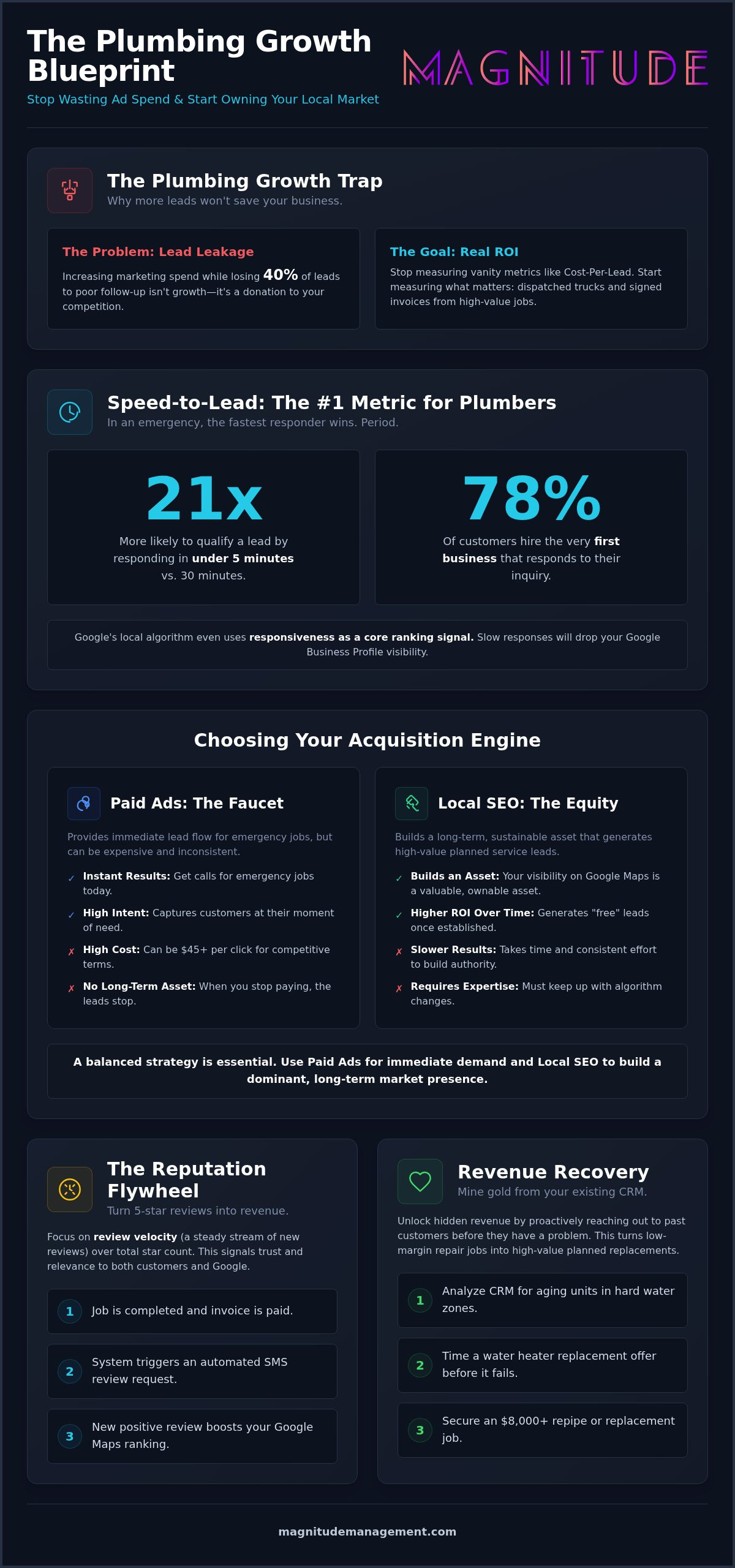
You’ve been told that to get more customers for plumbing business, you just need to turn up the volume on your ads. It’s a lie. Most plumbing owners are caught in a “Growth Trap” where they increase their marketing spend only to watch their margins shrink. Spending more on acquisition while losing 40% of leads to poor follow-up isn’t growth; it’s a donation to your competition. If your team isn’t equipped to handle the influx, you’re simply paying for the privilege of being frustrated.
Lead Leakage is the silent killer of plumbing ROI in Arizona.
Industry standard metrics like cost-per-lead (CPL) are often pure theater. A $50 lead for a “leaky faucet” is significantly more expensive than a $150 lead for a tankless water heater installation when you calculate the actual revenue generated per technician hour. Stop measuring success by the number of times the phone rings. Start measuring it by the percentage of high-intent calls that actually result in a dispatched truck and a signed invoice.
Emergency vs. Planned Service Economics
A $200 drain cleaning pays the bills, but an $8,000 whole-home repipe builds the business. You must understand the radical difference in the economics of these jobs. Emergency calls are high-stress and require immediate response velocity, but they’re often low-margin “one-and-done” interactions. However, in markets like Phoenix and Scottsdale, these emergencies are your primary entry point for building a long-term service agreement base. The extreme summer heat doesn’t just kill AC units; it stresses water heaters and accelerates the failure of aging polybutylene pipes. Use the emergency demand to get your foot in the door, then use systematic follow-up to secure the high-ticket planned services that provide stability during the shoulder seasons. If you find that a leak has led to more serious structural issues, you can check out Floodsafe Restoration LLC to see how experts handle the resulting mold and water damage.
The Failure of Traditional Lead Generation
Shared-lead platforms are a race to the bottom that erodes your profit margins. When you buy leads from massive aggregators, you’re competing with five other plumbers for the attention of a “tire-kicker” who only cares about the lowest bid. This forces you into a pricing strategy that leaves no room for quality or growth. Relying on these third-party platforms for your digital marketing strategies is a recipe for dependency. Magnitude’s perspective is clear: ownership of the lead source is the only path to scalability. If you’re tired of paying for leads that three other contractors already called, it’s time for an ad waste audit to see where your budget is actually disappearing. You need an acquisition engine that you control, not a faucet that someone else can turn off at any time.
Speed to Lead: The #1 Metric for Plumbers in 2026
Imagine a homeowner in Scottsdale at 2 AM. A pipe has burst; water is warping their expensive hardwood floors. This customer isn’t looking for a “brand story” or a catchy slogan. They’re looking for a truck in their driveway. They call the first three names they see on Google Maps. If you wait six minutes to respond, you’ve already lost the job. Data from 2026 confirms that responding to a lead within five minutes makes you 21 times more likely to qualify that prospect compared to waiting 30 minutes. To get more customers for plumbing business, you must stop treating lead response as an administrative task and start treating it as your primary competitive advantage.
Google’s local algorithm has evolved to prioritize “responsiveness” as a core ranking signal. When you make a marketing plan, you have to account for how search engines track your interaction speed. If you consistently miss calls or leave form submissions sitting in an unmonitored inbox, your Google Business Profile will drop in the rankings. Speed isn’t just about closing the sale; it’s about maintaining your visibility in the Phoenix and Tucson markets. You can’t afford to let “industry theater” distract you from the brutal reality that 78% of customers buy from the first business that responds to their inquiry.
Magnitude’s 3-Step Lead Velocity Sequence
We solve the “leaky bucket” problem through a disciplined, three-step automation process. First, our system triggers an instant AI-powered SMS acknowledgment the second a lead is generated. This stops the customer from calling the next plumber on the list. Second, an automated dispatch notification is sent directly to your available technicians. Finally, every interaction is logged in real-time within your CRM. This Lead Response Automation for Service Businesses ensures no prospect falls through the cracks during the chaotic Arizona monsoon season or peak summer heat waves.
The Cost of a Missed Call
The true cost of a missed call isn’t just the lost $500 repair. It’s the $15,000 in lifetime customer value that walks out the door. A single emergency call often leads to a water softener installation, a water heater replacement, or a whole-home repipe down the line. We use advanced call tracking to identify exactly where your dispatch bottlenecks occur during peak hours. By implementing the Magnitude Lead Hub, you bridge the gap between “Ad Click” and “Truck Dispatched.” This system ensures you get more customers for plumbing business by capturing the high-intent traffic you’re already paying for. If you’re ready to stop wasting budget on leads you never talk to, it’s time for an ad waste audit to find your hidden profit.
Building a scalable plumbing company requires more than just skilled technicians; it requires a systematic approach to lead velocity that never sleeps.
Local SEO vs. Paid Ads: Choosing Your Acquisition Engine
Paid advertising is your “faucet.” You turn it on, and the leads flow instantly. In competitive Arizona markets like Phoenix and Tucson, Google Ads and Local Services Ads (LSA) are essential for capturing immediate emergency demand. However, relying solely on paid traffic is a dangerous game. As CPCs for “emergency plumber” keywords climb toward $45 in 2026, your margins will suffer if you don’t have a plan for long-term sustainability. You need to Ad Waste Audit your current spend to ensure you aren’t overpaying for low-intent traffic that never converts.
Local SEO is your “equity.” It is the process of building long-term dominance on the map. To get more customers for plumbing business in 2026, you must adopt a hybrid approach. This means optimizing for traditional Google Maps rankings while ensuring your data is structured for the 45% of consumers now using AI search to find local recommendations. You can’t just buy your way to the top forever; you have to earn a permanent seat at the table.
Dominating Google Maps in Arizona
Phoenix and Tucson plumbing isn’t just about fixing leaks. It’s about managing hard water. To dominate the local map, your content must target specific “hard water” keyword clusters like scale removal and water softener repair. These high-value terms attract homeowners looking for permanent solutions, not just quick fixes. Each service area page for Mesa, Glendale, and Peoria needs to be unique. These cities have different water profiles and infrastructure ages. Our guide on Local SEO for Home Service Businesses explains how to build these pages to capture hyper-local search volume without triggering duplicate content penalties. If your Mesa page looks exactly like your Peoria page, Google will ignore both.
The ROI Comparison: SEO vs. PPC
Local Services Ads are your first line of defense. With an average CPL of $57 for plumbers in 2026, they offer the most efficient way to secure emergency calls. But SEO is where you build the asset. Over time, the cost of an organic lead drops significantly while your ad costs only go up. Get more customers for plumbing business results by shifting your mindset from “spending” to “investing.”
| Metric | Paid Ads (PPC/LSA) | Local SEO |
|---|---|---|
| 6-Month CPA | Moderate ($80 – $180) | High (Investment Phase) |
| 24-Month CPA | Static or Increasing | Low (Compound Interest) |
| Lead Type | Emergency / Transactional | High-Ticket / Research-Based |
| Asset Value | Rent (Stops when you stop paying) | Equity (Owned infrastructure) |
SEO is not a cost; it is an asset on your balance sheet. It provides the stability your dispatch board needs when ad auctions become too expensive for the average job value. By building search equity today, you protect your future margins against the rising costs of paid acquisition. This long-term mindset should also extend to your physical branding; for example, sourcing custom promotional products North Texas can help ensure your contact information remains physically present in a customer’s home, complementing your digital dominance.
Reputation Flywheel: Turning 5-Star Reviews into Revenue
Most plumbing owners treat a 5-star rating like a trophy they earned once and can now leave on the shelf. That is a mistake that will cost you visibility in 2026. Google’s algorithm and modern consumers don’t just care about your total star count. They care about “Review Velocity.” If your last three reviews are from six months ago, you are functionally invisible to a homeowner in Phoenix dealing with a slab leak. To get more customers for plumbing business, you must transform your reputation from a static badge into a dynamic engine that constantly signals your relevance and reliability.
Magnitude’s Reputation Flywheel removes the burden of “asking for the favor” from your technicians. We automate the process by triggering an SMS review request the moment a job is marked complete in your CRM. This ensures the request hits the customer’s phone while the relief of a fixed leak is still fresh. You can’t rely on your techs to remember to ask after a long day of water heater installs in the Tucson heat. Automation is the only way to ensure a consistent, high-velocity stream of feedback that keeps your business at the top of the Map Pack. For a deeper look at managing your digital standing, see our Contractor Reputation Guide.
Review Content and AI Search
The text within your reviews is now a primary ranking factor for AI-driven search recommendations. When a customer mentions “tankless water heater installation” or “hard water scale removal” in their review, they are providing the specific data points that search engines use to justify your business as the best answer to a query. This “Local Justification” is why you see Google highlighting snippets of reviews that match a user’s search term. You can’t afford generic feedback. Use this checklist to help your technicians encourage keyword-rich reviews:
- Confirm the specific problem you solved (e.g., “Glad we could fix that reverse osmosis system”).
- Ask the customer to mention the specific neighborhood or city.
- Explain that specific feedback helps other local homeowners find the right specialist.
The Social Proof Multiplier
Reviews shouldn’t live only on your Google Business Profile. They are high-conversion assets that should be embedded across your location-specific landing pages for Mesa, Scottsdale, and Peoria. When an undecided customer sees a recent review from their own zip code, the “Social Proof Multiplier” kicks in. We also use these reviews in retargeting ads to follow “tire-kickers” who visited your site but didn’t book. Seeing a neighbor’s praise for your rapid emergency response is often the final nudge needed to turn a click into a dispatch. If you aren’t sure how your current reputation stacks up against the competition, request a Local Search Visibility Audit to see the gaps in your strategy.
Your reputation is a revenue driver, not a vanity metric. You can scale your plumbing reputation today by turning every completed job into a marketing asset that works while your trucks are parked.
Magnitude’s Revenue Recovery: Mining Gold in Your Plumbing CRM
The most expensive lead is the one you already paid for and forgot. Most owners obsess over their daily lead count, believing they must constantly outspend the competition to get more customers for plumbing business. This is a fundamental misunderstanding of lead economics. Your existing database is not a static file of past transactions; it is a high-yield asset that requires active management. Lead acquisition costs in the Phoenix and Scottsdale markets are rising. You cannot afford to let dormant prospects sit in your CRM without a strategy to reactivate them.
Magnitude uses a disciplined Database Reactivation for Service Companies sequence to turn “dead” leads into active Arizona revenue. This isn’t about sending generic, annoying newsletters that end up in the spam folder. It is about surgical outreach based on previous job history and equipment age. If you aren’t mining your own data, you’re leaving the easiest money on the table for a competitor to grab.
The Hard Water Replacement Cycle
Arizona’s water is notoriously aggressive. While a water heater might last 10 to 12 years in other parts of the country, the heavy mineral buildup in the Phoenix basin often limits their lifespan to just 6 to 8 years. Calcium and magnesium scale destroys heating elements and tanks from the inside out. If you aren’t using CRM tags to track the age of every unit your technicians touch, you’re missing the most predictable revenue in the industry.
Consider a hypothetical scenario where you have a list of 500 customers who had a basic drain cleaning or minor repair two years ago. By triggering a “Hard Water Health Check” service call focused on scale removal and anode rod inspection, you can identify units nearing the end of their cycle. Converting just 5% of that list into a water heater replacement or a whole-home water softener installation can recover over $20,000 in revenue. This is pure profit recovery that requires zero additional ad spend.
Scaling with a Fractional CMO
Plumbing businesses often reach a ceiling between $2M and $5M in annual revenue. You have the trucks and the technicians, but you lack the strategic leadership to move beyond the daily chaos of dispatch. You get stuck in a cycle of “buying ads” rather than “engineering growth.” This is the point where industry theater fails and radical accountability must take over. You need a partner who understands the mechanics of success, not just the aesthetics of a website.
Magnitude’s Fractional CMO service provides the high-level marketing leadership required to manage your service radius and dispatch capacity with precision. We move beyond superficial metrics to focus on net profit and measurable outcomes. It’s time to stop guessing and start following a repeatable growth system. Get a Strategic Growth Audit from Magnitude to see how we can help you get more customers for plumbing business by maximizing the assets you already own.
Stop Chasing Leads and Start Engineering Growth
Success in the Arizona plumbing market requires a shift from passive advertising to active system architecture. You don’t just need a higher lead count; you need a disciplined approach to lead velocity and database equity. By prioritizing the 5-minute response rule and mining your existing CRM for hard water replacement cycles, you turn your business into a predictable revenue engine. This is how you get more customers for plumbing business without falling into the trap of endless; low-margin ad spend.
Magnitude offers the antidote to industry theater. Our specialized home service expertise in Tucson and Phoenix provides you with an AI-powered local search visibility strategy built for radical accountability. We don’t just help you rank; we help you dominate. It’s time to stop guessing which ads are working and start using a no-nonsense, results-oriented strategy that fills your dispatch board with high-value jobs.
Dominate Your Local Market with Magnitude’s Lead Hub
Your market is waiting for a leader who values speed and substance over generic marketing fluff. Take control of your visibility and your margins today.
Frequently Asked Questions
How can I get more plumbing leads without using HomeAdvisor or Angi?
You must own your lead source through Local SEO and Google Local Services Ads (LSA). Shared lead platforms force you into a race to the bottom on price because you’re competing with five other contractors for the same prospect. By optimizing your Google Business Profile and running targeted local ads, you generate exclusive leads that aren’t sold elsewhere. This strategy ensures you keep your margins intact while building long-term search equity in Phoenix and Tucson.
What is the fastest way to rank my plumbing business on Google Maps in Phoenix?
Focus on “responsiveness” and local citations. Google’s algorithm now heavily weights how quickly you interact with customers and the accuracy of your NAP (Name, Address, Phone) data across the web. Ensure your Phoenix office has a verified, optimized Google Business Profile with consistent activity. High review velocity and responding to every query within minutes are the quickest ways to climb the Map Pack rankings in competitive Arizona markets like Scottsdale and Glendale.
How much should a plumbing business spend on digital marketing in 2026?
Most high-growth plumbing companies allocate 7% to 12% of their gross revenue to marketing. In 2026, a significant portion of this budget should go toward a hybrid of paid acquisition and local search visibility. If you’re aggressive about trying to get more customers for plumbing business, your spend must be balanced between the immediate “faucet” of Google Ads and the long-term “equity” of SEO to protect your future margins.
Does my plumbing company really need a CRM for lead generation?
Yes; a CRM is the foundation of lead velocity. Without one, you’re guaranteed to suffer from “lead leakage” where a large percentage of your inquiries never get a follow-up. A system like the Magnitude Lead Hub automates the intake process, logs every interaction, and ensures that emergency calls are dispatched immediately. It’s the difference between a disorganized shop and a scalable, revenue-generating machine in Scottsdale or Mesa that never misses a call.
How do I improve my response time for emergency plumbing calls?
Implement AI-powered SMS automation to provide instant acknowledgment. Customers with a burst pipe will call the next plumber if they don’t hear from you in seconds. Use a system that triggers an immediate text response the moment a lead enters your funnel. This keeps the prospect engaged while your dispatchers coordinate with technicians in the field, ensuring you win the job before your competitors in Peoria or Glendale even see the notification.
Why is my plumbing business losing ranking to competitors with fewer reviews?
Review velocity and keyword relevance often outweigh total star count. Google prioritizes businesses that receive fresh, frequent reviews over those with a high total but no recent activity. Additionally, if your competitors’ reviews mention specific services like “tankless water heater repair” or “scale removal,” they gain an advantage in search justifications. To get more customers for plumbing business, you need a system that drives consistent, keyword-rich feedback from every completed job.
What are the best keywords for plumbing SEO in Arizona?
Focus on “hard water” and “emergency” intent clusters. Terms like “water softener repair Phoenix,” “reverse osmosis system installation Tucson,” and “emergency slab leak repair Scottsdale” drive the highest value. General keywords are too broad and expensive. You need to target the specific infrastructure problems unique to the Arizona climate to attract homeowners who are ready to pay for specialized expertise rather than just price-shopping for the cheapest drain cleaning.
How do I recover lost customers from my old plumbing database?
Use database reactivation sequences based on service history. Most plumbing databases are gold mines of forgotten revenue. By tagging customers who had a minor repair two years ago and sending a targeted “Hard Water Health Check” offer, you can trigger new service calls. This predictive maintenance strategy leverages Arizona’s aggressive water profile to time water heater replacement offers perfectly, turning dormant contacts into active revenue without buying a single new lead.