How to Automate Customer Reviews for Your Service Business in 2026
Every $15,000 HVAC installation that finishes without a Google review is a leak in your company’s balance sheet. You spent the marketing dollars to acquire the lead and paid the technician to do the work, yet you’re leaving the most valuable asset, the social proof, on the table. It’s time to stop hoping your field crew remembers to ask for a rating before they pull out of the driveway. When you learn how to automate customer reviews for service business operations, you transform a manual chore into a high-performance engine.
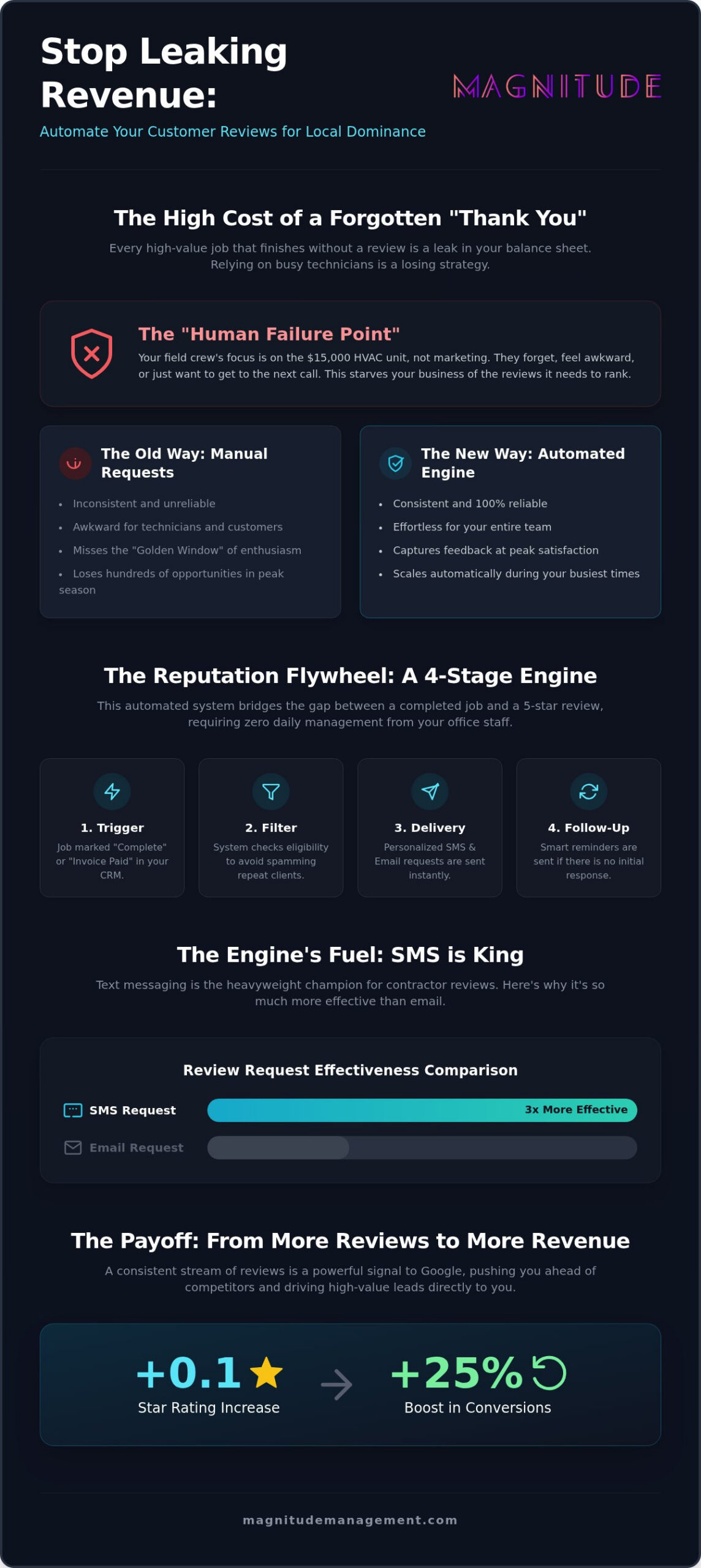
You likely feel the sting of seeing a competitor with half your experience outrank you simply because they have a higher review volume. With a 0.1-star increase potentially driving a 25% boost in conversions, the stakes are too high for guesswork. We’ll show you how to eliminate manual follow-ups and build a hands-free reputation engine that dominates local search results. This guide explains how to use the MAGNITUDE Lead Hub, from Magnitude Management Services, Inc. (DBA MAGNITUDE), to trigger requests the moment a job closes, ensuring high-value projects never go unreviewed. We’ll walk through the Reputation Flywheel, a system designed to turn every completed ticket into a ranking signal that forces Google to pay attention.
Key Takeaways
- Connect your CRM to the Reputation Flywheel to eliminate the “human failure point” where technicians forget to ask for reviews on the job site.
- Discover why SMS requests outperform email by 3x and how to automate customer reviews for service business growth using the Magnitude Lead Hub.
- Identify the optimal trigger for your trade, whether it’s job completion or invoice payment, to capture feedback during the “Golden Window” of customer enthusiasm.
- Learn how a consistent stream of keyword-rich reviews signals business prominence to Google’s algorithm, naturally pushing you ahead of local competitors.
- Follow a structured five-step framework to audit your customer data and build a hands-free system that requires zero daily management from your office staff.
What Is Customer Review Automation for Service Businesses?
Review automation is a system that triggers feedback requests based on specific actions in your CRM. It’s not a “nice to have” feature; it’s a strategic bridge between job completion and search visibility. By removing the manual burden from your team, you ensure that every successful project contributes to your digital footprint without requiring an extra thought from your office staff. This process is a core component of Online Reputation Management (ORM), focusing specifically on the high-velocity generation of verified social proof. When you automate customer reviews for service business growth, you replace the inconsistency of human effort with a repeatable, high-performance engine.
The system works by deploying SMS and email sequences at optimized intervals. It doesn’t just send a single “how did we do” message. It follows a structured cadence designed to capture the customer’s attention when their satisfaction is at its peak. If you want to see how your current review volume stacks up against the competition, a local search visibility audit can reveal exactly where your manual process is failing you.
The Death of the Manual Review Request
Relying on technicians to ask for reviews is a losing strategy. Your field crew is focused on fixing $15,000 HVAC units or clearing complex plumbing blockages, not marketing. They forget. They feel awkward. Or they simply want to get to the next call. This creates a “human failure point” that starves your business of the visibility it deserves. There’s also a psychological barrier at play. If a request arrives three days after the service, the customer’s peak enthusiasm has evaporated. During the brutal Arizona summer cooling season, your call volume spikes and your team is stretched thin. If your review process isn’t hands-free, you’ll miss hundreds of opportunities during your busiest months when your local search rankings matter most.
Software vs. Systems: Why You Need Both
A standalone app is just another login for your office staff to ignore. True automation requires a system integrated directly with your dispatch software, like the Magnitude Lead Hub. This ensures that the moment a job is marked “complete” in your CRM, the Reputation Flywheel begins to spin. However, the software is only as good as your data hygiene. If your technicians aren’t entering correct phone numbers or closing out tickets properly, the engine stalls. At Magnitude, we believe automation must be invisible to the customer but measurable for the owner. You need to see the direct correlation between a closed ticket and a new five-star rating to understand your true return on effort. Systems provide the infrastructure; software provides the delivery.
The Mechanics of a High-Performance Reputation Engine
When you decide to automate customer reviews for service business success, you aren’t just buying software. You’re installing a strategic infrastructure. The process follows a precise four-stage cycle: Trigger, Filter, Delivery, and Follow-up. The trigger happens in the field. When a technician marks a $15,000 HVAC installation as “Job Complete” in your CRM, the engine starts. The filter then determines if the customer is eligible for a request, preventing you from spamming a property manager who sees your team weekly. While the SBA suggests several tactics to increase positive reviews, the most effective method remains the immediate, automated request delivered while the air is cold and the customer is relieved.
Personalization is where AI becomes a force multiplier. A generic request is easy to ignore. An AI-enhanced request mentions the specific service provided, such as “Thanks for letting us handle your emergency drain cleaning today.” This distinction between a routine repair and a major install matters. Review gating, or the practice of only sending requests to happy customers, is a direct violation of Google’s 2026 policies. You don’t need to gate. A robust system focuses on high-volume, authentic feedback that naturally dilutes the occasional outlier. Architecting this Reputation Flywheel requires a deep understanding of your trade’s specific economics and customer psychology.
SMS: The King of Contractor Reviews
Text messaging is the undisputed heavyweight champion of review generation for plumbers, roofers, and foundation repair specialists like Crown Leveling Inc.. Industry data shows that 90% of text messages are read within three minutes. Compare that to email, which often sits buried in a “Promotions” tab for days. To maximize conversion, your request must be under 160 characters. It should be direct. “Hi [Name], thanks for choosing [Company]. Could you leave us a quick review about your service today? [Link].” Timing is everything. Sending this text exactly 15 minutes after the technician leaves the job site captures the “Golden Window” of peak gratitude.
Multi-Channel Drip Sequences
A single request is a start, but a sequence is a system. We recommend a “Three-Touch” rule. If the initial SMS doesn’t result in a click, the system sends an email 24 hours later. If there is still no response, a final SMS reminder goes out on day three. The logic must be airtight. The moment the system detects a new review, the sequence must stop automatically. This prevents you from looking disorganized or desperate. Managing this cadence ensures you stay top-of-mind without becoming a nuisance. It transforms your reputation from a variable you hope for into a metric you control.
Choosing the Right Triggers: Dispatch, Invoice, or Completion?
Most business owners are terrified of asking for a review before the payment is processed. They wait for the “Invoice Paid” trigger in ServiceTitan or Housecall Pro. This is a tactical mistake. By the time the bank transaction finalizes, the customer’s emotional connection to the service has flatlined. To successfully automate customer reviews for service business growth, you must trigger the request at the peak of satisfaction. Waiting 24 to 48 hours for an accounting event to occur is the fastest way to ensure your request gets archived and ignored.
We know that reviews directly affect clients’ buying decisions, so the speed at which you generate them dictates your lead flow. For complex, multi-day projects like a full roof replacement or a $15,000 HVAC install, the trigger must be tied to the final inspection. Don’t automate based on the first day of the permit pull. You need a system that recognizes the “Job Complete” status in your field software as the signal to fire the Reputation Flywheel. This ensures the request hits the customer’s phone while they are still admiring the new infrastructure in their home.
The “Moment of Delight” Framework
The “Moment of Delight” is the exact second a customer feels the most relief. In Tucson, it’s the moment the A/C kicks back on after a long afternoon in 110-degree heat. That is when you ask. Triggering a request when the technician hits “Complete” on their tablet is superior to any other method because it captures the peak of the experience. Consider a Phoenix-based HVAC company we analyzed. They moved their automation trigger from “Invoice Paid” to “Job Complete.” They doubled their monthly review volume within thirty days. They didn’t change their service. They simply changed the timing to match the customer’s psychological peak.
Filtering for Quality
While you cannot selectively ask only happy customers for reviews, you can structure your automation to prioritize internal feedback. A simple “How was your service?” thumbs up or down survey provides a safety net. If a customer indicates a “thumbs down,” the system should immediately route them to a private feedback form. This allows you to recover the service and resolve the issue before a negative comment hits your Google Business Profile. Be careful. Google’s 2026 policies are aggressive against review gating. Your automation must provide the option for all customers to leave a public review, but a well-designed internal filter ensures you address friction points privately. It’s about radical accountability and fixing the problem before the public sees it.
5 Steps to Building Your Review Automation Engine
Building a system to automate customer reviews for service business growth requires more than just a software subscription. It demands a structured workflow that accounts for the specific economics of your trade and the psychology of your customers. If you treat this like a “plug and play” app, you’ll fail to see the ranking boost you’re looking for. You need an engine that handles the high-volume chaos of a Tucson summer without breaking. Follow this five-step framework to transition from manual requests to a hands-free reputation engine.
- Step 1: Audit your current customer data and CRM capabilities.
- Step 2: Define your “Golden Window” based on your specific trade.
- Step 3: Build SMS and email templates that sound like a human, not a bot.
- Step 4: Integrate your CRM with a platform like the Magnitude Lead Hub.
- Step 5: Monitor, test, and refine based on conversion rates.
Step 1-2: Data and Timing Strategy
You cannot automate reviews with bad data. If your field crew is lazy with data entry or consistently puts landline numbers into the mobile field, your SMS strategy is dead on arrival. Cleaning your database is the first step toward operational efficiency. You must also establish “Quiet Hours” within your automation logic. If your team finishes an emergency plumbing call at 2 AM, your system should wait until 9 AM to send the request. Sending a text in the middle of the night is a guaranteed way to turn a five-star experience into a one-star complaint. Before you start, audit your local search visibility to see exactly how your current manual process is hurting your rankings compared to the competition.
Step 3-5: Execution and Optimization
Your scripts must sound human. Avoid corporate jargon or begging. A simple “Hey [Name], [Tech Name] just finished up. How did we do?” is far more effective than a long-winded paragraph. This personal touch is vital during the “Arizona Surge.” When the temperature hits 110 degrees and your call volume triples, you don’t have time to manually follow up on every $15,000 HVAC install. The automation acts as your auxiliary marketing team, ensuring no job goes unreviewed during the peak season.
Don’t fall for the “Set it and forget it” myth. While the system runs itself, you still need to check your dashboard weekly to identify trends. Are certain technicians getting fewer reviews? Is the SMS conversion rate dropping? Using the Magnitude Lead Hub as your central engine allows you to spot these leaks and patch them before they affect your lead flow. If you’re ready to stop leaving your reputation to chance, it is time to build your Reputation Flywheel with a partner who understands the mechanics of local service growth.
Beyond the Ask: Turning Reviews into Local Search Dominance
Reviews are not a vanity metric. They are the primary fuel for Google’s local algorithm. When you build a system to automate customer reviews for service business operations, you are signaling “Prominence” to the search engine. Google defines Prominence as how well-known a business is; it relies heavily on review count, score, and the frequency of new feedback. If your competitors are getting five reviews a month while you are generating twenty through the Magnitude Lead Hub, you are forcing Google to recognize your authority. This isn’t just about visibility. It’s about radical accountability and measurable growth.
The content of these reviews matters as much as the star rating. A review that simply says “Great job” is helpful, but a review that says “Best HVAC repair in Tucson” is a ranking asset. Your automated templates should nudge customers to mention the specific service they received. This creates a natural density of local keywords that traditional SEO can’t replicate. This is the core of the Reputation Flywheel: a steady stream of social proof that lowers your overall cost-per-lead by making every other marketing effort more efficient. To understand how the leading platforms stack up for review generation for home service companies, compare the latest automated systems before committing to a solution. Don’t forget the final step: responding. Automation can handle the initial response, but a human touch on the replies reinforces your brand’s transparency and builds trust with future prospects.
Reviews and the AI Search Era
AI search engines and Generative Engine Optimization (GEO) have changed the rules for 2026. These systems don’t just count links; they analyze sentiment and specific mentions to recommend local contractors. If AI search bots see consistent mentions of your “professionalism” and “fair pricing” in recent reviews, you become the top recommendation. Volume and recency are the two most important metrics now. A hundred reviews from three years ago won’t save you from a competitor with twenty reviews from the last month. For a deeper dive into these mechanics, read our Contractor Reputation: 2026 Guide to 5-Star Growth.
The ROI of a 5-Star Reputation
Your reputation is a permanent business asset, unlike a one-time lead from a paid ad. A 4.8-star rating significantly increases the click-through rate (CTR) on your Google Ads, making your ad spend work harder. If two HVAC companies bid on the same Tucson keyword, the one with the superior reputation will almost always win the click for a lower price. When you automate customer reviews for service business growth, you are essentially buying future leads at a massive discount. You have to calculate the lifetime value of this authority. Stop viewing reviews as a post-job chore and start seeing them as the foundation of your lead generation infrastructure. It is time to stop wasting ad spend and start building authority with Magnitude today.
Build Your Reputation Infrastructure
Your reputation isn’t a byproduct of good work; it’s the core infrastructure that drives your lead generation. We’ve established that relying on technicians to ask for feedback is a systemic failure point. By the time you choose to automate customer reviews for service business growth, you’re doing more than saving office time. You’re building a defensive moat around your local search rankings. The “Moment of Delight” is your highest ROI trigger, and missing it means leaving your most valuable asset on the table.
Magnitude offers specialized expertise for HVAC, plumbing, and roofing contractors. We act as a fractional CMO for Arizona businesses, providing the AI-powered local search visibility you need to outpace competitors. It’s time to stop hoping for reviews and start engineering them. Let Magnitude build your automated reputation engine today and turn your completed tickets into a permanent ranking advantage. You’ve done the hard work in the field. Now, let your systems dominate the search results.
Frequently Asked Questions
Is it legal to automate customer review requests?
Yes, it’s perfectly legal. You just need to follow TCPA and CAN-SPAM rules by ensuring you have consent and an opt-out link. Automation is just a delivery method for a standard business request. It doesn’t change the legality of the communication itself. We build these safeguards into the Magnitude Lead Hub to ensure your reputation engine stays compliant while it scales without legal friction.
Will Google penalize my business for getting too many reviews at once?
Google won’t penalize you for high volume if the reviews are authentic. The algorithm actually rewards businesses that show consistent, high-velocity feedback. Penalties only happen when Google detects “review bursts” from fake accounts or non-customers. As long as your requests are tied to real jobs, a surge in five-star ratings is a signal of prominence, not a red flag to the search engine.
What is the best time of day to send a review request to a customer?
The best time is 15 minutes after your technician marks the job complete. This captures the peak of customer gratitude before life gets in the way. If a job finishes after 8 PM, your system should hold the request until 9 AM the next day. Timing is about psychology, not just the clock. Capture the relief they feel the moment the problem is solved.
Can I automate reviews for multiple locations in Phoenix and Tucson?
Yes, you can manage multiple locations seamlessly. When you automate customer reviews for service business growth across different cities, the system routes data to the correct Google Business Profile. Whether you’re running crews in Phoenix or Tucson, the Magnitude Lead Hub ensures the right customer reviews the right branch. Multi-location management is essential for maintaining local search dominance as your service area expands.
How do I handle negative reviews if I’m using an automated system?
You handle them with a private feedback loop. Your system should include a quick internal survey that asks “How did we do?” before providing the Google link. If the customer is unhappy, they’re directed to a private form where you can recover the service. This fixes the issue before it goes public. It’s about proactive management and fixing internal failures before the world sees them.
Do I need a specific CRM like ServiceTitan to automate my reviews?
You don’t need a specific brand of CRM. While we work with ServiceTitan and Housecall Pro, we can connect to any modern software that exports data via API or webhooks. The Magnitude Lead Hub is the engine; your CRM is just the fuel tank. If your software tracks job completion, we can build the automate customer reviews for service business sequence to fire immediately.
Can I offer a discount or incentive for an automated review?
Absolutely not. Offering discounts, gift cards, or any incentive for a review is a direct violation of Google’s 2026 policies. It can get your business profile banned or permanently flagged. The goal of automation is to remove friction, not to buy influence. Trust the quality of your work and the ease of the SMS link to generate honest, high-value ratings that build real authority.
How many reviews per month should a service business aim for?
Aim to outpace your top three competitors by 20% every month. If they’re getting 10 reviews, you need 12. At a minimum, you want 10 to 15 fresh reviews per month to satisfy Google’s “Recency” requirements. In the 2026 AI search era, a business with 500 old reviews will lose to a competitor with 50 reviews from the last 90 days. Recency is the new currency.