Garage Door Company Marketing in Peoria: How to Choose a Growth Partner
A polished marketing report doesn’t mean your schedule is filling with profitable jobs. Effective garage door company marketing Peoria should help nearby homeowners find you, make it easy to request service, and show which inquiries become booked work. If calls go unanswered or lead sources aren’t tracked, you may be paying for clicks without seeing which opportunities turn into jobs.
A stuck-open door calls for a different message from a planned replacement. Your marketing partner should understand that distinction, along with your service radius, estimate process, and lead follow-up. More activity isn’t the answer if it reaches the wrong homeowners or doesn’t connect to your sales process.
This article explains how to assess local visibility in Maps and organic search, evaluate lead capture, and choose a partner who reports on qualified calls, estimates, and booked jobs rather than vanity metrics. You’ll also see how local SEO, paid advertising, landing pages, call tracking, and follow-up systems can work together, plus what to ask before you commit. The goal is a practical way to turn local discovery into trackable opportunities without relying on ranking promises or vague reports.
Key Takeaways
- Judge garage door company marketing Peoria by whether it connects local discovery to qualified inquiries and booked jobs, not by activity alone.
- Separate repair, installation, and replacement messaging so homeowners can find the service they need and take the next step.
- Compare agencies on local SEO, paid media, lead handling, tracking, and reporting. Treat ranking or lead-volume guarantees as a red flag.
- Build a baseline by confirming services and coverage, checking visibility, and testing whether calls and forms are tracked through to estimates and jobs.
- Choose a partner whose process fits your service area and operating capacity. Use an audit to identify visibility or tracking gaps before deciding what to change.
What should garage door company marketing in Peoria accomplish?
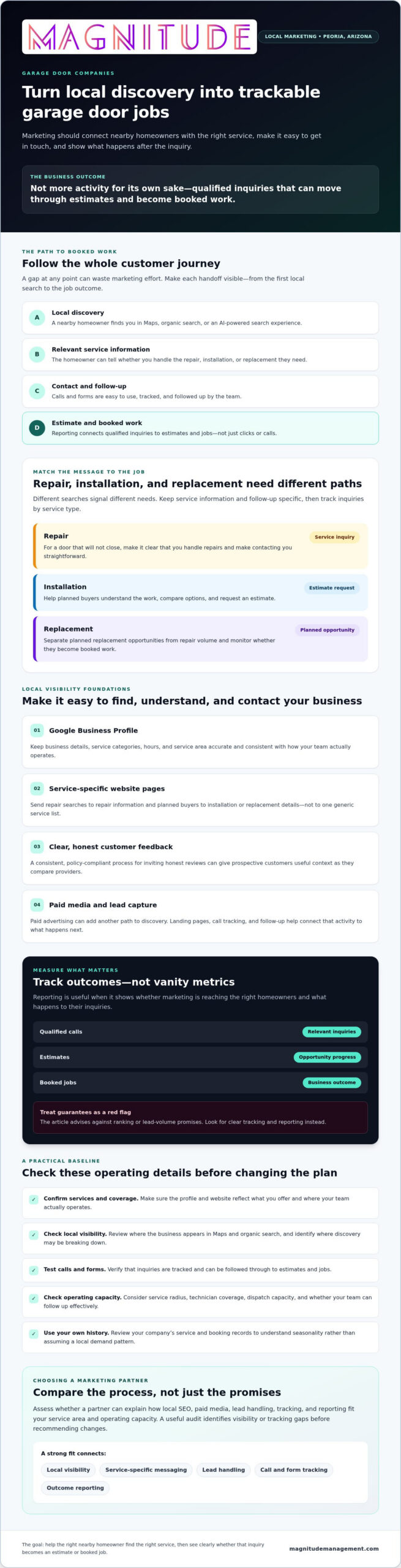
More visibility is not a business outcome by itself. Garage door company marketing Peoria should connect local discovery to a relevant inquiry, a realistic estimate, and booked work. That means attracting homeowners in the areas your team can serve, helping them find the right service, and tracking what happens after they call or submit a form.
Think of marketing as one operating path: a homeowner finds your business, understands whether you handle their problem, contacts you, receives a next step, and can be tracked through to an estimate or booking. A gap anywhere in that path can waste effort. A call from outside your service radius may not be useful. A qualified repair inquiry that goes unanswered may never reach dispatch.
How do repair, installation, and replacement searches differ?
A homeowner whose door won’t close is likely looking for a clear way to call and confirmation that you handle repairs. Someone planning an installation or replacement may take more time to compare options, review customer feedback, check relevant credentials, and request an estimate. Local search engine optimization helps explain how businesses can appear for location-based queries, but visibility must lead to information that fits the search.
Match each service page and follow-up to the customer’s intent. A repair page should state what repair services you offer and make contacting you straightforward. Installation and replacement pages should help planned buyers understand the work and request an estimate. Track inquiries by service type so repair calls don’t get mixed with replacement opportunities.
Which garage-door business details shape a local strategy?
Set goals around the work your operation can take on. Before increasing demand, define your service radius, technician coverage, dispatch capacity, and ability to respond to calls and forms. More inquiries are not automatically better if they fall outside your coverage or arrive when your team can’t follow up effectively.
- Repairs: Track relevant service inquiries and whether they reach dispatch.
- Installations: Measure estimate requests and their progress through follow-up.
- Replacements: Separate planned opportunities from repair volume and monitor booked work.
Review seasonality using your company’s own service and booking history. Don’t assume demand follows a particular pattern in Peoria without evidence. A local search visibility audit can show where your business appears and help identify where discovery may be breaking down before you choose what to change.
How can Peoria garage door companies turn local searches into inquiries?
Local visibility helps nearby homeowners find your business in Maps, organic search, and AI-powered search tools. To turn discovery into an inquiry, give them a clear next step. An accurate Google Business Profile, relevant service pages, and consistent business information help people understand what you do and where you operate. Paid advertising can add another path to discovery, but it only becomes useful when customers can contact you easily and your team follows up.
For garage door company marketing Peoria, make information consistent and specific. A homeowner searching for repairs should land on a page about repairs, not a generic list of services. Someone considering a replacement needs details that help them compare options and request an estimate. Matching information across your profile and website can also help AI-powered search experiences interpret your services and location. It does not guarantee a recommendation or a lead.
What should a garage-door Google Business Profile communicate?
Keep the profile accurate. Business details, service categories, hours, and service area should reflect how your team actually operates. Describe garage-door services plainly, without implying unsupported locations or availability. A consistent, policy-compliant process for inviting honest customer reviews can give prospective customers useful context as they compare providers. The International Door Association offers trade-specific context for the door and access systems industry.
Reviews and a complete profile can support trust, but they don’t replace a useful service page or dependable lead handling. Measure whether discovery leads to calls or form submissions, then check whether those inquiries are routed and followed up consistently. Paid ads may promote selected services, while local SEO and accurate business information support organic discovery. Neither channel can make an unclear offer or missed inquiry convert.
How should local pages reflect garage-door customer intent?
Give repair, installation, and replacement searches distinct page paths. Each page should explain the service, identify the areas you genuinely cover, and make the next step easy to find. Use Peoria and other relevant service-area references where they help customers understand coverage. Avoid repeating city names without adding practical information.
- Repair: Explain the repair services offered and make calling straightforward.
- Installation: Describe the work and how a homeowner can discuss a project.
- Replacement: Clarify the service and provide a practical way to request an estimate.
Test the experience on a phone, then connect calls and forms to lead tracking and follow-up. A local search visibility audit can help identify discovery gaps. For help connecting local visibility and lead generation, explore Magnitude’s garage-door marketing services.
How should you compare garage door marketing agencies in Peoria?
Compare agencies by how well they connect local visibility and advertising to qualified inquiries and booked work. Ask what they’ll do, who handles incoming leads, how results are tracked, and what reports will show. No agency or channel can guarantee rankings or lead volume. A credible partner will explain its process, assumptions, and limits instead of promising outcomes it can’t control.
Ask each provider the same questions. That makes proposals easier to compare and helps prevent a polished dashboard from disguising gaps in execution.
| Area | What to ask | Useful evidence |
|---|---|---|
| Local SEO | How will you assess local search visibility and improve the paths for repair, installation, and replacement searches? | A clear audit, prioritized actions, and visibility reporting tied to relevant services and coverage. |
| Paid media | How will campaigns match the services and locations we’re prepared to handle? | Campaign and landing-page alignment, along with a plan to identify wasted spend. |
| Lead handling | Who receives calls and forms, and how will missed or unqualified inquiries be identified? | A defined routing and follow-up process that fits your team’s capacity. |
| Tracking | Can inquiries be separated by source and service type, then followed through the sales process? | Call and form tracking connected to estimates and booked jobs where possible. |
| Reporting | Will reports show business outcomes or just marketing activity? | Qualified calls, estimates, booked work, and revenue attribution where the available data supports it. |
Which questions reveal whether an agency understands this trade?
Ask how the plan distinguishes an urgent repair call from a planned replacement inquiry. Find out how reporting accounts for your service radius, technician coverage, dispatch capacity, and job quality. Clarify who owns call tracking, lead routing, and follow-up measurement. A useful SBA guide to competitive analysis can also help frame questions about the local market and competitors.
Separate activity metrics, such as clicks or page views, from outcomes such as qualified calls, estimates requested, jobs booked, and revenue connected to a source. Each step answers a different question. A click shows attention, not whether the service fits; an estimate is a sales opportunity, not a completed booking.
Hypothetical scenario: Suppose a company tracks repair inquiries and replacement inquiries separately. For each category, it can compare the number of inquiries, how many fit its coverage and capacity, estimates issued, and jobs booked. Use your own records to assess performance. This illustration is not a forecast or industry benchmark.
When should you combine local SEO and paid advertising?
Local SEO supports discovery through Maps and organic results over time. Paid campaigns can add visibility for selected services when the pages, budget, and lead-handling process are ready. Paid placement won’t fix an inaccurate profile or an unhelpful service page. Consider a paid advertising waste audit to identify campaign gaps before deciding where to invest.
What should a Peoria garage-door marketing plan measure first?
Start by defining the work you want, where you can dispatch technicians, and whether you can trace inquiries from source to outcome. A practical baseline for garage door company marketing Peoria defines services and coverage, checks local visibility, verifies call and form tracking, then compares qualified inquiries with estimates and booked jobs. Increase demand only when your team can handle it.
Which measures connect marketing to booked work?
Use a measurement sequence that separates attention from sales activity:
- Define services: Track repairs, new installations, and replacements as distinct inquiry types.
- Confirm coverage: Record the areas your technicians serve and available capacity for each type of work.
- Audit visibility: Review Maps presence, profile accuracy, service-page relevance, and review activity.
- Verify tracking: Test calls and forms, confirm each inquiry has a source, and make sure it enters your intake process.
- Review outcomes: Track qualified inquiries, estimates issued, booked jobs, and revenue attribution where your records support it.
Impressions and clicks can show whether people encountered your marketing. They can’t tell you whether a homeowner needed a service you provide, lived within your coverage area, received an estimate, or booked the work. Reliable attribution depends on consistent source tracking and intake records. Ask your team to record the service requested, service area, qualification, estimate status, and booking outcome for each inquiry.
Use your company’s own close-rate and job-value data to evaluate performance by service type. A repair inquiry and a replacement estimate may have different sales paths, so blending them can hide what’s working. Your own completed-job records provide a more relevant baseline than an outside benchmark.
What should the first review of local performance include?
Check whether your business appears for relevant nearby searches, whether its profile details are accurate, and whether each service page answers the customer’s actual need. Then inspect review activity and the operational handoff. Are calls answered, forms assigned, and follow-ups recorded? A visible business can still lose opportunities if an inquiry sits unassigned or never reaches the right person.
Before increasing campaign demand, compare incoming opportunities with technician coverage and dispatch capacity. If follow-up is inconsistent, define ownership and next steps first. A clear lead response automation process for service businesses can help organize inquiry routing and follow-up measurement.
If you need to identify gaps in Maps and organic local visibility, request a local search visibility audit before deciding what to change.
Is Magnitude the right marketing partner for a Peoria garage door company?
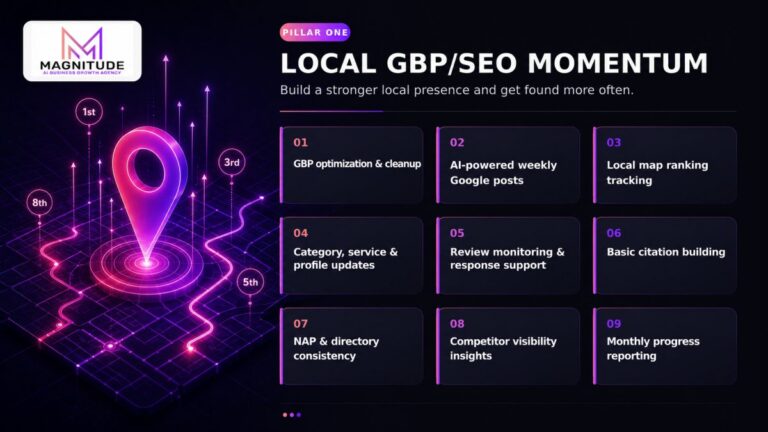
Magnitude may be a fit if your garage-door business needs stronger local search visibility, more accountable advertising, or a clearer way to track inquiries through sales activity. Its services for garage-door companies include local SEO, Google Business Profile optimization, Google Ads, reputation management, and lead generation. The useful question isn’t whether an agency can promise growth. It’s whether its process addresses the gaps affecting your business.
That process should reflect how garage-door work is sold and delivered. Repair inquiries may need different routing from installation or replacement estimates. Your service-area boundaries and technician capacity affect which leads are useful, while call tracking and CRM follow-up can help show whether inquiries progress toward booked jobs. Outcomes also depend on local competition, service coverage, your operations, and execution. Marketing can support growth, but it can’t control every part of that chain.
When does specialized local marketing support make sense?
Consider support if nearby customers aren’t finding your company, your Google Business Profile doesn’t clearly represent your services, or your reporting stops at clicks and rankings. A partner should explain what it will assess, how the work connects to customer inquiries, and what evidence will guide the next step. A local search visibility audit can help identify discovery gaps before you commit to changes.
First, check whether your business can handle the demand you want to generate. Confirm technician coverage in the areas you target and a dependable process for answering, assigning, and following up on calls and forms. More visibility won’t solve missed inquiries or dispatch constraints. It may simply make those issues more apparent.
What should you prepare before discussing a growth plan?
Bring information that helps an agency understand both your goals and your operating limits. You don’t need a perfect dashboard. Useful records can show what work you want, where you can serve customers, and how leads currently move through your business.
- Your service categories, such as repairs, installations, and replacements
- Service-area boundaries, technician coverage, and dispatch capacity constraints
- Current lead sources and available call or form records
- Estimate and booked-job information, organized by service type where possible
- Customer-review records and any existing process for requesting or responding to reviews
These details create a practical starting point for evaluating priorities, tracking gaps, and choosing suitable next steps. They also help keep a proposed plan grounded in the work your team can deliver. Magnitude’s local focus includes Peoria, Tucson, Phoenix, Oro Valley, Scottsdale, Mesa, and Glendale. If local discovery is your main concern, request a local search visibility audit to begin a conversation about where to focus. Treat the discussion as an assessment, not a promise of rankings, lead volume, or booked jobs.
Build a Local Marketing System You Can Measure
Choosing a growth partner comes down to more than who can improve your visibility. For garage door company marketing Peoria, look for a process that connects local discovery with the work your team can serve, then tracks what happens after an inquiry. Keep repair, installation, and replacement opportunities distinct, and judge progress by qualified leads and booked jobs, not just clicks or rankings.
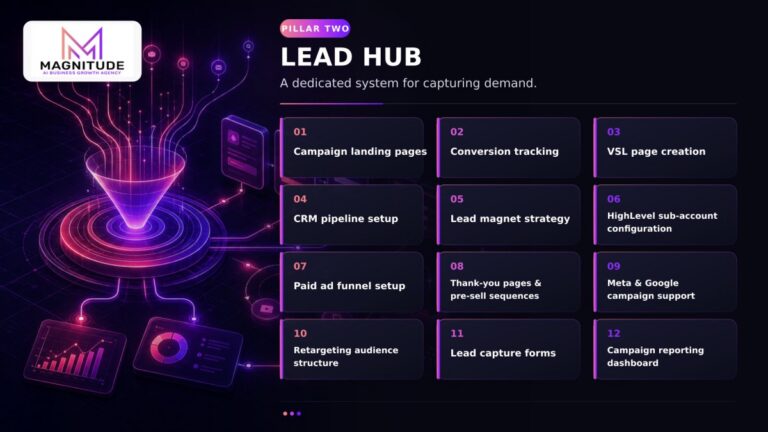
Magnitude offers local SEO and Google Business Profile optimization for garage-door companies, along with lead generation, reputation management, and Google Ads. Its home-service marketing systems can connect lead capture, call tracking, and CRM automation so you can see how inquiries move through follow-up. No agency can control every factor. Competition, service coverage, dispatch capacity, and execution all influence outcomes.
Start with a clear view of your current local visibility and the gaps between discovery and customer contact. Then decide what to improve based on evidence and your operational capacity. Request a local visibility review to discuss where your Peoria garage-door business may need attention. A measured, realistic plan gives you a stronger basis for making the next marketing decision.
Frequently Asked Questions
How should a garage door company market itself in Peoria?
Start with accurate local business information, useful pages for repairs, installations, and replacements, and a clear way to request service. Effective garage door company marketing Peoria connects that visibility to call handling and lead tracking. Set priorities around your service radius and dispatch capacity, then review qualified inquiries and booked jobs alongside search activity. Rankings and clicks can show visibility, but they don’t prove that marketing generated revenue.
Does local SEO help garage door companies get more customers?
Local SEO can help nearby homeowners discover your company when they search for relevant garage door services. Results depend on factors such as competition, profile accuracy, service-page quality, reviews, and consistent execution. Visibility alone doesn’t guarantee calls or sales. Track inquiries by source and service type, then compare which leads qualify, receive estimates, and become booked work over time. That evidence helps you judge whether local search is contributing meaningful opportunities.
Should a garage door company use Google Ads or SEO in Peoria?
Choose based on your goals, available budget, competition, and how quickly you need to test demand. Google Ads can support campaigns for specific services, while local SEO builds search visibility over time. Neither guarantees booked jobs. Compare lead quality, campaign costs, technician capacity, and follow-up before choosing one channel or combining them. Ads and SEO work best when the landing pages and inquiry process can turn attention into a useful next step.
What should a garage door marketing agency report each month?
Ask for a report that separates visibility and activity from business outcomes. It can include search presence, calls, qualified inquiries, estimates, booked jobs, and lead sources, provided your company records them consistently. A useful report explains what changed, what the available data supports, and what the agency recommends doing next. Rankings and impressions may provide context, but they shouldn’t be the only evidence used to evaluate marketing performance.
How can garage door companies get more replacement leads?
Make replacement services easy to find with accurate local business information and a dedicated, useful page explaining the service and how to request an estimate. Follow up consistently, and record replacement inquiries separately from repair calls so their quality and outcomes don’t get mixed together. Before shifting campaigns or deciding which source performs best, review your own records for qualified leads, estimates, bookings, and close rates.
How do I know if my garage door marketing is working?
Connect each inquiry to its source and service type, then record whether it was qualified, estimated, and booked. Review the full path, not just website visits, ad clicks, or Maps visibility. Use consistent records and your own baseline to identify meaningful patterns. If source information is missing or unreliable, improve call and lead tracking before drawing firm conclusions about return. Better measurement starts with a complete view of each opportunity.