HVAC Content Marketing Ideas: A Results-First Strategy for Arizona Contractors
How much did you spend last month on generic blog posts that didn’t generate a single install lead? Most HVAC content marketing ideas are nothing more than expensive digital wallpaper that fails to move the needle in hyper-competitive markets like Phoenix and Tucson. You’re likely exhausted by rising costs on Google Ads and the frustration of seeing national aggregators sit at the top of the map pack while your own site stagnates. It’s time to stop treating your website like a brochure and start treating it like a high-performance mechanical system.
You know that content should drive revenue, not just traffic. I’m going to show you how to build a high-intent content engine that captures high-ticket jobs by addressing the specific “mechanical anxiety” of Arizona homeowners. We’ll examine how to leverage active incentives like the SRP Cool Cash rebates and 15.2 SEER2 efficiency standards to build immediate authority. This guide covers the transition from invisible to indispensable; including how the Magnitude Lead Hub helps you master the 5-minute lead response rule. We are stripping away the marketing fluff to focus on the mechanics of local search visibility and consistent lead flow during the shoulder seasons.
Key Takeaways
- Stop attracting DIYers with basic tips and start producing high-intent content that targets homeowners ready to invest in professional system replacements.
- Master AI search visibility and Answer Engine Optimization to ensure your business is the first answer for voice and AI queries in the Phoenix and Tucson markets.
- Deploy high-performance HVAC content marketing ideas like equipment comparison guides and local case studies to build authority and justify your premium rates.
- Synchronize your publishing schedule with Arizona’s specific seasonal demands, targeting pre-summer cooling needs and monsoon-driven humidity concerns.
- Bridge the gap between traffic and revenue by integrating the Magnitude Lead Hub to capture inquiries and maintain the 5-minute lead response standard.
Why Most HVAC Content Marketing Ideas Fail to Drive Service Calls
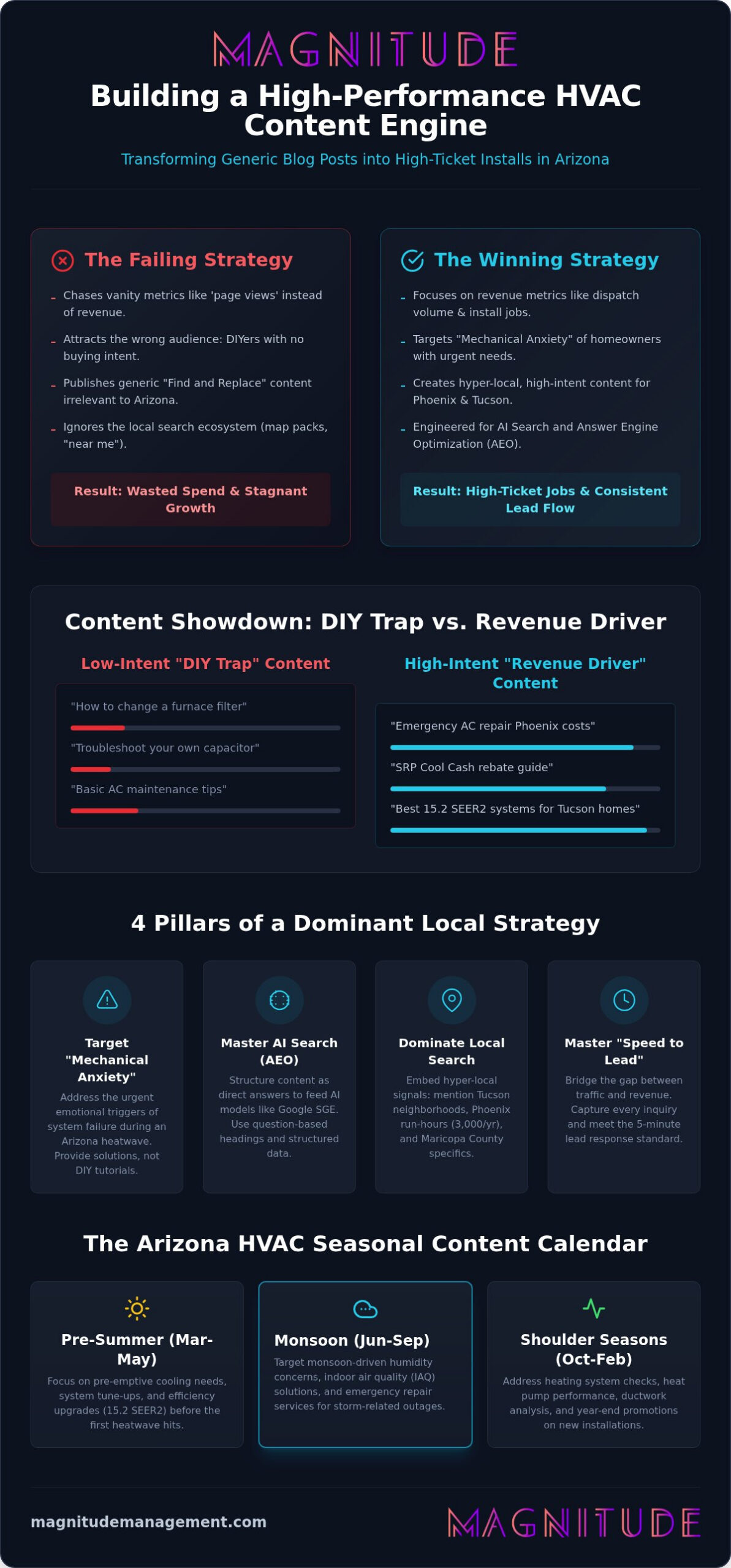
Most contractors treat their websites like digital filing cabinets for generic advice. They post about “how to change a furnace filter” because some cut-rate agency told them it builds authority. It doesn’t. It builds a list of DIYers who have no intention of opening their wallets. Traditional Content marketing often fails in the home services sector because it prioritizes vanity metrics like “page views” over actual dispatch volume. If your traffic isn’t calling your office, your strategy is broken.
The core problem is a massive gap between information and intent. You don’t need readers; you need callers. When you fill your site with “Find and Replace” content that could apply to a home in Maine as easily as one in Maricopa County, you lose the trust of local homeowners. They can tell when a post lacks the grit and expertise of a technician who actually works in the 115-degree Phoenix sun. Without a specific focus on high-intent HVAC content marketing ideas, you’re just paying for wasted server space.
The DIY Trap: Attracting the Wrong Audience
If you teach a homeowner how to troubleshoot their own capacitor, don’t be surprised when they don’t call you for the repair. Educational content that focuses on simple repairs attracts the wrong demographic. You want to target “Mechanical Anxiety.” This is the specific emotional trigger that occurs when a system fails during a Tucson heatwave. These customers aren’t looking for a tutorial; they’re looking for a solution. They want to know why their variable-capacity system isn’t hitting the 15.2 SEER2 efficiency they were promised. Contrast low-value “how-to” keywords with high-intent queries like “emergency AC repair Phoenix” or “heat pump replacement costs.” One gets you a reader; the other gets you a high-ticket install.
Ignoring the Local Search Ecosystem
Generic content ignores the critical signals that Google uses to rank you in the local map pack. If your content doesn’t mention specific Tucson neighborhoods or the fact that a Phoenix AC runs for 3,000 hours a year, you’re invisible to the local search engine. AI-driven search results now prioritize geographic relevance and verified local expertise. You can see how your current site measures up by requesting a Local search visibility audit. Without these local markers, your HVAC content marketing ideas will never trigger the “near me” results that drive the majority of service calls. Content is only half the battle. If you don’t have a “Speed to Lead” system like the Magnitude Lead Hub to capture that traffic, you’re letting revenue slip through the cracks while your competitors respond in under five minutes.
Building an AI-Ready HVAC Content Strategy for Local Dominance
AI search visibility, or Generative Engine Optimization (GEO), is the new benchmark for Arizona contractors in 2026. Traditional SEO is evolving. AI models like Google SGE and Perplexity don’t just scrape text; they synthesize data to provide direct answers. If your website isn’t structured to feed these “Answer Engines,” you’re effectively invisible to homeowners using voice search or AI assistants. Winning in this environment requires a technical shift in how you deploy HVAC content marketing ideas.
Answer Engine Optimization (AEO) for HVAC
Answer Engine Optimization is the process of making your HVAC business the definitive answer for AI search. This requires a shift in how you structure your digital assets. Instead of burying answers in long-form paragraphs, use H2 headers as direct questions. This captures “People Also Ask” snippets and feeds AI exactly what it needs to recommend your service. For example, “What is the best SEER2 rating for a Phoenix home?” followed by a concise, data-driven answer provides the clarity AI prefers.
Technical infrastructure is just as important as the words on the page. You must use specific schema markup to tell AI exactly which Tucson zip codes or Phoenix neighborhoods you serve. This structured data acts as a digital map, proving your local relevance to algorithms that prioritize proximity and verified expertise in next-generation solutions in heating, ventilation, and air conditioning (HVAC). Without this technical layer, even the best writing fails to reach the intended audience.
Google Business Profile: Your Most Important Content Feed
Your Google Business Profile (GBP) is no longer a static listing; it’s a high-velocity content channel. Daily GBP updates frequently outrank monthly blog posts because they signal immediate local activity. This is your “Authority Engine.” Use real-time photos of technicians on jobs in Scottsdale or reviews from Tucson homeowners as your primary content. AI engines weigh these verified local signals heavily when deciding which contractor to feature in the top results. It’s a transparent way to prove you are actually performing the work you claim to do.
Don’t let your GBP exist in a vacuum. Link your posts back to high-intent pages on your site or invite users to get a Local search visibility audit to see where they currently stand. This creates a feedback loop that reinforces your dominance in both traditional maps and AI-driven search. If you want to stop guessing and start measuring, you can partner with a strategic agency that understands the mechanics of AI search visibility and revenue-focused content.
High-Intent HVAC Content Ideas: Moving Beyond the Basics
If your blog reads like a textbook, you’re losing money. Homeowners in the Phoenix and Tucson markets don’t visit your site to learn the history of refrigeration; they visit because their system is failing or their utility bills are skyrocketing. High-intent HVAC content marketing ideas must bridge the gap between “I have a problem” and “I need this specific solution.” You need to stop playing the role of a teacher and start acting as a high-stakes financial consultant for the homeowner’s largest appliance.
Consider the power of a hyper-local case study: “How a $15,000 System Replacement Lowered a Phoenix Home’s Bill by 40%.” This isn’t just a story; it’s a financial proof point. In a region where air conditioners run for 3,000 or more hours per year, efficiency isn’t a luxury. It’s a necessity. You should also produce “Economic Transparency” content that highlights the hidden tax of a 10-year-old unit. When a customer understands that keeping an aging, inefficient system is costing them an extra $100 a month in utility waste, the “wait and see” approach disappears.
High-Ticket Replacement Content
Your content needs to dismantle the #1 objection: “Can’t I just repair this one more time?” In Arizona, the answer is often a hard no. You must shift the conversation from the initial install price to the Total Cost of Ownership (TCO). Use comparison tables to demonstrate the ROI on high-efficiency SEER2 ratings. For example, show the difference between a federal minimum 14.3 SEER2 unit and a 15.2 SEER2 variable-capacity system that qualifies for the SRP Cool Cash rebate. When you visualize the savings, you justify premium pricing and move the customer toward a high-ticket replacement.
Reputation-Based Content
Trust is the currency of the home services industry. Don’t just bury your 5-star reviews on a testimonial page. Turn them into “Story” content. Highlight specific technicians by name and describe the exact problem they solved in a Tucson neighborhood. This humanizes your team and builds a layer of “Lead Guard” protection before the customer even picks up the phone. Understanding the mechanics of Reputation Management for Contractors is vital here; your content should prove that you are a reliable local partner, not a faceless national aggregator. Show behind-the-scenes video walk-throughs of your 21-point inspection process to demonstrate exactly what the homeowner is paying for. This level of transparency eliminates the mystery and positions your company as the only logical choice for high-value HVAC jobs.
The Arizona Seasonal Content Calendar: Capturing Leads Year-Round
Arizona HVAC seasonality is brutal and predictable. Your HVAC content marketing ideas must align with the thermometer if you want to maintain a steady dispatch board. In Phoenix and Tucson, an air conditioner runs for 3,000 or more hours per year. This is nearly four times the workload of a unit in a northern climate. This extreme usage means your content must be timed to the exact moment a homeowner feels the first hint of mechanical anxiety.
During March and April, launch your “Phoenix Heat Wave Prep” checklist. This is your primary window to push high-efficiency replacements before the 110-degree days arrive. Focus your messaging on the SRP Cool Cash rebate requirements, specifically the 15.2 SEER2 threshold. By July and August, the focus shifts to Monsoons. Your content should address humidity control and the impact of dust storms on condenser coils. When winter hits in December, transition to furnace safety and heat pump efficiency. Even in the desert, a heating failure is a high-priority emergency for a homeowner.
Summer Peak: Emergency and Speed-to-Lead
When the temperature hits triple digits, search volume for “AC repair near me” explodes. Your content must emphasize 24/7 emergency response and technician availability. However, traffic is worthless if you can’t convert it instantly. You must adhere to the “5-Minute Rule.” If you don’t respond to a lead within five minutes, your conversion rate drops significantly. This is where Lead Response Automation becomes your most valuable asset. It turns desperate searches into booked appointments while your competitors are still checking their email. Your content should promise speed, and your systems must deliver it.
Shoulder Season: Database Reactivation
October and November are for revenue recovery. Use your content to re-engage past customers for maintenance agreements. This is the perfect time for Database Reactivation for Service Companies. Instead of spending more on expensive Google Ads, you are mining your existing list for dormant revenue. Offer “Early Bird” replacement specials to fill the gaps in your schedule before the spring rush begins. This strategy justifies premium pricing by positioning you as a proactive partner rather than a reactive service provider. If you want to stop the seasonal revenue roller coaster, partner with Magnitude to build a year-round lead engine.
Converting Content Traffic into Revenue with the Magnitude Lead Hub
Content is a liability if it doesn’t lead to a transaction. Most contractors waste thousands on HVAC content marketing ideas that drive traffic to a dead end. If your blog posts don’t funnel users toward a high-conversion landing page, you’re essentially providing free education for your competitors’ future customers. Traffic without a conversion engine is just a vanity metric that does nothing to pay for your fleet or your technicians’ salaries. You need a system that captures interest and forces it through a tracked, automated sales process.
The connection between content and revenue is often broken by poor infrastructure. If your website provides the answer but fails to provide a clear, frictionless path to booking, the homeowner will leave. This is especially true in the Phoenix and Tucson markets where the heat makes customers impatient. Bad content also kills your Google Ads ROI. If you pay for a click and send that user to a generic page that doesn’t mirror the intent of their search, you’re burning cash. Magnitude’s approach ensures that every piece of content serves as a gateway to your sales pipeline.
The Lead Hub: Your Sales Infrastructure
The Magnitude Lead Hub acts as the central nervous system for your growth. It doesn’t just host your words; it captures and nurtures leads automatically. This infrastructure is critical for maintaining the five-minute response rule. When a Tucson homeowner is dealing with a system failure, they won’t wait an hour for a callback. Our system ensures they’re engaged immediately. By integrating Meta and Google Ads with intent-based content, we create a feedback loop that maximizes your ROI. You stop spending on what feels good and start investing in what actually moves the needle.
Advanced call tracking is another non-negotiable component. You must know which specific content idea actually made the phone ring. Was it the SEER2 comparison guide or the monsoon prep checklist? Without this data, you’re just guessing. The Lead Hub provides total transparency, allowing you to see the journey from the first click to the closed job.
Audit Your Way to Growth
The first step toward dominating your market isn’t writing more; it’s identifying where you’re currently losing money. You can start this process by requesting an Ad Waste Audit. This reveals the gaps in your current strategy where bad content or poor targeting is draining your budget. Once the waste is removed, you can align your Authority Building Strategy with real-time local search data. Magnitude provides a fractional CMO approach to HVAC growth, acting as a disciplined strategic partner rather than just another vendor. Stop settling for digital wallpaper and start building a revenue engine. Schedule a strategy session today to secure your position as the top HVAC contractor in the Arizona market.
Build Your High-Performance Revenue Engine
The difference between a stagnant dispatch board and a thriving HVAC business in Arizona often comes down to infrastructure. You’ve learned that generic “how-to” blogs only attract DIYers who don’t pay for service. Real growth requires high-intent content that addresses the specific mechanical anxiety of homeowners in Phoenix and Tucson. You must also embrace the technical reality of AI-driven search by structuring your site for Answer Engine Optimization. Without these strategic shifts, you’re simply handing your market share to national aggregators or competitors who are faster and more visible.
Implementing these HVAC content marketing ideas is only the first step. To truly dominate your local market, you need the support of AI-powered Local SEO experts who specialize in Arizona Home Services. Magnitude provides the advanced CRM and Lead Hub automation necessary to ensure no inquiry goes unanswered during those critical 110-degree peaks. It’s time to stop guessing and start measuring your results with radical transparency. Stop wasting ad spend and start capturing high-intent HVAC leads with a Magnitude Lead Audit. Your business deserves a marketing system that works as hard as your technicians do.
Frequently Asked Questions
What is the best type of content for getting HVAC leads quickly?
High-intent comparison guides and emergency service pages generate leads fastest. In markets like Tucson, homeowners aren’t looking for a history of cooling; they need to know if a heat pump or traditional unit survives the summer. Content that highlights current SRP rebates or specific SEER2 efficiency standards provides the logical proof required for a quick booking. Pair this with a conversion-focused landing page to capture the lead before the customer moves to a competitor.
How often should an HVAC company post to its Google Business Profile?
You should post to your Google Business Profile daily to signal maximum local activity to the algorithm. In Phoenix and Scottsdale, high-velocity posting often outranks static blog content because it proves you’re actively working in the community. Use real job site photos and technician updates to build immediate trust. This consistent feed of verified local data is a primary signal for winning the local map pack and appearing in AI-driven search results.
Does blogging still help with local SEO for contractors in 2026?
Blogging remains effective only if you pivot from generic advice to Answer Engine Optimization. In 2026, content must be structured to feed AI assistants and voice search queries. Instead of “how-to” guides, focus on specific Arizona problems like monsoon-driven humidity or Phoenix dust storm maintenance. This builds the topical authority necessary to rank for high-ticket keywords while providing the technical data that Google SGE and Perplexity require to recommend your services.
What are some high-intent keywords for HVAC replacement in Phoenix?
High-intent keywords focus on immediate needs rather than general research. Target phrases like “emergency AC replacement Phoenix,” “15.2 SEER2 heat pump installers,” and “SRP rebate qualified HVAC contractors.” These queries indicate a homeowner who is ready to spend money to solve a cooling crisis. Avoid broad terms like “air conditioning” and focus on geographically specific long-tail keywords that trigger the local map pack in Peoria, Mesa, or Glendale.
How can I use AI to help with my HVAC content marketing?
Use AI to analyze local search data and structure your HVAC content marketing ideas for Generative Engine Optimization. AI tools help identify the exact questions homeowners in Tucson are asking during peak seasons. However, the real value lies in using AI search visibility strategies to ensure your technical schema markup is flawless. This tells AI models exactly which zip codes you serve and which high-ticket installations you’ve completed recently in Scottsdale or Peoria.
What is the difference between educational and intent-based content?
Educational content teaches a reader how to do something, which often attracts DIYers who won’t pay for service. Intent-based content addresses a specific problem that requires a professional solution. If you write about “how to clean coils,” you get a hobbyist. If you write about the “Total Cost of Ownership of a 10-year-old unit in Phoenix,” you get a homeowner ready for a high-ticket replacement. Focus on revenue-generating intent to avoid wasting your budget.
How do I track the ROI of my HVAC content marketing efforts?
You track ROI by integrating your content with a system like the Magnitude Lead Hub. This allows you to follow the journey from a specific blog post or GBP update to a closed job in your CRM. Use advanced call tracking and lead-attribution software to see which pieces of content are actually making the phone ring. Stop looking at page views and start measuring the cost-per-lead and total revenue generated from each content channel.
Why is local SEO more important than national keywords for my HVAC business?
National keywords are vanity metrics that don’t drive truck rolls. Your business survives on proximity. Local SEO ensures you appear when someone in Oro Valley or Mesa searches for a contractor “near me.” Google prioritizes verified local expertise and geographic relevance over broad national authority. By dominating the local map pack, you capture high-intent leads in your specific service area where travel time is low and profit margins are highest.