Authority Building: 2026 Strategy for Arizona Trades
Your Arizona Registrar of Contractors (ROC) license is more than a $590 biennial tax; it’s the single most underutilized asset in your digital arsenal. While you’re busy paying mandatory Residential Recovery Fund assessments, lead aggregators who don’t own a single service truck are outranking you in Phoenix, Tucson, and Scottsdale. This happens because Google’s AI currently favors digital entity signals over physical expertise, forcing you into a high cost-per-lead trap. This article provides the strategy for authority building for local contractors to reclaim your territory. We’ll show you how to bridge the gap between statutory licensing and digital verification to dominate the Map Pack and win high-ticket contracts.
You likely feel the frustration of being a superior craftsman who remains invisible while inferior competitors win on review volume alone. We agree that it’s unacceptable for a middleman to dictate your lead flow or for your skills to be overshadowed by marketing theater. You’ll learn to deploy the Magnitude Reputation Flywheel to automate trust and use a Local Search Visibility Audit to pinpoint where your digital footprint is leaking revenue. We’re moving past vanity metrics to focus on the systems that ensure you’re the business Google recommends in 2026.
Key Takeaways
- Define authority as the intersection of Arizona ROC licensing and digital proof to stop losing high-ticket contracts to lead aggregators.
- Transform mandatory compliance costs into a competitive moat by using statutory data to satisfy Google’s strict E-E-A-T requirements.
- Execute a systematic process for authority building for local contractors by aligning technical Schema markup with clean, cross-platform entity verification.
- Prioritize review velocity and recency through a Reputation Flywheel to ensure AI search engines recommend your business over stagnant competitors.
- Utilize the Magnitude Lead Hub to integrate these authority signals directly into your sales pipeline for measurable revenue growth.
What is Authority in the Local Contractor Market?
Authority in the contracting world isn’t about your brand’s color palette or how many trucks you have running service calls on the I-10. It is the measurable level of trust search engines and AI models have in your business entity. For Arizona trades, authority building for local contractors has shifted from a marketing tactic to a survival mechanism. Without it, you’re stuck in a race to the bottom. You’ll either compete on price with unlicensed “handymen” or pay a massive premium to lead aggregators who sell the same lead to four of your competitors.
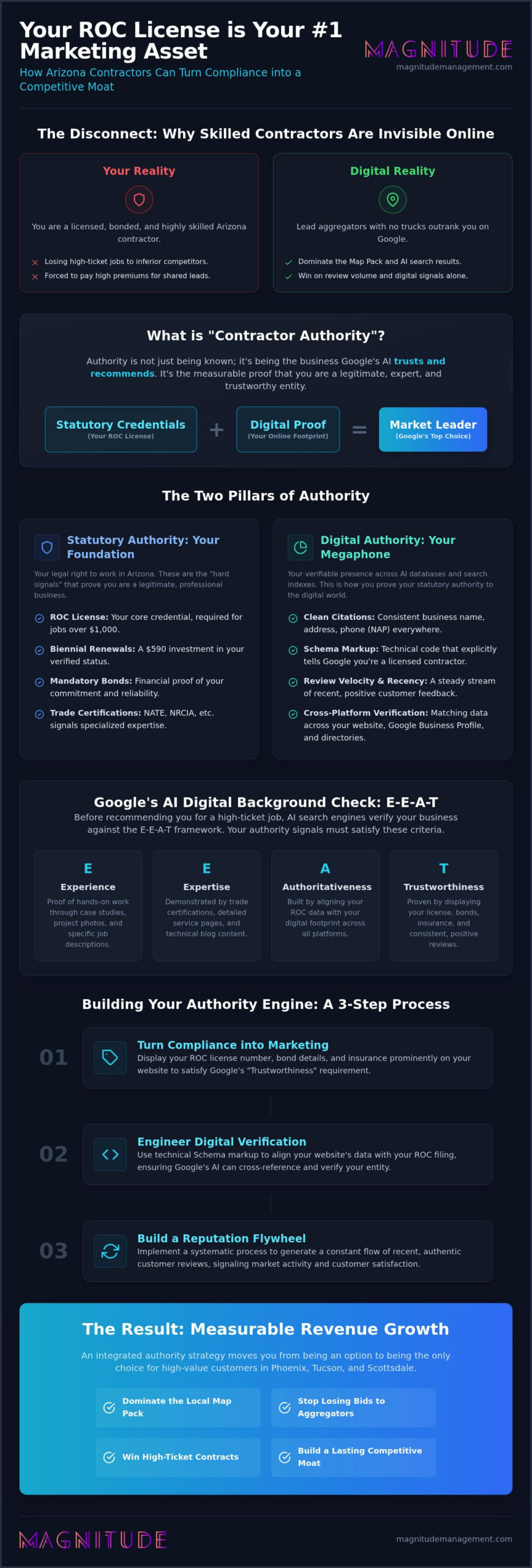
True authority is the intersection of statutory credentials and digital proof. It’s the difference between being “known” and being “trusted.” Being known means you have a website that Google has indexed. Being trusted means you’re the entity Google recommends in an AI Overview or the Map Pack. In 2026, search engines act as the ultimate gatekeeper. They cross-reference your Arizona Registrar of Contractors (ROC) data against your digital footprint to decide if you’re worth the risk of a recommendation. This trust is built on three pillars: Regulatory Compliance, Digital Entity Data, and Social Proof.
Statutory Authority vs. Digital Authority
Statutory authority encompasses your legal right to work in cities like Phoenix or Scottsdale. This includes your biennial ROC license renewals, your $320 renewal fees, and your mandatory bond requirements. These are the “hard” signals that prove you’re a legitimate professional. Digital authority represents your verifiable presence in AI databases and search indexes. It’s built through clean citations, structured schema markup, and consistent review velocity. Contractor Authority is the synthesis of statutory credentials and digital entity verification that forces search engines to categorize you as a market leader.
Why Perceived Authority is the New Barrier to Entry
AI search engines now conduct a digital background check on your business before you ever appear in a local search result. They prioritize E-E-A-T (Experience, Expertise, Authoritativeness, and Trustworthiness) because the stakes for home services are high. A homeowner in Tucson isn’t just buying a product; they’re inviting a stranger into their home for a $15,000 HVAC install. This high-ticket transaction requires significantly more authority than a $100 simple drain cleaning. If the search engine can’t verify your expertise, it won’t show your business to the high-intent customer.
Google’s AI prioritizes entities it can verify across multiple platforms. This is why understanding What is Online Reputation Management? is vital for modern trades. It’s not just about hiding bad reviews. It’s about engineering a digital footprint that proves you are a licensed and highly recommended expert. To see where your current authority stands, you should start with a Local Search Visibility Audit to identify gaps in your entity data.
Leveraging Statutory Compliance as a Competitive Moat
Stop viewing your Arizona Registrar of Contractors (ROC) license as a mere regulatory hurdle. It is actually your most powerful defensive tool against lead aggregators and unlicensed competitors. In a market where a license is required for any job exceeding $1,000, your statutory standing is a primary trust signal. Google’s AI models now scrape official databases to verify business legitimacy. If your digital footprint doesn’t explicitly match your ROC filing, you’re invisible to the highest-value homeowners in Phoenix and Tucson. Effective authority building for local contractors requires you to turn these mandatory compliance markers into visible marketing assets.
Displaying your license number, bond details, and insurance certificates isn’t just about avoiding a fine. It’s about satisfying the “Trustworthiness” pillar of Google’s E-E-A-T framework. When you showcase these credentials alongside customer feedback, ensure you follow the FTC guidelines for online reviews to maintain total transparency. Beyond the ROC, trade-specific certifications like NATE for HVAC or NRCIA for roofing act as specialized authority signals. These prove you possess the technical expertise that generalists lack, allowing you to command higher job values during the estimation process.
Turning Arizona ROC Licensing into a Marketing Asset
Your biennial renewal fee of $590 is an investment in your brand’s verified status. You should link your Google Business Profile directly to your entry in the ROC database to create a hard-coded connection between your legal entity and your search presence. This differentiation is vital when competing against “trunk slammers” who undercut your prices but can’t provide the same legal protections. Highlighting your specific bond and insurance coverages on your landing pages directly reduces consumer anxiety. It tells the homeowner that their property is protected, which is often the deciding factor for high-ticket contracts. Roofing contractors in particular should understand how to get more roofing leads without relying on shared lead aggregators that erode your margins and send the same prospect to multiple competitors.
Navigating Local Regulations and Permit SEO
Real-world activity is the ultimate proof of authority. By documenting your permit history and municipal code compliance in specific neighborhoods, you build geographic relevance that generic competitors cannot fake. Creating guides for Tucson or Phoenix building codes captures top-of-funnel traffic from homeowners researching their projects. Mentioning specific local inspectors or unique city requirements proves you’re a local fixture, not a remote lead-gen site. You should Run a Local Search Visibility Audit to check if your current compliance signals are actually reaching search engines. Leading trades in the Valley often work with a digital marketing agency for HVAC contractors to turn these technical details into measurable revenue growth.
Engineering Digital Entity Verification for AI Search
AI search engines are no longer satisfied with a simple website. They demand proof. Authority building for local contractors in 2026 requires a shift from simple ranking to complex entity verification. This means proving to Google’s Knowledge Graph that your business is a real-world entity with a physical footprint in Arizona. If the AI can’t verify you, it won’t recommend you.
Cleaning up inconsistent citations across the top 50 local directories is your first move. Inconsistent data at the aggregator level creates entity confusion, which kills visibility. You must then implement advanced Schema markup to define your service area and trade entities. Connect your physical location to local landmarks like Camelback Mountain or the Tucson Mountains. Use Neighborhood Silos to rank for specific zip codes like 85251 or 85704 without resorting to spammy keyword stuffing. Finally, verify your business with third-party aggregators like Apple Maps and Bing to feed the datasets used by AI models.
Beyond the Map Pack: Proving Physical Relevance
Proving relevance goes beyond a PO Box or a rented suite. Real entity verification involves validating your business through local Arizona business associations like the Greater Phoenix Chamber or the Tucson Metro Chamber. You should also use GEO signals in your project photos. This involves ensuring metadata is intact and capturing recognizable local street signs or landscape features in Scottsdale or Mesa. It proves you’re actually doing the work in the neighborhoods you claim to serve, providing the “Experience” signal Google’s E-E-A-T framework requires.
Zero-Click Optimization for Contractor FAQ Queries
Over 51% of Google searches now end without a click. To win in this environment, you must answer high-intent questions directly on the search results page. If a homeowner asks, “How much does a new roof cost in Phoenix?” or “AC repair near me on Sunday,” your site should provide the structured answer that AI Overviews crave. Focus on high-urgency emergency queries where the user needs a solution immediately. For a deeper look at managing these trust signals, see our Contractor Reputation: 2026 Guide to 5-Star Growth.
Building a Reputation Flywheel that Scales
Static reputation is a liability. If your last five-star review was posted six months ago, Google’s AI assumes your business has stalled. Effective authority building for local contractors requires a Reputation Flywheel. This is a self-sustaining system where high-quality reviews improve your local rankings, which generates more high-intent leads, leading to more reviews. This cycle creates a compounding advantage that competitors in Phoenix and Tucson can’t easily replicate. It moves your business from chasing leads to being the inevitable choice for homeowners. A disciplined home service business growth strategy treats this flywheel not as a marketing tactic but as a core operational system that compounds over time.
Velocity and recency are the new metrics of trust. Research shows that 87% of homeowners won’t even consider a contractor with a rating below 4 stars. But a 5-star rating from 2024 is meaningless in 2026. Search engines prioritize “freshness” because it proves your service trucks are actually on the road today. During the peak Arizona summer, when AC units fail across the Valley, this recency becomes your primary differentiator. When customers include specific phrases like “best HVAC tech in Oro Valley” in their feedback, it provides the semantic proof Google needs to rank you for those high-intent keywords.
Automating the 5-Star Review Engine
Manual review requests are a recipe for inconsistency. Your technicians are focused on completing the job, not marketing. You must use CRM automation to capture feedback immediately after a project is marked complete in your system. This ensures a steady stream of data to feed the flywheel. If you receive negative feedback, handle it professionally and publicly. This transparency preserves your authority and shows potential clients that you take radical accountability for your work. You should Audit your ad waste and lead capture to ensure these hard-won reputation signals are actually converting into revenue.
Geotagged Images as Local Ranking Signals
Project photos are more than visual portfolios; they are data-rich geographic signals. Every photo your team takes on a job site in Scottsdale or Mesa contains EXIF data that includes precise GPS coordinates. When you upload these geotagged images to your Google Business Profile and website, you provide undeniable proof of your service area. A single geotagged photo from a high-competition zip code provides a higher ROI than a dozen stock images because it validates your physical relevance to the AI search engine. To start building your own automated reputation system, partner with a reputation management agency for HVAC companies today.
The Magnitude Approach: Building Your Authority Engine
Theory alone doesn’t pay the bills or keep your trucks in Scottsdale and Mesa moving. You need a structured infrastructure that converts technical signals into bankable revenue. Our approach to authority building for local contractors moves beyond visibility to focus on radical accountability. We start with AI Search Visibility audits. These aren’t standard SEO reports. They are deep-tissue inspections of your entity structure to find where Google’s Knowledge Graph is losing trust in your business. If your digital signals don’t perfectly align with your real-world operations, you’re bleeding opportunities to competitors who have better systems, even if they have inferior skills.
Scaling an Arizona trade business from $1M to $10M requires more than just more leads; it requires a disciplined strategic partner. Our Fractional CMO services provide the high-level oversight needed to manage complex growth without the overhead of a full-time executive. We prioritize Database Reactivation as a core strategy. Your existing list of past customers and old leads is a dormant asset. By leveraging your established authority, we re-engage these contacts to generate high-margin revenue without increasing your top-of-funnel ad spend. It’s about maximizing the yield from every dollar you’ve already invested in your reputation. Contractors who pair authority-building with a proven home service business growth strategy consistently outperform those who treat SEO and operations as separate disciplines.
Integrating Lead Hub with Authority Signals
The Magnitude Lead Hub is the central nervous system of your growth engine. It integrates your authority signals directly with sales pipeline automation. We don’t just report on clicks. We track the entire journey from the moment a homeowner discovers you in a Tucson search result to the final signed contract. By using call tracking and attribution modeling, we identify which specific authority-building efforts drive the highest job values. This data allows us to cut waste and double down on what works. To understand how this fits into your operational flow, read our guide on Lead Response Automation: The 2026 Profit Engine.
Measuring Authority ROI: From Clicks to Contracts
Standard SEO metrics like organic traffic are often vanity numbers. In the high-stakes world of Arizona trades, the only metric that matters is the conversion rate on your estimates. High authority reduces your Customer Acquisition Cost (CAC) because trust is pre-established before your tech even rings the doorbell. When homeowners view you as the definitive expert, they stop shopping on price. This shift in perception is the direct result of a systematic authority engine. You can’t fix what you haven’t measured. Schedule your Local Search Visibility Audit today to see exactly where your entity stands in the 2026 search environment.
Secure Your Territory in the 2026 Search Landscape
Traditional marketing fails because it ignores the technical reality of AI-driven search. You’ve learned that true authority requires more than a 5-star rating; it demands a synthesis of statutory ROC compliance and verifiable digital entity signals. This system is your only defense against rising lead costs and the encroachment of lead aggregators who don’t understand the Phoenix or Tucson markets. Effective authority building for local contractors transforms your business from a service provider into a recommended market leader.
Magnitude is specialized in Arizona trade economics. We don’t settle for vanity metrics. We focus on measurable revenue through AI-powered GEO search optimization and our proprietary Magnitude Lead Hub platform. This infrastructure ensures that your physical expertise is translated into the machine-readable data that search engines trust. You’ve worked hard to build a skilled team and a solid reputation in the Valley. Now it’s time to build the digital engine that protects those assets and drives high-ticket contracts to your door without manual effort.
Get Your Free Local Search Visibility Audit today to expose your entity gaps and reclaim your local visibility. You have the skills; we provide the authority.
Frequently Asked Questions
What is the difference between local SEO and authority building for contractors?
Local SEO focuses on ranking for specific keywords like “plumber near me,” while authority building for local contractors establishes your business as a verifiable entity that search engines trust enough to recommend. While SEO might get you on the page, authority ensures you dominate the Map Pack and AI Overviews. It’s the difference between having a website and having a reputation that search engines can’t ignore.
How long does it take to build authority in a competitive market like Phoenix?
Expect to see measurable momentum within 90 to 120 days, though total market dominance in Phoenix or Scottsdale often takes six to twelve months of consistent effort. Authority isn’t a one-time setup; it’s a cumulative process. You’re competing with established trades that have years of data. By focusing on review velocity and clean entity verification, you can accelerate this timeline and start outranking older, stagnant competitors.
Does my Arizona ROC license number actually help my Google ranking?
Yes, your ROC license number is a primary trust signal that helps Google verify your business as a legitimate entity. In the 2026 search environment, AI models cross-reference your digital footprint with official state databases. Displaying your license number and linking to your ROC profile on your website provides the Expertise and Trustworthiness signals required by the E-E-A-T framework, directly impacting your visibility in local search results.
Why is my roofing business not showing up in the Google Map Pack?
Your roofing business is likely invisible because of inconsistent entity data or a lack of localized GEO signals. If your business name, address, or phone number varies across directories, Google loses confidence in your location. Additionally, without geotagged project photos from specific Tucson or Mesa neighborhoods, the algorithm can’t verify that you’re actually doing work in the field. Fixing these technical gaps is the first step toward recovery. Roofing companies struggling with Map Pack visibility should also explore proven strategies for how to get more roofing leads in Arizona without depending on expensive shared lead sources.
Can I build authority if I have a few negative reviews?
You can still build significant authority with a few negative reviews, provided you handle them with radical accountability. Search engines don’t expect perfection; they look for authenticity and active management. Responding professionally to criticism proves you’re a real business that stands behind its work. Maintaining a high review velocity and recent positive feedback will quickly outweigh occasional outliers, keeping your Reputation Flywheel moving in the right direction.
What are neighborhood silos and how do they help local search?
Neighborhood silos are content structures that group your services by specific geographic areas, such as Oro Valley or Glendale. Instead of generic service pages, you create deep authority by documenting projects, local building codes, and community-specific challenges within these silos. This strategy proves to AI search engines that you have high geographic relevance in specific zip codes, allowing you to rank without resorting to spammy keyword stuffing.
How do I prove my business is an authority to AI search engines?
Proving authority to AI requires a clean, machine-readable digital footprint. You must implement LocalBusiness Schema markup, maintain consistent citations across top directories, and verify your entity with third-party aggregators like Apple Maps. Additionally, using authentic photos of your technicians and trucks in recognizable Arizona locations provides the visual proof that AI models use to distinguish real service companies from generic lead-generation sites that don’t do the work.
Is authority building worth the investment for a small plumbing company?
Authority building is the most critical investment a small plumbing company can make to stop overpaying for leads. Without a trusted digital entity, you’re forced to compete solely on price or buy expensive, shared leads from aggregators. Establishing authority allows you to win high-ticket contracts in competitive areas like Peoria or Scottsdale by pre-establishing trust. It reduces your long-term customer acquisition costs and builds a sustainable asset that works without manual effort. Before committing to any vendor, use a home service marketing agency buying guide to evaluate whether a potential partner has the conversion-focused infrastructure your business actually needs.